
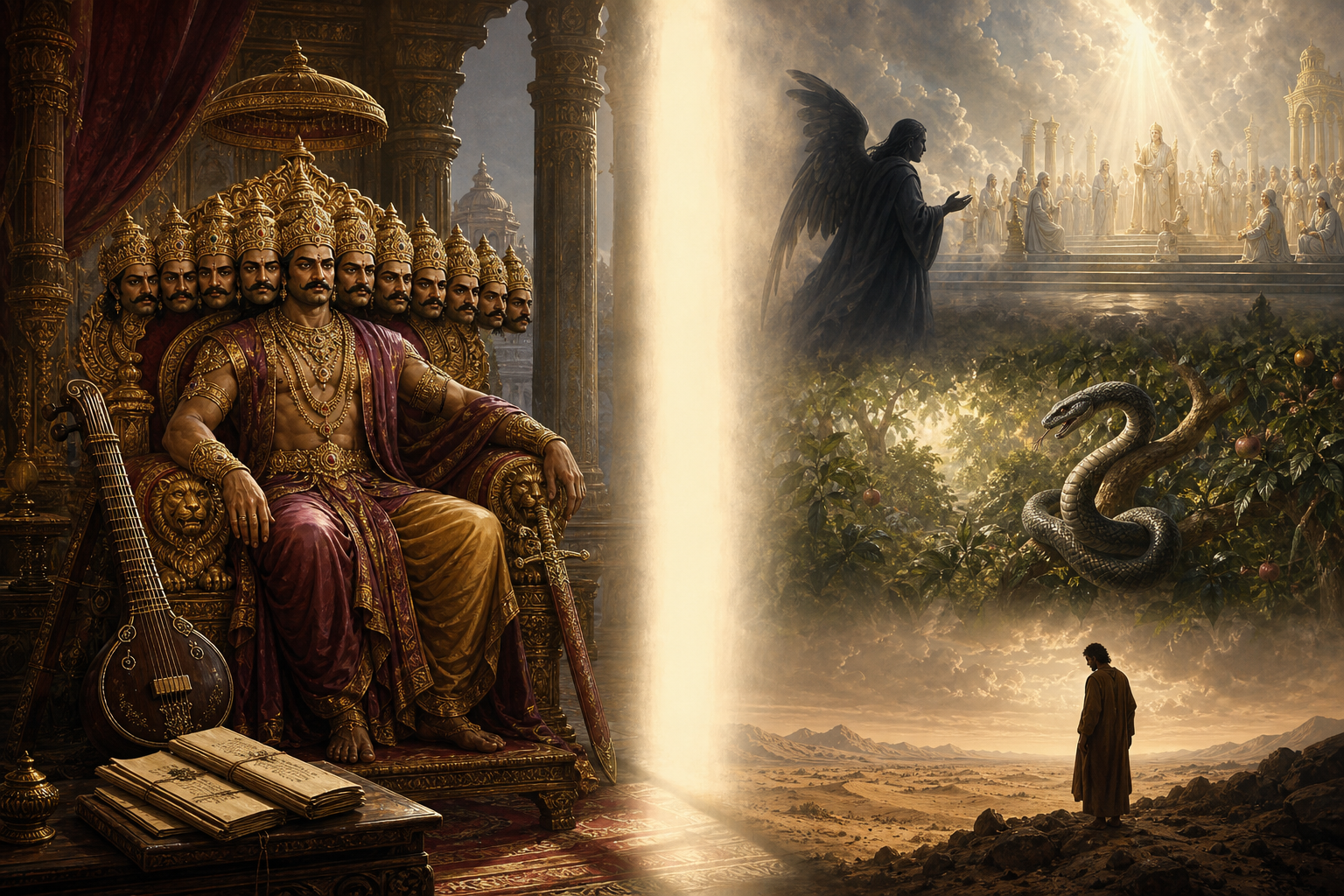
You may have heard Ravana described as the Hindu equivalent of Satan. It sounds like a convenient shortcut: both oppose a righteous or divine figure, both are associated with grave wrongdoing, and both are defeated. But the shortcut breaks down as soon as you ask what kind of beings they are and what work they do within their respective traditions.
The direct answer is no. Ravana is not a Hindu Satan. You can compare the two at the narrow level of antagonism, pride, or opposition to moral order, but treating them as equivalents distorts the Ramayana and oversimplifies the Abrahamic traditions at the same time.
The shortcut confuses narrative role with religious identity
Two figures can occupy similar positions in stories without belonging to the same religious category. A king who becomes the principal antagonist of an epic is not automatically equivalent to a cosmic tempter or spiritual adversary. Similarity of plot function does not establish identity of nature, theology, or moral meaning.
Ravana is an embodied ruler within the world of the Ramayana. He has a kingdom, family relationships, political responsibilities, extraordinary abilities, desires, attachments, and opportunities to choose differently. His conflict with Rama grows through particular actions, above all the abduction of Sita and his refusal to repair that wrong. His defeat belongs to a narrative about dharma, kingship, self-mastery, loyalty, and the consequences of allowing power to serve desire.
Satan, especially in common Christian theology, usually belongs to a different category. He is understood as a superhuman adversary and tempter whose activity is situated within a cosmic spiritual conflict. That description itself needs qualification because Jewish, Christian, and Islamic understandings are not interchangeable. Even so, it already shows why the proposed equivalence fails: one figure is a morally responsible king and epic antagonist, while the other commonly functions as a transhistorical spiritual adversary.
The most you can safely say is that both may be described as opponents of a divinely ordered good. That is a comparison of function, not an equation of identity. Ravana cannot simply be treated as the equivalent of Satan because their resemblance ends well before their theological meanings begin.
Ravana is judged through adharma and moral agency
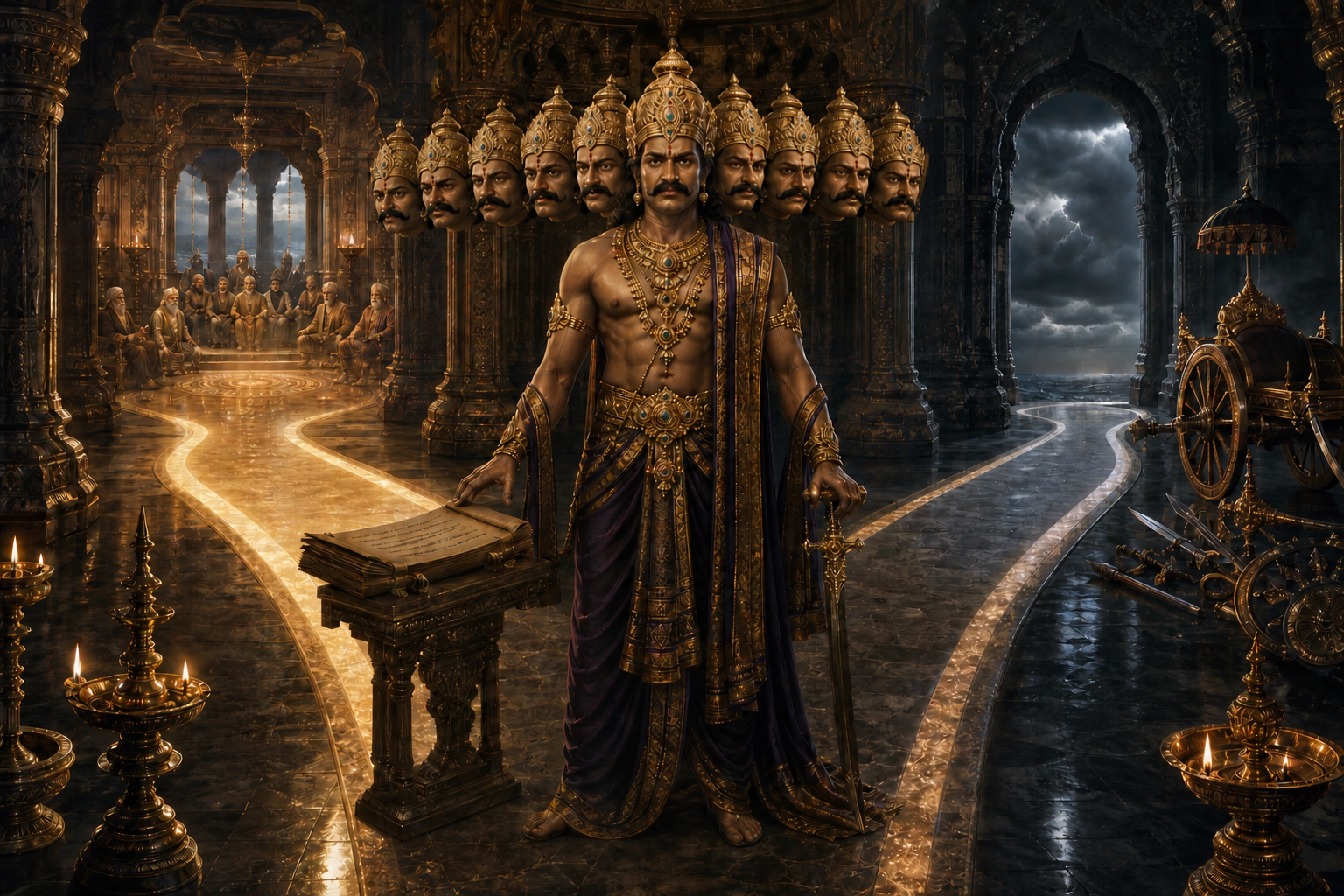
Ravana is not presented merely as evil wearing a personal form. He is a being of considerable capacity who directs that capacity toward adharma. His power magnifies the consequences of his choices; it does not make him the metaphysical source of all wrongdoing.
This distinction matters because the Ramayana’s moral force depends on agency. Ravana desires what is not his to take. He violates the dignity and freedom of Sita. He receives counsel, has opportunities to reverse course, and persists. His downfall therefore reveals more than the defeat of a villain. It shows what happens when ahankara, possessiveness, and the need to dominate become stronger than discernment.
Many Hindu tellings also remember Ravana as learned, formidable, politically powerful, and devoted to Shiva. Those qualities do not excuse his conduct. They sharpen the judgment against it. Knowledge without self-command can serve vanity. Devotion in one part of life does not cancel adharma in another. Administrative power cannot make an unjust act just.
This is one of the most useful lessons you can draw from Ravana. A person need not be ignorant, weak, or devoid of religious attainment to fall. Ability can increase moral responsibility. Ravana becomes frightening precisely because his strengths are real and his refusal to govern himself is consequential.
Calling him Satan erases that lesson. It encourages you to place evil wholly outside ordinary moral agency, as though Ravana belongs to a separate substance called evil. The dharmic vocabulary is more demanding. It asks how desire becomes entitlement, how entitlement recruits intelligence, how intelligence rationalizes wrongdoing, and why repeated refusal to correct an injustice eventually destroys the person who benefits from it.
The English word demon can create another trap. Ravana is a rakshasa king, but translating every rakshasa as a demon may import assumptions drawn from Christian demonology. Indigenous categories should first be understood inside the cosmology, narrative, and moral vocabulary that give them meaning. A rakshasa is not automatically a servant of Satan, an anti-god, or an embodiment of absolute evil.
The same caution applies to Ravana’s famous ten heads. Different devotional, literary, and popular interpretations assign them different symbolic meanings. You need not accept a modern list of ten vices as though it were the single canonical explanation. The secure moral point does not depend on that symbolism: extraordinary capacity without mastery of desire can become self-destructive.
There is no single Abrahamic Satan to use as a template
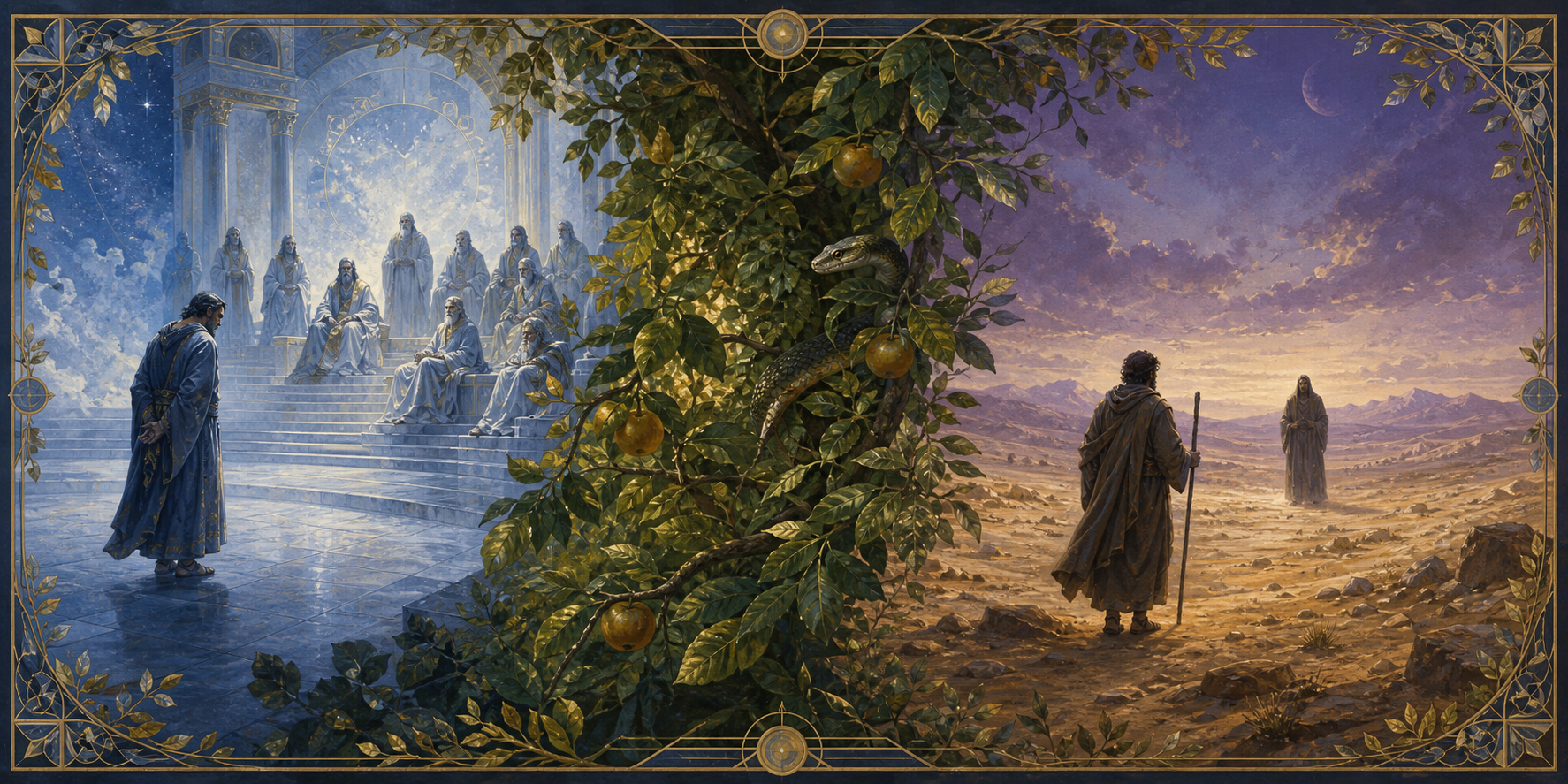
The phrase Satan in the Abrahamic religions can sound more precise than it is. Judaism, Christianity, and Islam are related traditions, but they do not simply hand down one unchanged character with an identical role.
- In Jewish scriptural and interpretive settings, satan can carry the sense of an adversary or accuser. Its use does not always imply the fully developed cosmic Devil familiar from later Christian imagination.
- In common Christian theology, Satan is generally understood as a fallen spiritual adversary, tempter, and chief personal agent of opposition to God.
- In Islamic discourse, Iblis and shaytan belong to a framework shaped by refusal, pride, temptation, and disobedience. Those terms should be interpreted within the Quranic and Islamic context rather than treated as alternative spellings of a Christian figure.
This variation means that a responsible comparison must begin with a question: which understanding of Satan do you mean? A discussion of a biblical accuser, the Devil of Christian theology, and Iblis in Islamic tradition will produce three related but different comparisons.
The phrase Hindu Satan creates the same problem on the other side. Hindu traditions do not require every form of evil, obstruction, or adharma to originate in one supreme evil personality. Asuras, rakshasas, hostile rulers, deluded beings, destructive desires, and cosmic disturbances are not interchangeable categories. Nor do they collectively amount to a single opposing deity equal to the divine.
That is why the search for one Hindu counterpart often goes wrong. It starts with a category from one religious system and then scans another tradition for the character who looks most similar. Good comparative religion works in the opposite direction. It first understands each figure in the language of its own tradition and only then asks whether a limited comparison illuminates something.
Compare by dimension, then mark where the analogy stops

You do not have to avoid comparison altogether. Comparison becomes useful when you state its scope. Instead of asking whether Ravana is Satan, ask whether they perform a similar function in one clearly identified respect.
| Dimension | Ravana | Satan in a common Christian comparison |
|---|---|---|
| Kind of figure | An embodied rakshasa king and epic antagonist | A superhuman spiritual adversary and tempter |
| Scale of conflict | A particular conflict involving Sita, Rama, Lanka, kinship, rule, and dharma | A cosmic and transhistorical conflict involving temptation and opposition to God |
| Moral mechanism | Desire, possessiveness, pride, misuse of power, and refusal to correct wrongdoing | Rebellion, spiritual opposition, deception, and temptation |
| Relation to evil | Commits grave adharma but is not the sole origin or universal personification of evil | Commonly treated as the chief personal agent of evil |
| Moral texture | Considerable abilities and devotional or intellectual attainments coexist with culpable conduct | Usually functions primarily as an emblem and agent of spiritual opposition |
The table identifies a genuine resemblance: each can stand in opposition to an order understood as good, righteous, or divine. It also identifies the stopping point. Similar opposition does not give them the same nature, history, moral psychology, or place in a religious worldview.
Use the following method whenever you encounter a cross-religious equivalence:
- Name the exact tradition and text. Ravana in which Ramayana tradition? Satan in which Jewish, Christian, or Islamic setting? Broad labels conceal important differences.
- State the dimension being compared. Is the comparison about plot, moral symbolism, metaphysical status, temptation, kingship, or the origin of evil?
- Keep the original categories visible. Retain terms such as rakshasa, dharma, adharma, ahankara, Satan, Iblis, and shaytan until their meanings have been explained.
- Identify the resemblance in one sentence. For example, both figures can oppose a righteous or divine order and can warn against pride.
- Identify the breaking point immediately. Ravana is a powerful ruler whose particular choices bring destruction; Satan in common Christian theology is a cosmic spiritual adversary and tempter.
- Return to the ethical purpose. Ask what conduct the story teaches you to notice. With Ravana, the crucial pattern is the corruption of power by desire and the escalating cost of refusing good counsel.
This method prevents two opposite mistakes. The first is flattening distinct traditions into a collection of supposedly identical characters. The second is refusing every comparison and losing the chance to clarify a real similarity. A disciplined analogy says both where the comparison works and where it stops.
Key takeaways for a careful answer
- Ravana is the principal antagonist of the Ramayana, not a universal source or personification of evil.
- His wrongdoing is understood through adharma and moral agency: desire, pride, domination, and refusal to correct an injustice.
- His knowledge, power, and devotion do not absolve him. They demonstrate that accomplishment without self-mastery can serve destructive ends.
- Satan does not have one identical meaning across Judaism, Christianity, and Islam. Name the particular tradition before making a comparison.
- Ravana and Satan may be compared as adversarial figures, but they are not equivalent in their nature, scale, moral texture, or theological function.
- Terms such as rakshasa should not be translated in ways that silently import an entire foreign demonology.
If you need a concise explanation, use this formulation: Ravana is not the Hindu Satan. He is a powerful rakshasa king whose abduction of Sita, misuse of power, and refusal to reverse his adharma place him against Rama. Satan, particularly in common Christian theology, is a cosmic spiritual adversary and tempter. The two can be compared as antagonists, but they do not hold the same religious office.
The next time someone proposes a one-to-one religious equivalent, ask three questions: equivalent in narrative role, in moral symbolism, or in kind of being? That small clarification will usually expose whether the analogy teaches anything. In Ravana’s case, it also brings you back to the more demanding lesson: power does not ruin a person by itself, but power placed at the service of unchecked desire can make every opportunity to repent easier to refuse.
References
