

You may have been told to be yourself, only to discover that acceptance lasted as long as you remained convenient. Once you expressed a boundary, changed direction, or stopped playing an assigned role, approval disappeared. The choice can then seem stark: keep performing for others, or treat every personal impulse as sacred.
Hindu thought offers a more demanding and more useful path. Authenticity is neither social obedience nor impulsive self-expression. It is the work of discerning what in you is deepest, what is merely reactive, and what your responsibilities require. That distinction matters whenever an invitation to be yourself turns into a demand for an acceptable performance.
Your first impulse is not necessarily your truest self

The phrase “be yourself” becomes misleading when it assumes that you contain one obvious voice and simply need the courage to obey it. In practice, several movements can speak within you at once. There is what you fear, what you desire, what habit has trained you to do, what your social role demands, and what you judge to be right. They do not always agree.
Hindu traditions do not offer a single metaphysical account of the self. Different schools understand Atman, the individual self, and the relation between the self and ultimate reality in different ways. That diversity should prevent us from turning Hindu authenticity into a single slogan. Yet one practical distinction remains valuable regardless of the school you follow: the loudest thought in your mind does not automatically deserve to govern your conduct.
Ahankara is often translated as the “I-maker.” It is the function through which experience becomes mine and identities become me: my reputation, my grievance, my achievement, my group, my image. Ahankara is not simply a villain. You need a working identity to answer your name, keep promises, perform duties, and participate in society. Trouble begins when that constructed identity claims to be the whole self.
This is why authenticity cannot mean doing whatever feels strongest in the moment. Anger may honestly be present, but its presence does not make an insult righteous. Fear may be real, but it does not prove that surrender is wise. Desire may reveal something important, but it does not settle what you ought to do. A feeling is information. It is not yet a command.
When an inner voice demands immediate action, separate four things before deciding:
- Sensation: What is happening in your body and mind right now?
- Story: What interpretation are you placing on the situation?
- Value: What principle do you want your conduct to embody?
- Duty: What responsibility remains yours even if nobody applauds you?
This separation is a practical form of discernment. It lets you acknowledge an emotion without pretending that the emotion has already answered the moral question.
Test authenticity through truth, duty, and non-harm

A choice does not become authentic merely because it is unpopular. Defiance can be another performance, especially when your identity depends on appearing independent. Nor does a choice become false merely because it preserves harmony. You need better tests than approval and rebellion.
Use the following four-part examination. It is not a claim that every Hindu school reduces ethical life to four rules. It is a practical way to bring several central Dharmic concerns into one decision.
- Satya, or truthfulness: Are you being honest about the situation and about your own motive? Saying that you “have no choice” may conceal fear. Calling a desire “my true self” may conceal impatience. Truth begins with refusing to deceive yourself.
- Dharma, or right responsibility: What do you owe to the people, commitments, and circumstances genuinely entrusted to you? Authenticity does not cancel a promise merely because keeping it has become inconvenient.
- Ahimsa, or non-harm: Can you act without causing needless injury? Non-harm does not require avoiding every disagreement. A necessary boundary may disappoint someone. The question is whether you are protecting what matters or using honesty as permission to wound.
- Svadharma, or your proper responsibility: Is this action suited to your actual nature, capacity, and situation, or are you copying a life that wins admiration? Svadharma asks what is truly yours to carry. It is not a blank cheque for selfish preference, and its social applications have long required careful interpretation rather than mechanical use.
These tests correct one another. Truth without ahimsa can become cruelty. Non-harm without truth can become appeasement. Duty without self-knowledge can become mechanical conformity. Self-knowledge without duty can become self-absorption.
Suppose you are being pressed to accept an obligation you cannot responsibly fulfil. An impulsive response might be a resentful yes or an explosive no. The four-part examination produces a more exact answer. Truth requires admitting your limits. Dharma requires considering whether some portion of the responsibility is legitimately yours. Ahimsa shapes the manner of refusal. Svadharma asks whether you are declining because the task is genuinely misplaced or because it is difficult. The authentic response may be a firm refusal, a limited commitment, or a request for time. What matters is that the decision survives all four questions.
A role becomes a mask when it requires inner dishonesty
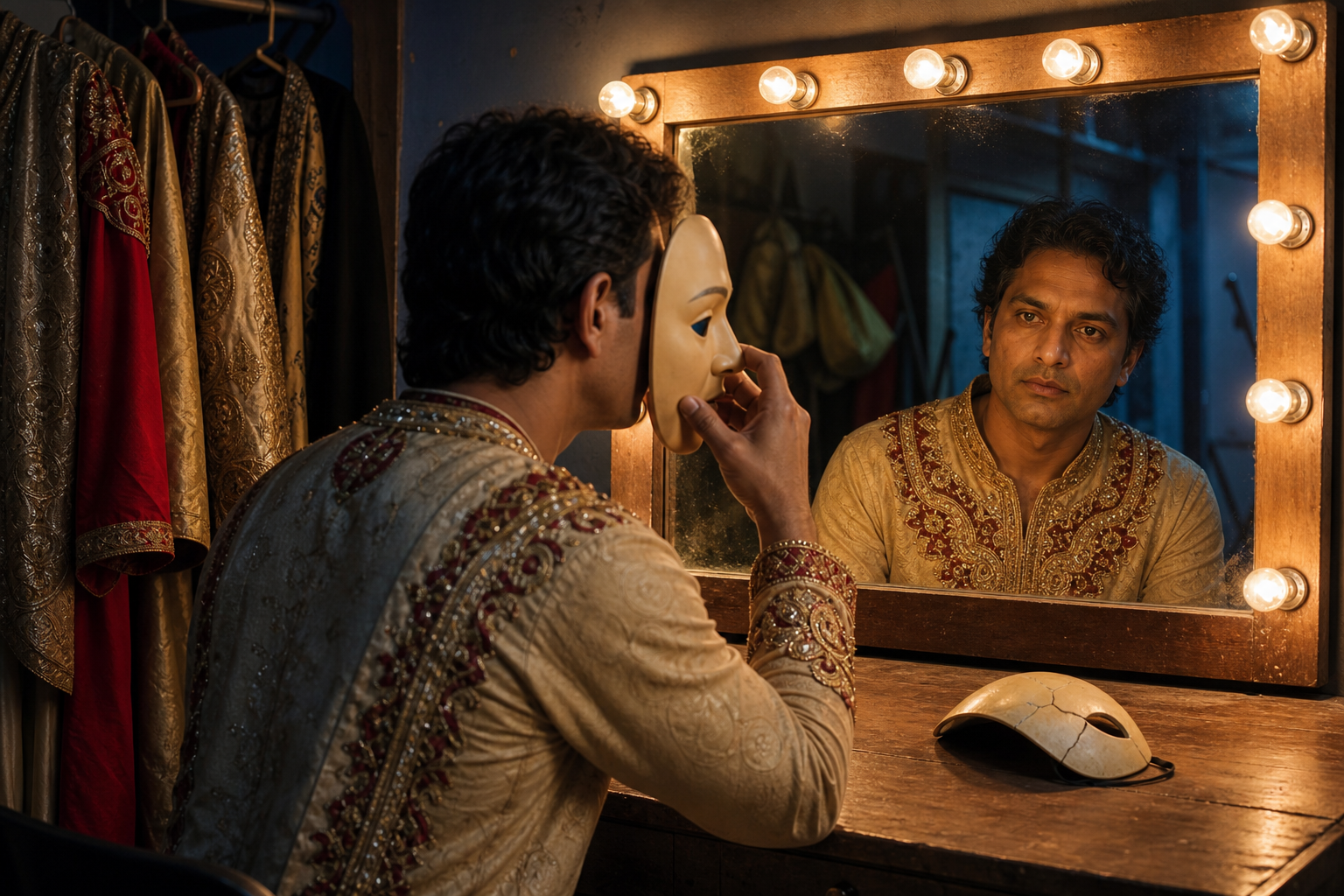
You do not become inauthentic merely by behaving differently in different relationships. A parent, colleague, friend, devotee, and citizen may properly speak in different registers. Context changes the form of conduct. It need not change the values governing that conduct.
A role gives a value an appropriate form. A mask conceals or contradicts the value for the sake of approval. Patience with a child and directness with a colleague can both express respect. Agreeing with whoever is present, while privately resenting every agreement, is something else.
Watch for recurring signs that a role may have hardened into a mask. These are prompts for reflection, not automatic verdicts:
- You regularly say the opposite of what you believe because disagreement might reduce your status.
- You volunteer for obligations and then blame others for accepting your offer.
- You cannot explain a major choice except by saying that people expect it from you.
- You defend a public identity that your private conduct repeatedly contradicts.
- You feel compelled to exaggerate either conformity or rebellion so that others will recognise the person you are trying to appear to be.
The remedy is not to discard every role. Family obligations, inherited practices, community ties, and disciplined forms of worship can express the self rather than suppress it. Tradition becomes a problem when you perform its outer signs while refusing its demand for truthfulness, responsibility, restraint, or inner transformation. Rebellion can be equally hollow when it rejects a practice only because rejection produces a more flattering identity.
Begin with a proportionate correction. Stop making promises you already know you will resent. Do not claim certainty when you are still considering. State what you can do, what you cannot responsibly accept, and when you will give an answer. This is often more authentic than a dramatic declaration because it changes conduct rather than merely announcing a new identity.
Use a repeatable practice when approval is at stake

Authenticity is tested most clearly when honesty carries a cost. If nobody disagrees with your choice, you may never discover whether conviction or approval is directing you. The aim is not to seek conflict. It is to keep anticipated praise or rejection from making the decision in advance.
Use this sequence when you feel pressured to perform a version of yourself:
- Name the audience. Identify whose approval you are trying to secure or whose disapproval you fear. Replace the vague idea that “everyone” expects something with the actual person or group involved.
- Name the threatened identity. Complete the thought: If I do not comply, they may no longer see me as dependable, successful, traditional, modern, spiritual, strong, or agreeable. This reveals what ahankara is trying to protect.
- Separate fact from prediction. Write down what has actually been said or done, then distinguish it from what you imagine will happen. You cannot make a truthful decision while treating a feared future as an established fact.
- Apply the four tests. Examine truthfulness, dharma, ahimsa, and svadharma. If your preferred action fails one of them, revise the action rather than inventing an excuse.
- Choose the smallest sufficient act. You may need to correct a false statement, refuse one obligation, ask for time, or stop pretending enthusiasm. Do what restores alignment without turning the moment into a performance of courage.
- Review the result. After acting, ask whether your speech, values, and responsibilities are now more coherent. Relief alone is not proof that you acted rightly, and discomfort alone is not proof that you acted wrongly.
This is abhyasa: repeated practice rather than a one-time discovery. You do not uncover a finished, socially isolated personality and then protect it forever. You learn to notice attachment, examine motive, correct conduct, and return to alignment. A sincere correction made later is more authentic than defending an earlier mistake because consistency has become part of your image.
Authenticity also does not require total disclosure. Privacy is not dishonesty. You may decline to discuss an intimate matter, postpone a conversation until you are composed, or share a decision only with those whom it concerns. Truthfulness forbids deliberate deception; it does not require giving every person unrestricted access to your interior life.
If direct honesty could expose you to violence, coercion, loss of shelter, or another serious danger, do not treat confrontation as a spiritual test. Protecting safety may require quiet planning, limited disclosure, and support from trustworthy people or appropriate services. An authentic boundary does not have to be announced in the most dangerous possible way.
Key takeaways
- Authenticity in Hindu thought is better understood as alignment than as spontaneous self-expression.
- Ahankara supplies a workable identity, but it becomes distorting when reputation, role, or reaction is mistaken for the whole self.
- A feeling should be acknowledged as information and then examined through truthfulness, dharma, non-harm, and proper responsibility.
- Different behaviour in different roles is not hypocrisy when the same governing values remain intact.
- Truth does not require cruelty, non-harm does not require submission, and privacy does not require deception.
- The most reliable change is usually a proportionate act that brings speech, choice, and responsibility into closer agreement.
The next time someone asks you to be yourself, do not begin by asking which version of you will win approval. Ask what is true, what is actually yours to carry, and what can be done without needless harm. Then take the smallest honest action that answers all three. Authenticity becomes dependable when it is practised as dharma, not displayed as a personality.
References
