

You may chant, attend satsanga, and volunteer regularly, yet still wonder whether you have actually surrendered. The question becomes especially sharp when devotion meets a difficult duty: should you keep acting, wait for grace, obey another person, or accept an outcome you did not choose?
Bhakti does not ask you to become passive. It asks you to relocate the center of action. You still discern, decide, work, protect what has been entrusted to you, and answer for your conduct. What you surrender is the claim that everything belongs to you, depends on you, or must end according to your preference. Loving service, or seva, is how that surrender becomes visible.
Surrender gives up proprietorship, not responsibility

Bhagavad Gita 18.66 culminates in the call sarva-dharman parityajya mam ekam saranam vraja: take refuge in the Divine alone. Read carelessly, this can sound like permission to abandon ordinary obligations. Within bhakti, however, surrender does not cancel karma-yoga or ethical responsibility; it purifies the motive of action. Your work, family duties, promises, and service become offerings rather than instruments for proving your importance.
This produces a demanding balance. You are dependent on grace, but you remain responsible for the quality of your conduct. You cannot command the fruit of an action, but you can tell the truth, prepare carefully, avoid needless harm, keep a promise, correct an error, and ask forgiveness. Saying “Krishna will take care of it” after neglecting what was yours to do is not surrender. It is avoidance clothed in devotional language.
When a decision is unclear, separate three things that the ego tends to mix together:
- Your duty: What has actually been entrusted to you in this situation?
- Your manner of acting: Can you proceed truthfully, compassionately, patiently, and without violating dharma?
- Your demand upon the result: Are you willing to do the work without insisting on praise, control, vindication, or a particular outcome?
The first two require disciplined action. The third requires surrender. Keeping those categories distinct prevents two common errors: using spirituality to escape responsibility, and treating responsibility as proof that you control everything.
The Hare Krishna maha-mantra gives this posture a direct voice. In the Gaudiya Vaishnava understanding, its names can be heard as an intimate appeal to the Lord and the Lord’s compassionate potency: please accept me. That plea does not mean “approve whatever I want.” It means, “Receive me, redirect me, and let my life become fit for Your service.” The movement is from entitlement to dependence, and from dependence to willing action.
Use the six limbs of saranagati as a decision test

A passing devotional feeling cannot carry every hard decision. The classical six limbs of saranagati turn surrender into a practical discipline. Use them not merely as concepts to remember, but as questions with which to examine your next action.
- Anukulya-sankalpa: choose what is favorable to devotion. Keep practices, relationships, speech, and commitments that strengthen remembrance, honesty, compassion, and steadiness. Ask, “Will this choice help me remember whom I serve?”
- Pratikulya-vivarjana: refuse what obstructs devotion. Identify the habit or situation that repeatedly pulls you toward deception, cruelty, vanity, resentment, or negligence. Do not merely regret it during prayer; change the condition that keeps feeding it.
- Raksisyatiti-visvasa: trust in divine protection. Trust does not guarantee that events will follow your preferred script. It means fear no longer has the final authority over your conduct. Do what is right even when you cannot secure every consequence.
- Goptrtva-varana: accept the Divine as maintainer. Receive your abilities, opportunities, food, relationships, and time as gifts held in stewardship. Use practical supports without turning wealth, status, an institution, or another person into your ultimate refuge.
- Atma-niksepa: offer the self. Do not offer only the pleasant part of life. Bring your ability, confusion, ambition, failure, body, labor, and future into the relationship with the Divine. Self-offering includes allowing your plans to be corrected.
- Karpanya: cultivate honest humility. Admit that effort alone cannot manufacture grace. Humility is neither self-hatred nor a performance of inferiority. It is freedom from the need to pretend that you are self-sufficient.
These limbs also expose imbalances. Trust without duty becomes fatalism. Duty without trust becomes anxious control. Humility without discernment becomes vulnerability to manipulation. Discernment without humility becomes pride. Mature saranagati keeps all six in conversation.
Suppose a community asks you to take on another responsibility. Anukulya asks whether the work genuinely supports devotion. Pratikulya asks what existing obligation would suffer. Trust helps you answer without fear of disappointing everyone. Atma-niksepa lets you offer either a sincere yes or a truthful no. Karpanya prevents you from imagining that the entire community depends on your involvement. The result may be service, delegation, a smaller commitment, or a respectful refusal. Surrender is found in the integrity of the answer, not automatically in saying yes.
Seva reveals what your surrender is becoming
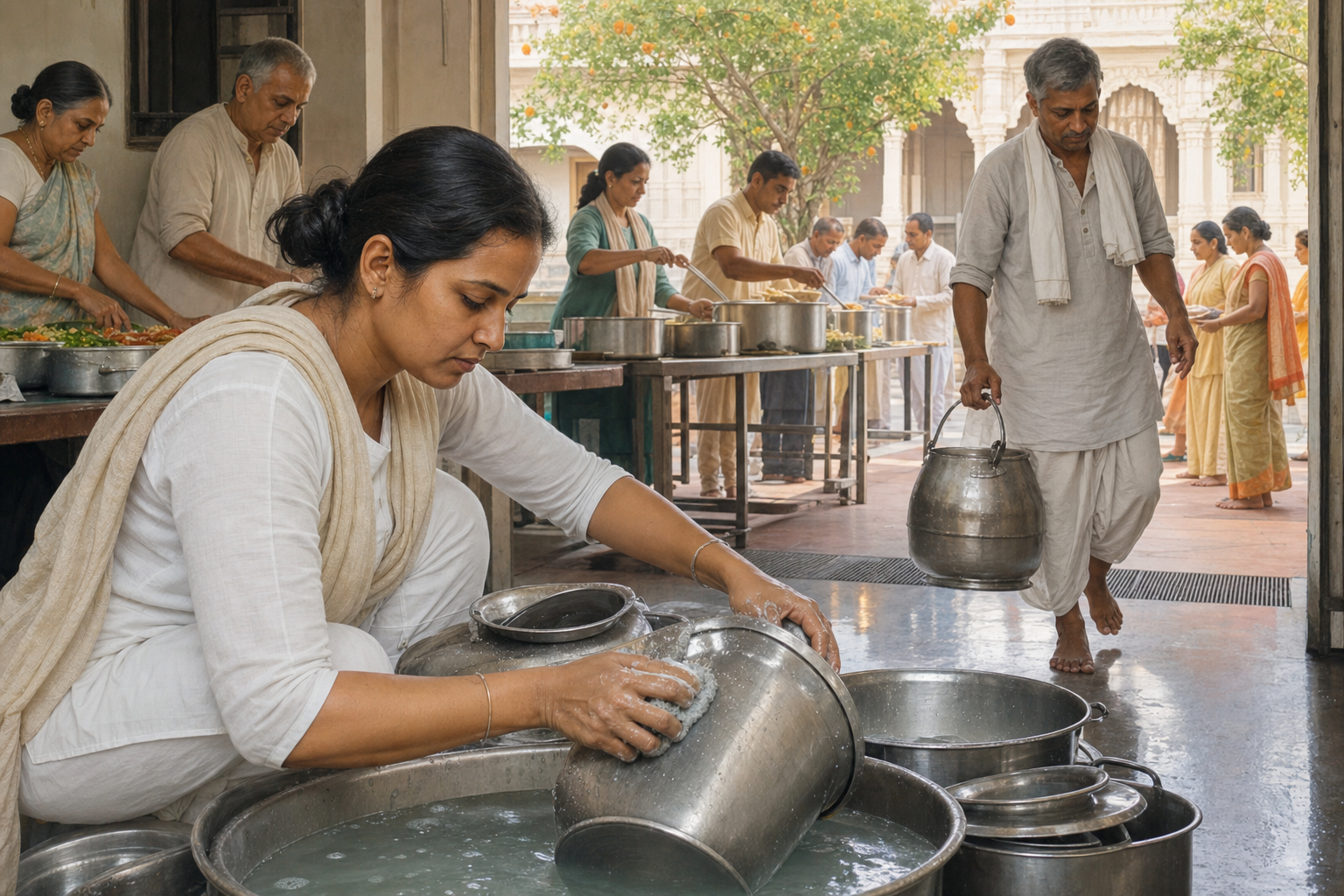
Dasa-bhava is the chosen disposition of being a servant of the Divine. It is not demeaning human servility. In bhakti, it is voluntary, love-motivated, discerning, and dignity-giving. The devotee is not trying to become worthless. The devotee is trying to become available to the Beloved.
This is a complete devotional relationship, not merely remedial work for beginners. Srimad Bhagavatam 7.5.23 includes dasya and atma-nivedanam among the nine modes of bhakti, alongside hearing, chanting, remembrance, worship, prayer, and friendship. Vaishnava aesthetics likewise recognizes dasya as an enduring devotional rasa marked by reverence, loyalty, and readiness to serve.
Seva may involve cleaning a sacred space, preparing or distributing prasada, welcoming a newcomer, teaching what you are qualified to teach, caring for someone vulnerable, fulfilling a household responsibility, or completing unnoticed administrative work. The outer task matters, but it does not by itself make the action devotional. Before accepting service, test it:
- Is it genuinely needed? Service responds to a real need rather than creating activity for its own sake.
- Can you perform it responsibly? Enthusiasm does not compensate for a promise you cannot keep or a role for which you lack competence.
- Does it respect your existing dharma? Temple or community work should not become an excuse to neglect dependents, employment, health, or prior commitments.
- Would you still do it without recognition? If visibility is the main attraction, acknowledge that honestly before calling the desire seva.
- Does the manner match the offering? A devotional task performed through contempt, manipulation, or careless speech contradicts its stated purpose.
Boundaries belong inside this discernment. Spiritual surrender is directed toward the Divine; it is not unlimited permission for a teacher, organizer, institution, spouse, or senior devotee to control your conscience. Guru-seva rightly joins learning with humility and gratitude, but bhakti also calls for viveka, accountability, courage, and moral clarity. A demand built on fear, secrecy, humiliation, or the suspension of ethical judgment should not be accepted as proof of devotion. Sacred service should make you more truthful and dependable, not more easily dominated.
Seva can also create practical solidarity across the Dharmic family. Sikh seva and sarbat da bhala, Jain vaiyavrtya, humility, and ahimsa, Buddhist compassion and the bodhisattva ideal, and Hindu bhakti do not rest on identical metaphysics. They do, however, give communities substantial ground for cooperation through compassion, restraint, remembrance, and service without erasing doctrinal distinctions. If you organize a shared project, define the common task clearly and let each tradition speak in its own theological language. Unity does not require vagueness.
Build surrender into the turning points of your day

Grand declarations of self-offering are easy to make in an emotionally charged moment. The harder work occurs when you wake distracted, receive criticism, face an unpleasant duty, or finish a task nobody notices. A simple morning, midday, and evening rhythm gives surrender somewhere concrete to live.
- Morning japa: ask to be accepted and directed. Use the mantra commitment given by your lineage or teacher. If you have no assigned commitment, choose a sustainable practice rather than an impressive one you will quickly abandon. As you chant, hear the holy names as address, not background sound. Let the underlying petition be simple: O Lord and divine energy, please accept me in service.
- Midday recollection: offer the duty immediately in front of you. Before a consequential message, meeting, household task, or difficult reply, pause. Name what is yours to do, choose the quality you want to bring to it, and release the demand to control the other person’s response.
- Evening reflection: look for conduct, not spiritual theatre. Ask where you acted from service, where you acted from vanity or fear, and what needs repair. Gratitude belongs here, but so does accountability. If you spoke harshly or broke a commitment, surrender means correcting it rather than merely feeling remorseful.
Personal japa interiorizes remembrance; congregational sankirtana gives it a communal body. Shared singing can interrupt self-preoccupation and train the heart to participate without being the center. When geography or circumstances leave you isolated, live or archived digital satsanga can support continuity, mentoring, and participation across distance. It should strengthen practice and relationship, not become an endless substitute for actually chanting or serving.
Do not make unusual emotion the scorecard. Chanting may be accompanied by gratitude, tears, or a felt softening, but such experiences cannot serve as a reliable rank. The more durable signs are ordinary and inconvenient to imitate: less reactivity, more patience, gentler speech, attentive listening, and greater reliability in service. If the mantra feels dry but you are becoming more truthful and less self-centered, do not dismiss that change. If chanting feels intense while your conduct grows harsher, do not use the intensity to avoid examination.
Questions that prevent common bhakti mistakes
Does surrender mean accepting every event as morally good?
No. Taking refuge in the Divine does not require you to rename adharma as dharma. You can accept that an event has occurred without approving the action that caused it. You can grieve, protect another person, oppose wrongdoing, seek accountability, and still relinquish hatred and the fantasy of total control. Bhakti replaces domination with service; it does not replace moral judgment with indifference.
What if you feel no devotion while chanting?
Offer truthful attention rather than manufacturing emotion. You can pray, in effect, “I do not feel what I wish to feel, but I am placing this attention before You.” Then pronounce and hear the names as carefully as you can. Judge the practice over time by whether remembrance is entering your choices, speech, and service. Emotional dryness is not permission to chant mechanically, but neither is it proof that the act has no value.
Can household and professional duties become seva?
Yes, when they are performed as responsible offerings rather than as vehicles for ego or excuses to avoid explicit sadhana. Earning honestly, caring for family, keeping agreements, mentoring fairly, and doing necessary work with attention can all express service-mindedness. The devotional label does not sanctify careless work. Offering a duty to the Divine should increase its integrity.
How can you tell when seva is feeding the ego?
Notice what happens when the task is invisible, another person receives credit, or your preferred method is not chosen. Resentment does not automatically invalidate the service, but it reveals where the offering is still conditional. Do not wait to become perfectly selfless before helping. Continue the necessary work while bringing the desire for status into prayer, reflection, and honest correction.
At your next morning practice, bring one real duty with you. Chant with the plea to be accepted, name how that duty can be offered, complete it as carefully as you can, and release the demand to be praised for it. In the evening, look at what the offering changed in your conduct. That is where surrender stops being an idea and begins to become bhakti.
References
- Dandavats — Hare Krishna as a Heartfelt Cry: Surrender, Bhakti, and Dharmic Unity in Practice
- Dandavats — Bond of Love with HG Akuti dd: Profound Insights on Bhakti, Seva, and Dharmic Unity
- DharmaRenaissance Blog — Surrender that Liberates: How Dasa-Bhava Shapes Bhakti, Seva, and Dharmic Unity