

If a parent asks you to carry the consequences of a choice you did not make, obedience can look like the safest form of dharma. Rama and Bhishma complicate that assumption. Both honored their fathers at extraordinary personal cost, but neither life gives parents a license to turn private longing into a child’s permanent obligation.
You can revere their sacrifices without copying them mechanically. Their lives help you ask a more practical question: when does service to a parent uphold dharma, and when does it merely transfer the cost of an elder’s ungoverned desire to the next generation?
The resemblance is real, but the failures are not identical
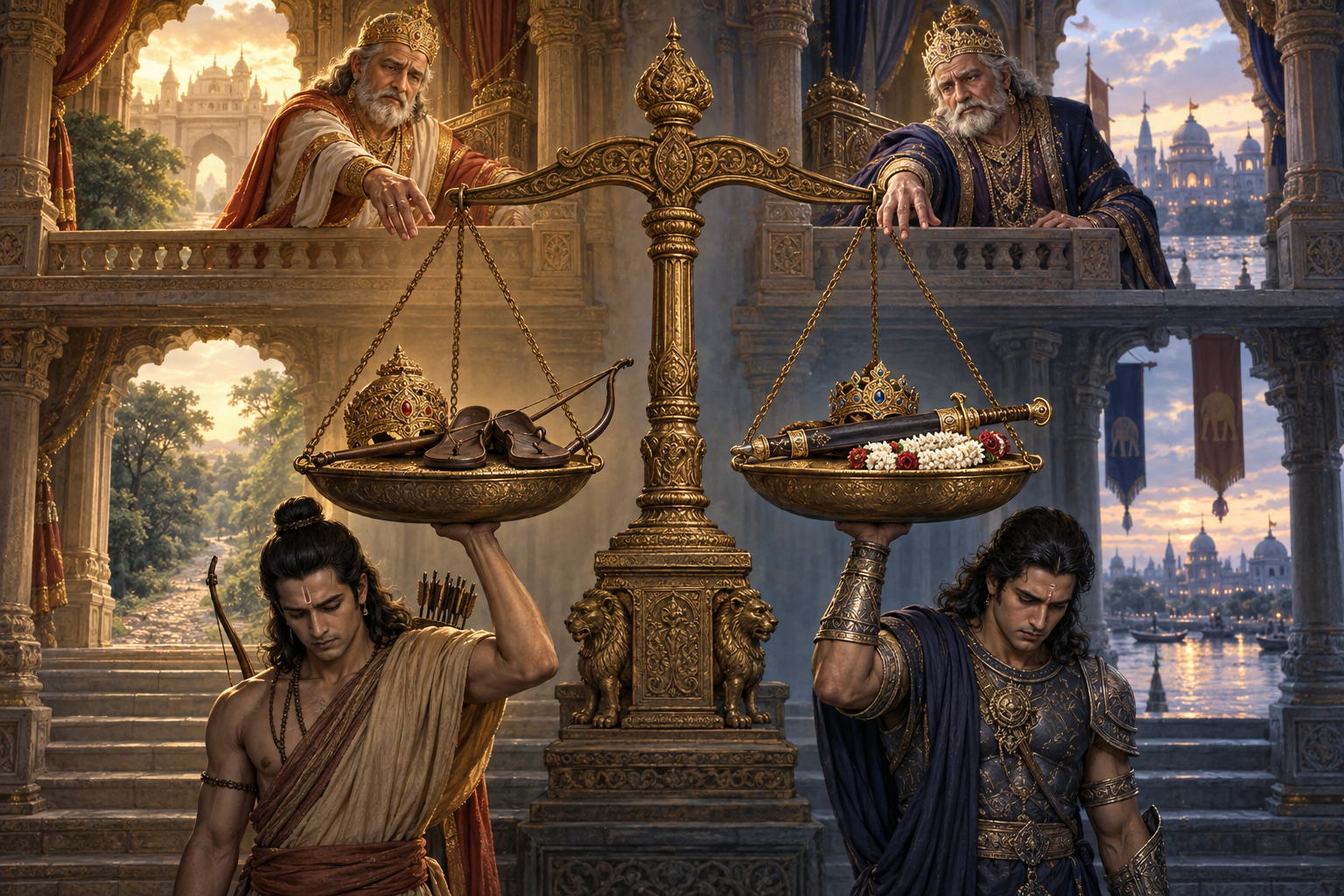
The moral parallel is sharp: two exemplary sons absorbed burdens created by paternal desire. Yet the two situations are not interchangeable, and the difference matters.
Dasharatha had granted boons to Kaikeyi. When she demanded Rama’s exile and Bharata’s installation as heir, the king’s earlier promise became a trap. Rama had not made that promise, sought the throne through intrigue, or caused the conflict. He nevertheless accepted exile so that his father’s word would not be publicly broken. His action preserved satya when Dasharatha could no longer reconcile his promise, his affection for Rama, and his responsibility as king.
Shantanu’s predicament arose differently. He desired marriage with Satyavati, but her father wanted assurance that her descendants would inherit the throne. Devavrata removed the obstacle by renouncing his own claim and then taking the terrible vow of lifelong celibacy. That vow won him the name Bhishma. It solved Shantanu’s immediate problem, but it also narrowed the future of the Kuru succession and bound Bhishma to defend a throne he could guide but never occupy.
Dasharatha did not formulate Rama’s exile, and Shantanu did not command Devavrata’s full vow. That does not erase paternal responsibility. A parent can create coercive conditions without issuing an explicit order. Children often read an elder’s grief, silence, disappointment, or helplessness as a command more powerful than spoken words.
| Question | Rama | Bhishma | What you should notice |
|---|---|---|---|
| What created the burden? | Dasharatha’s binding boons and Kaikeyi’s demands | Shantanu’s desired marriage and its succession condition | The son inherited a problem he did not originate |
| What did the son surrender? | Immediate kingship, home, and royal life | The throne, marriage, and descendants | The sacrifice reached far beyond ordinary assistance |
| What did the sacrifice accomplish? | It protected the truth of Dasharatha’s word | It enabled Shantanu’s marriage | A noble response can rescue an elder from an immediate crisis |
| What remained unresolved? | The royal household still suffered division and grief | The dynasty became more dependent on a fragile line of succession | Removing today’s obstacle can move its cost into the future |
A noble sacrifice does not make the demand noble
The epics ask us to hold two judgments at once. Rama’s fidelity can be admirable while the conditions imposed on him remain grievously unjust. Bhishma’s resolve can be awe-inspiring while the desire that made such a vow seem necessary remains undisciplined. Praising the son’s character must not become a way of absolving the father.
This distinction prevents a common misuse of dharmic language. Someone may point to Rama and say that a good son obeys without question. Someone else may invoke Bhishma to praise total renunciation for the family’s sake. Both readings detach the visible sacrifice from the moral failure that preceded it. The lesson is not that parents may ask for anything. It is that extraordinary people sometimes preserve dharma after those with power have placed it in danger.
Rama chose his response, but he did not choose the conditions. Bhishma authored his vow, but he did so within a dilemma created by Shantanu’s longing. Voluntary action can therefore contain both moral freedom and inherited pressure. When applying these narratives to your own family, do not ask only whether the child eventually agreed. Ask what made refusal feel impossible.
This also explains why imitating the external act is not enough. Dharma is not a contest to reproduce the largest sacrifice. Rama’s exile and Bhishma’s vow belonged to particular royal crises involving truth, succession, and public order. Your duty is to identify what preserves justice in the situation actually before you, not to stage a smaller imitation of an epic ordeal.
Use six tests before accepting an inherited burden
When family loyalty and an unfair demand arrive together, emotion can compress every question into one: will you obey? Slow the decision down. Write a one-sentence answer to each of these tests before making a promise that will shape your life.
- Identify the originating desire. What does the parent actually want, and is it a need, a duty, or a preference? Naming the desire prevents affection, prestige, fear, and obligation from being bundled together under the single word family.
- Trace the distribution of benefit and cost. Who receives the desired outcome? Who gives up time, livelihood, relationships, vocation, or standing? A demand deserves special scrutiny when one person receives the benefit and another carries nearly all the loss.
- Measure the duration. Temporary help during a genuine difficulty is not the same as a life-defining renunciation. Do not let an immediate emotional crisis produce an indefinite vow. Put a boundary, review date, or clear completion point on help whenever the duty itself does not require permanence.
- Check every role, not only the role of child. You may also have obligations to a spouse, children, dependants, community, or legitimate vocation. Filial duty does not automatically erase them. A proposed sacrifice that fulfills one relationship by abandoning several others may only relocate the adharma.
- Examine the precedent. Will your sacrifice teach the family that the most responsible member must always repair everyone else’s choices? Bhishma’s case shows why succession and institutional consequences matter. A solution can appear selfless now while making the household more fragile later.
- Test whether truth can survive refusal. Can you state your limits without deception, humiliation, or hatred? If yes, respectful refusal may protect dharma better than resentful compliance. Honor does not require pretending that an excessive request is reasonable.
If you cannot answer these questions because the request remains vague, do not make the vow yet. Ask for the expected sacrifice, duration, beneficiaries, and alternatives in plain language. Clarity is not disrespect. It is how you prevent a moment of pressure from becoming an inherited family structure.
Fathers, elders, and leaders must govern desire first
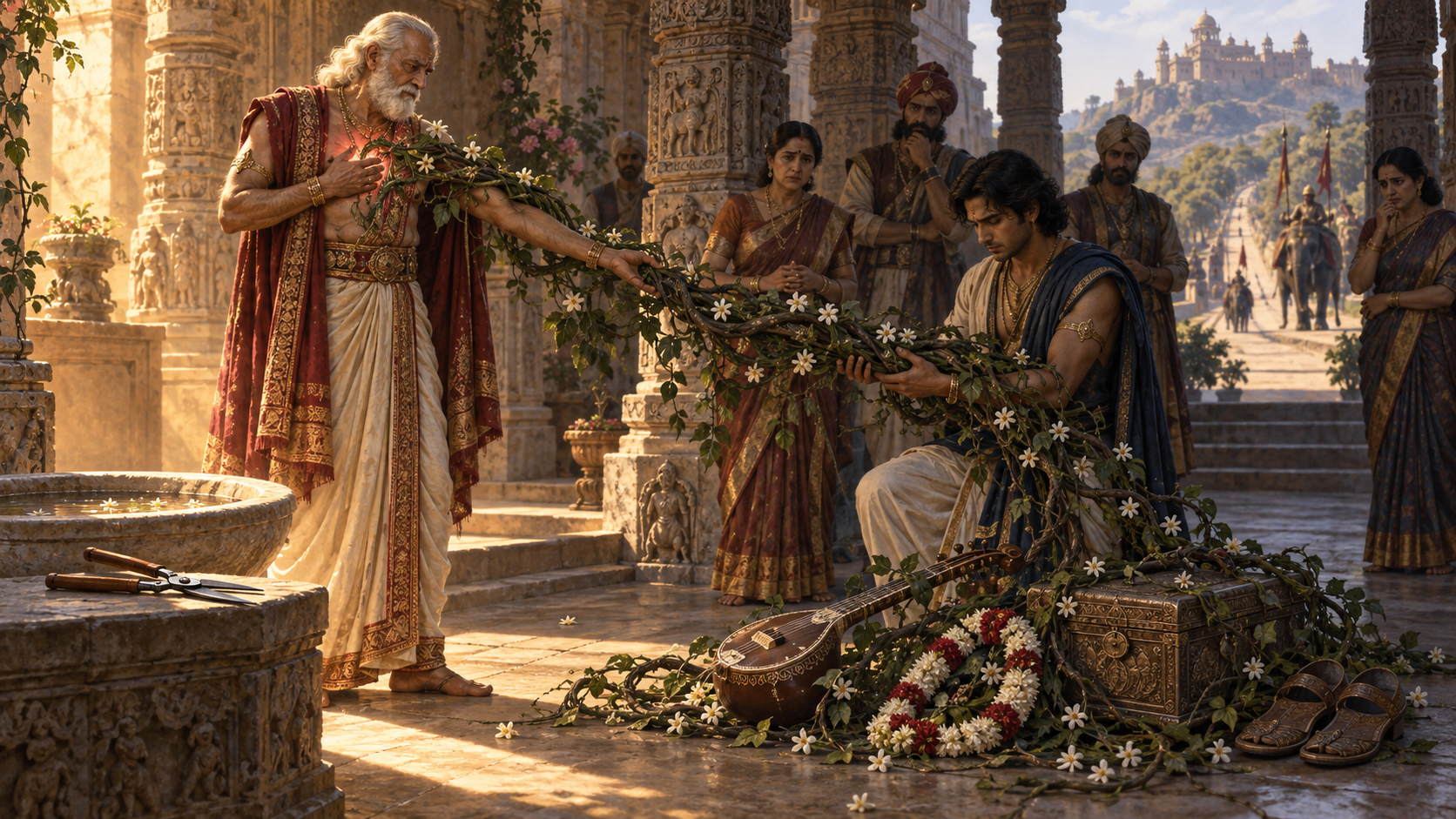
The heavier teaching falls on the person with greater authority. A father should not wait for a son to become heroic enough to repair his lack of restraint. An elder’s first duty is to govern desire before it becomes someone else’s test of loyalty.
- Turn desire into an honest request. Say what you want without disguising it as divine command, family honor, or proof of love.
- Own the primary cost. The person pursuing a preference should bear its foreseeable consequences before asking a child to surrender a future.
- Stop disproportionate sacrifice. If a child offers far more than the situation requires, parental love should restrain the offer rather than profit from it.
- Protect succession and continuity. In a family, institution, or state, a solution is incomplete if it satisfies the present leader while leaving the next generation without a stable path.
- Permit principled disagreement. A child who questions the means has not necessarily rejected the parent. Treating every boundary as betrayal converts affection into coercion.
Silence does not remove this responsibility. Shantanu did not need to dictate Bhishma’s vow for Devavrata to perceive his father’s sorrow and the barrier to his marriage. When an elder sees a younger person preparing to pay an excessive price, failing to object can become a form of consent.
The same principle applies beyond the household. A leader who depends on the permanent self-denial of the most dutiful person has not built a sound institution. Character may rescue a broken arrangement once. It cannot substitute for disciplined leadership, fair succession, and limits on personal appetite.
Key takeaways
- Rama and Bhishma show the greatness of a son’s response, not the unlimited entitlement of a father.
- A sacrifice can be freely chosen while still arising from pressure created by another person’s desire.
- Immediate relief is not enough; examine what the decision does to future relationships, duties, and succession.
- Filial dharma must be considered alongside truth, justice, proportion, and duties to other people.
- An elder who benefits from a child’s renunciation has a duty to question whether the sacrifice is excessive.
- Before making a permanent promise, name the desire, the beneficiary, the cost, the duration, and the available alternatives.
The next time family duty is used to demand a life-changing sacrifice, resist the false choice between cold rebellion and unquestioning surrender. Honor the relationship, state the real cost, and choose the smallest commitment that genuinely serves dharma. Rama and Bhishma teach us to admire fidelity. Their fathers’ dilemmas teach us why fidelity should never be exploited.

References

Leave a Reply
You must be logged in to post a comment.