
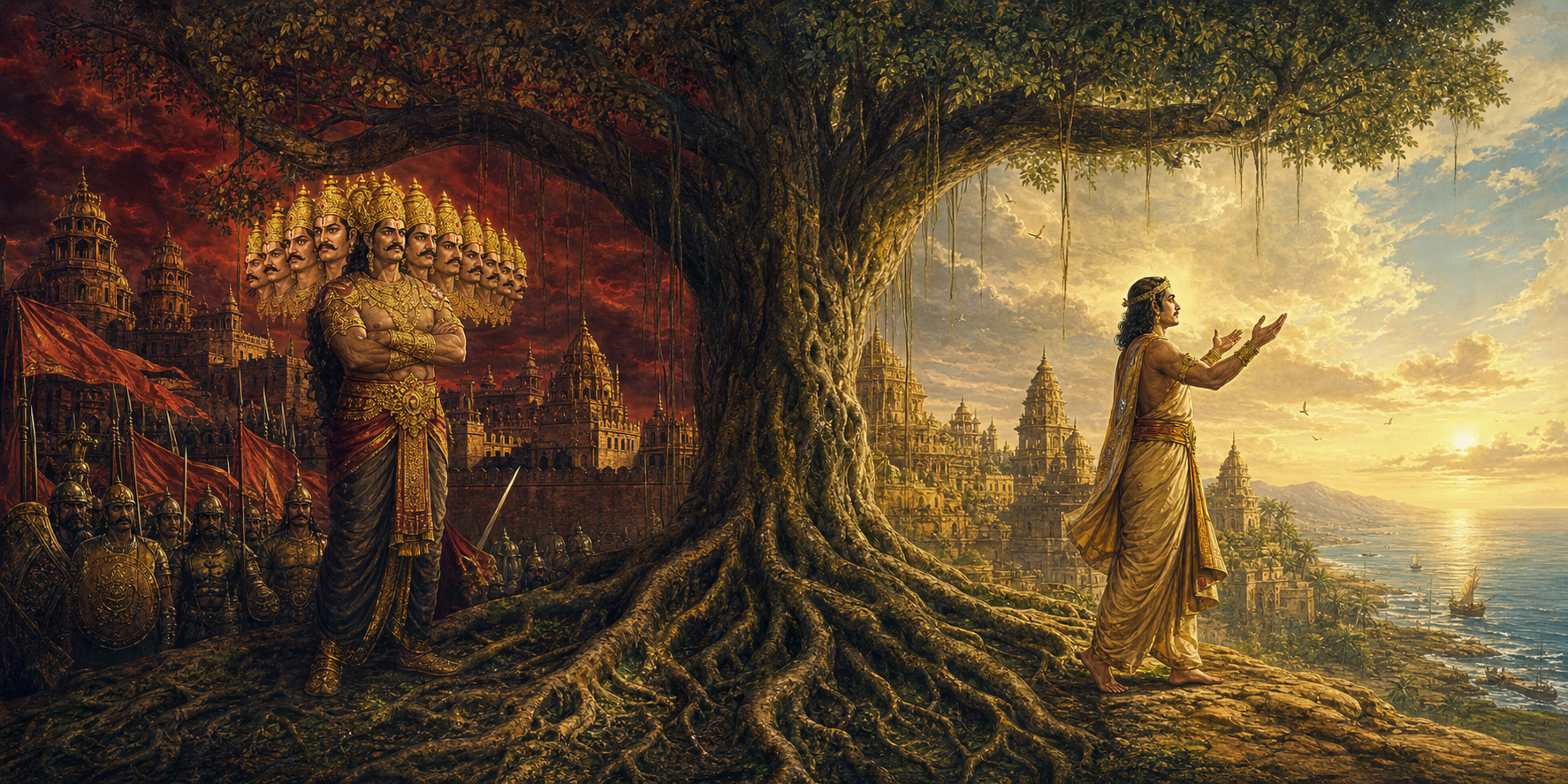
You are reading an epic, the word Rakshasa appears, and a translation renders it as “demon.” Should you now assume that the character is evil by nature? No. That shortcut makes Vibhishana look like an exception that needs explaining, while leaving the moral complexity of Ravana almost unintelligible.
A better method is to ask three questions in order: Which lineage does this figure belong to? What pressures shape the figure’s situation? What does the figure actually choose? Genealogy establishes relationships, powers and inherited circumstances. Conduct reveals whether those inheritances are directed toward dharma or adharma.
The family tree prevents a basic moral mistake
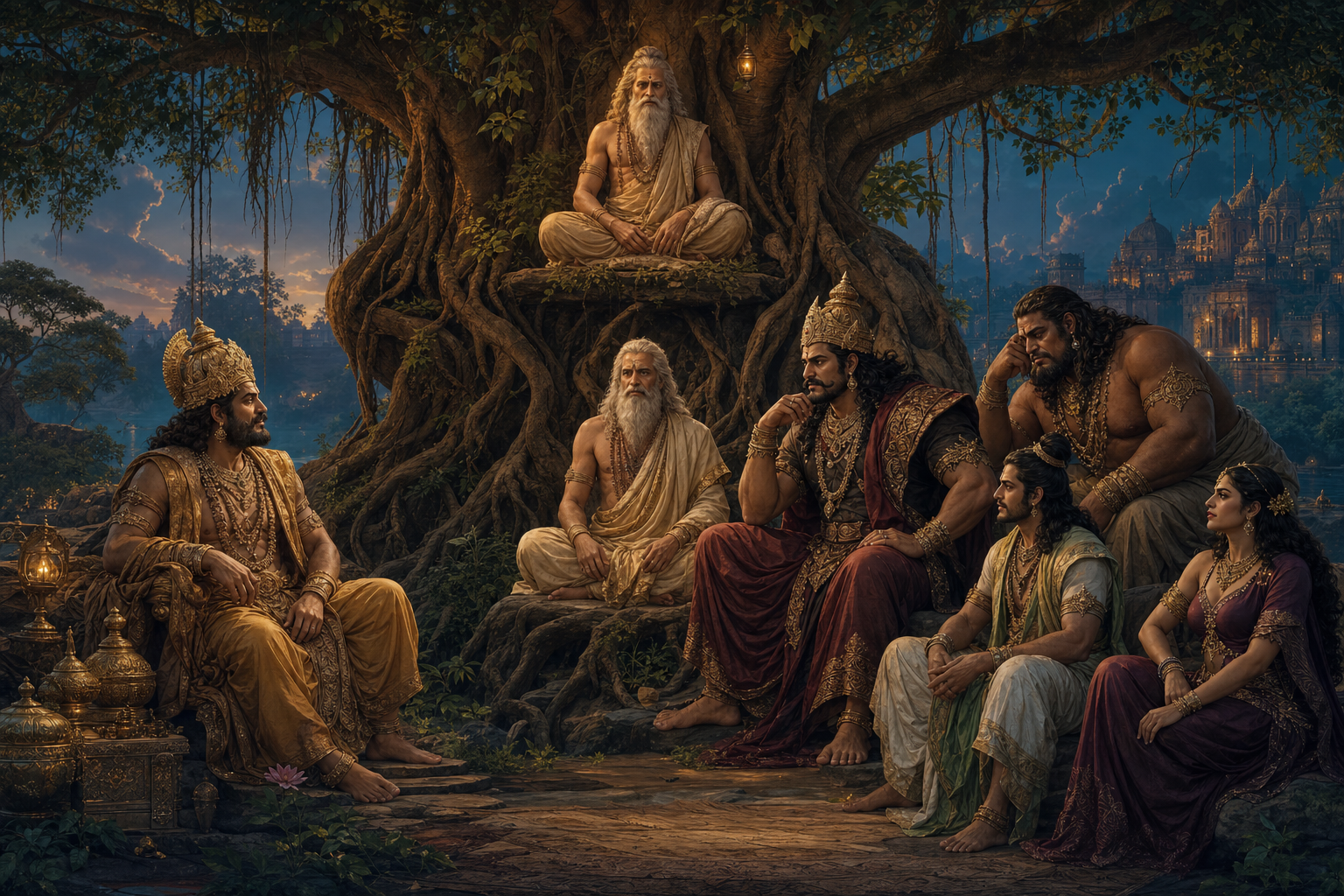
Rakshasas form a class of beings within a much larger cosmological network. They are not an independent creation standing outside the families of the universe. Several Puranic genealogies connect Rakshasas with Kasyapa and Khasa and place them alongside Yakshas. This proximity matters because it replaces a simple opposition between divine beings and monsters with a web of related orders, including Devas, Asuras, Yakshas and Nagas.
Another prominent genealogy runs through Pulastya and Visrava. Within that line, Kaikesi is the mother of Ravana, Kumbhakarna, Vibhishana and Shurpanakha. The practical lesson lies within the household itself: siblings with a shared ancestry can develop radically different moral dispositions.
- Ravana combines learning, tapas, devotion to Shiva and political ability with conquest and uncontrolled desire.
- Kumbhakarna possesses immense strength and loyalty to his kin, yet allows that loyalty to carry him into a disastrous cause.
- Vibhishana places truthful counsel and dharma above obedience to his brother.
- Shurpanakha follows another course again, showing that even one family cannot be reduced to a single temperament.
If ancestry dictated moral worth, this family would make little sense. Its internal differences are precisely the point. Birth gives each sibling a setting, a set of relationships and particular capacities. It does not make the decisive choices for them.
You should therefore resist forcing every Rakshasa mentioned across different periods and traditions into one rigid modern family chart. Terminology and genealogical emphasis can vary. Record the lineage supplied by the particular narrative you are reading, then use broader genealogies to recognize relationships rather than manufacture a hereditary moral rank.
Use the three gunas as a diagnostic lens, not a caste system
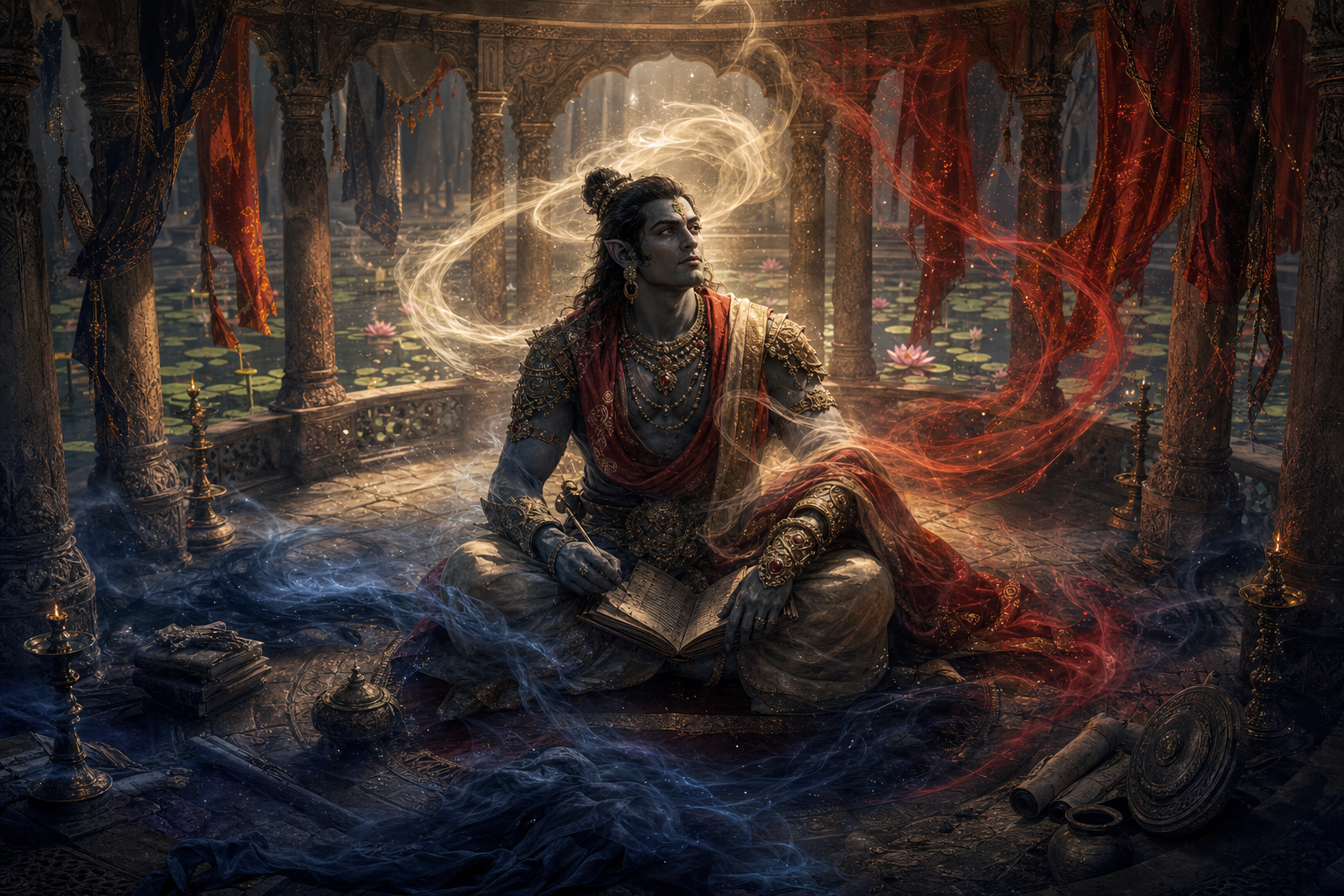
Sattva, rajas and tamas provide a useful way to distinguish moral tendencies among Rakshasas. Treat this threefold scheme as an interpretive tool assembled from recurring epic and Puranic patterns, not as a canonical roster in which every figure has been permanently assigned a box.
| Guna-aligned tendency | What to notice | Useful examples | Common reading error |
|---|---|---|---|
| Sattva | Truthful counsel, restraint, compassion and protection of the vulnerable | Vibhishana and Trijata | Assuming sattva requires passivity or unquestioning family loyalty |
| Rajas | Ambition, grandeur, prowess, attachment to achievement and intense loyalty | Ravana and Kumbhakarna | Mistaking knowledge, strength or magnificence for righteousness |
| Tamas | Predation, cruelty, delusion and violence pursued without regard for consequence | Baka, Kirmira, Khara and Dushana | Projecting the conduct of destructive individuals onto the entire Rakshasa class |
Vibhishana is sattva-aligned because he repeatedly urges Ravana to return Sita and make peace with Rama. When that counsel fails, he changes allegiance rather than turn family loyalty into an excuse for adharma. Trijata displays the same clarity in a quieter form by consoling Sita within Lanka. Neither figure needs to cease being a Rakshasa before acting with compassion and discernment.
Ravana reveals the danger of rajas more sharply because his virtues are real. He is learned, politically capable, devoted to Shiva and empowered by tapas. Yet those accomplishments do not discipline his desire. His brilliance instead enlarges the reach of his error. When you read his story, do not flatten him into either a misunderstood hero or a creature of featureless evil. The tragedy is that formidable capacities remain yoked to domination.
Kumbhakarna poses a related problem. Loyalty, courage and strength can look noble in isolation. Their moral quality changes when they serve a ruinous undertaking. His case asks you to examine not only whether a person is loyal, but also what the loyalty protects and whether truth is allowed to correct it.
Tamasic figures such as Baka and Kirmira in the Mahabharata and Khara and Dushana in the Ramayana embody predatory violence and blindness to consequence. Their conduct warrants an unequivocal moral judgement. What does not follow is a judgement against every being called Rakshasa.
The guna framework works only if you keep it dynamic. Sattva, rajas and tamas describe operative qualities, not bloodlines. They help you identify what governs a particular choice: clarity, agitated attachment or obscuring delusion. Turning them into permanent identities would recreate the very essentialism that the contrasting children of Visrava disprove.
Judge the response to power, counsel and vulnerability
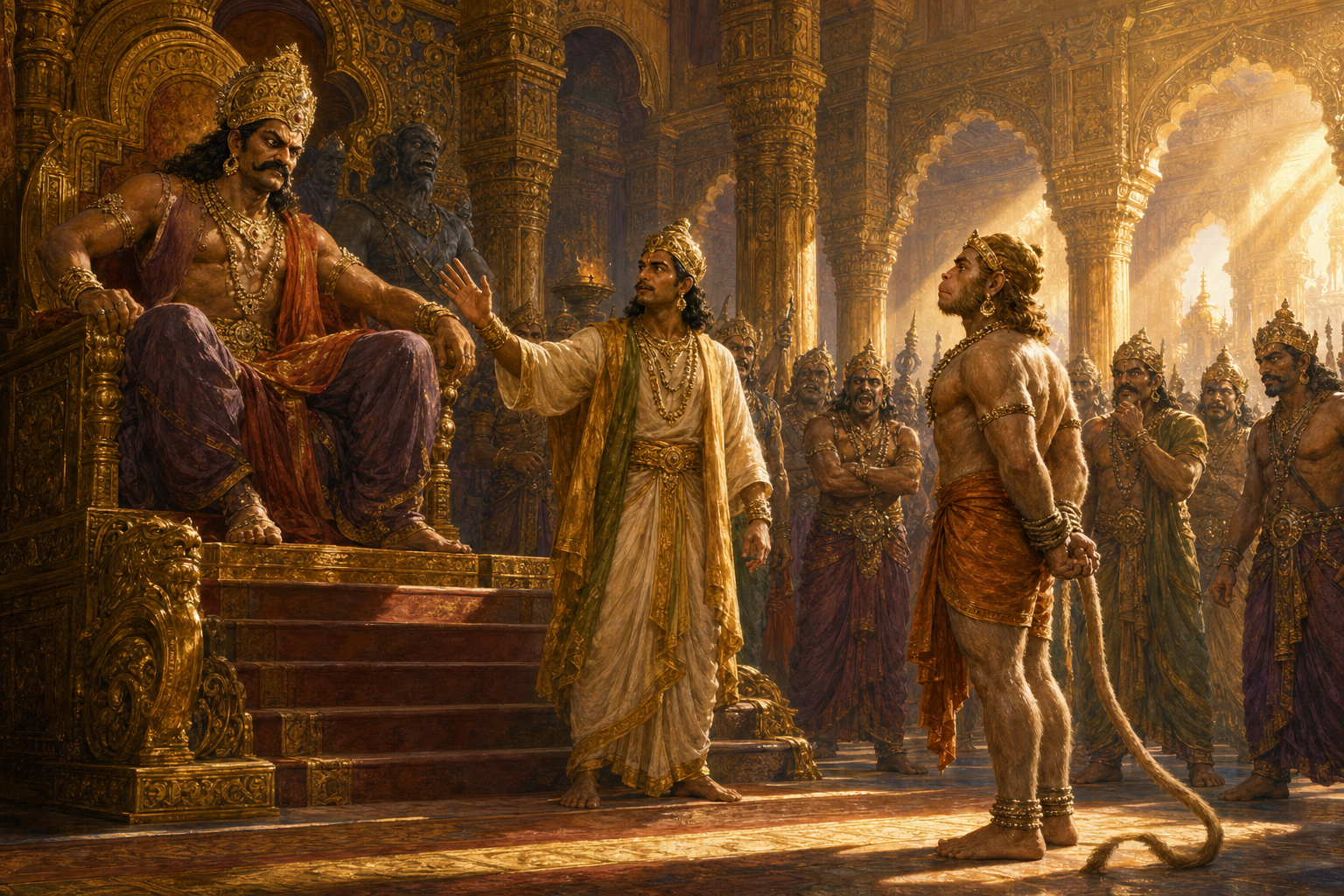
Shape-shifting, maya, great strength and night-wandering are recurring Rakshasa attributes. Diets also range from restraint to cannibal predation. These features tell you what kind of danger or possibility an episode contains, but none supplies a complete moral verdict. A power describes what a character can do. Dharma is disclosed by what the character does with it.
Four tests will give you a more reliable reading than appearance or group identity:
- Watch the response to truthful counsel. Does the character reconsider, ask what is right, or punish the person who speaks honestly?
- Watch the treatment of someone vulnerable. Compassion toward a captive or restraint toward a weaker opponent often reveals more than ritual status or outward form.
- Ask what power protects. Strength used to defend the conditions of dharma differs morally from strength used to feed appetite, pride or conquest.
- Notice what the right choice costs. A convenient declaration of virtue carries less weight than a decision that risks belonging, status or kinship.
These tests clarify why Vibhishana’s change of allegiance should not be dismissed as simple betrayal. He counsels restitution before leaving his brother’s side. The sequence matters: he first attempts correction within the relationship, then refuses complicity when correction is rejected. Loyalty is honored, but it is not made higher than dharma.
Trijata’s conduct supplies another useful test. She cannot overturn the political order of Lanka by force, yet she refuses to let that limitation become moral indifference. Her compassion toward Sita shows that dharmic agency can operate inside an adharmic environment without control over the whole environment.
The relationship between Bhima and Hidimba widens the lesson beyond Lanka. Their union produces Ghatotkaca, whose valor and sacrificial death materially alter the course of the Mahabharata war. Here, kinship across different orders becomes part of a dharmic alliance. An inherited category begins the episode, but deeds determine how the participants should be judged.
This also prevents a subtler error: confusing spiritual or intellectual attainment with moral completion. Tapas, mantra, learning and mastery of maya can make a being powerful. They do not guarantee control over anger, greed, pride or delusion. Capability and character must be evaluated separately.
Keep ritual, legal and narrative meanings in their settings
The word rakshasa does not perform exactly the same job in every setting. Its association with the verbal root raksh, “to protect,” is suggestive, but etymology cannot overrule usage. Protection and peril remain in tension, and the context tells you which aspect is active.
- In early ritual usage, terms such as rakshas and yatudhana can identify forces hostile to yajna. Protective rakshoghna mantras and rites answer disruption with disciplined ritual knowledge.
- In epic narrative, Rakshasa can identify a class containing compassionate counsellors, ambitious rulers, loyal warriors and violent predators. Character still has to be established through action.
- In classical discussions of marriage, rakshasa vivaha denotes a condemned mode involving violent abduction. That legal label classifies a manner of taking a bride; it does not prove that every narrative Rakshasa shares one moral nature.
This distinction gives you a simple rule: never carry a definition from one genre into another without checking what the term is doing there. A ritual adversary, a cosmological lineage and a legal classification can share a word without becoming interchangeable concepts.
The same restraint is needed when comparing Dharmic traditions. In Buddhist narratives, Rakshasas and related beings can move from wrathful roles to vows protecting the Dharma. In Jain cosmology, Rakshasas appear among the Vyantara classes and remain subject to karmic law. Sikh teaching approaches the practical problem through the inner enemies of lust, anger, greed, attachment and pride. These are not identical cosmologies, and they should not be collapsed into one system. Their ethical convergence is narrower and more useful: turbulent power can be redirected, no embodied category escapes moral law, and spiritual work is measured by transformation.
Key takeaways for your next Rakshasa episode
- Identify the setting first. Decide whether the term appears in ritual, narrative, cosmological or legal discourse before defining it.
- Sketch the immediate relationships. Note parents, siblings, rulers, allies and dependants. This reveals the loyalties under pressure.
- Record choices, not just attributes. Shape-shifting, learning, tapas, strength and lineage are capacities or circumstances; none independently proves dharma or adharma.
- Apply the gunas provisionally. Ask whether clarity, restless attachment or delusion governs the action, then revise your judgement as the character changes.
- Look for the response to correction. The treatment of honest counsel often separates tragic rajas from deliberate tamas and emerging sattva.
- Do not generalize from the worst member. Condemn cruelty plainly while keeping responsibility attached to the character who chooses it.
At your next recitation or reading, write three short notes beside the first Rakshasa you encounter: lineage, response to counsel and use of power. If those notes complicate the word “demon,” let them. The epics are training you to recognize dharma under difficult appearances, including in your own loyalties, ambitions and impulses.
References
