

Perhaps effort has started to feel confusing. You inherited a temperament, family patterns, obligations, and consequences you did not consciously choose. You may also have prayed, meditated, served, or tried to live ethically without receiving the change you wanted. Is your life ruled by karma, redirected by choice, or carried by grace?
You do not need to solve that question as an abstract debate before taking your next step. A practical Dharmic answer begins by holding three truths together: your conditions are real, your response matters, and the fruit is not entirely yours to command. That position is more demanding than fatalism and more humble than the idea that you can simply invent yourself through willpower.
Your freedom begins within conditions, not outside them
Start by distinguishing a condition from a command. A condition narrows the field in which you act. It may make a wholesome response difficult, costly, or initially unattractive. It does not necessarily dictate what you must do.
Anger, for example, may arise before you have consciously invited it. That arising is part of your present field. Whether you feed it, speak from it, examine it, or let it pass involves further moments of intention. Dharmic freedom usually lives in those moments. It is not freedom from every cause; it is the growing capacity to respond wisely amid causes.
Hindu accounts make this especially concrete by distinguishing stored karma, presently operative karma, and karma being formed now: sanchita, prarabdha, and agami. Prarabdha helps describe the circumstances already bearing fruit. Purushartha, purposeful striving through knowledge, devotion, ethical action, and discipline, helps shape agami. The distinction does not promise control over every outcome. It tells you why present effort still matters when the past cannot be undone.
The Bhagavad Gita places instruction beside deliberation rather than treating guidance as the destruction of agency. The learner receives a vision of reality, duty, disciplined action, devotion, and surrender, yet must still act. Dharma informs choice; it does not make the person morally absent.
Buddhist dependent origination also avoids the extremes of absolute self-authorship and helpless determinism. Intentions arise within conditions, but ethics, meditation, and wisdom can alter the conditions under which later intentions arise. Jain thought places even sharper weight on self-discipline: vows, restraint, austerity, repentance, right vision, right knowledge, and right conduct stop new karmic bondage and shed what has accumulated. Sikh teaching holds karma together with hukam, the Divine Order, and nadar, grace. You remain responsible for truthful living, remembrance, and service while recognizing that life unfolds within a wisdom larger than the isolated ego.
These are related Dharmic grammars, not interchangeable doctrines. Buddhism does not need a permanent self-author to defend transformation. Jainism does not make divine pardon the engine of liberation. Hindu schools differ over the relation between the jiva, Brahman, Bhagavan, knowledge, devotion, and grace. Sikhism joins responsibility to life in hukam and receptivity to nadar. Respecting those differences makes the shared practical insight clearer: causality is real, yet disciplined transformation remains possible.
When you feel trapped, sort the situation into these three categories:
- Given now: facts you cannot honestly reverse today, including past actions, existing duties, another person’s decision, and consequences already in motion.
- Trainable: attention, habits, knowledge, emotional regulation, speech, environment, and the company you keep.
- Chosen next: the smallest truthful action presently available, such as keeping silence instead of retaliating, completing a neglected duty, asking for counsel, making repair, or returning to practice.
Keep speculation about invisible past lives out of the first category. Karma is not permission to explain why another person deserved suffering. Its safest moral use is first-personal: given what is here, what kind of cause will you add now?
Practice turns a sincere intention into a dependable choice

A choice can be sincere and still lose to a trained habit. That does not prove that effort is meaningless. It shows that freedom is a capacity requiring cultivation. You train before the difficult moment because the difficult moment rarely provides ideal conditions for learning restraint, remembrance, or clarity.
Abhyasa, steady practice, works with vairagya, appropriate detachment. The first returns attention to what matters. The second loosens the demand that every impulse be obeyed and every result possessed. A sustainable discipline therefore uses small commitments, regular practice, study, service, and honest reflection instead of depending on a dramatic vow or a passing spiritual mood.
Build your daily discipline around a simple sequence:
- Choose a stable cue. Begin after an event that already occurs each day, such as waking, bathing, or preparing for sleep. A stable cue removes the need to renegotiate whether practice will happen.
- Use a primary practice from a coherent path. This may be japa or dhyana in a Hindu lineage, mindfulness or metta in Buddhism, samayik or pratikramana in Jainism, or simran in Sikhism. Let the method train you before deciding that ordinary resistance means it is unsuitable.
- Name the ethical edge of the day. Identify the behavior most likely to carry you away from Dharma: harsh speech, dishonesty, indulgence, resentment, carelessness, or avoidance of duty. Give your practice a place to become conduct.
- Express the practice outwardly. Seva, generosity, nonviolence, and practical care prevent spirituality from becoming an enclosed project of self-improvement.
- Review without theatrical judgment. Notice where attention narrowed, where you remembered, what triggered the lapse, and what condition should be changed before the next recurrence.
If your lineage prescribes a mantra, count, vow, diet, ritual sequence, or form of repentance, learn it from a competent teacher rather than assembling an improvised mixture. Unity among Dharmic traditions does not mean that every technique can be detached from its purpose. A practice designed for devotion, insight, karmic restraint, or remembrance carries assumptions about the path and its goal.
Environment also belongs to spiritual discipline. If the phone takes your attention before remembrance does, move it away from the place where you practise. If fatigue repeatedly defeats an evening commitment, choose a more reliable cue. If a particular conversation, media habit, or social setting regularly produces the same lapse, do not call the pattern mysterious. Change the condition you can change.
Community becomes important precisely where self-observation becomes unreliable. Satsanga, sangha, and sangat give different traditions a shared practical insight: companionship aligned with Dharma helps stabilize practice. But a community cannot respond to a struggle you keep hidden. Ask concretely. Saying that you are “having difficulty” gives a mentor little to work with; naming the recurring trigger, action, and consequence makes counsel possible.
Judge progress by fruits that survive ordinary life. Is recovery from a lapse becoming quicker? Is your speech kinder when challenged? Do you bargain less with duties you already know are yours? Can you practise without waiting for the right mood? Is your attraction to a harmful pattern weakening? These measures are less glamorous than a peak experience, but they tell you whether practice is increasing usable freedom.
Grace completes effort without making effort unnecessary
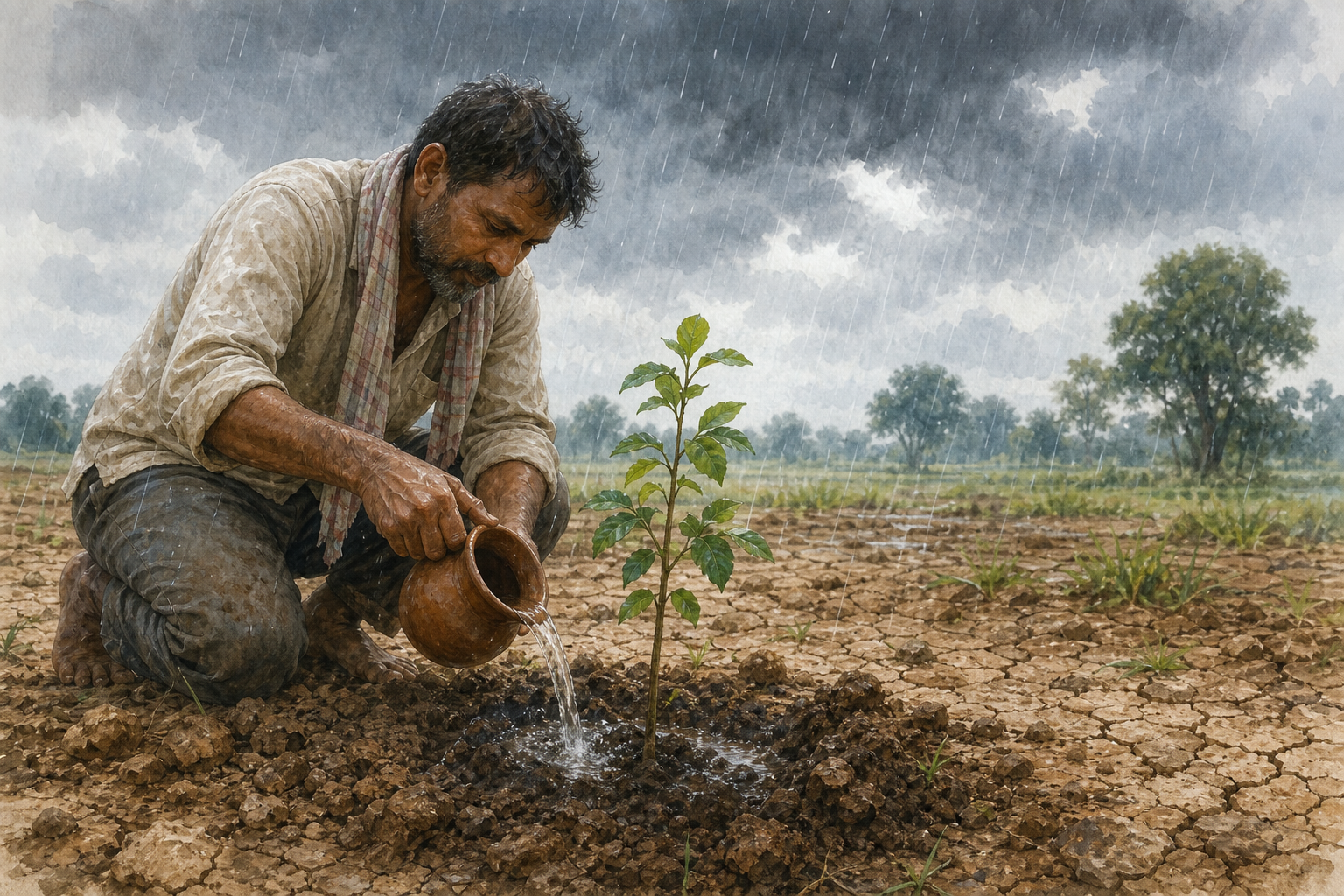
Grace is easily distorted in opposite directions. It can be imagined as arbitrary favoritism bestowed on a spiritual elite, or reduced to a pleasant name for one’s own achievement. Neither view gives a sound basis for Dharmic life.
Traditions that affirm divine grace do not all describe its relation to effort in the same way. Vishishtadvaita emphasizes a synergy of disciplined response and surrender. Dvaita preserves personal responsibility alongside dependence on the Lord. Gaudiya Vaishnava thought speaks of the jiva’s minute independence: love and surrender must be voluntary, yet the finite being never becomes the independent controller. Sikh teaching places responsible living within hukam while nadar opens the heart to remembrance. In each case, grace humbles self-sufficiency without turning passivity into a virtue.
Other Dharmic paths require different language. Advaita directs attention to self-knowledge that dissolves the misidentification sustaining bondage. Buddhism develops freedom through the transformation of conditioned intention without appealing to a divine chooser of the saved. Jainism makes disciplined purification central and does not treat liberation as a decree of divine pardon. A serious cross-Dharmic understanding must preserve these differences while recognizing their common refusal of spiritual exclusion by birth.
Where grace belongs to your path, practise four postures:
- Act without a contract. Do not turn prayer, japa, seva, or austerity into a transaction in which the Divine owes you the outcome you selected.
- Ask without entitlement. Dependence can be honest without becoming a claim to special status.
- Receive help as responsibility. A teacher, timely counsel, an opportunity to repair, or a softened heart is not merely something to enjoy; it asks for a response.
- Relinquish the fruit, not the duty. Surrender concerns your possessiveness toward the result. It does not excuse avoidable negligence.
There is a useful test here. If your idea of grace lets you postpone an apology, neglect practice, expect exemption from ethics, or wait for the Divine to perform your duty, it has become evasion. If your idea of effort makes you contemptuous of people who struggle, it has strengthened ahankara rather than weakened bondage.
Grace and effort correct one another. Effort keeps surrender from becoming inert. Grace keeps discipline from becoming pride. You bring attention, truthfulness, restraint, devotion, and service. You do not claim ownership over every condition that made those acts possible or every fruit that may follow.
Use the framework at a crossroads and after a lapse

When you must make a difficult choice
A difficult decision often becomes confused because facts, fears, duties, preferences, and hoped-for signs are treated as one thing. Separate them before acting.
- Name the conditions without dramatizing them. What has already happened? What obligation exists? What information is missing? What consequence cannot be wished away?
- State the Dharmic boundary. Which option requires deception, cruelty, exploitation, betrayal of a legitimate duty, or deliberate harm? Do not rename a clear ethical compromise as intuition.
- Compare the tendencies each option trains. Ask not only, “What will I get?” but also, “What kind of chooser will this action make easier to become?” This is the practical importance of agami karma.
- Seek counsel from someone whose conduct you respect. Ask that person to examine the place where desire, fear, resentment, or spiritual ambition may be distorting your view.
- Choose, act, and release the fantasy of total control. A careful decision can still produce pain or an unwanted result. An agreeable result does not retroactively make an unethical method righteous.
This sequence is useful whether you are facing conflict, vocation, family responsibility, or a decision about religious commitment. Dharma does not guarantee a painless option. It helps you avoid adding needless inner disorder to a difficult outer condition.
When the wrong choice has already been made
Do not confuse accountability with a permanent identity. “I acted dishonestly” names something that can be examined, repaired, and restrained. “I am beyond return” turns remorse into paralysis. Dharmic traditions take consequences seriously while retaining paths of correction through ethical change, knowledge, restraint, remembrance, service, and, where affirmed, grace.
Use a direct reset:
- Stop the harmful sequence as soon as you recognize it. Do not let shame become the reason for repeating the act.
- Name what happened without euphemism. Precision prevents a vague confession from protecting the behavior.
- Repair what can be repaired. An apology, restitution, corrected statement, fulfilled duty, or changed boundary may be required. Spiritual recommitment does not erase what you owe another person.
- Return through the discipline of your path. That may involve japa, meditation, pratikramana, simran, seva, scriptural study, repentance, or guidance from a teacher.
- Change the condition that enabled repetition. Adjust access, routine, company, digital boundaries, or another recurring trigger rather than relying on fresh determination alone.
- Tell a trustworthy person what support you need, then resume your regular practice at its next cue.
Growth is often nonlinear. A useful measure is not whether you can claim never to fall, but whether the time between recognition, repair, and return is shortening. Consequences may remain, and another person is not required to restore trust immediately. Grace is not immunity from karma, and repentance is not control over someone else’s response.
When you are choosing a spiritual path
Do not mistake pluralism for the claim that all disciplines say the same thing. The Hindu principle of Ishta makes room for a chosen form or ideal while honoring other approaches. Jain anekantavada cautions against confusing a partial standpoint with the whole. Those insights support respect, but respect does not require a homemade system in which karma, emptiness, jiva, Brahman, Bhagavan, hukam, and grace lose their distinct meanings.
Choose a primary practice and a trustworthy community long enough to learn what they are actually training. Ask how the path understands bondage, liberation, ethical duty, disciplined effort, authority, and grace. You can honor the wider Dharmic family while allowing one coherent discipline to correct you in places where private preference would not.
Key takeaways
- Karma describes consequential causality, not a command to remain as you are. Begin with the next cause you can honestly shape.
- Practice trains choice before pressure arrives. Use a stable cue, a coherent method, an ethical focus, service, and review.
- Dharmic traditions do not give grace one uniform meaning. Preserve their differences instead of forcing every path into a divine-election model.
- Where grace is affirmed, it removes entitlement rather than responsibility. Relinquish possession of the fruit, not the duty to act.
- After a lapse, stop, name, repair, adjust the enabling condition, seek support, and return to practice.
- Measure spiritual growth in conduct: steadier attention, cleaner speech, quicker recovery, reduced harm, deeper remembrance, and less pride.
At your next regular daily cue, take up the practice your path has given you. Then identify the ethical action that practice must support today. Do not wait to feel completely free before beginning. In Dharmic life, greater freedom is formed through the next truthful choice, strengthened by repetition, and offered without a demand to control the fruit.
References
- Dandavats – Chosen People or People Who Choose? A Dharmic Analysis of Free Will, Karma, and Grace
- Dandavats – From Fear to Devotion: A Practical, Dharmic Guide to Bhakti, Satsanga, and Inner Peace
