
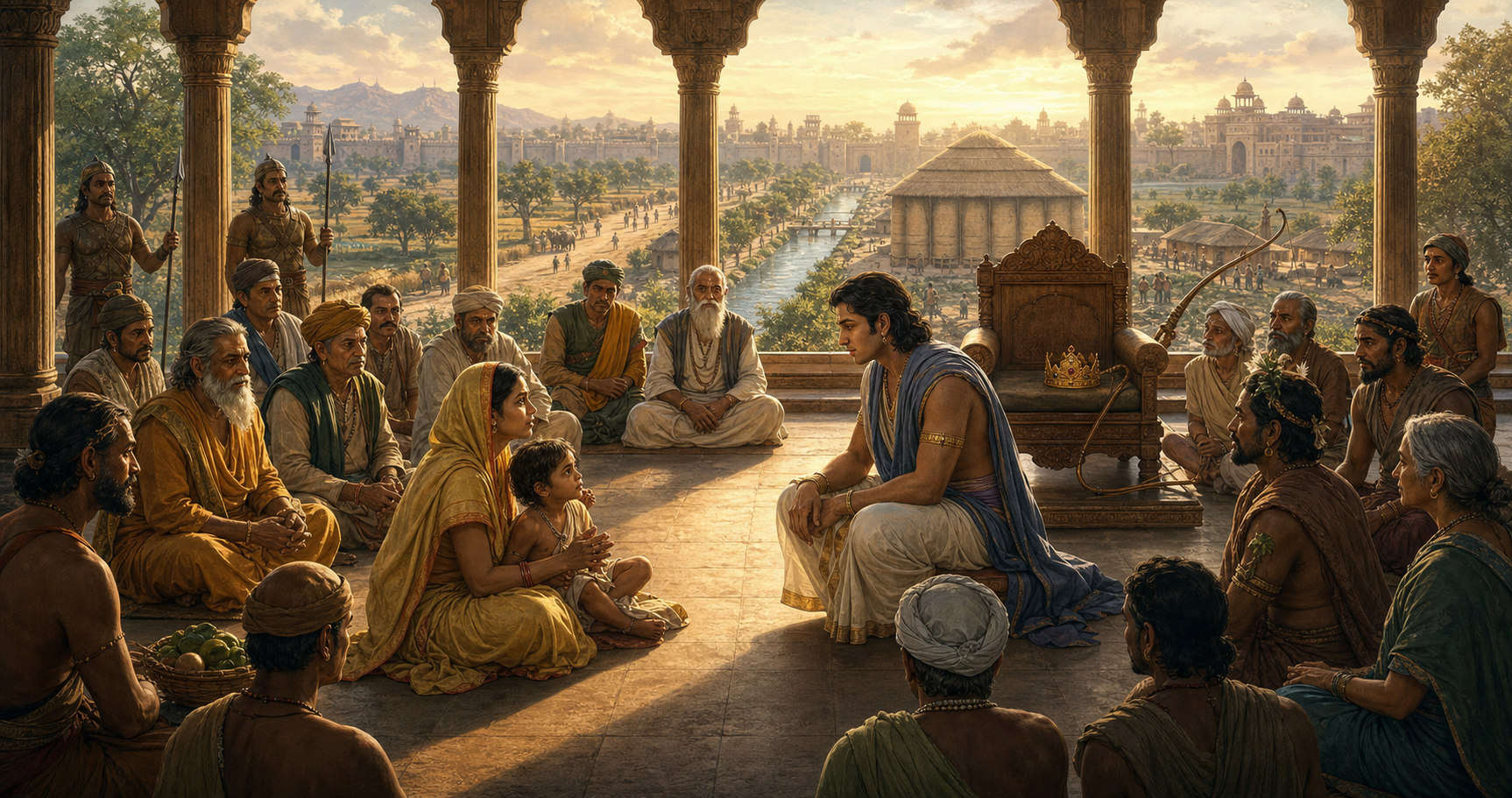
You may admire a leader’s religious language, administrative energy or electoral strength and still be unsure whether that leader governs according to dharma. The decisive question is not whether power invokes dharma. It is whether dharma restrains power.
Rajadharma gives you a disciplined way to make that judgment. Begin with the safety of the least protected person. Then examine justice, taxation, appointments, counsel, public institutions and the ruler’s capacity to correct a mistake. This approach works whether you are assessing a national government, a local administration or leadership within your own community.
Begin with the person who cannot command protection

Rajadharma is often reduced to the image of a noble king. That misses its practical purpose. The ruler exists to prevent public life from becoming a contest in which wealth, influence and force decide whose rights matter.
The classical name for that breakdown is matsya-nyaya, the law of the fish, in which the strong consume the weak. It does not require the complete disappearance of government. A state may retain ministers, courts, taxes and armed personnel while suffering a moral vacancy at its centre. If those institutions protect favourites, intimidate witnesses or allow private interests to capture public authority, the throne is occupied but rajadharma is absent.
The decline follows a recognisable sequence. Personal safety and property become uncertain. Agreements lose credibility because enforcement depends on influence. Travel and trade become riskier. Agriculture becomes harder to plan. Taxation feels arbitrary rather than reciprocal. Citizens then seek protection through patrons, factions or private force, which weakens public institutions further.
This sequence explains why protection is the first test of governance. Economic decline may appear later in a budget or treasury, but the ethical failure begins earlier, when an ordinary person cannot rely on public authority without finding a powerful intermediary.
When you evaluate a government, choose a person with little political leverage and trace that person’s path through the state. Can someone report a threat without needing a connection? Can a small trader rely on an agreement? Can a household protect its property through ordinary procedures? Can a witness speak without intimidation? If the formal route works only for the influential, administrative order is concealing matsya-nyaya rather than overcoming it.
The grief surrounding Sri Rama’s exile from Ayodhya makes the same distinction at the level of character. Office alone cannot provide a moral centre. Administrators may remain in place, yet public confidence falters when rightful duty, competence and trust are dislocated. The lesson is not that institutions are unnecessary. It is that institutions cannot remain healthy for long when leadership treats duty as optional.
Six duties turn righteous intention into government
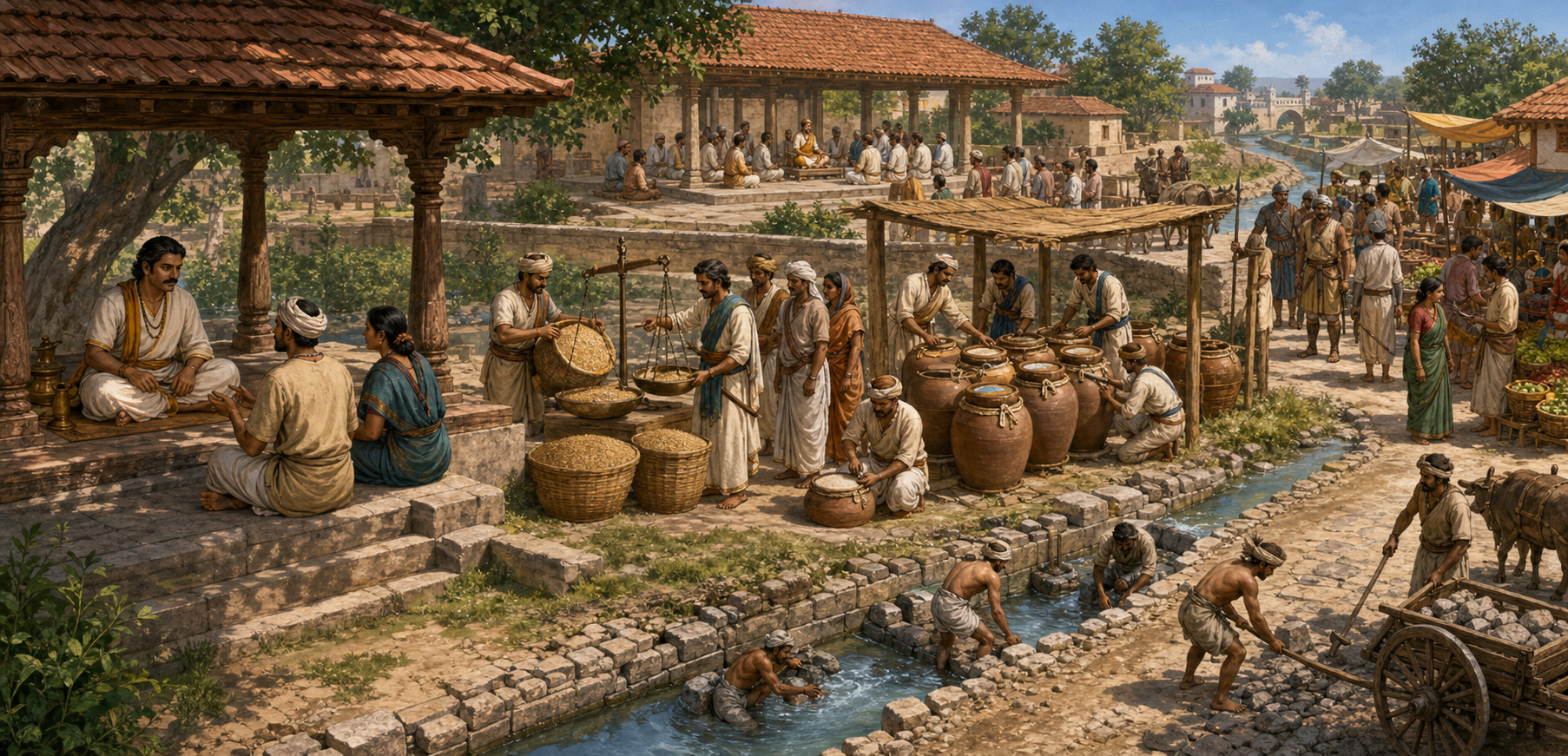
A leader may be personally devout and publicly negligent. Rajadharma does not allow private piety to compensate for failed administration. It asks whether moral discipline has become reliable public practice.
- Protection, or raksha: The ruler must protect life and property without fear or favour. Protection is inadequate when it arrives only after a scandal, depends on factional identity or disappears outside politically important places. Ask whether lawful public authority reduces people’s dependence on private muscle.
- Impartial and proportionate enforcement, or danda: Danda is not a ruler’s permission to punish at will. It is legitimate authority exercised under discipline. Enforcement must be visible enough to inspire confidence, prompt enough to remain meaningful, proportionate to the wrong and free from anger or partisan preference. Speed cannot redeem a biased process, and elaborate procedure cannot redeem indefinite delay.
- A disciplined treasury, or kosha: Revenue collection must be predictable, and expenditure must serve public responsibilities rather than sovereign vanity. A healthy treasury is neither endlessly hoarded nor treated as private wealth. Ask what is collected, under which rule, where it is spent and whether those answers are open to independent scrutiny.
- Competent and accountable ministers, or amatya: Appointments should rest on merit rather than flattery. Ministers need clear responsibilities, regular scrutiny and consequences for failure or corruption. Loyalty can support coordination, but loyalty without competence makes the ruler less informed and the state more fragile.
- Capable defence joined to a preference for peace: Rajadharma requires the capacity to protect the realm, its people and its institutions. That capacity is not a mandate for aggression. Strength serves dharma when it deters predation and supports a just peace, not when conflict becomes a stage for personal glory.
- Self-restraint and timely correction: A ruler must govern speech, desire, anger and pride before governing others. When a decision violates dharma, correction should begin with ending the wrong and repairing its effects. Delayed admission allows a correctable error to become a crisis of legitimacy.
These duties reinforce one another. Predictable justice makes economic exchange safer. Disciplined revenue sustains courts, infrastructure and defence. Competent ministers give the ruler accurate information. Self-restraint prevents all those instruments from being redirected toward revenge, spectacle or personal enrichment.
This is also why rajadharma is not a mandate for unchecked monarchy. Dharma binds the ruler as firmly as it binds the ruled. In a constitutional democracy, the responsibilities once concentrated around a throne are distributed among elected leaders, legislatures, courts, auditors, civil servants and other public institutions. The constitutional form changes; the demand that authority remain answerable to duty does not.
The hardest test is hearing a truth that threatens pride
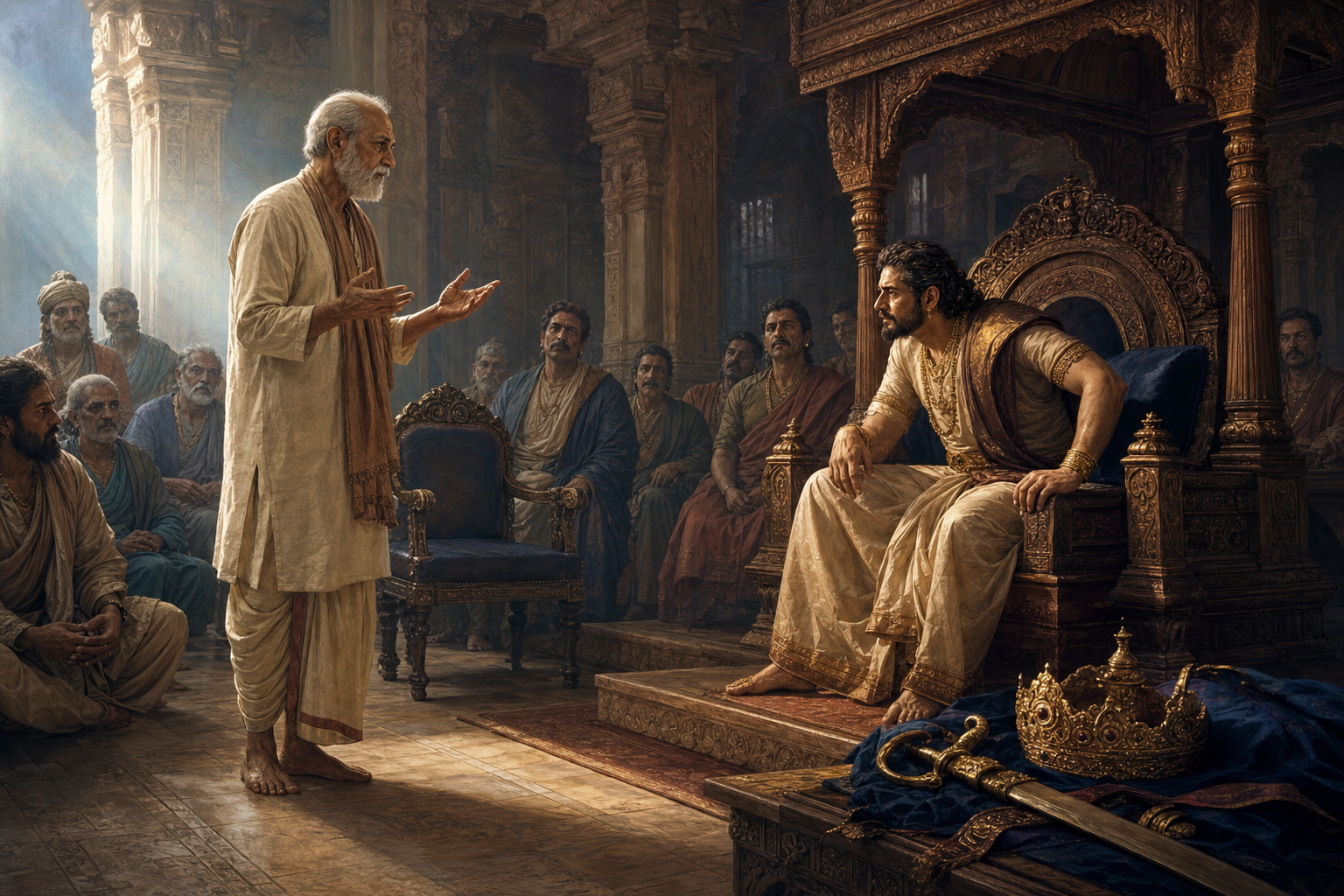
Ravana’s failure is more instructive than a simple contrast between a good ruler and a bad one. He receives a path back toward justice. Vibhishana urges him to return Sita, listen to wise counsel and place the people’s security above sovereign pride. The required correction is concrete. Stop sustaining the original wrong.
Ravana refuses because accepting sound counsel would require his ego to yield. His problem is therefore not a shortage of information. It is counsel blindness: the inability to accept information that contradicts desire, prestige or a chosen course. Power amplifies that weakness because frightened or ambitious advisers learn to replace truth with reassurance.
You can detect the same failure pattern before a government reaches catastrophe. Watch for four signs:
- Flattery is rewarded while principled disagreement is treated as disloyalty.
- Public justice is personalised, so criticism of a decision becomes an attack on the ruler.
- Law is applied aggressively to opponents and indulgently to allies.
- Propaganda and spectacle multiply while the underlying wrong remains uncorrected.
The remedy is not merely to appoint more advisers. A leader can fill a chamber with experts and hear nothing unwelcome. You need to know whether dissent can travel through the institution without being punished, whether information is independently checked and whether a minister’s status depends on accuracy rather than pleasing the sovereign.
Vidura-niti sharpens this discipline: listen before deciding, verify reports through independent channels, examine ministers regularly and do not confuse a personal enemy with an offender against the public. That last distinction is crucial. Public power ceases to be just when the ruler’s resentments determine whom the state investigates, rewards or punishes.
A dharmic leader need not be incapable of error. That expectation would reward concealment and performance. The better test is whether the leader has a governable ego: Can an error be named? Can a truthful adviser remain trusted after delivering bad news? Can policy change without the ruler pretending that nothing went wrong? A government that can correct itself is stronger than one that must describe every decision as infallible.
Examine all seven limbs, not the sovereign alone

Character matters, but admiration for a virtuous personality is not a complete theory of government. The seven-limbed understanding of the state, or saptanga, directs attention to the whole political organism: sovereign, ministers, populace and territory, fortifications and infrastructure, treasury, force and justice, and allies.
| Limb | Governance function | Question you should ask |
|---|---|---|
| Swamin | Sovereign leadership | Does the leader place public duty above appetite, anger and prestige? |
| Amatya | Ministers and administration | Are capable people appointed, audited and permitted to tell unwelcome truths? |
| Janapada | People and territory | Do households and livelihoods become safer, more stable and less dependent on patrons? |
| Durga | Fortifications and infrastructure | Can public systems withstand pressure and protect ordinary life beyond ceremonial centres? |
| Kosha | Treasury | Are revenue and expenditure predictable, transparent and directed toward public duties? |
| Danda | Force and administration of justice | Is coercive authority lawful, impartial, proportionate and restrained? |
| Mitra | Allies | Do relationships increase security and mutual benefit while preserving the possibility of peace? |
This model prevents a common political mistake: allowing strength in one area to hide decay in another. A full treasury cannot excuse partisan justice. Impressive infrastructure cannot compensate for corrupt ministers. Military capacity cannot make an unsafe populace prosperous. Personal virtue cannot repair institutions that receive no oversight.
The limbs also reveal how failure spreads. A captured ministry can redirect enforcement toward factional interests. A plundered treasury weakens infrastructure, courts and defence. Arbitrary force destroys trust, making revenue collection and cooperation harder. Neglect of the janapada eventually hollows out every other limb because the state depends on the people whose welfare it is supposed to secure.
Modern institutions can translate these functions without pretending that an ancient polity and a present constitutional state are identical. Rule of law disciplines danda. Independent audits protect kosha. Merit-based appointments and civil-service standards strengthen amatya. Resilient infrastructure develops durga. Public participation keeps janapada visible. Diplomacy oriented toward mutual benefit cultivates mitra. Elections and constitutional accountability place conditions around swamin.
Use Rama Rajya in this practical sense: as a horizon of predictable law, honest taxation, secure households and visible accountability. It is not a label that a government can award itself. A ruler who invokes Sri Rama while using law for factional revenge fails the standard carried by that invocation. Religious symbolism raises the obligation to govern dharmically; it does not lower the evidentiary test.
The wider Dharmic family adds useful guardrails. Buddhist Dasa-Raja-Dhamma places generosity, morality, self-restraint, non-anger and non-violence among the virtues of rule. Jain emphasis on ahimsa and anekantavada presses authority toward restraint, consultation and respect for more than one viewpoint. Sikh miri and piri join temporal responsibility to spiritual discipline, while sarbat da bhala directs power toward the welfare of all. These traditions do not erase their differences. They converge on a demanding proposition: political authority becomes legitimate through service, ethical restraint and public welfare.
Key takeaways: use this rajadharma audit
Choose one leader, institution or policy rather than judging an entire political system in the abstract. Answer each question with yes, partly or no, and write one observable fact beside the answer. A slogan, intention or partisan comparison is not evidence.
- Protection: Does this decision make the least protected person safer, or does it increase dependence on wealth, connections or private force?
- Justice: Would the same rule and procedure apply to a supporter, an opponent and someone with no political importance?
- Correction: When a wrong becomes clear, is the harmful conduct stopped and repaired, or merely explained away?
- Counsel: Can informed people disagree without retaliation, and can decision-makers verify reports outside the ruler’s preferred circle?
- Treasury: Are taxes, revenue and expenditure predictable and open to scrutiny, with public duty taking priority over prestige?
- Competence: Are appointments based on ability, and do audits or consequences follow corruption and persistent failure?
- State capacity: Does the policy strengthen people, infrastructure, finances, justice, security and alliances together, or improve one limb by damaging another?
- Self-restraint: Does the leader’s speech and conduct show mastery of anger, desire and pride when power is challenged?
Do not average away a grave failure in protection or impartial justice because a government performs well elsewhere. Those duties are load-bearing. A prosperous state that leaves vulnerable people exposed, or an efficient administration that weaponises enforcement, has not met the rajadharma test.
Apply the audit consistently. If you use demanding standards against an opposing party and excuses for your preferred party, you are measuring tribal loyalty rather than dharma. The value of rajadharma lies precisely in its ability to bind our side before it is used to condemn someone else’s.
Citizens also have duties within this order. Honest dealing, payment of due taxes, mutual aid, restraint in public speech and a preference for truth over faction help make good government possible. Public ethics cannot be outsourced to a throne, cabinet or court. Ruler and ruled either sustain trustworthy institutions together or weaken them together.
Before you support the next policy or defend the next leader, put the eight questions on paper. Begin with the person who has the least influence, demand evidence for each answer and ask what would happen if the same power were held by your political opponent. That is a small but serious way to move public judgment from personality worship toward rajadharma.
References
