

You have kept the vow, maintained the routine, or become more serious about japa. Yet an interruption now irritates you, disagreement feels disrespectful, and people who practice differently seem less committed. If discipline is making you easier to provoke and harder to correct, do not intensify it. Examine its direction.
Tapas should give you a dependable center, not a more impressive spiritual identity. This guide will help you tell stability from rigidity, recognize pride before it becomes entrenched, and build humility into your sadhana while the practice is still taking shape.
Judge tapas by what happens when life interrupts you
Tapas is the deliberate heat of self-transformation. It may take the form of a steady routine, restraint in speech, simplicity, dietary discipline undertaken wisely, japa, meditation, or endurance of discomfort in the service of dharma. Its measure is not how much suffering you can tolerate. Its measure is what the discipline removes from your conduct.
A sound practice should gradually weaken impulsiveness, resentment, vanity, and dependence on approval. It should strengthen attention, discernment, proportion, and the ability to keep your obligations without constant inner drama. If the practice makes you stricter about its form but careless about its effects on other people, the form has begun to displace the purpose.
This is why Yoga Sutra II.1 places tapas beside svadhyaya and Ishvara-pranidhana. Self-discipline needs self-study, or you will not see the motives hiding inside it. Self-discipline also needs surrender, or effort will quietly become a claim of ownership: my austerity, my purity, my attainment, my authority.
Remove svadhyaya, and you can repeat a demanding practice without noticing that it feeds comparison. Remove surrender, and success becomes evidence of personal superiority. Keep all three together, and tapas becomes less like self-punishment and more like the careful refinement of intention.
Inner stability does not mean that anger, hurt, envy, or fear never arises. It means that an emotion no longer gets unlimited authority over your next action. You notice it sooner, recover your moral bearings, accept sound counsel, and respond in proportion to what actually happened.
Dhruva gives this distinction a memorable form. Humiliation was converted into mantra, meditation, and sustained discipline rather than allowed to remain a demand for courtly validation. His name, associated with firmness and the North Star, points to an inner axis around which changing conditions can move without carrying your whole identity with them.
Humility is the companion of that stability. It is not self-contempt, theatrical meekness, or denial of genuine competence. It is freedom from the need to turn competence into rank. A humble practitioner can acknowledge progress without making progress a reason that others should defer to them.
Use three tests: interruption, correction, and obscurity

A controlled practice environment can make almost anyone feel composed. The more revealing question is whether composure remains available when control is taken away. Three ordinary situations expose the condition of your tapas more clearly than an exceptional meditative experience.
- The interruption test. Someone disturbs your japa, changes a plan, needs your help, or prevents you from completing the routine exactly as intended. Notice your first outward act. Can you protect the dignity of the other person while deciding whether the interruption is necessary? If the ritual is preserved but your speech becomes contemptuous, you have defended the container at the expense of the practice.
- The correction test. A teacher, elder, family member, or fellow practitioner questions your conduct. Before explaining yourself, restate the concern in words the other person would recognize. This separates understanding from agreement. If you cannot hear criticism without immediately invoking your years of practice, lineage, sacrifice, or experiences, spiritual identity is shielding itself from svadhyaya.
- The obscurity test. Ask whether you would maintain the discipline if nobody knew about it. Keep at least one meaningful observance private, apart from a teacher or accountable guide who needs to know. A vow that survives without praise is more likely to be serving transformation rather than reputation.
Do not use these tests to manufacture another scorecard. The mind can become proud of passing humility tests as easily as it becomes proud of fasting. Use them diagnostically. They show where your freedom narrows and which part of the practice needs a safeguard.
Also distinguish steadiness from suppression. Suppression says, “A spiritual person must not feel this,” and pushes the reaction out of sight. Stability says, “This reaction is present, but it does not have to choose my words.” Suppression protects an image. Stability protects dharma.
Catch mada before discipline hardens into identity

Mada is intoxication, conceit, or pride. It does not always arrive as an obvious boast. In sadhana it often appears as a change in posture toward other people: less curiosity, more certainty; less patience, more entitlement; less gratitude, more concern with who is advanced.
Three mechanisms deserve particular attention:
- Identity hardening: A discipline that began as a method becomes a badge. Vegetarianism, fasting, early rising, retreat, celibacy, study, or long meditation is no longer something you practice; it becomes the evidence by which you decide who you are and who others are not.
- Moral licensing: Because you have accepted hardship in one area, the mind feels entitled to indulgence elsewhere. Harsh speech, family neglect, impatience, or disdain is excused because the practitioner has supposedly paid a spiritual price.
- Social mirroring: Other people admire consistency, knowledge, charisma, or unusual experiences. Repeated admiration becomes a reflected identity. You begin to protect the role they have given you, even when honest correction would require you to step out of it.
These patterns explain how austerity can feed the very self-importance it was meant to weaken. The problem is not discipline itself. The problem is discipline separated from ethical restraint, honest examination, surrender, and service.
Watch for a practical early-warning profile: impatience with sincere questions, habitual comparison of lineages, private pleasure at being considered advanced, resistance to ordinary duties, and a drift from inquiry toward absolute certainty about your own experiences. When one of these appears, treat it as information. Do not defend it as the natural confidence of a serious seeker.
Unusual experiences require even more care. Visions, spontaneous movements, heightened intuition, striking coincidences, unusual perceptual clarity, or apparent capacities can become intensely salient. The mind may rapidly convert an experience into a conclusion about spiritual rank.
Yoga Sutra III.37 treats siddhis as impediments to samadhi when the mind still grasps at them. The useful response is neither dramatic denial nor public display. Record what occurred without embellishment, discuss it privately with a competent teacher, and continue the ethical and attentional foundations of practice. Do not reorganize your identity around an event whose meaning you cannot yet discern.
The classical warnings are sharp because power without humility repeatedly becomes self-defeating. Nahusha, Ravana, and Bhasmasura illustrate different ways that merit, austerity, or a boon can be consumed by pride. The lesson is not to fear strength. It is to refuse the assumption that acquired strength proves freedom from ego.
Build humility into the practice, not after it
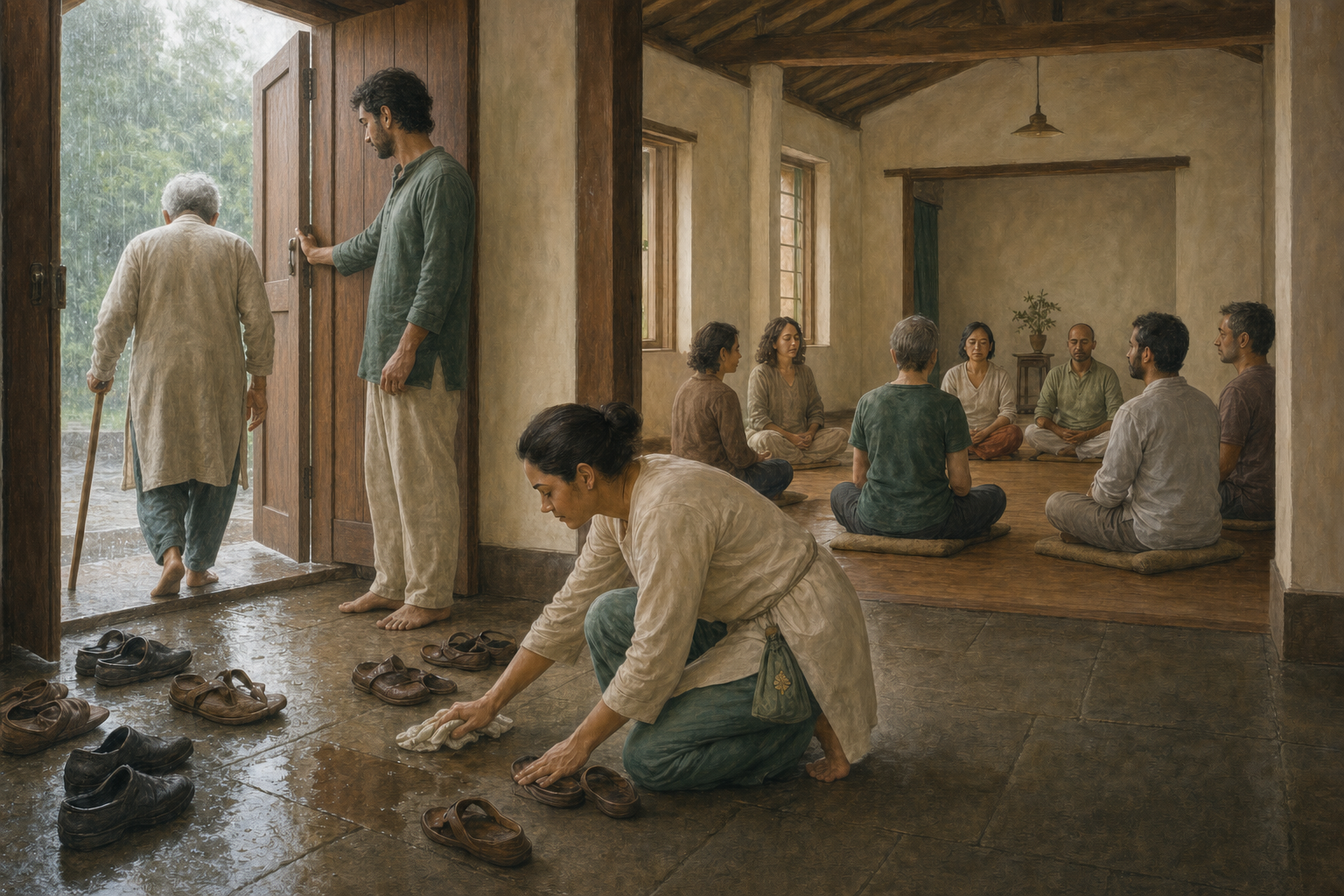
Humility cannot be left as a vague hope that you will remember once success arrives. By then, success may already be interpreting every objection as envy or ignorance. Give your practice structural safeguards from the beginning.
- Name the axis. Choose an orienting value or ishta: truthfulness, compassion, non-harm, devotion, or another clear commitment rooted in your path. Write one sentence describing how that axis should change your conduct. “My practice should make my speech more truthful and less cruel” is usable. “I want to become spiritual” is too vague to guide a difficult moment.
- Choose modest tapas you can carry into ordinary life. A daily twenty-minute period of breath-synchronized japa or silent sitting is more informative than an extreme observance followed by collapse, resentment, or neglected duties. Scale the practice to your real obligations. Food deprivation, sleep loss, or any discipline that compromises health and basic functioning is not proof of sincerity; replace it with a non-harmful form of restraint.
- Attach svadhyaya to the routine. After practice, ask: What made me defensive? Whom did I silently rank below myself? Did I use the practice to avoid a duty or conversation? What repair is now required? Write the answer plainly. A journal filled only with duration, repetitions, and experiences records performance but may miss transformation.
- Make surrender explicit. Begin or end by dedicating the fruit beyond your own status. In a theistic path, offer the effort to Ishvara or your chosen form of the Divine. In another dharmic framework, release the demand for recognition and dedicate the benefit toward liberation and the welfare of beings. The wording may differ, but the function is the same: effort is not converted into ownership.
- Authorize correction before you need it. Choose a competent teacher, elder, or mature practitioner who is allowed to disagree with your interpretation. Tell that person which tendencies you are watching. If unusual experiences arise, disclose them there rather than testing them on an audience. Accountability works best when established before criticism feels threatening.
- Pair contemplation with unadvertised service. Undertake one concrete act of seva each week. Prefer a needed task with little prestige: cleaning, preparing, carrying, listening, organizing, or helping someone complete an ordinary duty. Do not turn secrecy into a performance, but resist the urge to publish the evidence.
This design creates a closed loop. Tapas strengthens attention. Svadhyaya examines motive. Surrender loosens ownership. Accountability admits an outside view. Seva tests whether inner work can become useful action. If one element disappears, the others reveal the imbalance.
Four traditions, one operational question
Hindu, Buddhist, Jain, and Sikh paths do not use identical metaphysics or methods, and their differences should not be flattened. They do, however, offer closely related safeguards against making spiritual capacity into personal rank.
- Hindu traditions place tapas within ethical disciplines, self-study, devotion, non-attachment, and surrender. Capability is subordinated to moksha and dharma rather than displayed as proof of realization.
- Buddhist traditions acknowledge iddhi while giving priority to sila, samadhi, and prajna. Instruction that reduces ignorance matters more than psychic showmanship.
- Jain traditions distinguish external austerity from internal tapas such as repentance, humility, and study. Mana, or pride, remains a binding passion even when the outward penance is impressive.
- Sikh tradition answers haumai through Naam, simran, and seva. Riddhi-siddhi is not allowed to displace remembrance, humility, and service within community.
Across these paths, extraordinary capacity remains secondary to the reduction of ego-centered conduct. The operational question is therefore simple: Is your discipline reducing anger, greed, deceit, vanity, and the need for control while increasing restraint, clarity, compassion, and service? If not, greater intensity is unlikely to correct the direction by itself.
Key takeaways
- Measure tapas by its effect on conduct, especially when your routine is interrupted.
- Inner stability is not the absence of emotion; it is the ability to recover proportion before emotion governs action.
- Humility is not self-belittlement. It is freedom from using discipline, knowledge, or experience to establish rank.
- Svadhyaya, surrender, accountability, and seva are safeguards inside tapas, not optional additions after attainment.
- Treat unusual experiences as events to examine privately, not as credentials to display publicly.
- If a discipline harms health, basic functioning, or rightful obligations, choose a safer and more sustainable form.
When you lose balance, repair the next action

No routine makes you permanently immune to anger or pride. Dhruva himself later surged into anger against the Yakshas, and the intervention of wise counsel restored proportion and dharma. The meaningful sign of maturation was not an impossible record of never reacting. It was the possibility of being recalled to a wider moral view.
When you discover that your tapas has become rigid, do not answer the discovery with harsher tapas. Use a repair sequence:
- Stop the escalation. Do not defend your spirituality while angry. Return to natural breathing, mantra, or silence until you can speak without trying to punish the other person.
- Name the actual attachment. It may be attachment to control, recognition, purity, authority, or being seen as consistent. A precise name gives svadhyaya something real to examine.
- Invite an outside view. Speak with the teacher, elder, or accountable practitioner you previously authorized to correct you. Give the observable facts before offering your spiritual interpretation.
- Repair the consequence. If your conduct was harsh, apologize without explaining that the other person interfered with your practice. If you neglected an obligation, complete it. Repair turns insight into dharma.
- Resume at a sustainable scale. Keep the core discipline, but remove the part that was feeding display, harm, or resentment. A smaller honest vow is more purifying than an extreme vow protected by excuses.
At your next sitting, choose one vow small enough to keep, one person permitted to correct you, and one act of service nobody needs to applaud. Then watch what happens at the first interruption. That moment will tell you more about the direction of your tapas than the difficulty of the vow.
References
- DharmaRenaissance Blog – Dhruva’s Eternal Star: Powerful Symbolism, Dharmic Unity, and Practical Lessons for Today
- DharmaRenaissance Blog – Tapas, Siddhis, and the Hidden Trap of Mada: Preventing Spiritual Arrogance in Sadhana
