
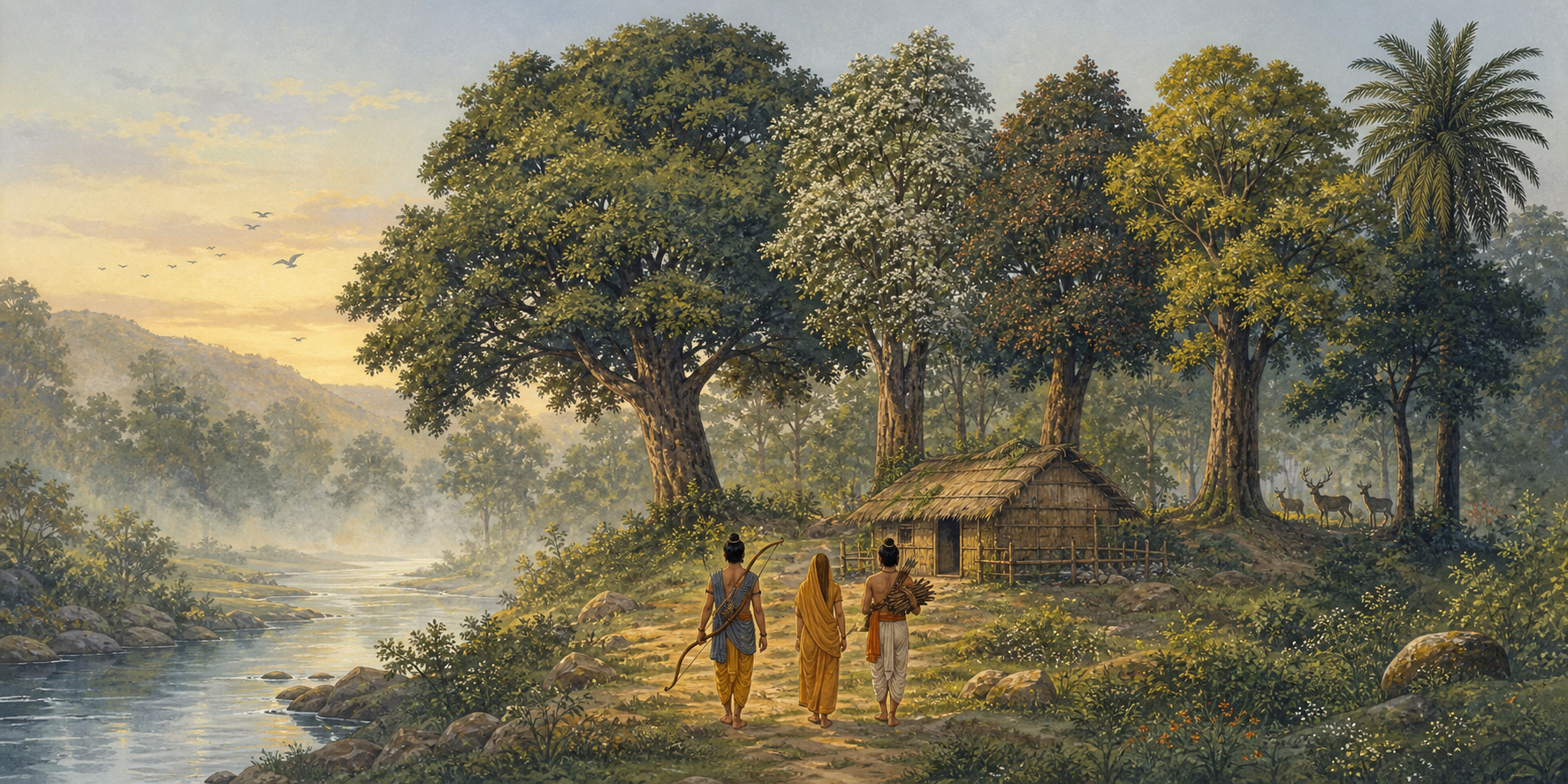
If you have heard that Panchavati’s five trees were once gandharvas cursed by Sage Agastya, you may be wondering whether that story actually appears in the Valmiki Ramayana. The direct answer is no: the curse motif belongs to later tradition, not to the epic’s critical text.
That does not make the later account disposable. It means you should read Panchavati in layers. The Valmiki narrative establishes the grove’s place in Rama’s exile; subsequent traditions interpret why its fivefold form matters. Keeping those layers distinct lets you respect both scripture and living Hindu memory.
Begin with Panchavati’s firm Ramayana foundation
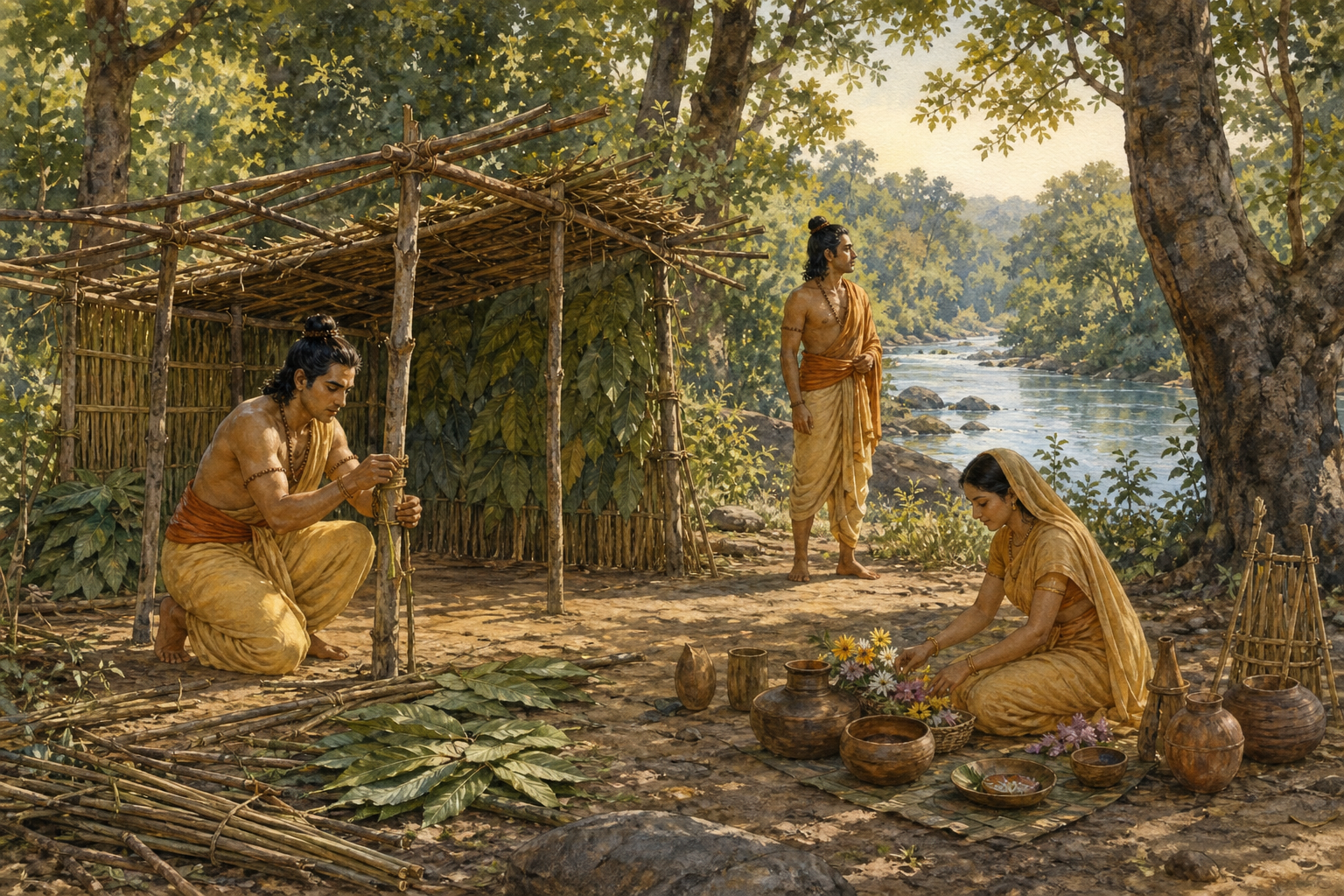
Panchavati enters the Ramayana through Sage Agastya’s guidance. During the forest exile of Sri Rama, Sita, and Lakshmana, the rishi counsels Rama, gives him celestial weapons, and directs the exiles to dwell at Panchavati. The grove becomes their sanctuary within Dandakaranya.
Notice the three parts of Agastya’s role: ethical counsel, material preparation, and guidance toward a suitable place. Panchavati is therefore not an incidental stop on a journey. Rama’s residence there follows the discernment of a rishi who understands both the forest and the demands of dharma.
This sequence also explains why the grove is sacred without requiring the curse story. Agastya directs the exiles there; Rama, Sita, and Lakshmana establish their hermitage; and righteous habitation consecrates the setting. Place and conduct work together. The forest offers shelter, while the exiles turn shelter into a disciplined home.
When you explain Panchavati from the Ramayana itself, stay with those points. Agastya, the celestial weapons, the direction to Panchavati, and the hermitage belong to the firm narrative ground. You do not need to attach every later explanation to Valmiki in order to make the place meaningful.
Place the five gandharvas in the later traditional layer

A later account gives the grove’s fivefold identity a moral prehistory. Five gandharvas, overcome by pride and inattentive to dharma, incur Agastya’s curse. They are bound to the forms of trees at Panchavati, where their release depends on serving a higher purpose.
That purpose is fulfilled when Rama, Sita, and Lakshmana make their dwelling beneath the grove’s protection. By providing shelter and sanctity to the righteous exiles, the gandharvas complete the movement from pride to service and attain liberation.
The transformation into trees is especially apt within this moral framework. Pride seeks status and attention. A tree stands rooted, gives shelter, and asks for no recognition. The curse is therefore more than punishment: it creates the condition in which the offenders can reverse the disposition that caused their fall.
The story also presents grace without evading responsibility. The gandharvas do not escape the consequence of their conduct merely because divine figures arrive. Their liberation comes when their changed condition is put to dharmic use. Service becomes the bridge between consequence and release.
If you teach, retell, or write about this episode, use a precise label: later Panchavati tradition or regional devotional tradition. Do not present it as a verse-level episode from the critical text of the Valmiki Ramayana. Attribution of that kind protects the distinction between textual provenance and devotional reception without treating either as meaningless.
Read the symbolism of five without turning it into history
The name Panchavati literally evokes a cluster of five. Later interpretation naturally connects that fivefold form with the pancha tattva, the five elements through which embodied existence is understood. In this reading, the grove becomes an image of life’s forces brought into harmony by disciplined and sacred living.
You can also notice how often dharmic traditions organize ethical life through groups of five: the five vows of Jainism, the Five Precepts of Buddhism, and, in the later Sikh tradition, the Five Ks. These parallels can open a useful conversation about restraint, responsibility, identity, and communal order across the dharmic family.
They should not be used as an etymology or a historical proof. Panchavati was not named after the Buddhist precepts, the Jain vows, or the Sikh Five Ks. A symbolic comparison asks how different traditions use a recurring number; an origin claim asks where a name or narrative came from. Those are different questions and require different evidence.
The same discipline applies to the five gandharvas. Their story can deepen your understanding of humility, atonement, and service, but the symbolism does not move the episode backward into Valmiki’s critical text. Spiritual fruitfulness and textual antiquity are not identical measures.
A reliable way to discuss any Ramayana tradition is to state its layer before drawing its meaning. Say, for example, that a later Panchavati telling interprets five trees as chastened gandharvas. You can then explore the teaching fully without making a historical claim the tradition itself cannot establish.
Approach Panchavati as sacred geography, not just a coordinate
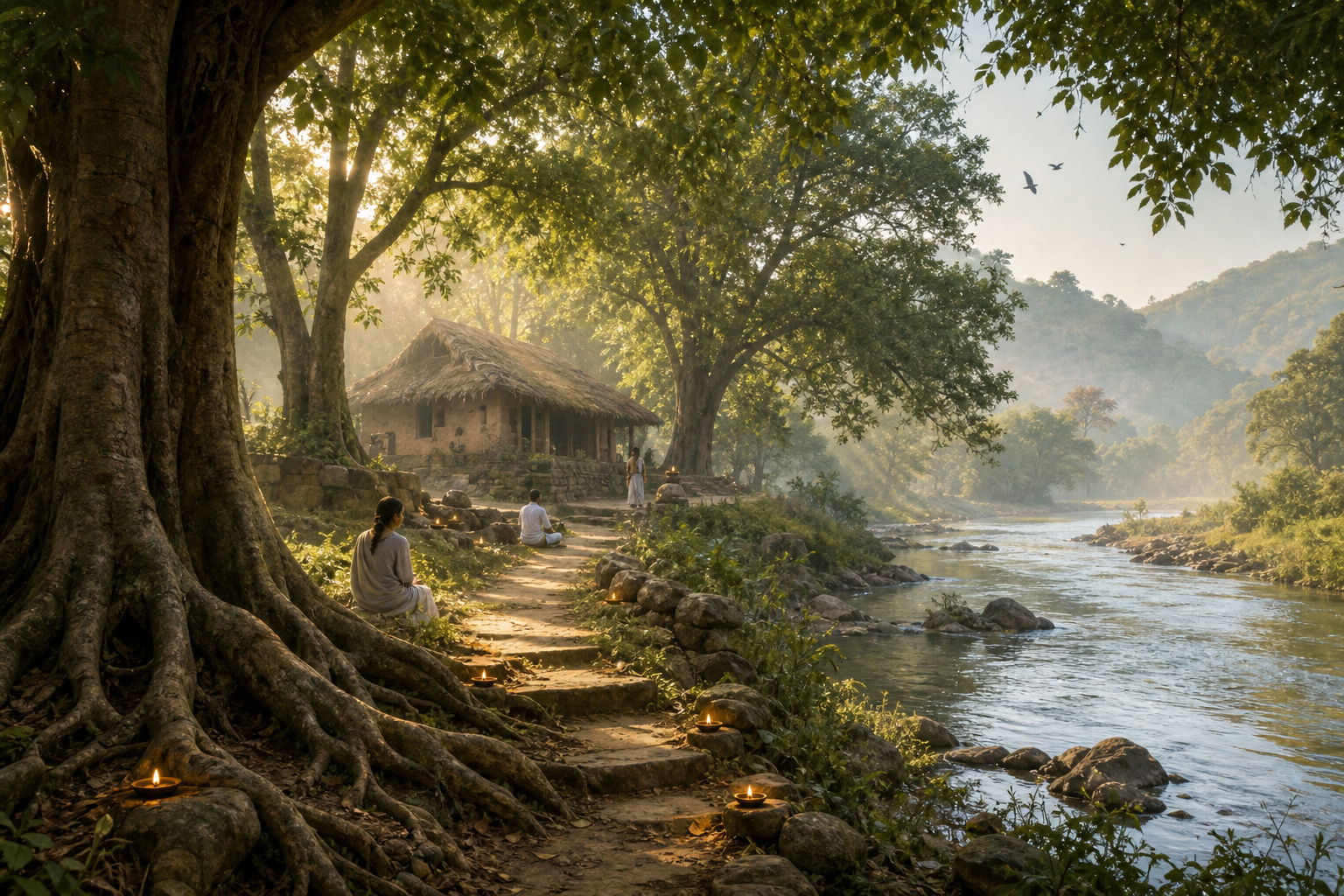
Panchavati is traditionally located along the Godavari River near present-day Nashik. Its continuing sanctity belongs to a wider pilgrimage landscape shaped by Ramayana remembrance, recitation, and ritual.
Sacred geography does not reduce a tirtha to a point on a map. It joins narrative, place, community, and repeated practice. The Godavari landscape recalls the exile; the remembered hermitage gives the landscape narrative form; and generations of devotees keep that relationship alive.
This is why a place may carry several kinds of memory at once. One layer comes from the epic’s account of Agastya and the exiles. Another comes from later stories about the grove. A third comes from the devotional practices through which communities continue to inhabit the Ramayana. You do not have to collapse these layers in order to experience them as parts of one sacred inheritance.
If you visit Panchavati, study it, or hear its traditions locally, use three questions to orient yourself:
- Text: Which part of the account is being connected directly to the Valmiki Ramayana?
- Tradition: Which details come from a later, regional, or oral telling?
- Practice: How do recitation, pilgrimage, ritual, and care for the natural setting preserve the place’s sacred memory?
These questions are not designed to catch devotees in an error. They help you listen more carefully. A local telling may preserve genuine theological insight even when it does not claim the same textual status as the epic’s critical text.
The grove’s symbolism also carries an ecological obligation. If trees and river participate in sacred memory, reverence cannot stop at narration. Respect for the landscape, restraint in its use, and care for its continuity become practical expressions of the same dharma celebrated in the story.
Key takeaways for reading Panchavati responsibly
- The Ramayana foundation: Agastya guides Rama, gives him celestial weapons, and directs Rama, Sita, and Lakshmana to dwell at Panchavati during their exile.
- The later expansion: The five gandharvas cursed into tree forms belong to later traditional and regional lore, not to the critical text of the Valmiki Ramayana.
- The moral teaching: The curse narrative turns pride into service and makes liberation the result of accepting consequence while serving a righteous purpose.
- The symbolic boundary: The pancha tattva and other dharmic groups of five provide comparisons for reflection, not proof of Panchavati’s historical origin.
- The living place: Panchavati’s sanctity arises from the relationship among Ramayana memory, devotional practice, the Godavari landscape, and responsible care for nature.
The next time you encounter a Panchavati story, ask one question before either accepting or rejecting it: which layer is this? Once you know whether you are hearing scripture, later tradition, symbolism, or local practice, you can receive its teaching on honest terms.
Begin with Agastya’s direction and the exiles’ hermitage. Then let later tradition show how a sacred community continued to think with that place. That order preserves textual clarity while leaving the living Ramayana room to speak.
References
