
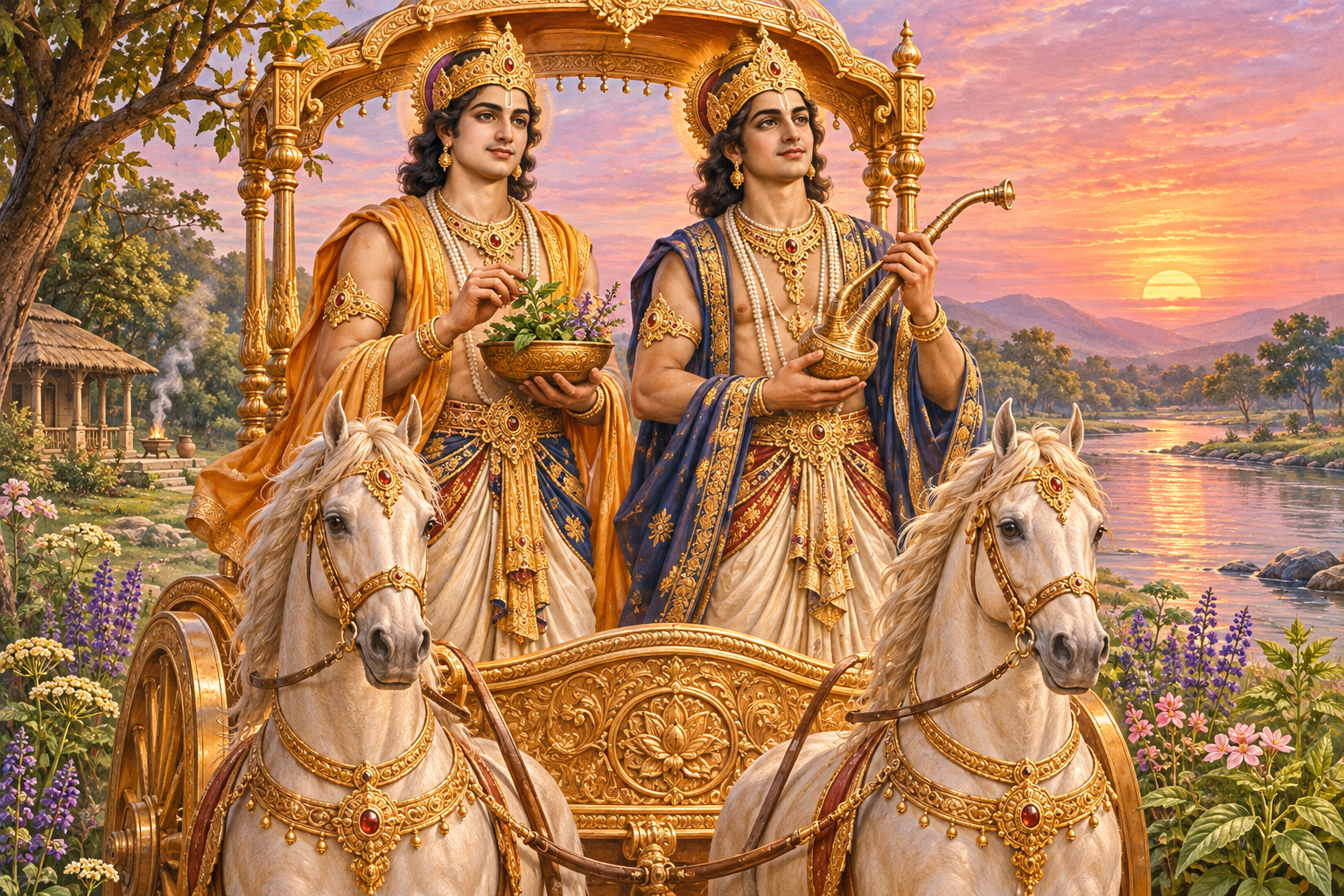
You may meet the Ashwini Kumars in a mantra, a translation of a Vedic hymn, or a family discussion about Dharmic names, and then encounter Nasatya and Dasra. Are these three different names for the same pair, two separate deities, or titles describing what the twins do?
The simplest answer is that Ashwini Kumars and Ashvins identify the divine pair, while Nasatya and Dasra distinguish the twins and reveal complementary aspects of their character. Once you keep the collective name separate from the individual names, their symbolism becomes much easier to read.
One divine pair, three ways of naming them
The Ashwini Kumars are twin deities associated with healing, speed, and grace in Vedic and Puranic tradition. Ashvins is a shorter collective name for the same pair. Nasatya and Dasra are their distinguishing names.
| Name | Who it identifies | What it emphasizes |
|---|---|---|
| Ashwini Kumars or Ashvins | The twins together | Their shared identity as swift divine healers |
| Nasatya | One twin in the common individual naming | Truth, rescue, restoration, and return to right order |
| Dasra | The other twin | Wondrous skill, effective action, and transformative accomplishment |
This table is a reading aid, not a rule that confines each deity to a sealed portfolio. Sanskrit divine names often work as personal names, descriptive epithets, and invocations at the same time. In older Vedic usage, a related dual form of Nasatya can also address the pair. Context therefore matters more than forcing every occurrence into a rigid one-name-for-one-function formula.
The distinction you should carry forward is straightforward: Ashwini Kumars names the unity of the twins; Nasatya and Dasra help you notice different qualities within that unity.
What Nasatya and Dasra signify
Nasatya: restoration grounded in truth
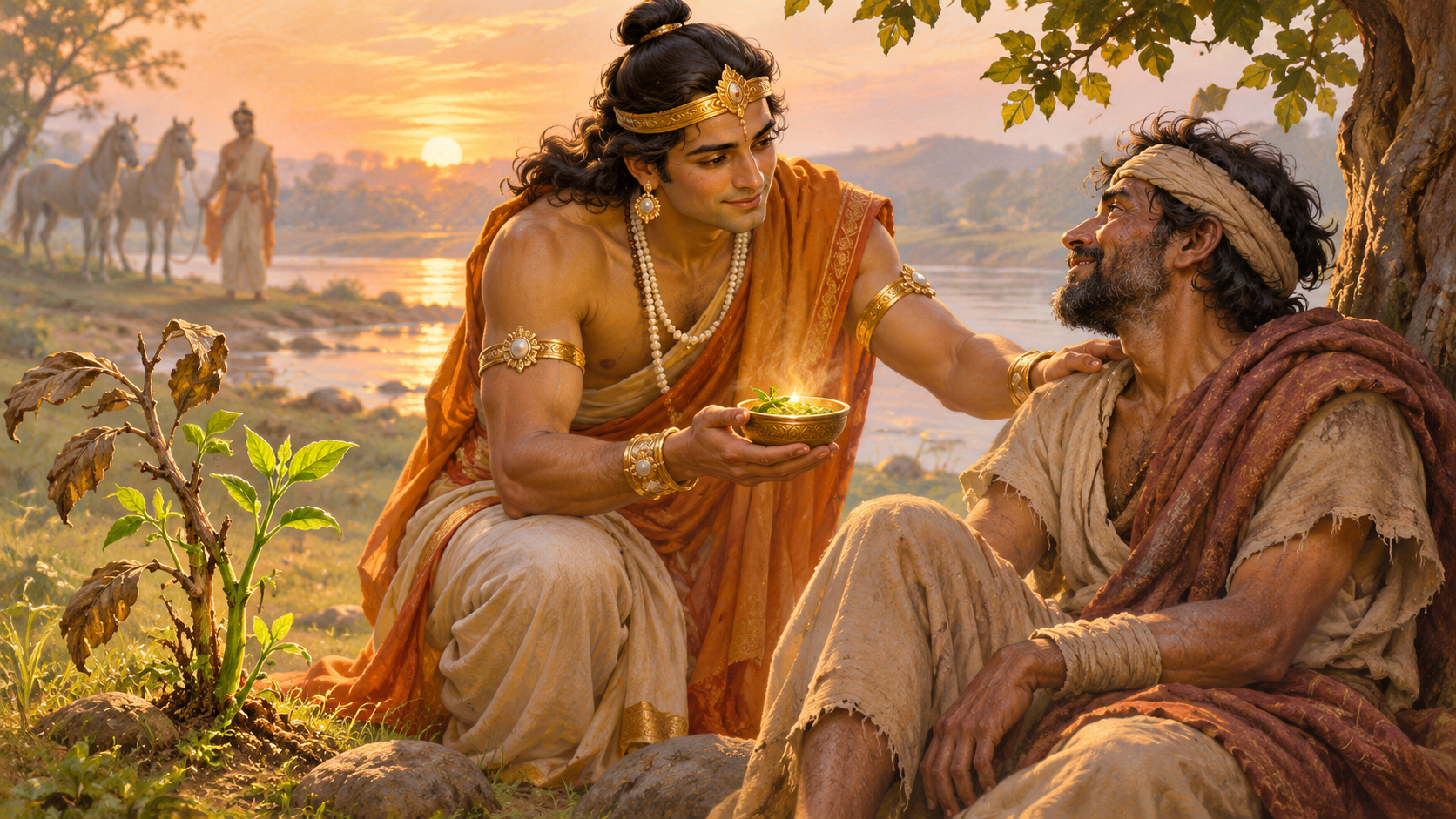
Nasatya cannot be captured perfectly by a single English word. It is commonly approached through two connected ideas: non-falsehood or truth, and rescue or restoration. These readings are not as far apart as they first appear. In a Dharmic frame, healing is more than suppressing a symptom. It is a movement away from disorder and toward a condition that is sound, whole, and rightly aligned.
Truth here should not be reduced to merely making a correct statement. It can signify faithfulness to what a being ought to be. Restoration then becomes truth expressed in life: the endangered is brought to safety, the impaired is made functional, and what has fallen out of order is returned to its proper course.
When Nasatya appears in a prayer or narrative, ask a precise question: what is being restored? It may be health, capacity, safety, movement, dignity, or right relationship. That question is more illuminating than memorizing one English gloss and applying it mechanically.
Dasra: skill that produces a real change
Dasra carries the sense of the wondrous, the skillful, and the accomplishment of extraordinary deeds. The emphasis falls on effective intervention. Something difficult is not simply observed or understood; it is changed through capable action.
It is easy to misread wondrous as spectacular. The deeper symbolism is competence. A healing deed is wondrous because it succeeds where ordinary capacity reaches its limit. Dasra therefore directs your attention to the act itself: what was done, how decisively it was done, and what condition became possible afterward.
When you encounter Dasra, look for the movement from need to response. If Nasatya helps you notice the restoration of right order, Dasra helps you notice the power and skill by which that restoration is achieved.
Why horses, youth, and twinhood matter
The shared title supplies symbolism that the individual names do not carry alone. The name Ashvin is related to ashva, the Sanskrit word for horse. The horse evokes speed, controlled energy, travel, and timely arrival. For divine healers, this movement is not decorative. Help must reach the one who needs it.
Speed should not be confused with haste. A horse under discipline combines force with direction. Read this symbol as readiness: the capacity to respond without becoming careless, and to move powerfully without losing control. That is why swiftness and healing fit together in the Ashwins’ identity.
Kumar signifies youth or a youthful prince. Applied to the twins, it conveys vitality, freshness, and power that has not become stagnant. Their youthfulness does not imply immaturity. Symbolically, it points toward renewal: life regaining movement and possibility after weakness or obstruction.
Their twinhood is equally important. The two are distinct without being rivals. A fruitful symbolic reading sees Nasatya and Dasra as two requirements of complete healing: restoration must be oriented toward what is right, and it must be carried out through effective action. Right intention without ability remains incomplete; ability without right orientation can become dangerous.
This does not mean every scripture divides the twins’ duties into a neat philosophical scheme. It means their paired form gives you a disciplined way to contemplate wholeness. Discernment and execution, truth and skill, compassion and competence belong together.
How to read the names in a mantra or story
You do not need an advanced knowledge of Sanskrit to read these names attentively. Use the following sequence whenever you encounter them:
- Identify whether the passage addresses the pair or highlights a distinguishing name. Ashvins or Ashwini Kumars normally directs your attention to their collective identity; Nasatya or Dasra may foreground a particular quality.
- Read the name beside the action. Notice whether the surrounding language concerns coming, rescuing, restoring, healing, protecting, or accomplishing. The verb often tells you which dimension of the name matters in that passage.
- Separate a word’s gloss from the deity’s full identity. Nasatya is not only an abstract idea called truth, and Dasra is not merely a synonym for wonder. Each name belongs to a living divine personality within a larger sacred tradition.
- Look for coordinated qualities. Where one name suggests restoration and the other effective action, read them together rather than constructing an opposition between them.
- Keep devotional healing and medical treatment in their proper relationship. Prayer and contemplation can shape courage, meaning, and spiritual discipline, but they should not be used to diagnose illness or justify delaying qualified medical care.
Suppose a verse invokes the Ashvins and asks them to arrive swiftly. The collective name, horse symbolism, and quality of timely aid reinforce one another. If Nasatya appears where something lost or impaired is being restored, the name draws attention to return and right order. If Dasra appears beside a decisive deed, the emphasis rests on skill that produces change. These contextual cues are more reliable than treating a dictionary definition as the whole theology.
The same method helps when evaluating a translation. If an English rendering gives only a proper name, you can ask what the untranslated name contributes. If it replaces the name with a single epithet, remember that the epithet reveals one dimension rather than exhausting the deity’s identity.
Key takeaways
- Ashwini Kumars and Ashvins refer to the divine twins collectively; Nasatya and Dasra distinguish them.
- Nasatya is best read through the connected ideas of truth, rescue, restoration, and return to right order.
- Dasra emphasizes wondrous competence: the skill and effective action that make transformation possible.
- The horse-related shared name adds speed, disciplined energy, mobility, and timely arrival to their symbolism.
- The twins are most illuminating when read together: right restoration requires both sound orientation and capable action.
The next time you meet one of these names, make three notes: who is being addressed, what action is requested or performed, and which quality the name brings into focus. That small practice turns an unfamiliar divine name into a doorway for reading Vedic symbolism with greater care.



References

Leave a Reply
You must be logged in to post a comment.