
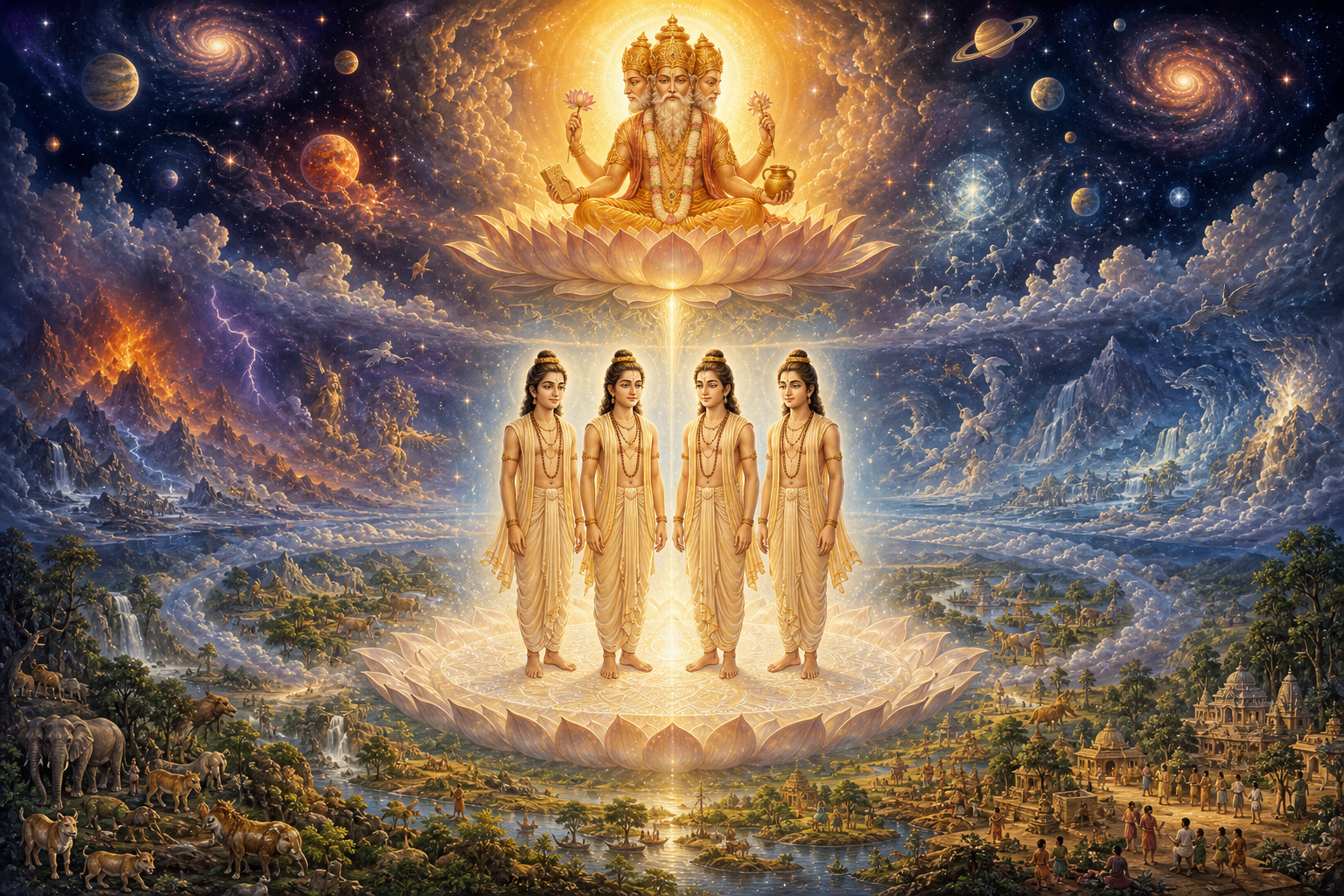
You may open a Purāṇa and meet three apparently incompatible kinds of birth: Brahmā appears without ordinary parents, sages emerge from his mind, and embodied beings come from wombs. If you treat all three as rival explanations of one physical event, Hindu creation can look confused. The confusion clears when you ask what level of reality each birth describes.
This shift matters because the Sanat Kumaras are not a decorative episode in the genealogy of the universe. They show that creation includes the transmission of knowledge, discipline, and dharma. Once you see their place in the sequence, the larger cosmology becomes easier to read and harder to dismiss as either primitive biology or arbitrary mythology.
The first question is: what kind of creation is this?
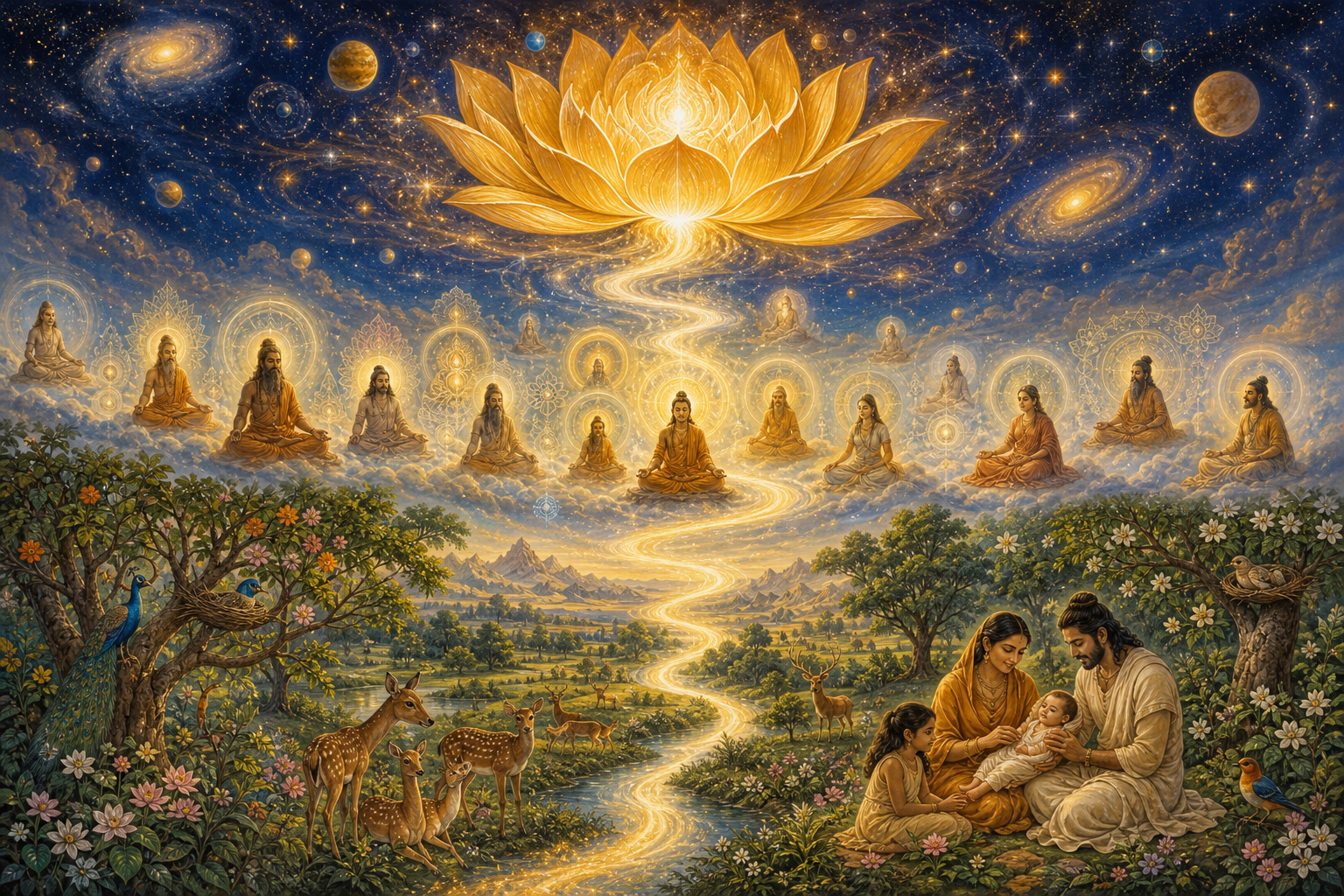
Hindu cosmology does not compress every origin into one mechanism. A crucial distinction is between sarga, primary emanation, and visarga, secondary diversification. They answer related but different questions.
Sarga concerns the emergence of the basic conditions and principles through which a cosmos can exist. In the Sāṅkhya-influenced account, manifestation proceeds from Prakṛti through Mahat, the principle of cosmic intelligence; Ahaṅkāra, the individuating principle; the Tanmātras, or subtle potentials; and the Mahābhūtas, the gross elements. This is primarily a causal order. It need not be read as though one material object were being assembled after another on a modern laboratory clock.
Visarga concerns differentiation within that manifested order: worlds are structured, progenitors perform their functions, lineages develop, and species continue through distinct modes of birth. Calling it secondary does not make it unimportant. It means that diversification depends upon conditions already brought into manifestation.
When a creation passage puzzles you, begin with three questions:
- Is this explaining why there is a cosmos at all?
- Is it explaining how intelligence, order, knowledge, or a lineage enters the cosmos?
- Is it explaining how an already embodied form of life reproduces?
The first points toward the self-born or primordial level. The second points toward mind-born creation. The third belongs to embodied generation. Many apparent contradictions disappear as soon as you stop requiring answers at one level to replace answers at another.
The same movement can be compared, without claiming that every school uses identical categories, to the Vedāntic progression from kāraṇa to sūkṣma to sthūla: causal, subtle, and gross. The correspondence is a reading aid, not a license to erase the differences among Purāṇic, Sāṅkhya, and Vedāntic accounts.
Self-born, mind-born, and womb-born are not synonyms
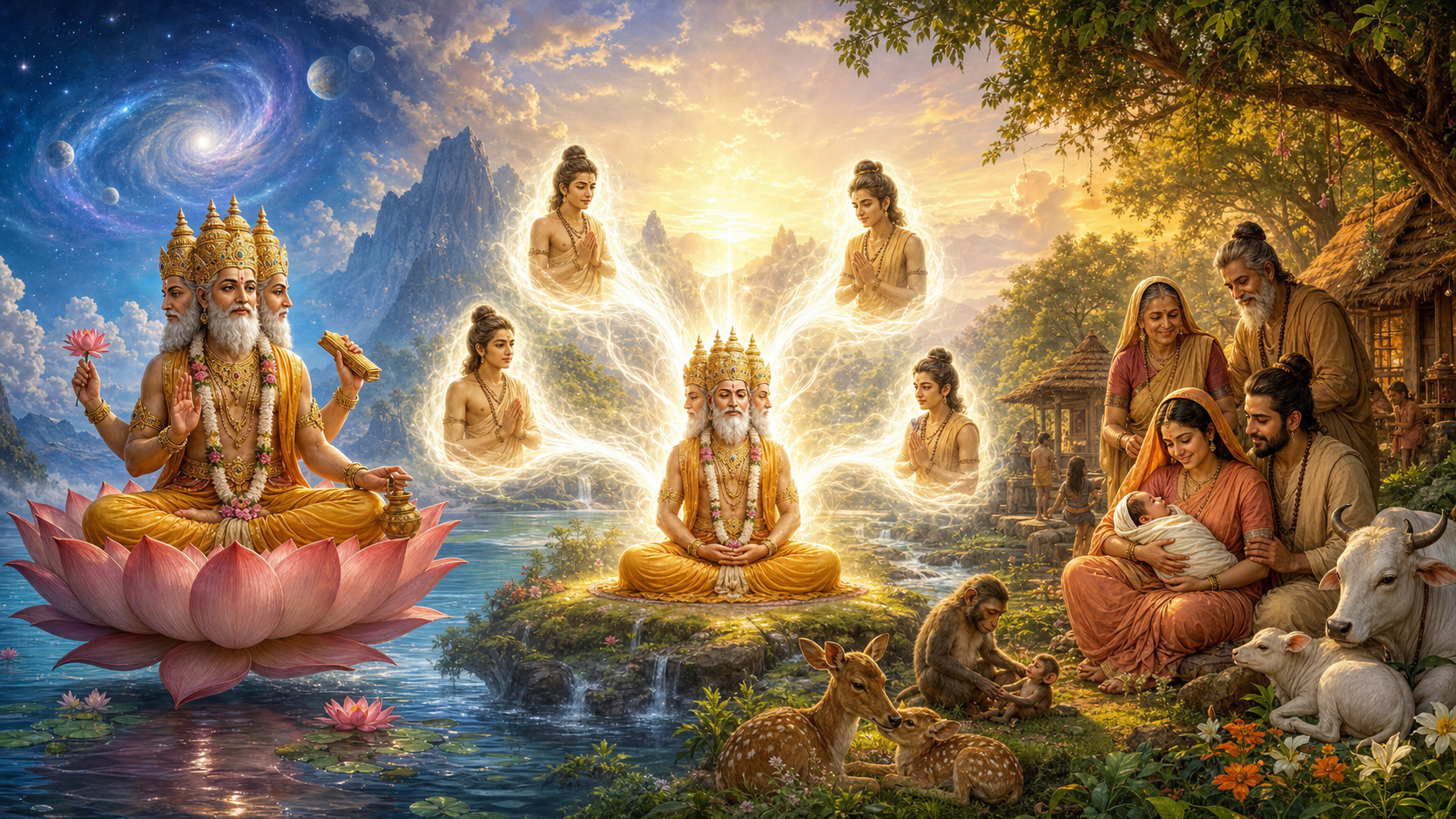
Self-born points to a primordial cause, not unusual anatomy
Svayambhū, or self-born, signals an origin without ordinary biological progenitors. The category belongs to metaphysics before it belongs to biology. Hiraṇyagarbha, the golden embryo, and Brahmā appearing upon the lotus from Viṣṇu’s navel give narrative form to the emergence of cosmic order from a reality that is not itself one more organism inside the universe.
It helps to keep Brahman and Brahmā distinct. Brahman names ultimate reality in Vedāntic discourse; Brahmā is the Purāṇic creator who performs a function within cosmic manifestation. Their similar spelling in English does not make them interchangeable. Nor does self-born always mean absolutely independent of every theological relationship. The lotus image can express Brahmā’s dependence upon Viṣṇu while still placing his appearance outside ordinary sexual generation.
When you encounter a self-born figure, do not begin by asking where the missing biological parent went. Ask what foundational reality, power, or cosmic office is being disclosed. That question fits the scale of the passage.
Mind-born describes intentional and intellectual generation
Mānasa creation is generation through mind, will, contemplation, or tapas. It is not a claim that an ordinary human imagination can manufacture a physical person. The cosmic setting matters: Brahmā’s mind-born sons personify powers that establish knowledge, order, discipline, teaching, and sacred lineage.
The lists of mānasa putras vary across tellings. They commonly include the Four Kumaras and may also include Nārada, Marīci, Atri, Aṅgiras, Pulastya, Pulaha, Kratu, Vasiṣṭha, Bhrigu, and Dakṣa. Some function as teachers, some as Prajāpatis or progenitors, and some connect the two roles. Variation in the roster should therefore be noticed, but it should not obscure the stable idea: cosmic order requires intelligence and dharma, not only matter and reproduction.
Womb-born is one embodied mode, not the whole Hindu taxonomy
Jarāyujā refers to beings born from a womb, including the familiar human and animal pattern of embodied parenthood. Yet the traditional biological classification is broader than the convenient self-born, mind-born, and womb-born sequence. It also recognizes aṇḍajā, egg-born; svedajā, associated with emergence from moisture; and udbhijjā, sprouting life such as plants.
This is one place where disciplined reading prevents an unnecessary conflict with science. Svedajā belongs to pre-modern natural history and its idea of spontaneous emergence. It should not be retrofitted into a claim about microbiology, genetics, or evolution. The durable philosophical point is broader: embodied life displays more than one pattern of propagation. Respecting an ancient category does not require pretending that every pre-modern biological explanation is a modern scientific result.
You can now see the direction of the whole map. Self-born language addresses primordial ground. Mind-born language addresses intentional and intellectual formation. Womb-born and the other embodied categories address the continuation of organisms. The word born remains meaningful in each case, but it does not carry exactly the same mechanism from one level to the next.
The Sanat Kumaras change what counts as creation
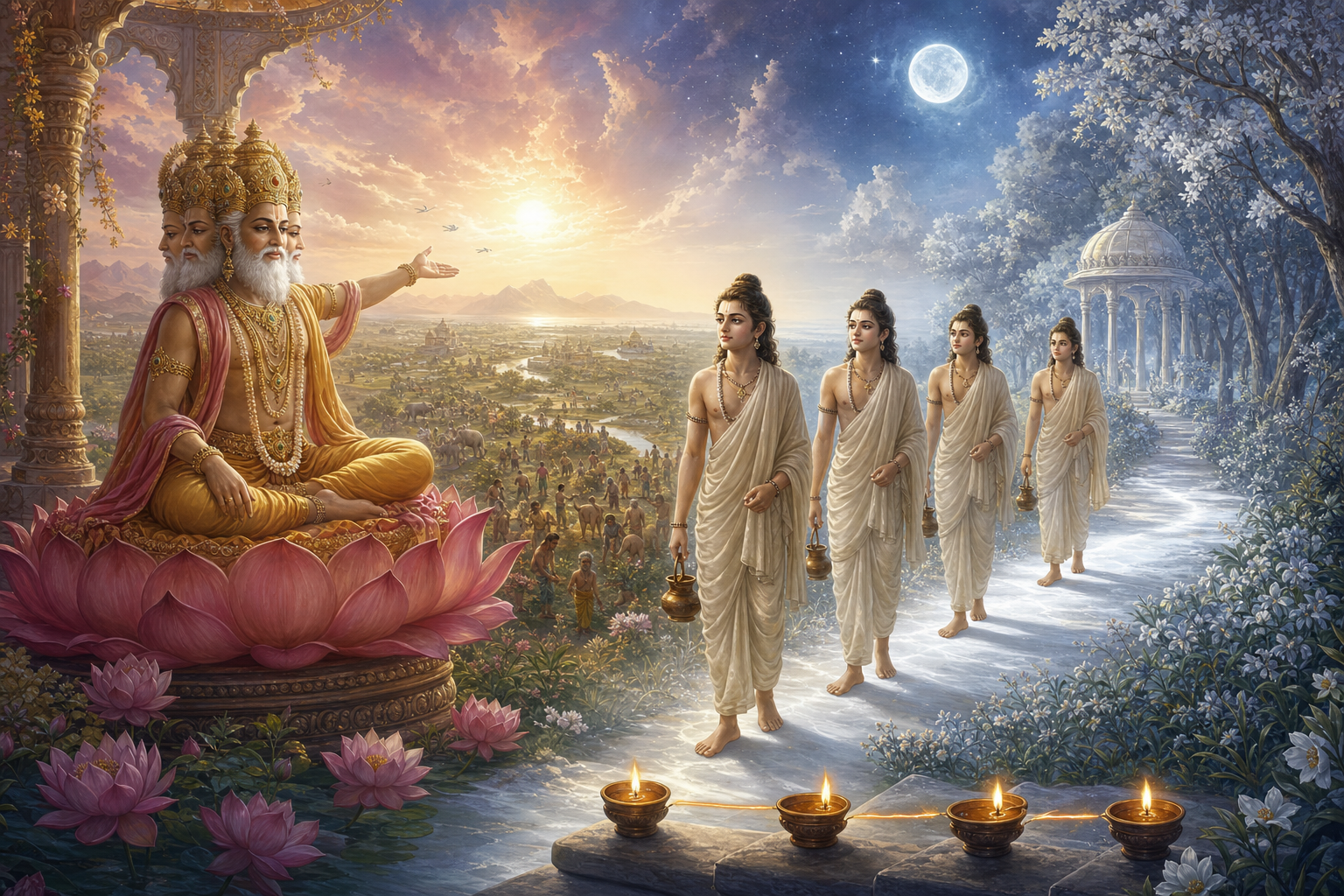
The Sanat Kumaras are four figures: Sanaka, Sanandana, Sanātana, and Sanatkumāra. The collective title can cause a small but persistent confusion because Sanatkumāra is also the name of the fourth member. Remembering the four names keeps the group distinct from the individual.
As Brahmā’s mind-born sons and perpetual brahmacārins, the Kumaras do not represent biological parenthood. Their generativity is intellectual and spiritual. They carry jñāna, disciplined inquiry, and liberating instruction into the created order. If you count creation only by the production of bodies, their role appears marginal. If you include the formation of consciousness and the transmission of dharma, they stand near the center of the cosmology.
Their counsel to King Pṛthu in Canto 4 of the Śrīmad-Bhāgavatam makes this function concrete. Liberation is connected with steady contemplation, virtue, and insight that becomes experiential. Knowledge is not merely a proposition handed from one mind to another. It must reshape attention, conduct, and perception.
Nārada displays another form of mind-born generativity. He moves across worlds, carrying bhakti and dharma through song, dialogue, narrative, and instruction. The Kumaras represent the concentrated authority of contemplation; Nārada often represents knowledge in motion. Neither needs political force or biological descent to establish a lineage of influence.
This gives you a precise way to evaluate any claimed transmission of dharma. Ask:
- What has actually been transmitted: information, disciplined understanding, devotion, or merely group identity?
- What tapas or sustained practice protects the teaching from becoming a slogan?
- Can the recipient embody the teaching in conduct, or only repeat its vocabulary?
- Does the transmission clarify dharma, or does it demand obedience without insight?
The Kumaras also prevent a false choice between renunciation and family life. Their brahmacarya reveals one valid mode of dharmic continuity; jarāyujā creation places parenthood and family within another. A cosmology capacious enough for both does not need to degrade embodied life in order to honor contemplation.
A five-question method for reading Purāṇic creation
You do not need to settle every dispute among schools before reading a creation narrative intelligently. Use the following sequence on a single passage before consulting elaborate commentaries.
- What is coming into being? Identify whether it is a principle, a deity with a cosmic function, a sage, a lineage, a world, or an organism. Do not let the shared word birth erase these differences.
- Is the passage operating at the level of sarga or visarga? If basic conditions of manifestation are emerging, read it as primary emanation. If beings and lineages are differentiating within a cosmos, read it as secondary creation.
- What function does the figure perform after appearing? A mind-born sage is explained as much by teaching, tapas, or ordering activity as by the manner of birth. Function often reveals why the genealogy places that figure where it does.
- Which details are stable, and which vary by telling? Preserve the recurring structure while allowing lists and narrative arrangements to differ. Textual plurality does not automatically mean doctrinal chaos, but neither should distinct accounts be falsely presented as identical.
- Is this metaphysics, sacred symbolism, or pre-modern natural history? A passage may involve more than one, but the categories should not be confused. Do not turn a metaphysical image into crude anatomy or promote an ancient biological classification as experimental science.
A simple annotation practice makes this method concrete. Draw three columns headed image, level, and function. For the lotus-born Brahmā, the image is the lotus, the level is primordial or cosmic, and the function is creative ordering. For the Kumaras, the image is mind-born sonship, the level is intellectual-spiritual differentiation, and the function is the transmission of jñāna and dharma. For a womb-born being, the level is embodied life and the immediate function is biological continuity.
This approach also handles the familiar objection that Purāṇic cosmology is merely an untidy collection of many gods. Deities and sages can be genuinely worshipped or revered while also disclosing principles, processes, and paths. Symbolic meaning and devotional reality are not mutually exclusive. Adhikāra-bheda, the recognition that people approach truth with different capacities and dispositions, helps explain why one metaphysical horizon can receive several narrative and devotional forms.
Reverse the movement in contemplation
Manifestation is described as a movement from causal and subtle conditions toward gross embodiment. Contemplation can travel in the other direction. Begin with a visible action, notice the thought and intention shaping it, and then ask what foundational understanding gives that intention its authority.
- Ground: Which dharmic principle makes this action worth creating?
- Mind: What intention, knowledge, or discipline is giving it form?
- Embodiment: What habit, relationship, institution, or work will carry it into the world?
This is not a modern replacement for the cosmology. It is an application of its causal logic. An institution without a clear ground becomes mechanical. A noble idea without disciplined embodiment remains private intention. Embodied activity without scrutiny of the mind can multiply adharma efficiently.
The ethical consequence is equally concrete. If embodied life participates in a continuity extending through mind to a common causal ground, ahiṃsā and care are not sentimental additions to cosmology. They are appropriate responses to what living beings are. Before you propagate an idea, establish a custom, or exercise authority, ask what kind of world it will reproduce once it leaves your mind.
Key takeaways
- Hindu creation is layered: sarga concerns primary emanation, while visarga concerns differentiation within the manifested cosmos.
- Svayambhū language belongs primarily to the primordial and metaphysical level, not to ordinary reproductive biology.
- Mānasa creation treats thought, tapas, knowledge, and teaching as real forces in the formation of cosmic and civilizational order.
- The Four Kumaras are Sanaka, Sanandana, Sanātana, and Sanatkumāra; their lineage continues through wisdom rather than biological descent.
- Jarāyujā, or womb-born life, is only one traditional embodied category alongside egg-born, moisture-associated, and sprouting life.
- Premodern natural history should be respected in context, not misrepresented as modern laboratory science.
The next time an unusual birth appears in a Purāṇic passage, resist the rush to label it either literal history or mere metaphor. Mark its level, identify its function, and ask what kind of continuity it establishes. That small discipline will give you a clearer reading of both Hindu creation and the dharma you are being asked to carry forward.