
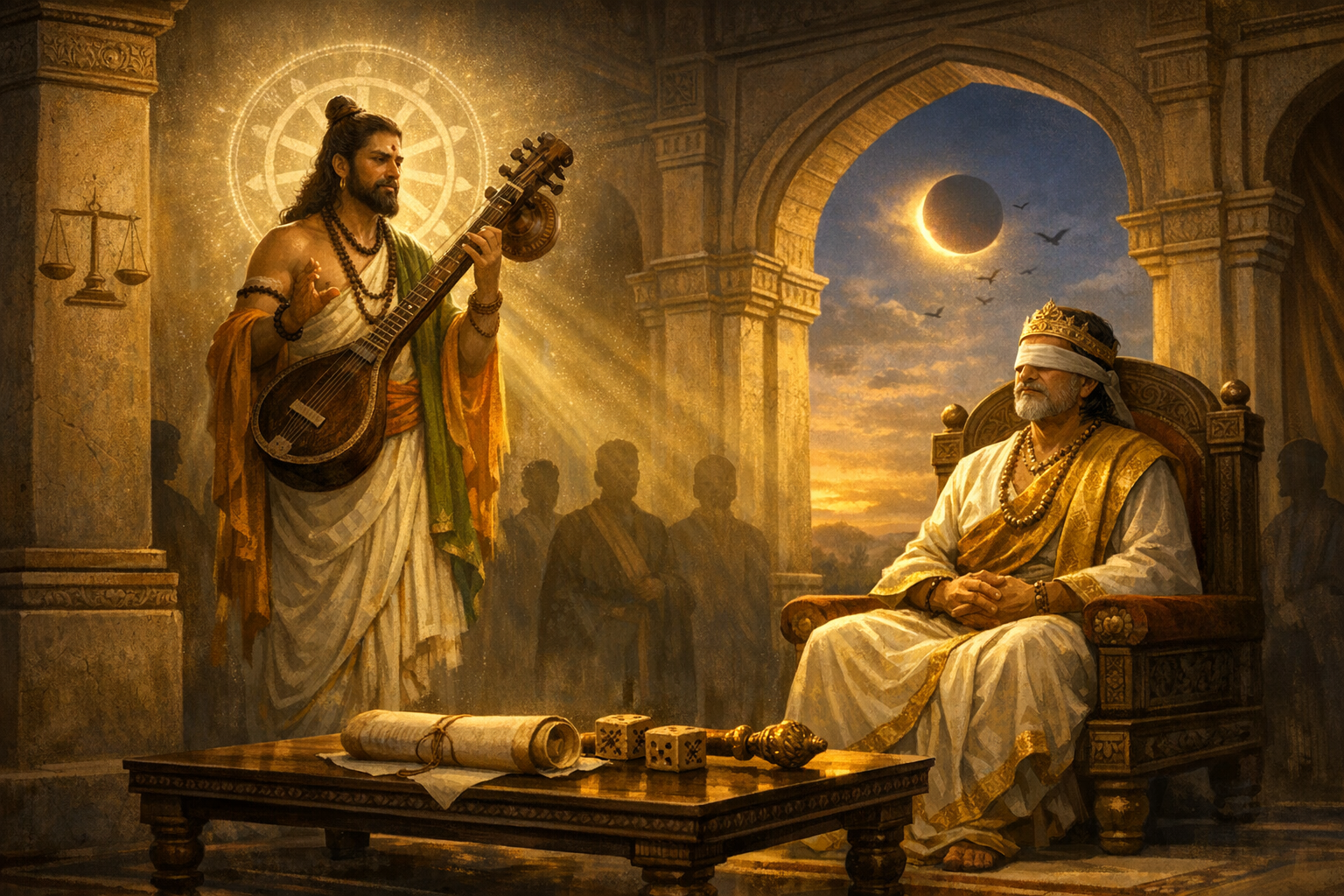
The departure of the five Pandava brothers, accompanied by Draupadi, for twelve years of vanvas and one year of ajñātavāsa was not merely an episode of geographical exile; it marked a constitutional crisis of dharma within the Kuru polity. In many recensions of the Mahabharata, the celestial sage Narada arrives in Hastinapura at precisely such liminal moments to articulate a principle that outlives courts and crowns: the moral law is sovereign even over kings. This episode, remembered as Narada’s warning to Dhritarashtra, frames the Kurukshetra War as a preventable catastrophe that unfolded because counsel grounded in dharma yielded to attachment, fear, and political expedience.
Narada’s interventions are thematically consistent across the epic tradition: he affirms the primacy of rajadharma (the duties of rulership), exposes the danger of moha (deluded attachment), and forecasts the karmic consequences of ignoring justice. Addressing Dhritarashtrablind by fate yet portrayed as morally blinkered by choicethe devarshi urges timely reconciliation: restore what is rightfully due, restrain Duryodhana, and prevent a fratricidal war. The counsel is not fatalistic prognostication but a rigorous application of the law of karma: unjust causes yield destructive effects, and rulers who prefer partiality to principle inevitably suffer the undoing of their house.
Placed alongside Vidura-niti in the Udyoga Parva and the Sanatsujata discourse, Narada’s speech is part of a triad of pre-war ethical advisories. All three converge on a single imperative: rajadharma is non-negotiable. A just monarch secures lawful succession, protects the vulnerable, disciplines the errant, and upholds agreementseven when such enforcement is politically inconvenient or personally painful. In this light, the dice game, the humiliation of Draupadi, and the refusal to redress wrongs are not isolated failings but serial breaches of constitutional dharma that destabilize the realm.
Narada’s rhetorical method blends prophecy with policy. He enumerates likely outcomes should adharma persist: elder statesmen will fall despite their valor, the Kuru lineage will be sundered, and the survivors will inherit a kingdom of grief. Such prophetic specificity functions not as supernatural spectacle but as an ethical shock meant to jolt Dhritarashtra into timely action. The technique mirrors other Mahabharata moments when seers narrate portents (notably in the Udyoga and Bhishma Parvas) to translate cosmic disorder into a call for immediate governance reform.
The warning also clarifies the epic’s core political theory: the interplay of daiva (destiny) and puruṣakāra (human agency) is mediated through karma. What appears fated is often the momentum of prior choices; what seems inevitable can be redirected by present adherence to dharma. In this frame, Narada’s counsel is pragmatic: a fair settlement with the Pandavas, restitution where due, and the curbing of Duryodhana’s ambition would restore equilibrium. Refusal, however, would render calamity not a mysterious act of fate but the recognizable climax of accumulated wrongs.
Dhritarashtra’s blindness works in the epic as a sustained moral allegory. Physical disability is never vilified; rather, the text indicts the willful eclipse of judgment. Fear of Bhima’s strength, dependence on Bhishma and Drona for military security, and a father’s partiality toward Duryodhana coalesce into policy paralysis. Narada’s intervention targets precisely this tangle of fear and favoritism, insisting that the king’s first loyalty is to dharma, not to kinship.
Narada’s appeal is also intellectually systematic. The speech presumes a layered dharma architecture long elaborated in the epic: rajadharma (public duty), āpaddharma (emergency ethics), and kṣātra-dharma (the code of warriors). The threshold for a “Dharma-Yuddha” is high and its authorization demands proof that conciliatory avenues have been exhausted and that the cause meets standards of justice, proportionality, and right intention. By urging restitution and reconciliation, Narada upholds the doctrine that war is a last resort and must be anchored in moral clarity rather than in insult, envy, or imperial appetite.
Contextually, the warning harmonizes with Krishna’s later peace embassy in the Udyoga Parva. Multiple envoys, arguments, and conciliatory proposals establish a procedural record: the Pandavas seek a just share, accommodations are offered, and litigation by dialogue is attempted before the field of Kurukshetra is chosen. The text, therefore, treats the war not as the romance of valor but as the administrative failure of conflict preventionan outcome Narada labors to avert.
Scholarly readings of the critical edition (CE) and the vulgate agree on the thematic kernel, even when episode placements vary across recensions: Narada appears as a crisis-mediator whose authority stems from alignment with Sanatana Dharma rather than from court factionalism. His voice complements Vidura’s juridical clarity and Sanatsujata’s metaphysical depth, yielding a composite advisory that spans policy, ethics, and ultimate purpose (moksha)a range later condensed in the Bhagavad-Gita’s synthesis of action, knowledge, and devotion.
From a comparative dharmic perspective, Narada’s counsel resonates widely. Buddhist political thought about the dhammarāja and the Cakkavatti ideal emphasizes ethical rule, compassion, and non-harm; Jain perspectives on leadership stress restraint (saṃyama), non-violence (ahiṃsā), and accountability for the karmic load of decisions; Sikh articulations of dharam within hukam combine spiritual integrity with the defense of justice. The episode thus models a shared civilizational ethic across Hindu, Buddhist, Jain, and Sikh traditions: legitimate power is inseparable from moral responsibility.
For contemporary readers, the episode’s psychology is strikingly familiar. Many recall moments when uncomfortable truths were deferred in families, institutions, or stateswhere short-term harmony concealed long-term fracture. Dhritarashtra’s dilemma maps onto present-day governance: unchecked favoritism distorts incentives; ignoring principled advisers corrodes institutional trust; and delaying fair settlement magnifies risk. Narada’s warning prescribes a timeless correctivelisten to conscientious counsel, recalibrate incentives to favor justice, and act in time.
Technically, the speech also exhibits the Mahabharata’s habit of embedding nīti (statecraft) within narrative. Narada does not lecture abstractly; he contextualizes norm and outcome, binds ethical breaches to likely consequences, and translates metaphysical law into administrative recommendations. The pedagogy is case-based: dharma is taught by tracing its presence or absence through concrete royal choices.
The episode’s ethical calculus foregrounds restitution as the pivot of peace. A just share of Indraprastha to the Pandavas would not be appeasement but restorationa vital distinction in rajadharma. Appeasement surrenders principle to pressure; restoration reestablishes principle by acknowledging rightful claims. Narada frames peace in these restorative terms, anticipating the Gita’s insistence that right action is measured by adherence to one’s svadharma, not by fear of loss or desire for gain.
Omens described around the eve of wareclipses, unnatural births, and disturbances in the natural orderfunction literarily as mirrors of moral disorder. Narada’s prophecy aligns with these motifs: when rulers invert justice, nature itself appears disordered in the epic imagination. The intent is didactic rather than superstitious; the cosmos dramatizes, in signs, what governance has failed to hear in words.
Narada’s impartiality is central. As a devarshi, he roams between realms and courts, reminding rulers that sovereignty is always penultimate. His authority derives from non-attachment; he advocates neither party interest nor punitive zeal. Instead, he advocates lokasaṅgrahathe welfare and cohesion of the manyby reconnecting policy choices to the enduring metrics of dharma and karma.
Read against the wider canvas of the Kurukshetra War, the warning is a hinge: if heeded, the Kuru state could have averted intergenerational trauma; when ignored, it confirms the epic’s thesis that justice postponed becomes suffering multiplied. The subsequent fall of towering figuresBhishma, Drona, Karnaunderscores that tactical brilliance cannot compensate for strategic injustice. The calamity is literary proof of Narada’s premise: adharma is strategically unsound because it is morally unsound.
The episode also refines the concept of “victory.” In the Mahabharata’s ethical vocabulary, a “Righteous War” (Dharma-Yuddha) is not triumphalist; it is the last avenue for protecting order when all other remedies fail. Even then, victory is existentially ambivalent: it carries grief, demands restraint, and obliges the victors to rebuild on the foundations of justice. Narada’s preference for reconciliation anticipates this ambivalence, treating nonviolent redress as the higher accomplishment whenever possible.
Leadership lessons flow directly from the text. Establish clear guardrails against nepotism; separate personal affection from public duty; institutionalize independent counsel; and create enforceable pathways for restitution in disputes. In corporate, civic, or governmental contexts, Narada’s template translates into robust governance codes: transparency, early mediation, proportionate remedies, and principled escalation only as a last resort.
Placed within the Mahabharata’s structure, Narada’s warning can be read alongside the Shanti Parva’s comprehensive Rajadharma chapters and the Bhagavad-Gita’s synthesis of karma-yoga, jñāna-yoga, and bhakti. Together they offer a complete ethical arc: why justice matters (narrative), what justice requires (normative doctrine), and how justice is sustained amid conflict (spiritual discipline). The episode is therefore not a discrete morality tale but a strategic node in a civilizational conversation about power and responsibility.
In sum, Narada’s voice before the Great War remains the voice of dharma speaking across millennia: govern justly, act in time, and refuse the seduction of partiality. When rulers heed such counsel, peace is more than the absence of war; it is the presence of order, dignity, and trust. When such counsel is ignored, the universe does not “punish” so much as reflect, with unsparing clarity, the arithmetic of choices already made. That is the inevitability of justice the Mahabharata enshrines and that all dharmic traditions affirm in their own language and practice.
Inspired by this post on Hindu Blog.
