
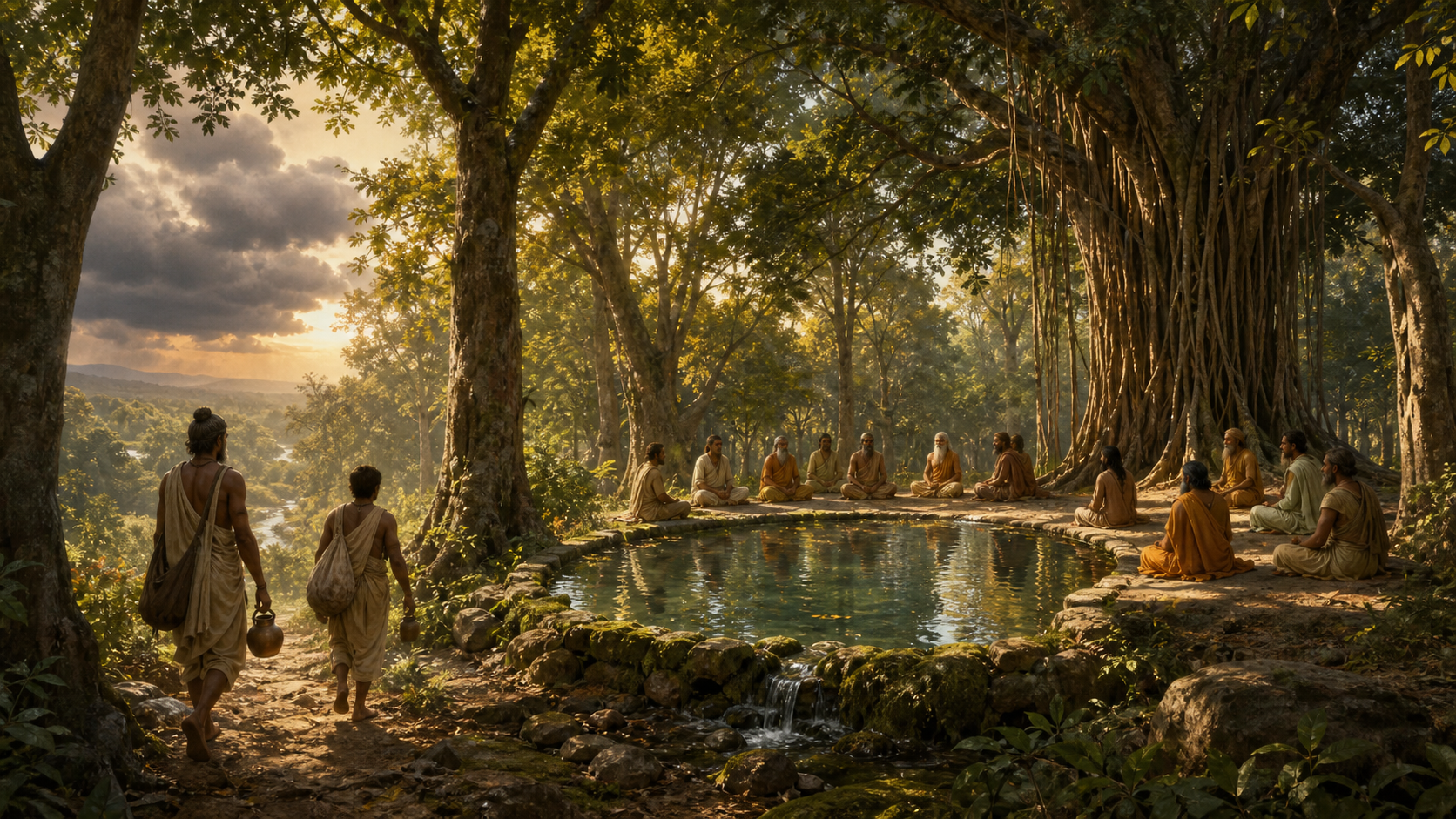
If you are considering a pilgrimage to Naimisharanya, the most useful question is not simply what you should see. It is what kind of refuge this sacred forest offers—and what you must bring home for the journey to matter.
Naimisharanya is not presented merely as a place where difficulty disappears. Its Puranic identity rests on a more demanding promise: time, place, sacred memory, and disciplined company can be brought into alignment so that you see your dharma clearly and resume it with steadier attention.
A refuge from Kali Yuga is not an escape from duty
The sages who sought Naimisharanya were looking for a place protected from the corrosive influence of Kali Yuga. That does not make the forest a hiding place from society. It makes it a setting in which the habits associated with decline—confusion, forgetfulness, weakened restraint, and separation from dharma—can be confronted through yajña, study, remembrance, and good company.
This distinction changes how you approach the kṣetra. If refuge means relief alone, pilgrimage becomes a search for a temporary feeling. If refuge means ethical reorientation, the real result appears after you leave: in greater truthfulness, compassion, humility, and self-restraint. Those are the qualities through which Naimisharanya answers the disorder of Kali Yuga.
The name Naimisha is traditionally associated with nimisha, a moment. One strand of sacred memory understands this as the instant in which demerit is dissolved at the holy place. Another recalls the defeat of Asuric forces in a moment. These explanations need not be forced into a single literal etymology. Their shared spiritual point is that a long period of disorder need not prevent a decisive turn toward dharma.
“In a moment” should not be reduced to a consequence-free shortcut. A pilgrimage does not make responsibility irrelevant. The moment that matters is the one in which intention stops wavering: you recognize what is wrong, submit the restless mind to practice, and choose a better course. The change may begin suddenly, but you still have to preserve it through conduct.
Before visiting, therefore, name one form of disorder you are actually prepared to address. Do not arrive with an undifferentiated list of wishes. Bring one question about your duty, one habit that weakens it, and one practice you can continue after returning. That turns the idea of refuge into a usable sankalpa.
The Wheel of Brahma makes sacred space a decision

The defining Puranic image is the Wheel of Brahma, or Brahma Chakra. When the sages asked for a place free from Kali Yuga’s destructive influence, Brahmā released a divine wheel and instructed them to settle where it came to rest. At Naimisharanya, the wheel disappeared into the earth, marking the place as suitable for sustained sacrifice, self-study, and satsanga.
Three features of this account deserve your attention. First, the sages acknowledged that spiritual practice is affected by its surroundings. Discipline is inward, but the company you keep, the rhythms you accept, and the places to which you give your attention can strengthen or weaken it.
Second, the chosen place was not determined by comfort or personal preference. The sages followed a sign and accepted the discipline attached to it. The wheel therefore represents more than divine selection. It marks the end of restless searching and the beginning of committed practice.
Third, the wheel did not lead them to private isolation. It led to a shared undertaking. The refuge was established through yajña, svādhyāya, and satsanga—offering, study, and association with those seeking truth. Naimisharanya is sacred not only because something happened there, but because generations remember it as a place where people gathered to preserve dharma together.
The symbolism joins time and place with unusual precision. A wheel evokes recurring time; a forest evokes continuity, renewal, and patient growth. The nimisha, the moment, introduces the possibility of immediate moral clarity within those longer cycles. You may not control the yuga in which you live, but you can decide what will govern the next moment.
This gives you a practical test for any refuge, including one created at home. Does it merely shield you from noise, or does it help you resume righteous action? Does it depend entirely on mood, or does it contain a stable rhythm of prayer, study, and service? A sanctuary worthy of the name returns you to responsibility with less confusion.
The assembly of sages explains how refuge is maintained
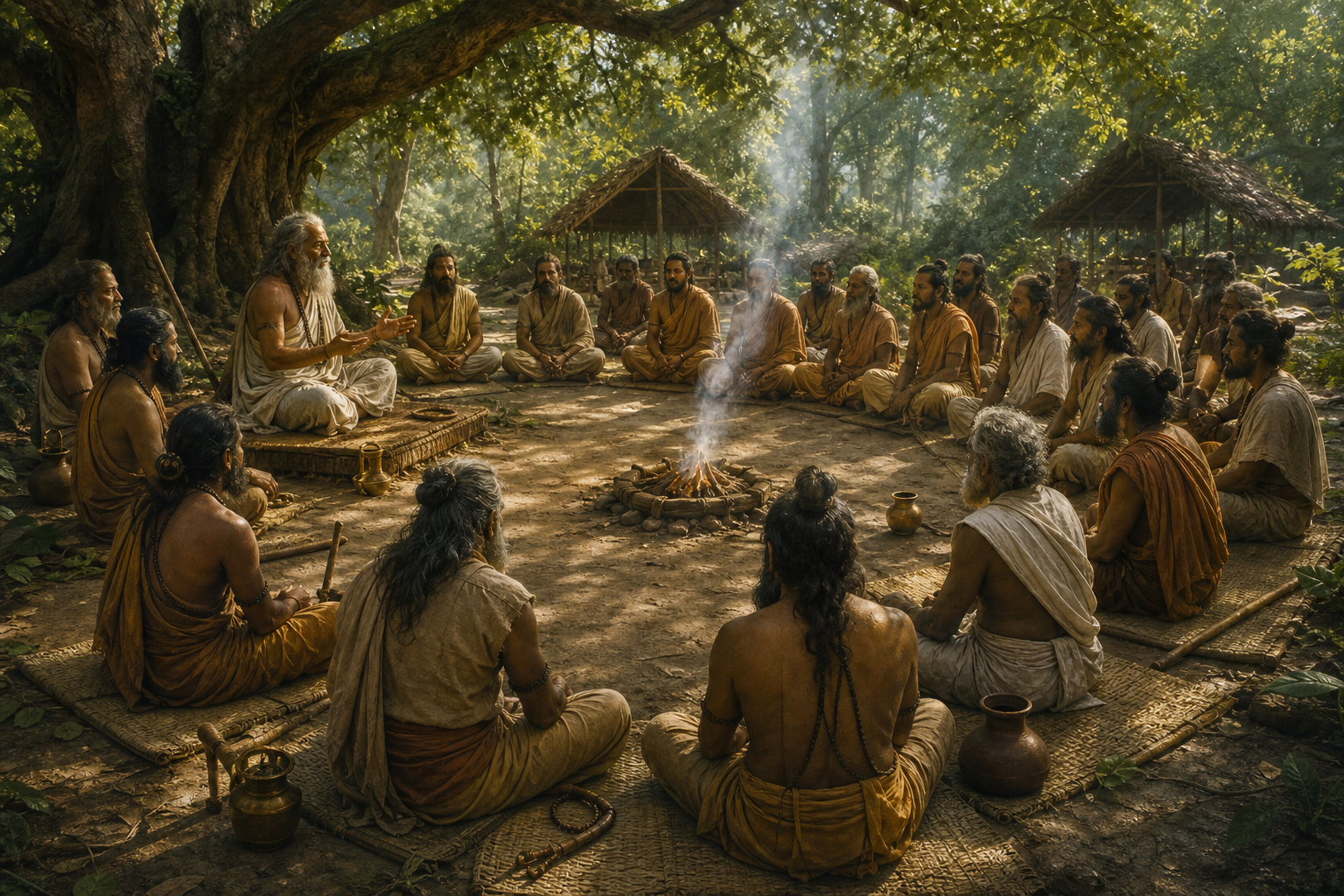
Naimisharanya’s sanctity cannot be separated from the gathering of rishis. Rishi Shaunaka and an assembly of sages are remembered as conducting an extended sacrifice there. During that gathering, Sūta, also known as Ugraśrava Sauti, narrated revered traditions including the Mahābhārata and several Purāṇas.
This is why the sacred forest should also be understood as a seat of learning. Ritual created the disciplined setting; narration brought inherited wisdom into the assembly; questions and attentive listening allowed that wisdom to be understood and carried forward. Knowledge was not treated as private possession. It survived because a community made time to receive, remember, discuss, and transmit it.
That pattern corrects a common weakness in modern spiritual consumption. Collecting quotations, recordings, and books can feel like study even when nothing has been digested. The Naimisharanya pattern is slower and more exacting: remain with a teaching, listen in the company of others, ask what it requires of you, and preserve it by living and sharing it accurately.
If you visit Vyas Gaddi, do not treat it only as another stop requiring a photograph. Read or listen to a manageable passage of sacred teaching. Then put the text away and state its demand in one plain sentence. If you cannot say what it changes in your conduct, you have acquired information but have not yet completed svādhyāya.
The same logic explains why satsanga matters. Alone, you can repeatedly reinterpret a teaching to protect your preferences. In worthy company, your understanding can be questioned, refined, and recalled when enthusiasm fades. The congregation of sages is therefore not decorative background to Naimisharanya. It reveals the social discipline by which a refuge remains alive.
This principle has resonances across the Dharmic family without erasing the distinctions among its paths. Buddhist forest disciplines join seclusion with mindful attention; Jain tapas is inseparable from restraint and ahimsa; Sikh sangat joins remembrance to shared life and sewa. The common lesson is modest but important: a sacred refuge matures through disciplined practice, ethical conduct, and company that helps you remember what matters.
How to make a Naimisharanya pilgrimage spiritually coherent
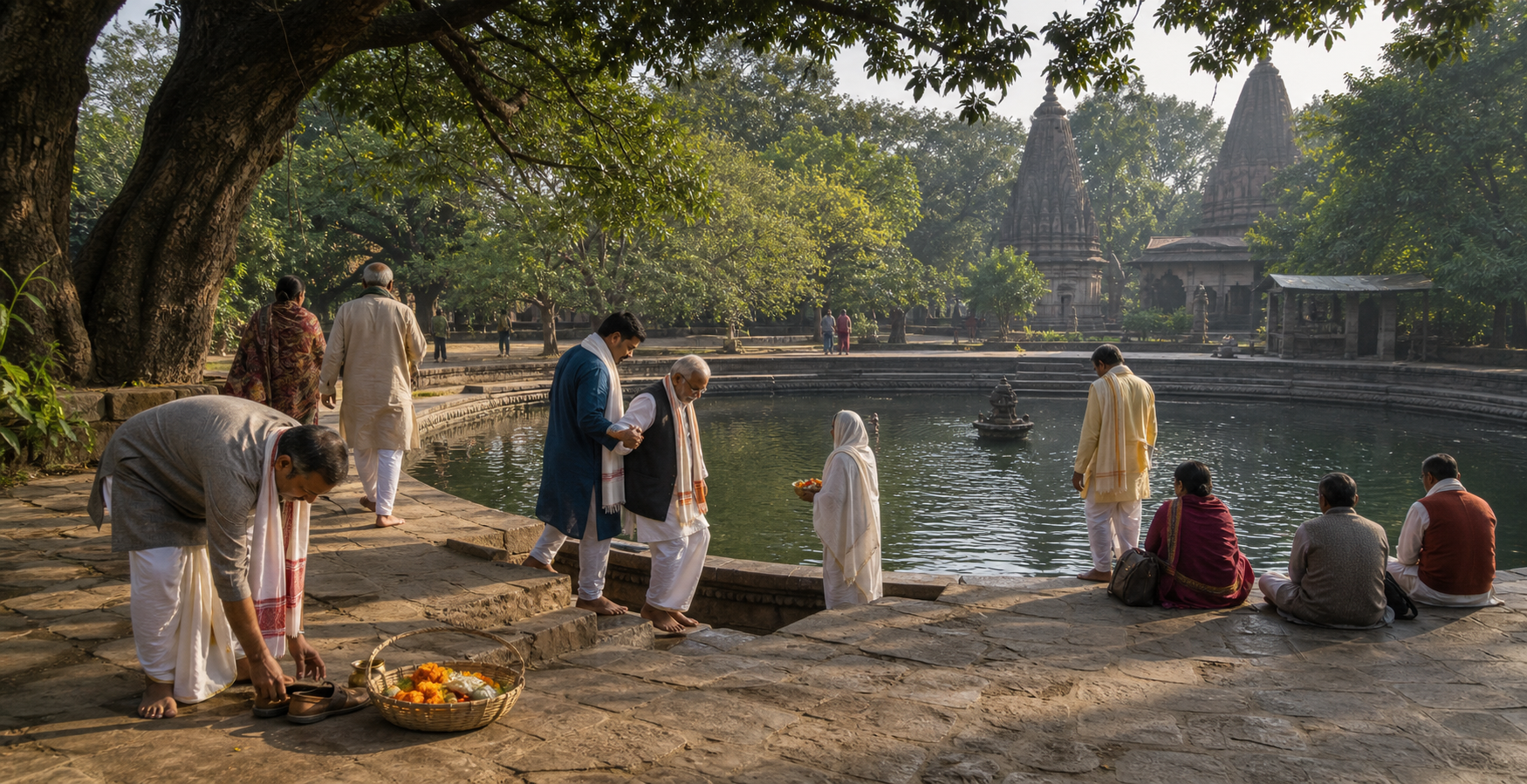
Pilgrims traditionally honour Chakra Tirtha, Vyas Gaddi, and the shrine of Lalita Devi, while practices associated with the kṣetra include parikrama, japa, scriptural recitation, and collective worship. A useful pilgrimage lets these places and practices form one inward movement rather than a checklist of disconnected visits.
The following sequence is a contemplative framework, not a claim about mandatory ritual order. Follow the guidance of the local tradition for specific rites.
- Enter with one clear sankalpa. Identify the recurring tendency you want to bring under dharmic discipline. Phrase the resolve as conduct you can observe after the pilgrimage, not as a vague wish to become more spiritual.
- Use Chakra Tirtha to examine repetition. The wheel can direct your attention to a cycle in your own life: distraction followed by regret, knowledge without practice, or devotion without service. Perform japa with that cycle in view and ask where a different choice must enter.
- At Vyas Gaddi, receive before interpreting. Listen to or recite sacred teaching without rushing to make it confirm an existing opinion. Identify one duty, restraint, or truth that the teaching places before you.
- At the Lalita Devi shrine, join knowledge to devotion. Intellectual clarity alone does not guarantee perseverance. Let worship become an offering of pride and a request for the steadiness needed to fulfil the duty you have recognized.
- Let parikrama become integration. Walk with attention rather than treating movement as transit between attractions. Conclude with an act of sewa and a commitment to protect the sacred landscape through restraint, cleanliness, and respect for its water and living habitats.
The last point is not secondary. A sacred forest is not an interchangeable backdrop for religious activity. Reverence for Naimisharanya includes care for the conditions that make a living landscape possible. If pilgrimage produces offerings but also carelessness toward water, vegetation, animals, or waste, the outward act has contradicted the meaning of the place.
After returning, assess the pilgrimage by one question: what is now different in your ordinary conduct? A powerful feeling at a tirtha may be genuine, but feeling alone is difficult to preserve. A continued period of japa, a regular appointment with scripture, a repaired obligation, or a recurring act of sewa gives the experience a form that can survive changing moods.
Key takeaways
- Naimisharanya is a Puranic refuge because sacred place, disciplined time, transmitted wisdom, and collective practice meet there.
- The association with nimisha, or a moment, points to the possibility of decisive moral and spiritual change; it does not remove the need for sustained conduct.
- The Wheel of Brahma marks both divine guidance and the sages’ willingness to stop searching and commit themselves to yajña, svādhyāya, and satsanga.
- The gatherings of Shaunaka, Sūta, and the rishis make listening, questioning, remembrance, and transmission central to the identity of the kṣetra.
- A pilgrimage bears recognizable fruit when devotion becomes truthfulness, compassion, restraint, service, and care for the sacred landscape.
If travel is not presently possible, you can still respond to Naimisharanya’s invitation. Reserve a dependable sanctuary of time for quiet japa and svādhyāya, keep the company of people who strengthen dharma, and connect remembrance to one concrete act of sewa. Do not try to reproduce the tirtha at home. Let its pattern correct the way you use attention.
When you do make the pilgrimage, arrive with a real question and return with a definite duty. That is how the calm of a sacred forest enters family life, community life, and the unsettled conditions it was meant to help you face.
References
