
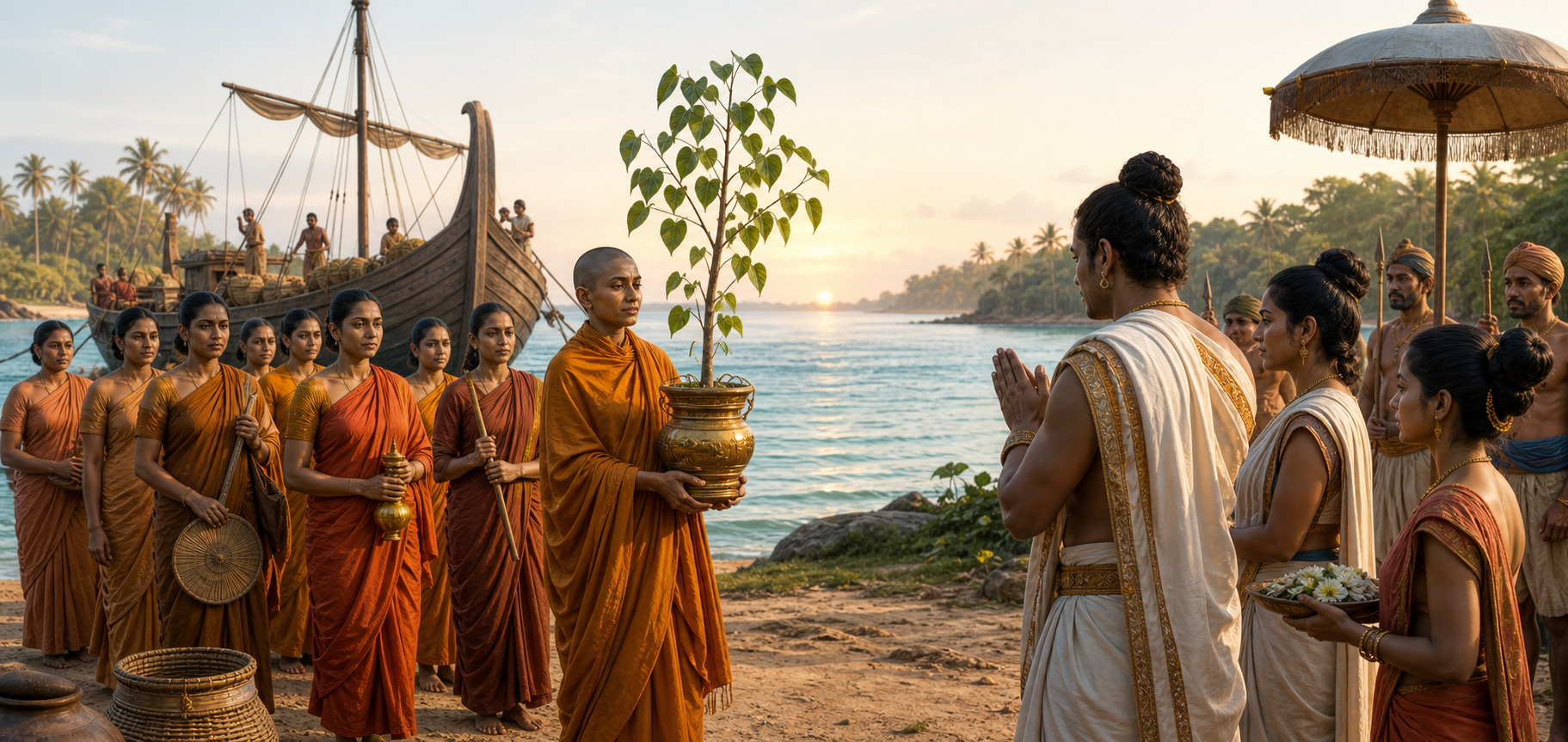
If Sanghamitra remains in your memory only as Ashoka’s daughter carrying a Bodhi sapling, you have the emblem but not the whole achievement. Her importance lies in how one mission gave India-Sri Lanka relations institutional, devotional and ethical forms that could endure beyond the Mauryan court.
Three elements make the story intelligible: the establishment of women’s monastic life, the planting of a sacred connection between Bodh Gaya and Anuradhapura, and cooperation built through royal trust. Once you keep those elements together, you can explain Sanghamitra’s legacy without turning tradition into unquestioned fact or stripping it of its civilizational meaning.
What Sanghamitra’s mission actually changed
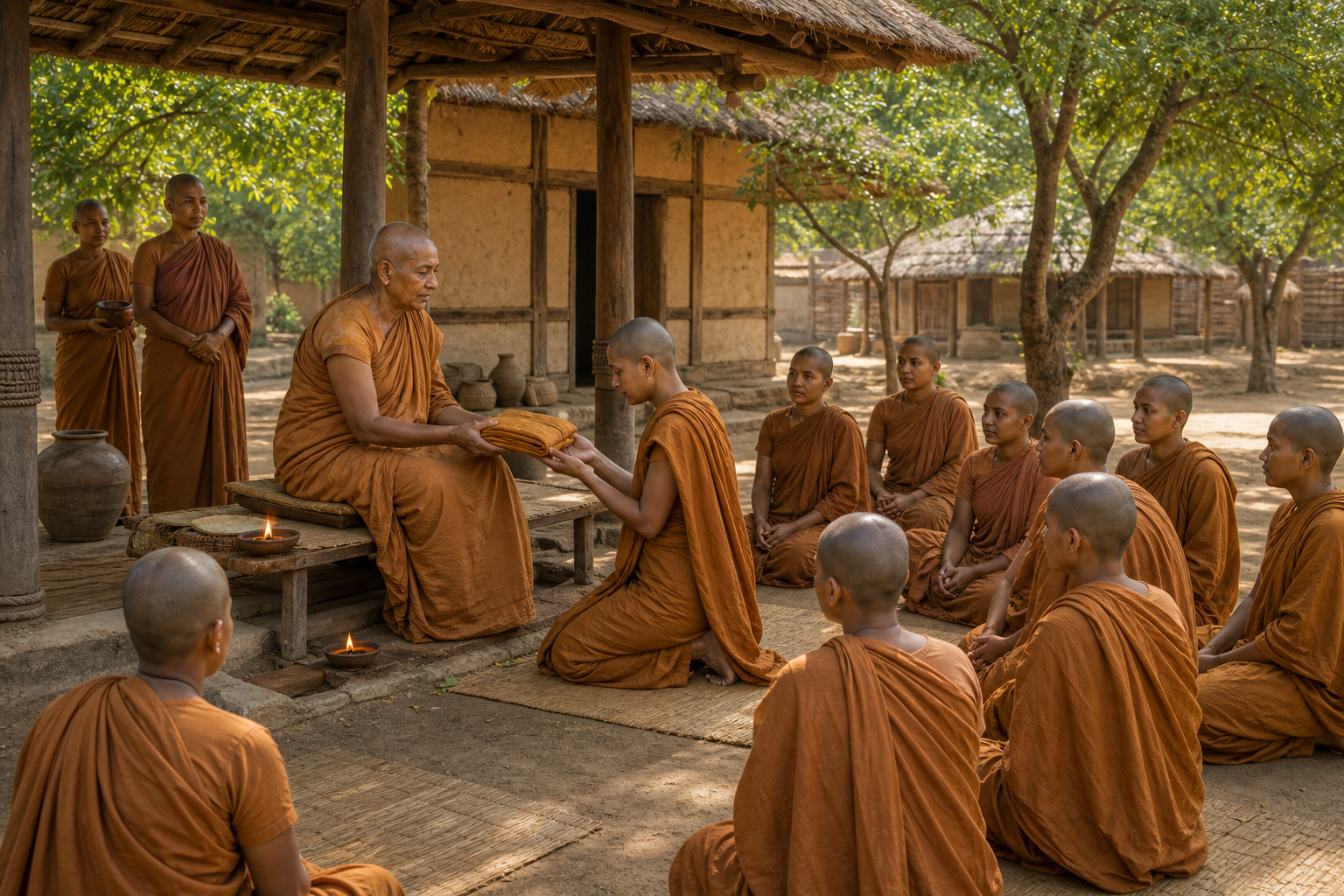
Sanghamitra lived in the 3rd century BCE and was a daughter of Mauryan emperor Ashoka. Alongside her brother Mahinda, she entered the Buddhist path and participated in the movement of Buddhist teaching from India to Sri Lanka. Her contribution was not simply a second version of her brother’s work. She is credited with helping establish the Bhikkhuni order in Sri Lanka, creating an institutional place for women who sought disciplined monastic life.
That distinction matters. A teaching can attract admiration without becoming a durable community. A monastic order gives practice a structure: people can enter it, learn its discipline, transmit it and guide others. Sanghamitra therefore helped Buddhism take root not only as a royal interest or a collection of ideas, but as a lived path available to women as well as men.
Her work also reached beyond monastics. She guided members of royal households and lay communities in ethical and disciplined living. The resulting bridge joined several levels of society at once: rulers could support it, monastics could preserve its discipline, and householders could embody its values in ordinary life. That combination helps explain why her mission mattered more than a single courtly encounter.
Mahinda and Sanghamitra should consequently be remembered together without allowing one to erase the other. Mahinda belongs to the early transmission of Buddhism to the island; Sanghamitra supplied a distinct institutional foundation through women’s participation. Treating her as an accompanying princess misses the specific work for which she is remembered.
Key takeaways
- Sanghamitra’s importance rests on institution-building, not merely on her relationship to Ashoka.
- The Bhikkhuni order made women active bearers of monastic discipline and transmission.
- The Bodhi sapling joined a sacred Indian place to a lasting Sri Lankan practice.
- Royal friendship enabled the mission, but monastic and lay communities gave it continuity.
- Her legacy is best described as a shared India-Sri Lanka inheritance, not a one-sided civilizational possession.
A spiritual mission carried by political trust

Ashoka’s position in the story can tempt us to reduce the mission either to imperial policy or to private religious devotion. Neither frame is sufficient. His decision brought governance, personal responsibility and spiritual purpose into the same field.
Ashoka was initially reluctant to send his daughter overseas. He nevertheless consented as the ethical purpose of the mission became clear and his friendship with Sri Lanka’s King Devanampiya Tissa deepened. The resulting voyage was therefore connected to both dharmic service and a relationship between rulers. Political trust created room for religious work, while Sanghamitra’s learning and discipline gave that trust substance.
This is an early and useful model of cultural diplomacy, provided we do not force a modern bureaucratic label onto the ancient world. A ruler could authorize contact, but a decree alone could not create a functioning spiritual community. Sanghamitra had to carry knowledge, enter another society, teach discipline and help local people make the tradition their own.
The mechanism had four parts:
- Ethical purpose: the mission was presented as service to a path of awakening and disciplined conduct.
- Political confidence: friendship between Ashoka and Devanampiya Tissa made sustained cooperation possible.
- Personal agency: Sanghamitra accepted the difficulty of an overseas mission and exercised religious authority in her own right.
- Local cultivation: Sri Lankan royal, monastic and lay communities turned what arrived from India into an enduring island tradition.
This sequence corrects the crude formula that India simply gave Buddhism and Sri Lanka simply received it. India supplied teachers, sacred associations and institutional knowledge. Sri Lanka received, cultivated and preserved them through its own communities. The bond became durable because transmission developed into shared custodianship.
If you are speaking about this history at a temple, in a classroom or at a cultural event, use the words shared inheritance. They preserve India’s formative role while recognizing Sri Lanka’s agency. That is more accurate than presenting the island as a passive edge of an Indian story.
Why the Bodhi sapling was more than a royal gift
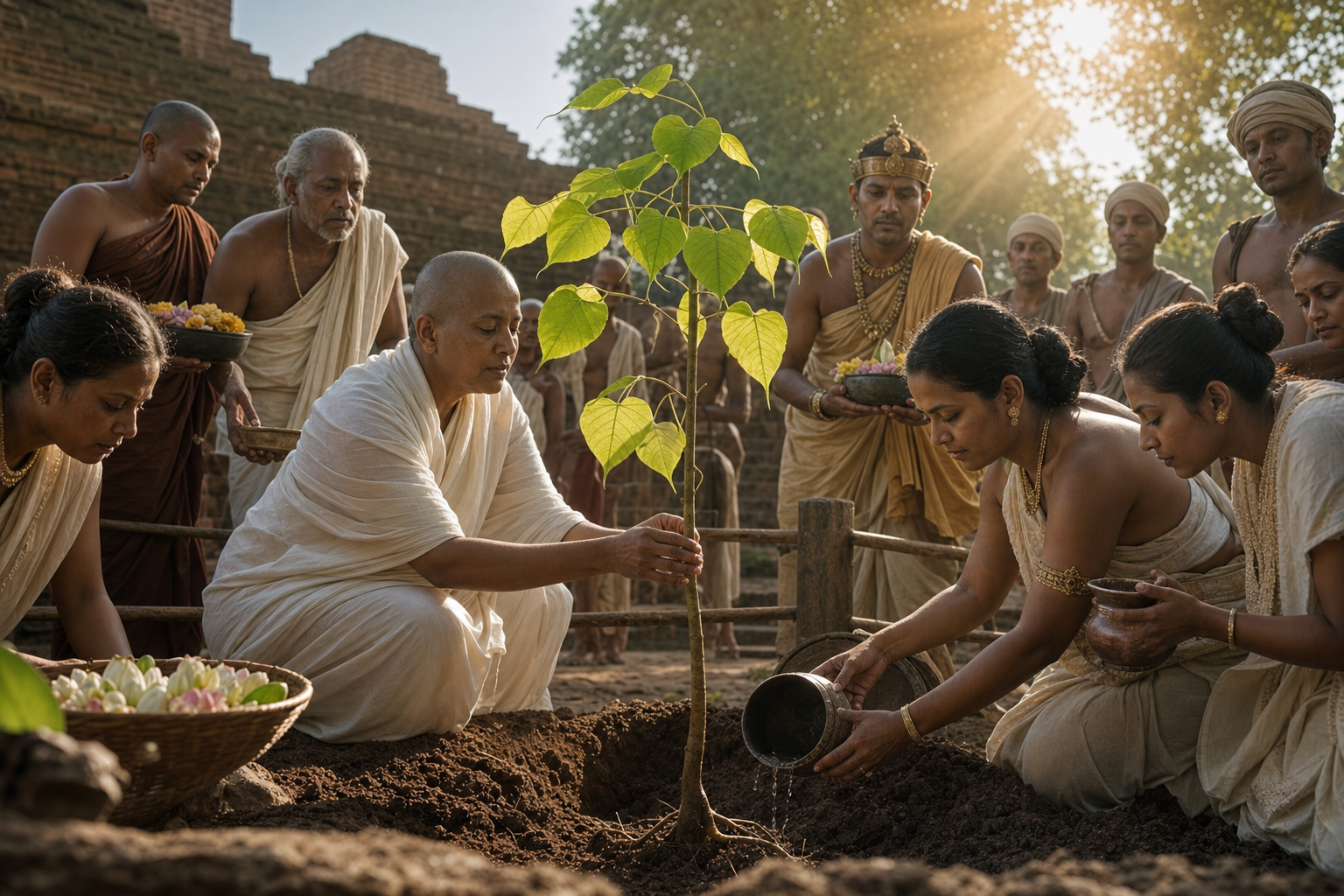
Tradition holds that Sanghamitra brought a sapling from the Bodhi tree at Bodh Gaya and that it was planted at Anuradhapura as the Sri Maha Bodhi. This was not merely a botanical object transported between courts. It made a sacred connection visible, local and capable of entering the ritual life of generations.
The sapling linked two places without making them interchangeable. Bodh Gaya remained associated with the Buddha’s awakening in India. Anuradhapura became the Sri Lankan home of a living sign connected to that awakening. Sacred memory could now be encountered on the island through a form rooted in the land yet genealogically associated with India.
Three relationships help you read the symbol carefully:
- Bodh Gaya and Anuradhapura: spiritual geography crossed the sea without erasing the identity of either place.
- Awakening and cultivation: a tree associated with enlightenment also required continuing human care, just as a spiritual tradition requires disciplined practice.
- Gift and stewardship: the act began with transmission from India, but its endurance depended on Sri Lankan guardianship and ritual continuity.
This is why the Sri Maha Bodhi belongs at the centre of the relationship, but not as a decorative legend. It embodies the method by which the relationship survived: something sacred was entrusted, planted and continually integrated into community life. The connection between the Bodhi tradition, Anuradhapura and Sanghamitra’s mission gave the India-Sri Lanka bond a physical focus that political agreements alone could not provide.
When you encounter an image or commemoration of Sanghamitra carrying the sapling, ask what the image leaves outside its frame. The answer should include the Bhikkhuni order, teaching among lay and royal communities, and the Sri Lankan work of preservation. The tree is the mission’s most recognizable symbol, not the entirety of the mission.
How to distinguish historical memory from later meaning
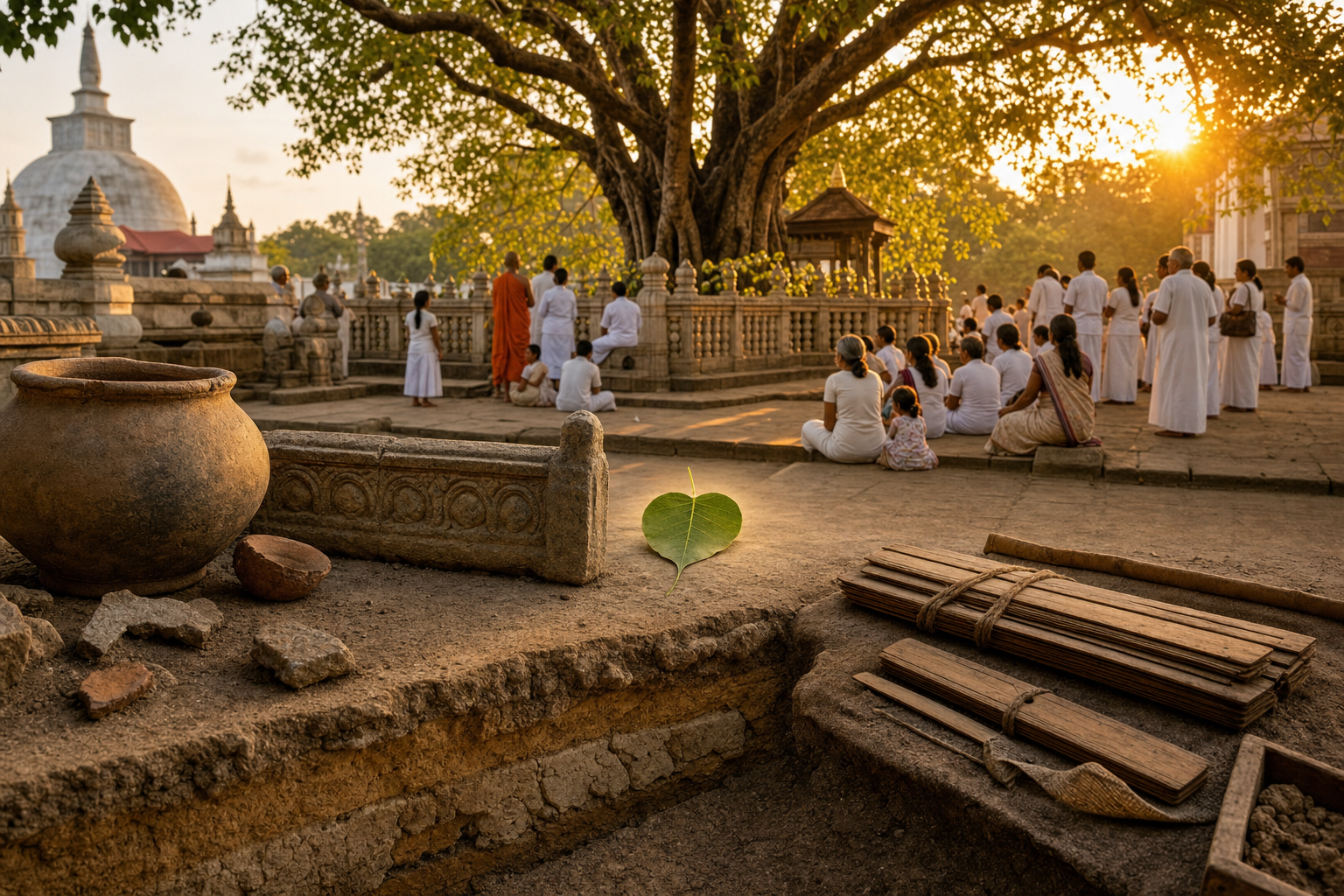
Sanghamitra’s memory comes through the Mahavamsa, material associations at Anuradhapura and continuing ritual traditions. These forms of evidence do different work. A chronicle gives people, actions and narrative sequence. Archaeological continuity can anchor a tradition in a place. Ritual continuity shows what a community considered important enough to preserve. None, by itself, verifies every remembered conversation, motive or dramatic detail.
This matters especially when discussing Ashoka’s reluctance, the precise conduct of the voyage or the circumstances surrounding individual decisions. Such details may carry historical memory and moral meaning, but they should not all be presented with the same level of certainty. The responsible approach is neither automatic belief nor automatic dismissal.
You can keep your language accurate with three simple distinctions:
- Say Sanghamitra is credited with helping establish the Bhikkhuni order. This recognizes her central place while avoiding a claim stronger than the available account.
- Say tradition holds that she carried the Bodhi sapling from Bodh Gaya. This preserves the tradition without disguising its evidentiary character.
- Say her work helped consolidate Buddhism in Sri Lanka. This captures the larger institutional effect without pretending that one person acted alone.
Variation in details does not erase the convergence around her pivotal function. The continuing association of Sanghamitra with women’s monastic life, the Sri Maha Bodhi and Anuradhapura has sustained a remarkably coherent historical memory. At the same time, phrases such as cultural diplomacy and dharmic unity are interpretations of the mission’s significance. They are useful when clearly presented as interpretations rather than ancient terminology.
This distinction will improve any lesson, commemoration or discussion you lead. State the central history plainly, mark the traditional elements honestly, and then explain the meaning you draw from them. Respect for tradition does not require careless certainty; historical care does not require contempt for sacred memory.
Carrying the shared dharmic inheritance forward
Sanghamitra’s journey arose from an Indian civilizational setting in which Buddhist, Hindu, Jain and other ascetic traditions pursued spiritual knowledge through teaching, debate and disciplined practice. Buddhism’s movement to Sri Lanka was therefore not a departure from India’s civilizational world. It carried values such as ahimsa, compassion and ethical self-restraint through a distinct Buddhist institution.
A dharmic reading should affirm this relationship without pretending that all traditions are doctrinally identical. Shared soil does not produce a single path. Hindu, Buddhist and Jain traditions developed their own teachings, disciplines and communities; Sikhism arose in later centuries and should not be projected into Sanghamitra’s historical period. The wider dharmic family is best understood through ethical kinship and civilizational continuity, not by erasing difference.
Sanghamitra also gives women’s agency a concrete historical form. Calling her courageous is not enough. Her agency appeared in accepting an overseas responsibility, carrying religious learning, helping establish a women’s order and guiding both elite and lay communities. Those actions are more instructive than a vague celebration of her as an inspirational figure.
If you are preparing a short presentation about her, build it around five moves:
- Place Sanghamitra in the 3rd-century-BCE Mauryan and Sri Lankan setting.
- Name the Bhikkhuni order before discussing the Bodhi sapling.
- Explain the friendship between Ashoka and Devanampiya Tissa as the political trust surrounding the mission.
- Identify the sapling account as tradition and explain what the Sri Maha Bodhi symbolizes.
- End with shared custodianship: India was the civilizational point of transmission, while Sri Lanka cultivated an enduring Buddhist inheritance.
That structure keeps the history human, the evidence honest and the dharmic connection visible. The next time Sanghamitra’s name appears, do three things: mention the women’s order before the tree, pair India’s transmission with Sri Lanka’s stewardship, and distinguish inherited memory from modern interpretation. You will tell a fuller story of a relationship that endured because both sides helped it take root.
References
- Hindu Pad – Sanghamitra’s Sacred Mission: How Ashoka’s Daughter Forged India-Sri Lanka Buddhist Ties
