
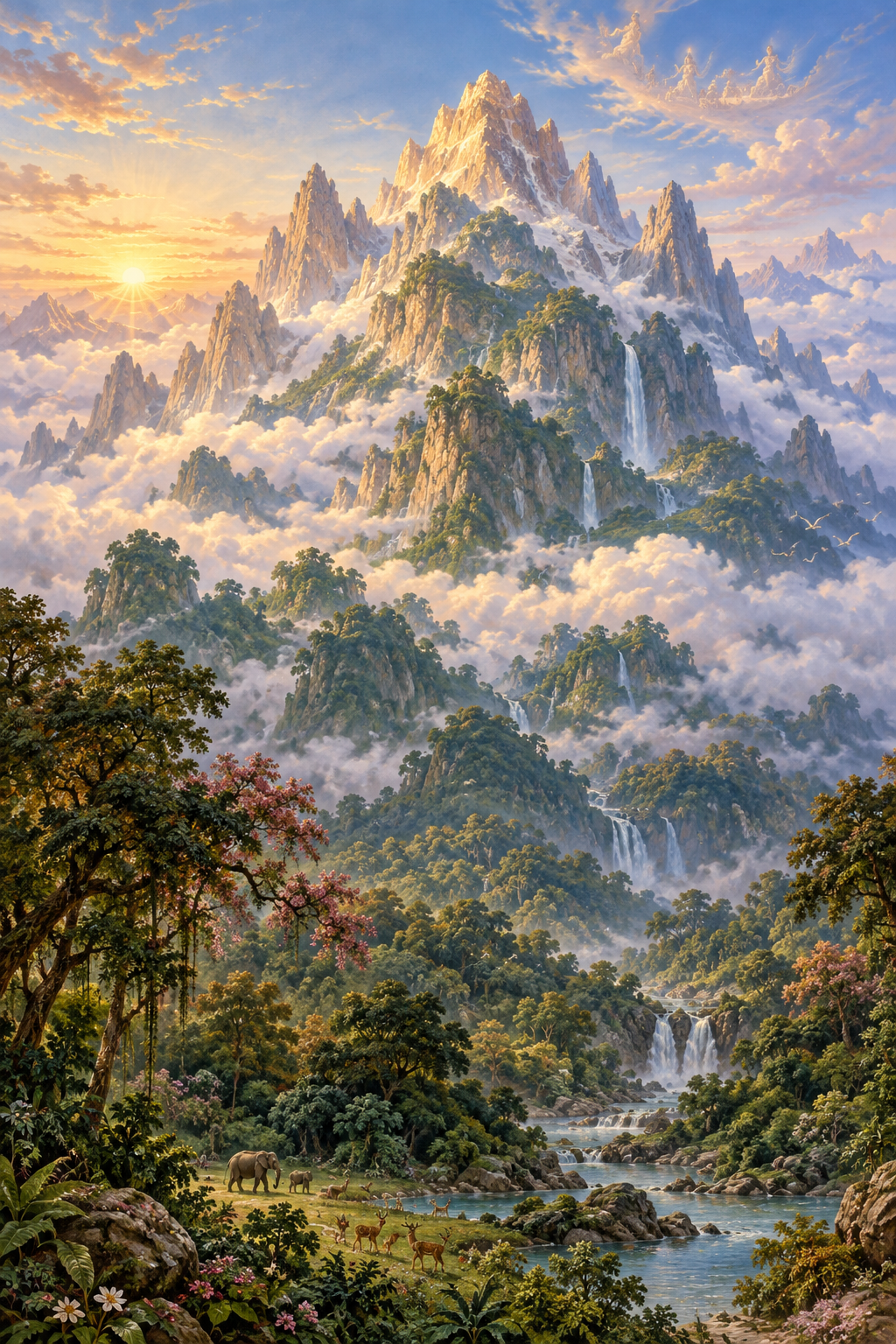
If you came to Mount Mandara expecting a modern location note, the Mahabharata asks for a different kind of attention. Its Mandara is a place you understand by noticing what rises, grows, moves and appears there.
Read those details carefully and a coherent picture emerges. Mandara brings immense scale, abundant life, real danger and celestial visitation into one landscape. That combination is the key to understanding what the mountain does in the epic imagination.
Start with what the Mahabharata places on Mandara
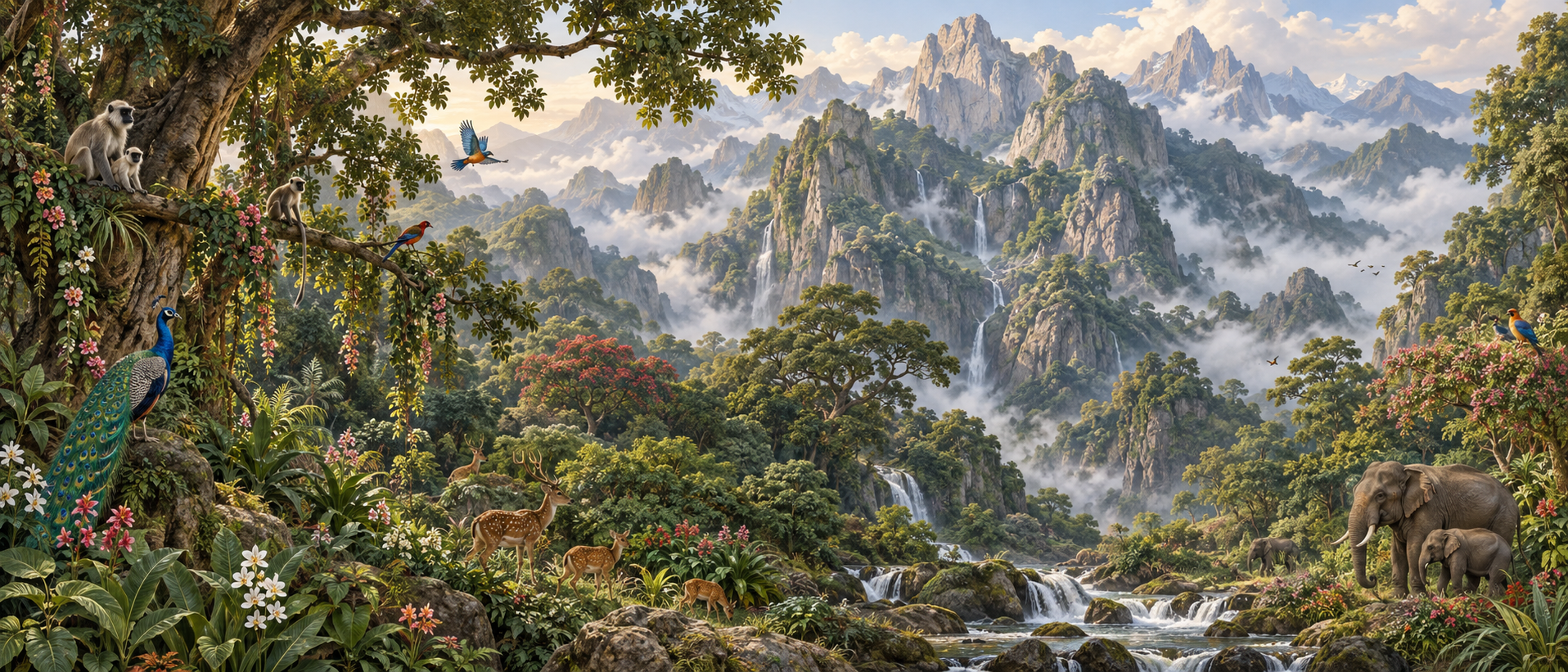
In the Astika Parva of the Adi Parva, Mount Mandara has soaring peaks compared with clouds. Innumerable creepers cover it, the songs of many birds echo across it, fierce-toothed beasts move upon it, and kinnaras, apsaras and devas visit it.
Each part of that description changes how you should picture the mountain:
- The peaks establish scale. Mandara rises beyond the proportions of an ordinary hill and draws the imagination upward.
- The creepers establish abundance. The mountain is not a bare mass of stone. Life spreads across its surface in profusion.
- The birds establish sound. You are not merely shown a distant silhouette; you are invited into an environment that can be heard.
- The beasts establish danger. Mandara is alive, but it is not domesticated or arranged for human comfort.
- The celestial visitors establish sacred significance. The mountain belongs to a narrative world in which natural and divine orders can meet.
This is the first discipline of reading sacred geography: make an inventory before assigning a meaning. The mountain’s significance arises from the whole arrangement, not from one attractive detail isolated from the rest.
On Mandara, sacred does not mean safe or tame
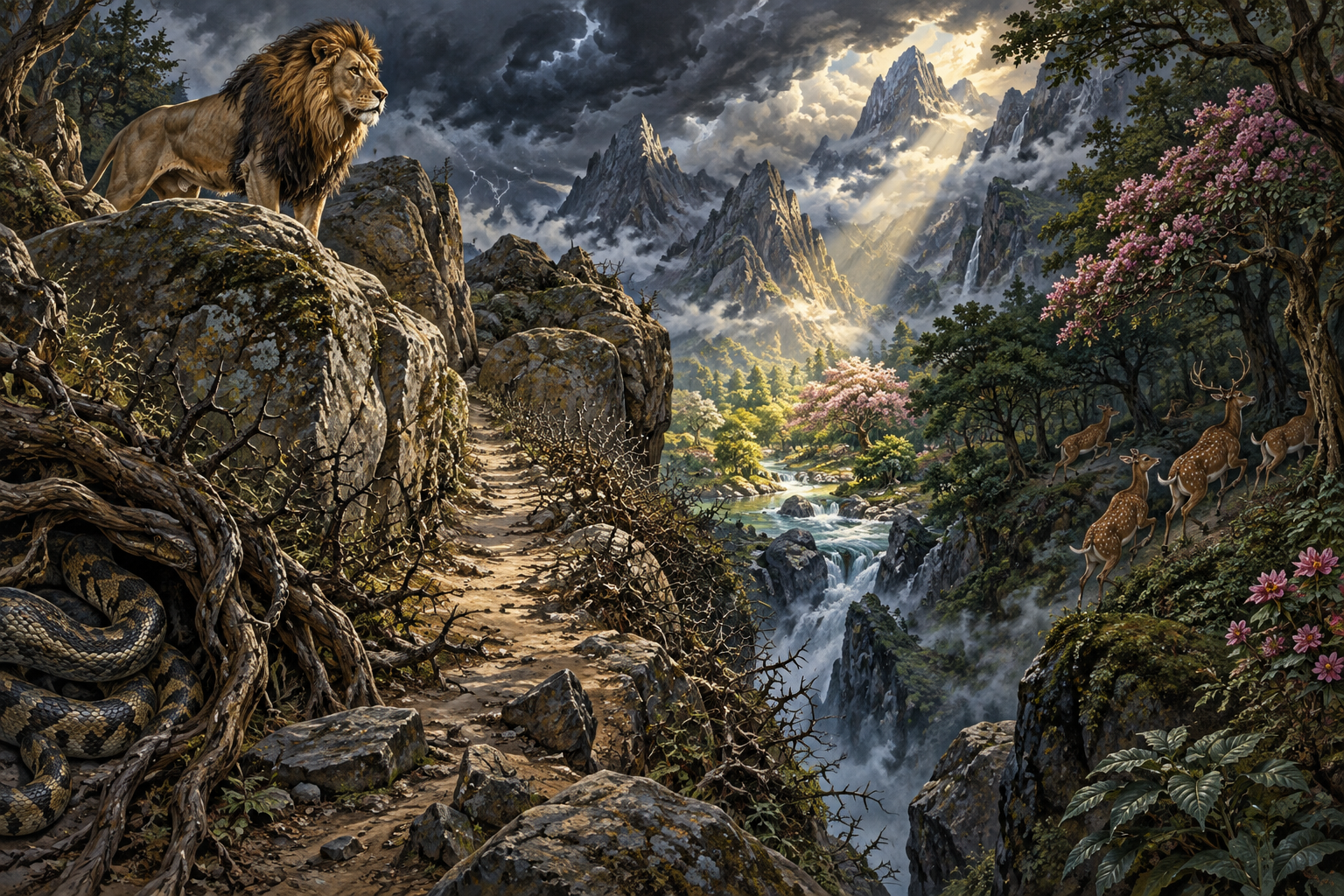
The birdsong and creepers could have produced a gentle pastoral scene. The fierce-toothed beasts prevent that reading. Beauty and danger occupy the same ground, and neither cancels the other.
That contrast matters because modern readers can unconsciously reduce a sacred place to a peaceful retreat. Mandara resists that reduction. Its vitality includes predation as well as song, wild movement as well as luxuriant growth. The mountain is not sacred because every unsettling feature has been removed. It is sacred while remaining powerful, untamed and more extensive than ordinary human control.
You can use a simple test when assessing an interpretation of Mandara: ask whether it accounts for the beasts as seriously as it accounts for the birds and celestial beings. If an explanation preserves only beauty, it has softened the scene. If it preserves only danger, it has ignored the abundance and divine visitation. A sound reading must hold all of them together.
Celestial visitors place Mandara within sacred geography
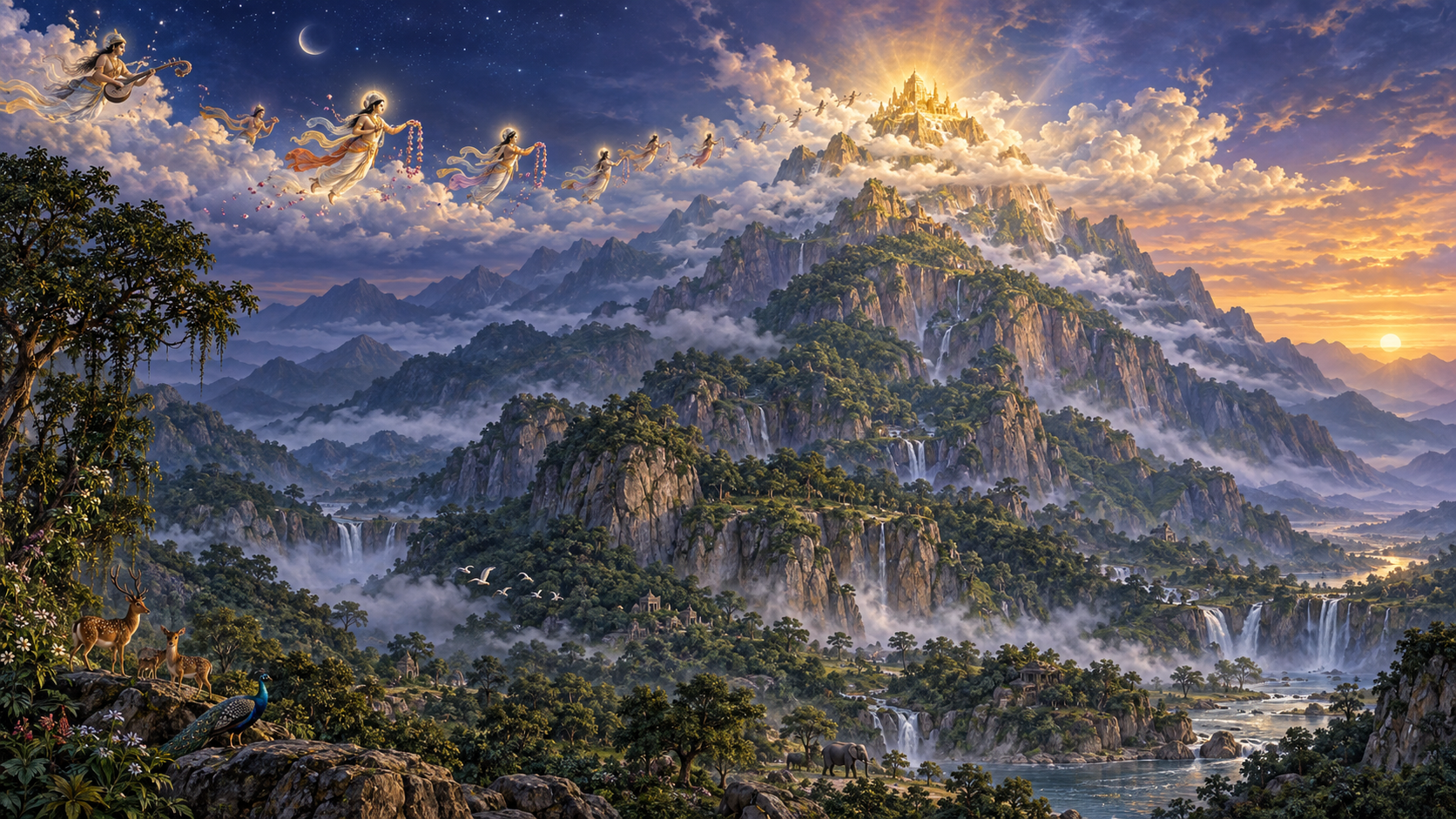
The movement from birds and beasts to kinnaras, apsaras and devas broadens the mountain’s population beyond the ordinary animal world. Mandara remains recognizably mountainous: it has peaks, vegetation, birds and predators. Yet celestial beings can enter that same setting. The epic does not need to erase nature in order to disclose sacred presence.
The wording also rewards precision. These beings are described as visiting Mandara. That supports the view that the mountain is accessible to the celestial sphere, but the brief description alone does not establish that every named being permanently resides there or serves an identical function. Readers should resist turning a vivid list into a detailed cosmological claim that the wording does not make.
A careful interpretation is therefore stronger than either extreme. Mandara need not be treated as merely physical scenery, because divine visitors are part of its portrayal. Nor should it be dissolved into a purely abstract symbol, because the creepers, birds, beasts and peaks retain their concrete force. Sacred geography allows a place to be landscape and meaning at once.
A five-step method for reading the Mandara description
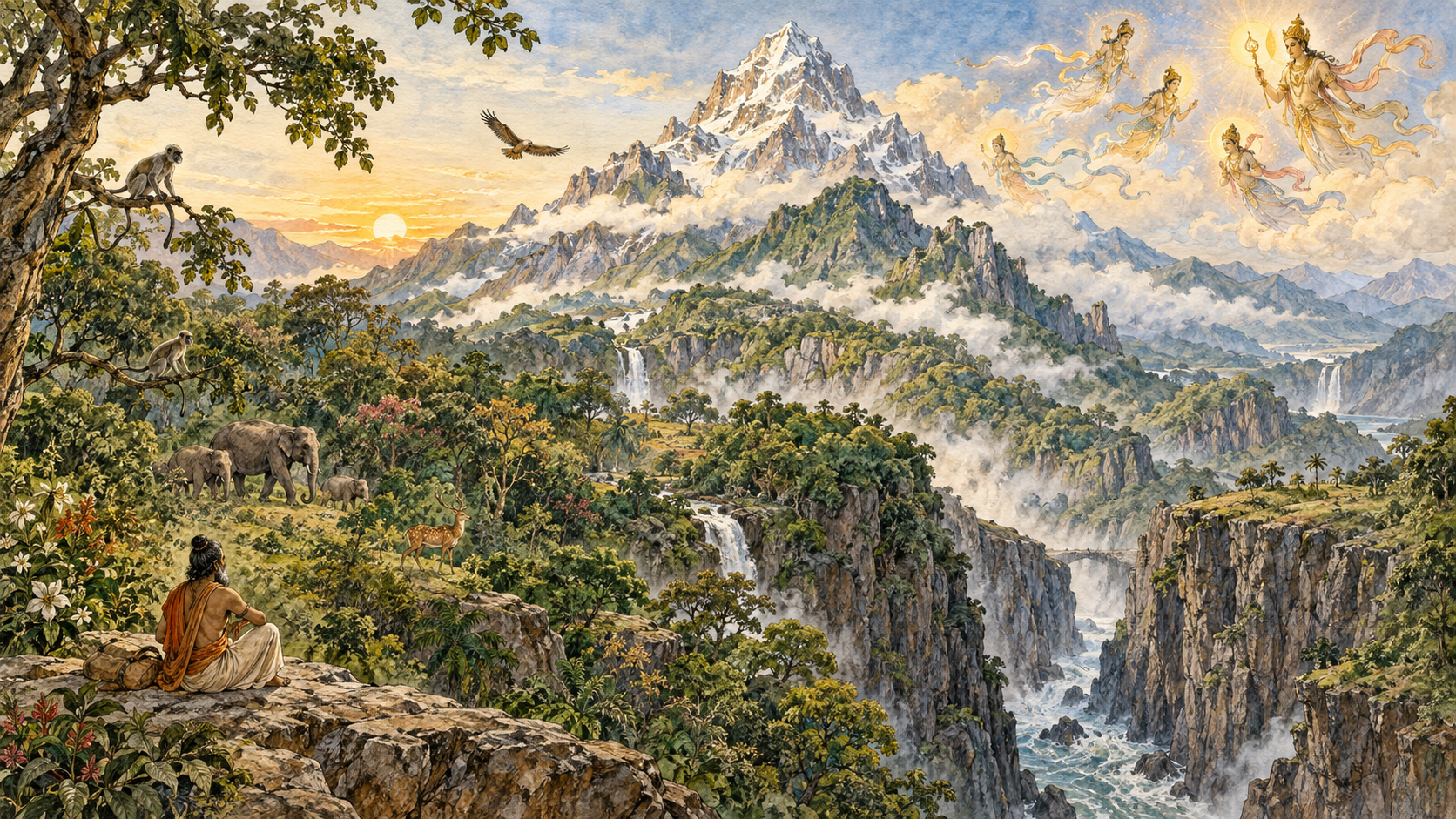
If you are studying the Mahabharata for spiritual understanding, teaching or discussion, this method will keep your reading close to what the epic actually gives you:
- Locate the description. Begin with the Astika Parva within the Adi Parva. This prevents details associated with Mandara elsewhere in the broader tradition from being silently imported into this particular scene.
- List the features without interpreting them. Write down peaks, creepers, birds, beasts, kinnaras, apsaras and devas. This gives you a textual baseline.
- Mark the relationships. Notice height and covering, birdsong and fierce teeth, natural life and celestial visitation. Meaning emerges through these combinations.
- Separate observation from inference. Celestial beings visit Mandara; that is part of the description. Calling Mandara a meeting ground of natural and divine orders is an interpretation of that detail. The interpretation is reasonable, but it should remain identifiable as interpretation.
- Check what your explanation leaves out. If it explains the cloud-like height but not the living abundance, or the divine presence but not the danger, revise it. The best reading is the one that requires the fewest details to be discarded.
This method also protects you from three common mistakes. A literal-only reading reduces Mandara to topography. A symbol-only reading makes its physical life disposable. A one-to-one decoding assigns every bird, creeper or beast a fixed hidden meaning without textual support. The richer approach begins with the complete scene and interprets only as far as its details permit.
Key takeaways
- Mount Mandara appears in the Astika Parva of the Adi Parva as a vast, living and sacred mountain.
- Its cloud-like peaks, innumerable creepers, birds and dangerous beasts make it abundant without making it tame.
- The visits of kinnaras, apsaras and devas connect the natural landscape with a celestial order.
- The mountain works best as sacred geography: a concrete place whose physical features carry spiritual and literary meaning.
- A reliable interpretation must preserve scale, fertility, sound, danger and divine presence rather than selecting only the convenient elements.
When you next encounter Mandara, keep the full inventory in view. Ask which details your interpretation explains and which it quietly abandons. That one check will help you meet the mountain as the Mahabharata presents it: neither a bare coordinate nor a weightless allegory, but a living landscape open to more than one order of being.
References

Leave a Reply
You must be logged in to post a comment.