

If you have encountered Jalandhara Samhara Murti in a temple, book, or sculpture catalogue, you may have wondered whether it is simply another image of Shiva defeating an asura. That reading catches the event but misses the reason the form matters.
Jalandhara Samhara presents destruction as a necessary act of restoration. It asks you to notice what happens when power is captured by ego, perception is distorted by illusion, and conduct crosses into adharma. Read in that order, the murti becomes more than a battle scene: it becomes a demanding lesson in what must end so that right order can return.
The name tells you how to approach the form
Begin with the full name. Each part prevents a common misunderstanding.
- Shiva is not appearing here merely as a formidable warrior. He manifests through a particular cosmic act.
- Jalandhara is the ocean-born adversary whose destruction gives the form its narrative setting.
- Samhara means destruction, dissolution, or withdrawal. In a Dharmic setting, it is not senseless violence; it is the ending of something whose continuation obstructs order.
- Murti makes that truth visible. The form gives a worshipper or viewer something definite to encounter rather than leaving the teaching as an abstraction.
This distinction matters. If you read the image only as the triumph of a stronger being over a weaker one, its ethical depth disappears. Shiva’s supremacy is directed against ego, illusion, and adharma. The decisive question is therefore not merely, “Who won?” It is, “What had become impossible to preserve?”
Samhara is severe because not every disorder can be repaired through accommodation. Some falsehoods survive by absorbing every compromise offered to them. The form confronts that limit. Restoration sometimes requires an ending.
How to read the iconography without forcing it
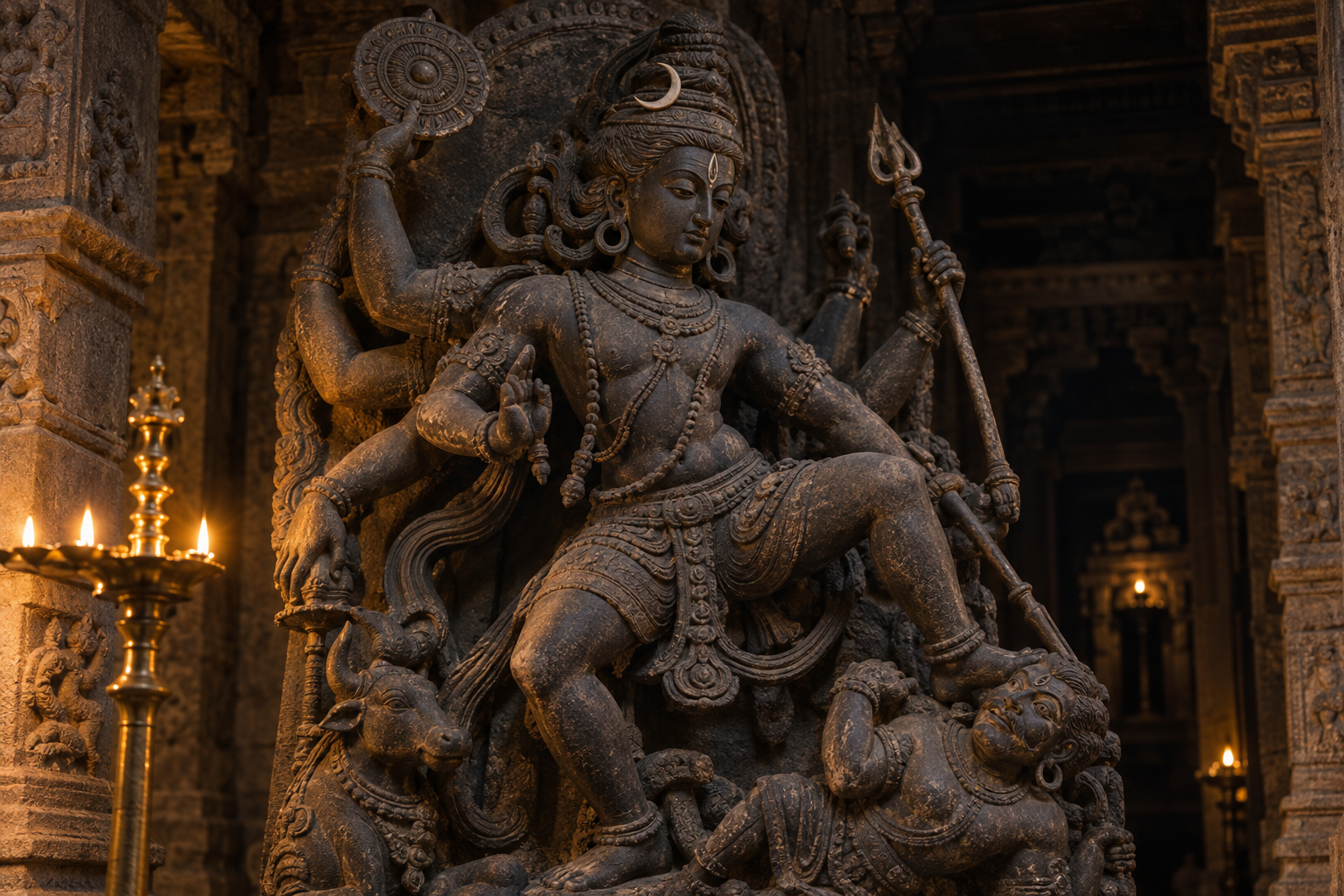
Images of Shiva can share fierceness, weapons, dynamic posture, attendants, and subdued adversaries. Do not identify every forceful Shaiva image as Jalandhara Samhara merely because it depicts combat. Establish the identity first; interpret the details second.
- Check the setting. Read the temple label, museum record, inscription, catalogue entry, or local account associated with the image. A secure identification is stronger than a guess based on one attribute.
- Locate the narrative center. Ask what relationship the composition emphasizes. Is the attention on Shiva’s action, the adversary’s defeat, the restoration that follows, or a moment immediately before the end?
- Separate defining features from shared Shaiva features. Matted hair, weapons, multiple arms, or a forceful stance may establish Shiva’s divine power without uniquely identifying this episode.
- Read posture and direction. Notice where the body, face, hands, and weapons direct your eye. Iconography communicates through relationships: command and resistance, stability and agitation, divine purpose and disordered power.
- Use the surrounding programme. Neighbouring panels, subsidiary figures, and the temple’s larger sequence can reveal whether you are looking at an isolated divine form or one moment in a narrative cycle.
Regional workshops and different periods may emphasize different moments. One representation can stress confrontation while another stresses the final supremacy of Shiva. Variation does not empty the form of meaning, but it does warn you against treating a single modern illustration as the universal template.
Resist another common error: converting every visual detail into a private allegory. Begin with what is actually visible and historically identified. Only then move toward spiritual interpretation. This order respects both the sacred image and the tradition that preserves it.
Ego, illusion, and adharma are three different problems

The form becomes more useful when you do not collapse its central themes into the vague idea of “evil.” Ego, illusion, and adharma are related, but each calls for a different kind of self-examination.
Ego turns capacity into entitlement
Ego here need not mean ordinary confidence or a healthy sense of responsibility. The danger begins when ability, status, devotion, learning, or strength is treated as proof that ordinary limits no longer apply. Capacity then becomes entitlement.
You can test for this directly. Notice where correction feels like humiliation, where disagreement is treated as disloyalty, or where success is used to excuse conduct that would be condemned in someone else. Those reactions show ego defending a position, not dharma defending a principle.
Illusion makes a false position feel self-evident
Illusion is not an invitation to dismiss the world or other people as unreal. In practical terms, it includes the misperception that arises when desire, fear, pride, or resentment dictates what you are willing to see.
When contemplating the murti, ask what fact you keep explaining away because accepting it would require change. The useful response to illusion is not greater intensity. It is clearer seeing: naming the fact, separating it from your preferred story, and allowing it to correct your conduct.
Adharma concerns conduct and order
Adharma is not a label to place casually on anyone you dislike. It concerns a departure from right order expressed through choices, relationships, and consequences. This is why the form should sharpen moral discrimination rather than encourage hostility.
Apply the lesson first to a pattern of conduct. Identify the broken duty, the deception being protected, the harm being normalized, or the boundary being ignored. That keeps the contemplation disciplined. It also prevents a sacred narrative from becoming a pretext for personal anger.
Turn contemplation into one act of restoration

You do not need to invent an elaborate ritual to engage this form. If your sampradaya, guru, or temple gives a particular mantra or worship sequence, follow that living discipline. For personal contemplation, use the murti to move from observation to a precise correction.
- Look before explaining. Sit with the image quietly. Notice Shiva’s composure or force, the direction of the action, the adversary, and the point where conflict is resolved.
- Name the principle. Say plainly what the form represents for this reflection: the ending of ego, illusion, or adharma. Choose the one that genuinely applies instead of selecting all three as general spiritual language.
- Identify the behaviour, not an enemy. Replace “this person is my Jalandhara” with a more exact statement such as “I am refusing correction,” “I am protecting a convenient falsehood,” or “I am allowing a broken obligation to continue.”
- Decide what samhara requires. Some patterns need moderation; others need termination. Determine whether you must apologize, disclose a fact, stop a dishonest practice, withdraw support from wrongdoing, or restore a neglected duty.
- Complete the restoration. Ending a harmful pattern leaves a space. Fill it deliberately with truthful speech, a repaired commitment, a clear boundary, or a renewed practice of dharma.
The last step is essential. Destruction by itself is not the spiritual achievement. Shiva’s destructive power serves cosmic order. Your application should therefore be judged by what it restores, not by how forceful it feels.
This also supplies a safeguard against self-deception. Anger often wants to destroy a person, relationship, or institution and then calls the impulse righteous. Contemplation of Jalandhara Samhara should narrow the target to the actual falsehood or adharmic conduct. If you cannot name what rightful order will be restored, pause before treating your impulse as dharmic clarity.
Key takeaways
- Jalandhara Samhara Murti depicts a specific cosmic act, not generic divine aggression.
- The ocean-born Jalandhara provides the narrative setting; ego, illusion, and adharma provide the form’s continuing spiritual relevance.
- Confirm an image’s identity through its context before assigning meanings to individual attributes.
- Direct the symbolism toward conduct and false perception, not toward declaring another person to be a demon.
- Let samhara end a harmful pattern, then complete the work by restoring truth, duty, or a necessary boundary.
When you next encounter this form, stay with the question it places before you: what are you still trying to preserve after it has begun to obstruct dharma? Name that pattern precisely, end what should not continue, and make the first act of restoration concrete.
References

Leave a Reply
You must be logged in to post a comment.