

You may honour Lakshmi, work hard for prosperity, and still feel uneasy before Ravana’s magnificent golden Lanka. If wealth is auspicious, why does the Ramayana place so much of it inside a kingdom ruled through abduction, fear, and deceit?
The answer appears at Lanka’s gate. Lankini helps you distinguish wealth from well-being, security from rightful protection, and a successful conquest from a dharmic victory. Her encounter with Hanuman turns a brief episode of the Sundara Kanda into a practical test for prosperity in your household, profession, community, or state.
Gold is not the Ramayana’s villain

Lanka’s splendour is real. Its walls do not become imaginary because Ravana is unjust. Traditions remember the golden citadel as the work of Visvakarma, connect its earlier history with Brahma and Kubera, and then place it under Ravana after his seizure of it. The sequence matters: a magnificent inheritance can pass into wrongful hands without immediately losing its shine.
This corrects a common mistake. The Ramayana does not require you to treat money, architecture, political strength, or technological skill as impure. Lanka’s material achievements are not denied. What the epic denies is the ruler’s right to use splendour as proof of righteousness.
Material success often survives its moral foundations for a time. A treasury can remain full after justice has been corrupted. Impressive buildings can stand while fear spreads through the people living around them. A powerful organisation can keep winning after its leaders have started silencing every honest objection. Lanka teaches you to expect this delay. Do not mistake continued performance for continued legitimacy.
The reverse inference is equally dangerous. Poverty is not proof of vice, and suffering is not evidence that Lakshmi has judged a person unworthy. The episode is a teaching about stewardship and political-moral order, not a formula for blaming people who lack wealth. Ravana’s fault is not that he possesses abundance. It is that possession, appetite, and power have ceased to answer to dharma.
When you evaluate prosperity, therefore, do not stop at the amount accumulated. Ask how it was obtained, who had to bear its cost, what restraints govern its use, and whether it enables others to flourish. The gold is only the visible part of the account.
What Lankini’s defeat at the gate actually means

As Hanuman approaches Lanka in secrecy, Lankini confronts him as the city’s appointed guardian. Their clash is short. Hanuman subdues her with one measured blow. Lankini then remembers Brahma’s warning: when a vanara overcomes her, the downfall of the rakshasa power will be near. She recognises the sign, accepts the justice of Rama’s cause, and allows Hanuman to pass. The encounter occurs early in the Sundara Kanda, commonly located around sargas 3 to 5 depending on the recension.
Hanuman does not simply defeat Lanka’s security system through superior force. Lankini herself interprets what has happened. The guardian announces that the protection she embodies has reached its appointed limit. In some tellings she disappears after yielding, giving visible form to the withdrawal of Lanka’s auspicious protection.
This is why the gate matters more than another battlefield would. A wall asks whether an outsider is strong enough to enter. A sacred guardian asks whether the order inside still deserves to be defended. Lankini’s answer changes because Ravana’s regime has exhausted its ethical claim upon protection.
Her withdrawal is not fickleness. Nor is it an opportunistic desertion after she meets a stronger opponent. She fulfils an older mandate from Brahma and recognises the dharmic purpose carried by Rama’s envoy. Her loyalty to Lanka is therefore subordinate to a higher loyalty. A protector who preserves a ruler’s wrongdoing at any cost has ceased to protect the realm in the fuller sense.
Keep the textual and symbolic levels distinct. In the immediate plot, Lankini is the guardian of Lanka. Traditions that remember her as Lankalakshmi read her as the city’s localised sri, its living fortune and auspicious standing. You do not need to force those two descriptions into a crude literal equation. The symbolic reading works because a city’s guardian and a city’s fortune answer the same question: does this polity still stand within dharma?
This threshold symbolism also has wider Dharmic resonances. Hindu landscapes recognise nagara-devatas, ksetrapalas, yakshinis, and dvarapalas. Buddhist traditions place powerful protectors such as Vajrapani in the service of Dharma. Jain traditions honour tutelary yakshas and yakshinis, including Cakresvari and Ambika. Sikh miri-piri binds temporal responsibility to spiritual discipline. These are distinct traditions, not interchangeable doctrines, but they converge on a useful question: what makes the exercise of protective power legitimate?
You can apply that question to a modern institution without pretending that an epic scene is an administrative manual. A gatekeeper proves useful when that person or institution can restrain internal power as well as repel an external threat. If laws, advisers, community norms, or civic virtues can challenge only outsiders but never the ruler, they function as guards of privilege rather than guardians of order. Lankini’s recognition exposes the difference.
From Lankalakshmi’s withdrawal to Vijayalakshmi’s victory
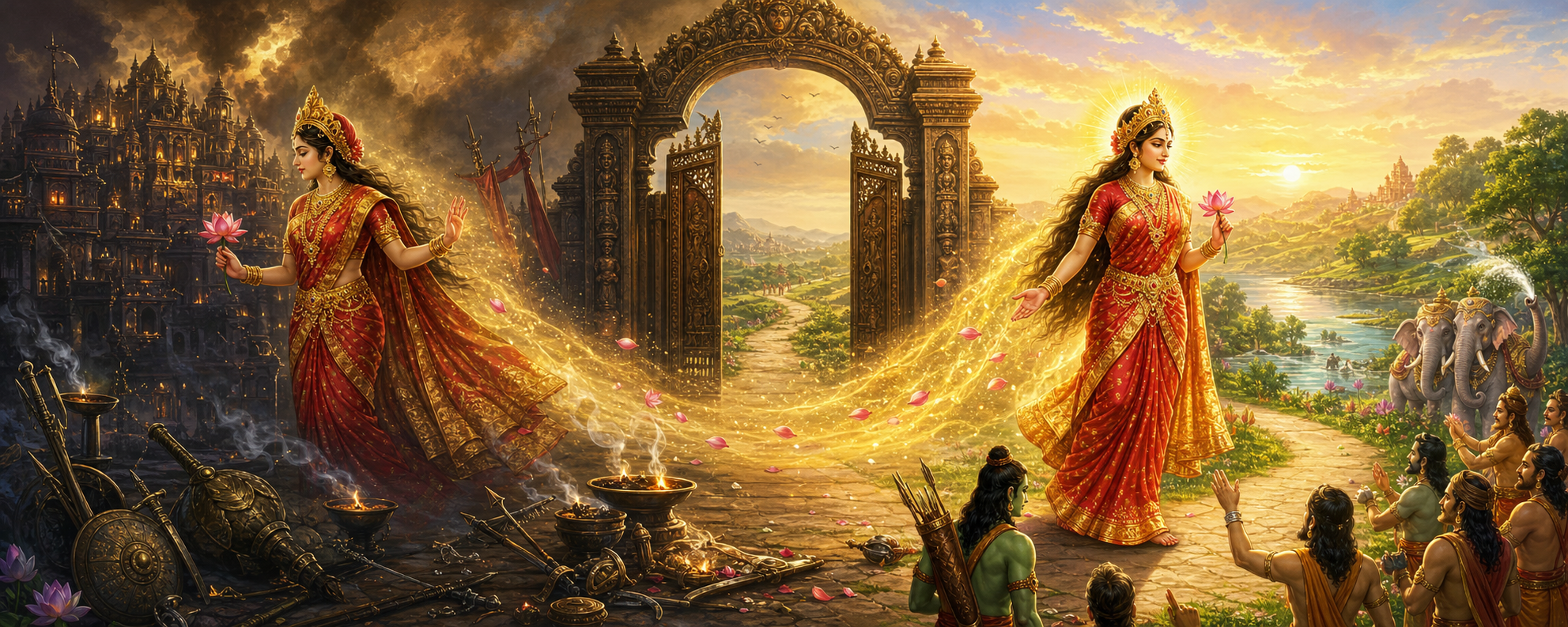
Lakshmi cannot be reduced to a pile of coins. Sri includes splendour, abundance, auspiciousness, dignity, fertility, and the conditions of flourishing. This is why the traditional description of fortune as cala, mobile, is ethically important. Wealth can be possessed, but auspicious prosperity cannot be imprisoned and compelled to endorse every use of it.
Lankalakshmi and Vijayalakshmi express opposite movements within that moral vision. Lankalakshmi marks the protection and fortune associated with a particular city. When the city’s rule becomes deeply adharmic, that protection ceases to ratify the regime. Vijayalakshmi, honoured among enumerations of the Astalakshmis, represents victory that crowns a rightful undertaking.
Vijaya here must not be confused with the mere ability to overpower someone. Ravana has already demonstrated conquest, accumulation, command, and the ability to make others fear him. Those accomplishments do not amount to Vijayalakshmi. Dharmic victory concerns the justice of the cause, the discipline of the means, and the order established by the result.
Hanuman embodies that distinction at the gate. He has immense strength, yet he enters as Rama’s envoy and acts in service of a defined mission. The measured nature of his response to Lankini matters. Force is present, but force is not the purpose. His task is to find Sita and advance a just cause, not to convert strength into a licence for appetite.
Do not turn Lakshmi’s mobility into a superstition that every setback reveals hidden sin or that every dishonest person must fail immediately. Lanka remains imposing even after its moral credit has been depleted. The episode instead warns you about an ethical lag: adharma can enjoy inherited capital, institutional momentum, and outward prestige after auspicious legitimacy has begun to depart.
This makes the teaching sharper, not weaker. You cannot wait for visible collapse before correcting a wrong. By the time the treasury empties, the institution fails, or public confidence disappears, the decisive breach may have occurred much earlier at an unnoticed moral threshold.
Use the gate test before calling prosperity a success

You can turn Lankini’s encounter into a disciplined audit. Use it before celebrating a gain, defending an institution, accepting a professional victory, or invoking Lakshmi over a project. The questions are practical because they examine the structure beneath the visible result.
- Examine the origin. Was the benefit created through honest effort, received as a trust, or seized through deception and domination? Lanka’s beauty does not erase the moral problem of Ravana’s appropriation. A clean exterior cannot cleanse a corrupt acquisition.
- Identify who paid the hidden price. Look beyond the beneficiary. If another person’s freedom, dignity, truthful speech, or rightful claim had to be suppressed, the gain carries Ravana’s warning even when it remains profitable or prestigious.
- Test the gatekeepers. Name the person, rule, institution, or practice empowered to say no. Then ask whether it can restrain insiders with power, not only strangers without it. A guardian who must approve every act of the ruler is ceremonial security.
- Separate permission from dharma. Something may be customary, technically permitted, or politically convenient and still rely on cruelty or deceit. Rajadharma demands more than the preservation of power. It asks whether power serves justice, truth, restraint, and the conditions in which people can flourish.
- Define victory before pursuing it. State what a just completion would look like. If success means only defeating a rival, silencing criticism, or possessing what another person refuses to surrender, you are describing conquest rather than vijaya.
- Check what the result will protect. Prosperity becomes auspicious through stewardship. Ask whether the new wealth or authority will strengthen duty, hospitality, learning, family responsibility, community resilience, and fair dealing, or merely enlarge appetite.
In a household, the test can be as simple as refusing to let status determine whose truthful concern is heard. In professional life, it means treating compliance officers, reviewers, and candid colleagues as safeguards rather than obstacles to be neutralised. In public life, it means judging a government by justice and restraint as well as roads, treasuries, monuments, or military strength.
The same test can deepen devotional practice. During a Sundara Kanda recitation, Navaratri observance, or reflection around Vijayadashami, pause at Lanka’s gate. Ask which gain in your life currently looks golden, which voice guards its moral boundary, and what correction that voice has been trying to make. This is not a replacement for worship. It is a way to prevent worship of Lakshmi from becoming a request for abundance without accountability.
There is also a warning for cultural and political advocacy. It is easy to condemn Ravana in sacred memory while excusing Ravana-like methods when they benefit one’s own faction. The Lankini test does not ask whether the powerful person is ours. It asks whether power remains answerable to dharma. A guardian who changes standards according to allegiance has already abandoned the gate.
Key takeaways
- The Ramayana does not condemn wealth itself; it rejects the use of splendour as proof that its possessor is righteous.
- Lankini’s defeat signals a loss of moral protection, not merely a failure of physical security.
- Remembering Lankini as Lankalakshmi expresses the mobility of sri: auspicious prosperity cannot be permanently bound to adharma.
- Vijayalakshmi represents the successful completion of a just undertaking, not victory at any cost.
- Wealth should be assessed by its origin, hidden costs, restraints, purpose, and stewardship, not only by its amount.
- Neither poverty proves wrongdoing nor outward success proves divine approval; the episode is an ethical teaching, not a simplistic prosperity formula.
The next time prosperity reaches your threshold, do not ask only how much has arrived. Ask what had to happen for it to arrive, who is allowed to challenge its use, and what kind of life it will sustain. If the answers withstand that gate test, welcome the abundance and steward it well. If they do not, repair the breach before asking Lakshmi for more.
References
