
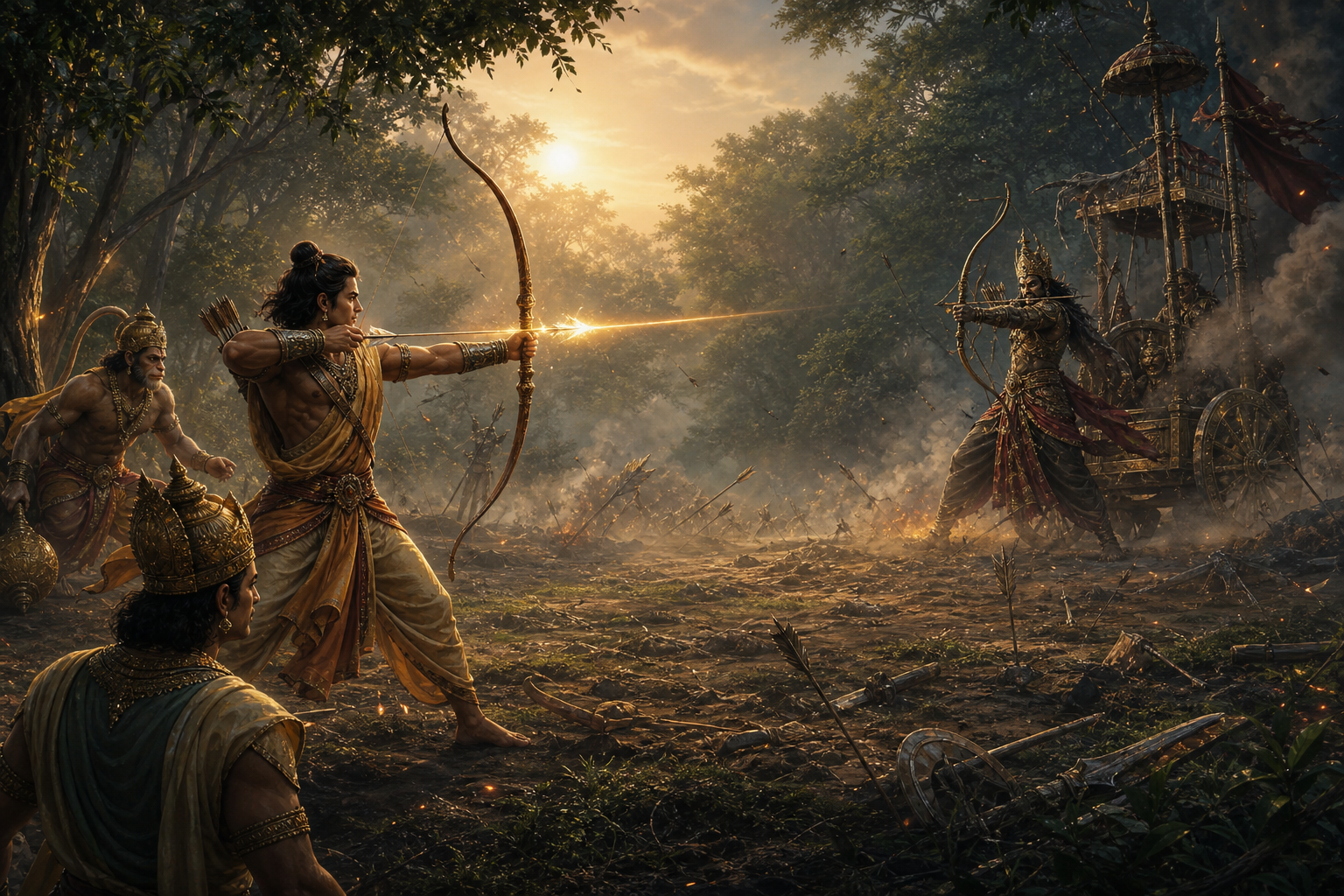
If you are asking why Lakshmana could defeat Indrajit, look beyond the final exchange of weapons. The decisive movement begins earlier: Lakshmana accepts wise counsel, recognizes the danger of Indrajit’s unfinished yagna at Nikumbila, and intervenes while the outcome can still be changed.
That sequence is the key to the episode. Lakshmana does not rely on courage without thought, strategy without moral limits, or devotion without action. He brings counsel, timing, discipline, and direct responsibility together. If you remember only who struck the final blow, you miss why this victory became one of the Ramayana’s clearest models of dharmic action.
The battle was decided before Indrajit appeared invincible
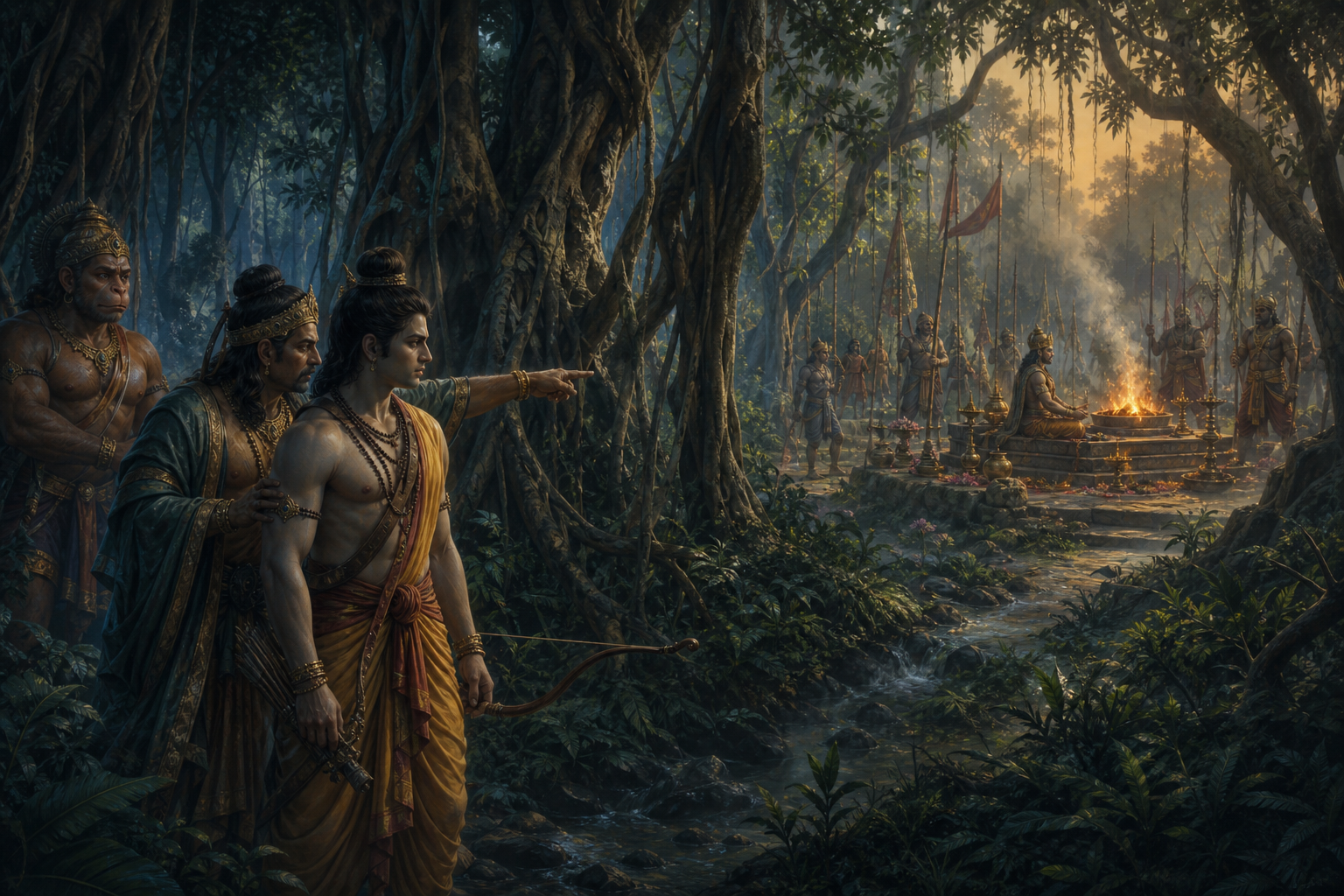
Indrajit, also known as Meghanada, was Ravana’s formidable son and one of Lanka’s most dangerous warriors. During the war, he began a powerful yagna at a sacred site dedicated to Ma Nikumbila. Its intended result was not merely spiritual merit. Completion would secure the ritual protection that Indrajit sought in order to become invincible and reverse the course of the conflict.
This made timing decisive. Lakshmana’s urgent task was not simply to find Indrajit and challenge him. It was to reach the point where his opponent’s growing advantage could still be interrupted. Within the Yuddha Kanda sequence, Lakshmana reaches Nikumbila before the yagna is completed, deprives Indrajit of its crucial protection, and then defeats him in direct combat.
Three decisions shape that result:
- Lakshmana listens before acting. Wise counsel identifies the real danger. He does not allow pride to turn the crisis into a test of whether he can solve everything alone.
- He acts before the danger becomes fixed. The yagna is unfinished. Delay would allow Indrajit’s intended protection to take effect, so Lakshmana intervenes at the meaningful decision point rather than waiting for a more dramatic battlefield encounter.
- He accepts the confrontation that follows. Interrupting Indrajit’s preparation does not replace courage. It creates the conditions for a direct battle that Lakshmana must still fight and win.
Strategy and bravery are therefore not competing explanations for the victory. Lakshmana’s bravery becomes effective because it is governed by accurate counsel and timely action. His strategy remains honorable because he does not use it to escape his duty.
Why interrupting the yagna does not make both sides equal
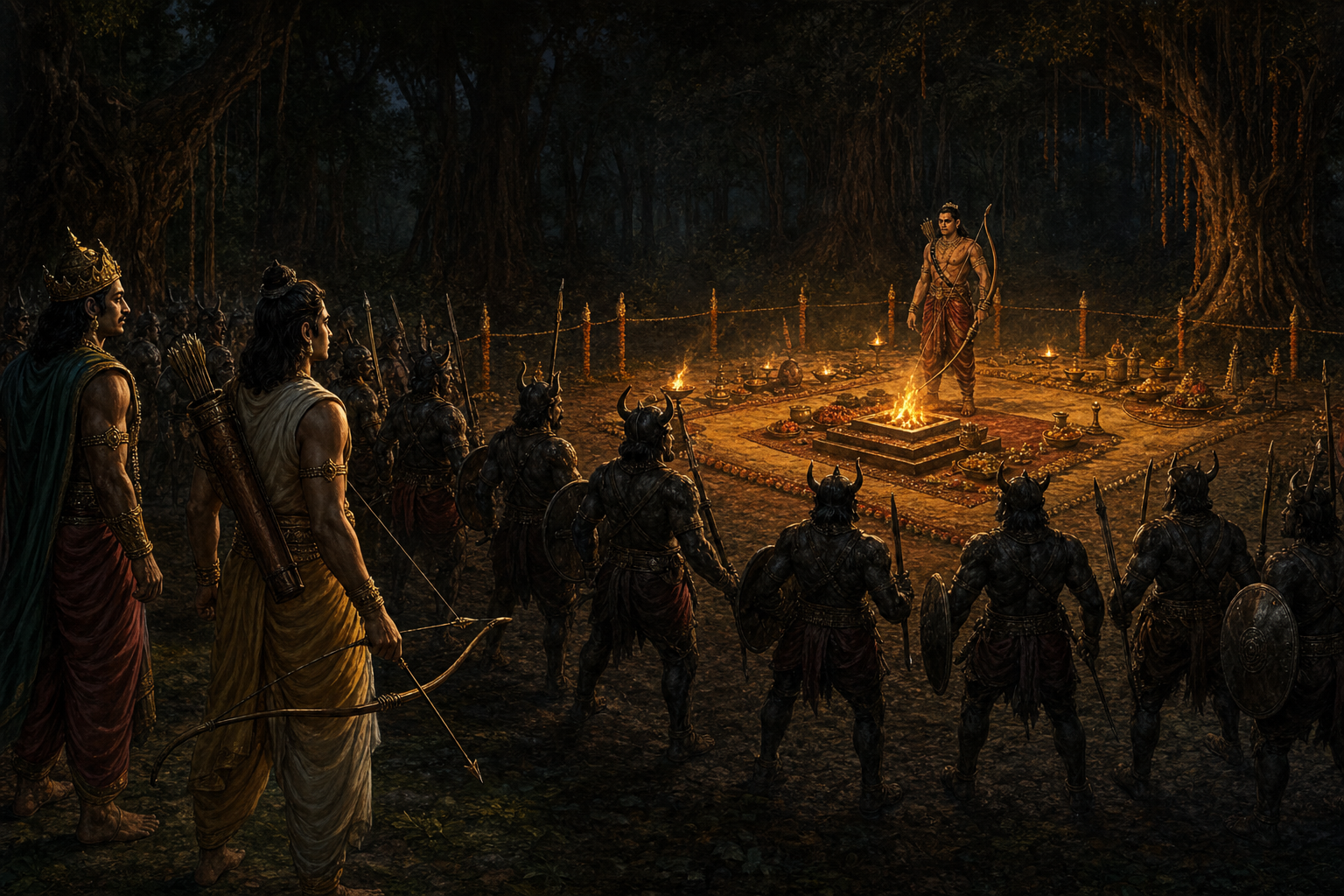
A serious reading must face the apparent difficulty: if a yagna is sacred, how can stopping it be dharmic? The answer lies in the purpose for which power is being sought. Indrajit’s rite forms part of his war effort and is intended to place invincibility at the service of Ravana’s side. The moral question is not simply whether a ritual is taking place. It is what that ritual is being used to accomplish.
Ritual power is not presented as an automatic certificate of righteousness. A sacred form cannot make every intention sacred. Within the ethical world of the Ramayana, power receives its proper dignity when it protects truth, life, harmony, and rightful order. When power is directed toward adharma, preventing its consolidation can become part of dharmic duty.
This does not provide a general excuse to disrupt worship, despise ritual, or attack practices one dislikes. The circumstances are specific: Indrajit is an active combatant in an ongoing war, and the yagna is the immediate means by which he seeks decisive military invulnerability. Lakshmana stops that process and then personally bears the danger of the battle. Removing an unjust advantage is not used as a substitute for accountability.
When you evaluate the ethics of an intervention, the episode gives you four useful tests:
- Purpose: What concrete end does the contested action serve?
- Necessity: Is intervention needed before serious harm or an unjust advantage becomes difficult to reverse?
- Responsibility: Will the person intervening accept the duties and consequences that follow?
- Restraint: Is the response directed at the enabling danger, or has opposition become an excuse for humiliation, vengeance, or personal ambition?
These questions prevent a shallow equation of dharma with passivity. They also prevent the opposite error of calling every forceful action righteous. The measure is not intensity. It is disciplined alignment between purpose, means, and duty.
Lakshmana’s heroism is disciplined seva, not self-display
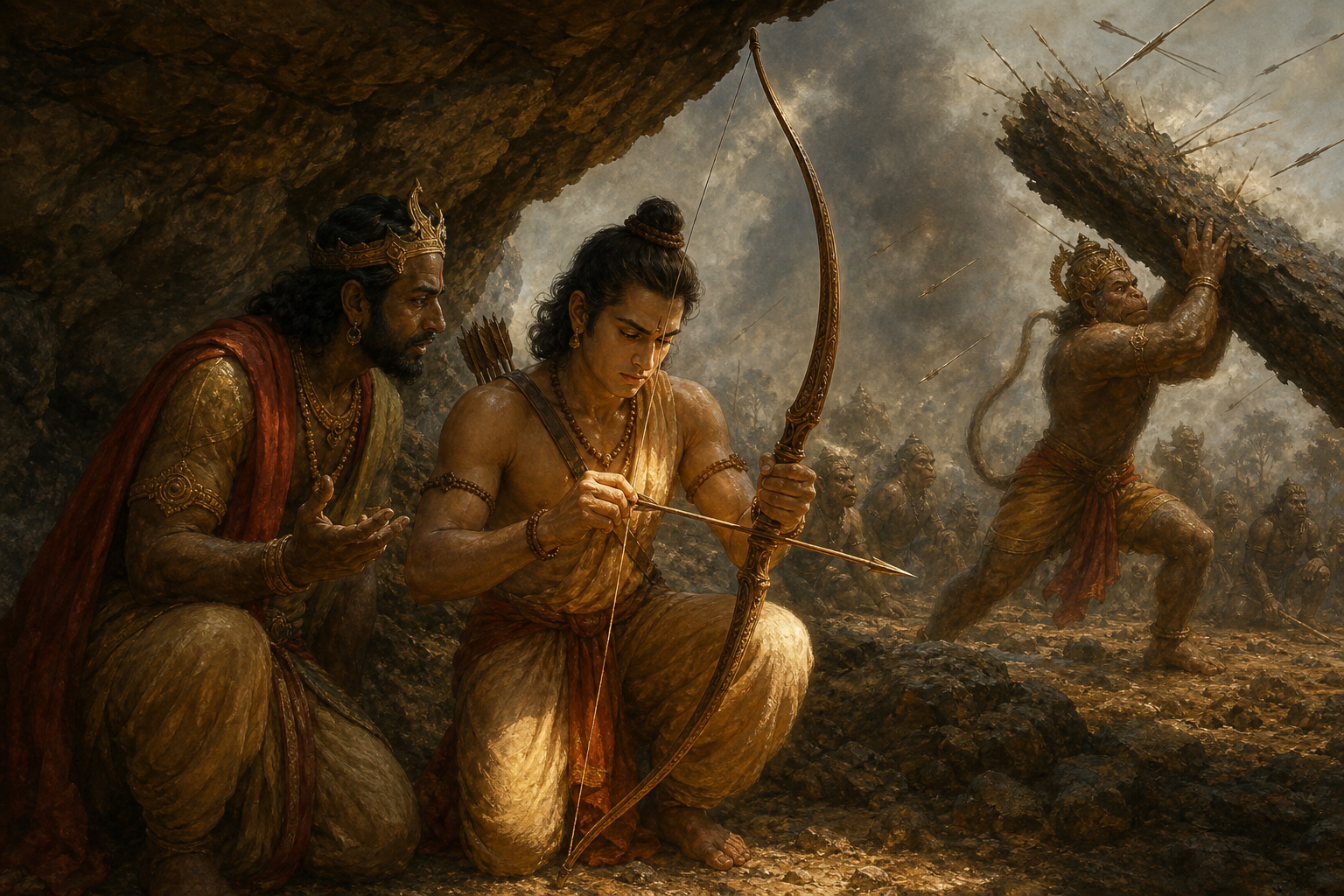
The honorific Indrajit Samhara Moorthy remembers Lakshmana specifically as the slayer of Indrajit. Yet the title carries more than the fact of a military victory. It preserves a form of heroism built from loyalty, self-mastery, moral clarity, and service.
Lakshmana’s loyalty is not passive obedience. Once the right course becomes clear, he takes initiative and enters danger. This is an important correction to a common misunderstanding of seva. Service does not mean waiting to be carried by someone else’s strength. It can require preparation, judgment, and decisive action on behalf of a duty larger than oneself.
His acceptance of counsel also matters. An ego-driven warrior may hear advice as an insult to his competence. Lakshmana treats sound guidance as part of strength. He allows knowledge of the situation to determine his next step, even though he must personally perform the difficult work afterward.
That combination separates humility from hesitation. Humility admits that another person may see what you do not. Courage acts once the truth of the situation is understood. Discipline keeps both qualities directed toward the proper end.
This is why the devotional memory of Lakshmana as Indrajit Samhara Moorthy should not be reduced to an image of violence. The victory is remembered because a force sustaining adharma is overcome by someone whose strength remains within the compass of duty. Ritual remembrance, temple iconography, and scriptural study keep the complete pattern before the devotee: service that can think, humility that can act, and courage that does not need ego for fuel.
The same pattern can speak across the wider Dharmic emphasis on self-mastery, responsibility, non-harm, compassion, and the common good without pretending that every tradition expresses those values in identical ways. The transferable principle is precise: power should be governed rather than worshipped, and courage should be answerable to an ethical purpose.
Use the Nikumbila moment to approach a difficult problem

It is tempting to turn Indrajit into a vague symbol for any problem and Lakshmana into a promise that confidence will defeat it. That reading is too easy. The episode offers a more demanding practice: identify what is making the problem stronger, find the last ethical point at which that process can be changed, and accept the work that remains after you intervene.
You can use the following discipline when a challenge appears overwhelming:
- Name your duty in one sentence. State what you are responsible for protecting or completing. If you cannot name a legitimate duty, urgency may be disguising wounded pride or a desire for control.
- Separate the visible opponent from the enabling condition. Ask what preparation, process, assumption, or recurring advantage keeps making the problem harder. Lakshmana had to address the yagna before he could settle the battlefield contest.
- Seek counsel that can correct your diagnosis. Do not ask only for encouragement. Ask someone trustworthy what you may have misunderstood, what timing matters, and what consequence your preferred action could create.
- Locate the point before hardening. Find the step after which the problem becomes significantly more difficult to reverse. Act there if you have the authority and an ethical means to do so.
- Set boundaries before acting. Decide what you will not do, even for a desirable outcome. Dharma cannot be protected by casually adopting deception, cruelty, or ego as ordinary methods.
- Finish the direct work. Changing the conditions is not the same as completing the duty. Once the unfair advantage, flawed process, or false premise has been addressed, you still have to meet the substantive challenge.
In professional life, this may mean correcting an approval process before repeated deadline disputes occur. In community work, it may mean challenging a false premise before positions harden around it. In personal discipline, it may mean changing the setup that repeatedly leads to failure instead of relying on willpower at the final moment. The analogy is useful only when the intervention remains truthful, proportionate, and directed toward a legitimate responsibility.
The method is not a guarantee that every obstacle will yield. Lakshmana still has to fight a formidable opponent after the yagna is interrupted. The practical lesson is therefore not that one clever move eliminates hardship. It is that courage should meet hardship under the best conditions that dharmic judgment can honestly create.
Key takeaways
- Lakshmana’s victory begins with wise counsel and timely intervention, not with the final blow alone.
- Indrajit’s unfinished yagna matters because it is intended to secure invincibility and change the conditions of the war.
- Stopping that preparation is followed by direct combat, so strategy does not replace courage or responsibility.
- The honorific Indrajit Samhara Moorthy remembers disciplined seva, loyalty, self-mastery, and dharmic strength as much as military success.
- The practical pattern is to identify an enabling condition, intervene before it hardens, preserve ethical boundaries, and then complete the difficult work.
Choose one challenge in front of you and write down three things: the duty you actually hold, the condition making the problem stronger, and the last ethical moment when that condition can be changed. Then ask one trustworthy person to test your diagnosis before you act. That measured sequence comes closer to Lakshmana’s example than merely admiring his final victory.
References
