
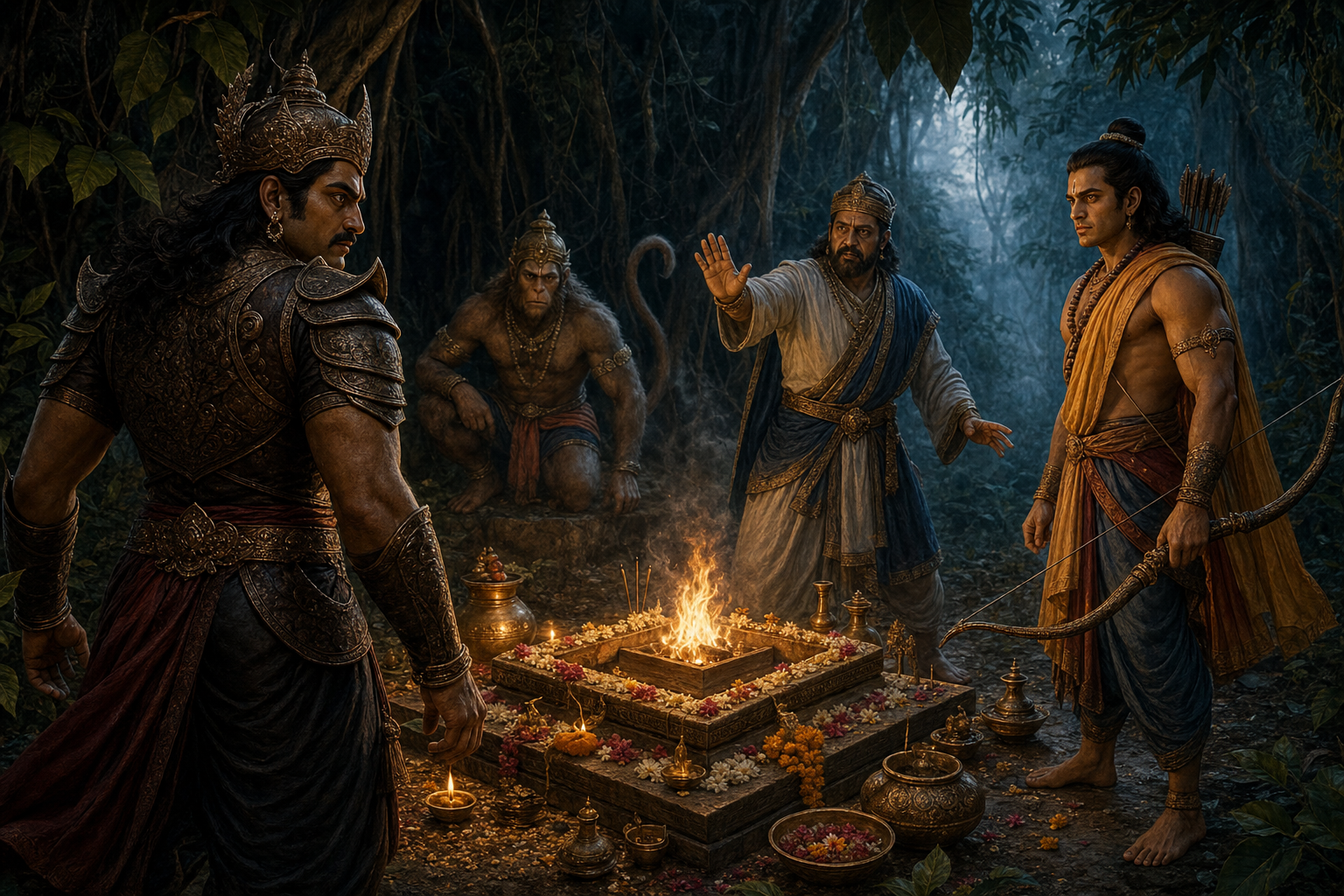
If the interruption of Indrajit’s yajna at Nikumbila has ever troubled you, the difficulty is real. A sacred rite was underway, Lakshmana intervened before it could be completed, and the intervention helped make Indrajit’s defeat possible. How can that be reconciled with dharma?
The answer cannot be that a righteous end excuses any means. The episode asks for a more demanding judgement: examine the purpose being served, the harm that delay would permit, the limits placed on intervention, and the motive of the person acting. That framework is useful well beyond the battlefield.
The real question at Nikumbila is not ritual versus irreverence
Indrajit, also known as Meghanada, was a formidable master of astras and maya. At Nikumbila, he sought invincibility through a sacred yajna invoking Ma Nikumbila. Vibhishana understood what completion of that rite would mean and guided Lakshmana, supported by Hanuman, to the ritual ground at the critical hour.
The ethical problem has three distinct parts. The form of the act was sacred. The immediate purpose was to obtain invincibility. The intended use of that advantage was to sustain Ravana’s war and prolong adharma. Confusing those three parts makes the dilemma seem impossible.
- Respect for a sacred form does not require blindness to the purpose for which it is being used.
- Stopping a destructive objective is not the same as condemning worship itself.
- A religious act does not automatically make every intention attached to it righteous.
Lakshmana’s target was not devotion to Ma Nikumbila. It was the acquisition of an overwhelming advantage in the service of adharma. Once the rite had been interrupted, the conflict proceeded as open combat. The distinction matters: the sacred was not treated as contemptible, and interruption was not celebrated as desecration for its own sake.
This is also the guardrail against abusing the story. Nikumbila is not a licence to attack a ceremony, community, or place of worship because you distrust it. The narrative presents an exceptional wartime situation, a specific destructive objective, informed counsel about the consequence of completion, and an intervention directed at that objective. Remove those conditions and the moral reasoning changes.
A four-part dharma-yuddha test for difficult action

Lakshmana is revered as Indrajit Samhara Moorthy, the one who slew Indrajit. Yet the epithet should not be reduced to superior battlefield power. His victory joins disciplined service to Sri Rama with correct timing, wise counsel, courage, and a bounded objective.
When you face a conflict and feel tempted to call your preferred action “dharmic,” apply four tests before acting. They will not make every choice painless, but they will expose several common disguises of anger and expedience.
1. Identify the actual object of intervention
Ask exactly what must be stopped. At Nikumbila, the object was not yajna as a practice. It was the completion of a particular rite being used to secure destructive invincibility.
Make the same distinction in your own dispute. Do not say, “I must defeat this person.” Name the harmful act, capacity, decision, or pattern instead. If you cannot describe the object without insulting an identity or condemning an entire group, you probably have not defined it carefully enough.
2. Account for necessity and timing
The Nikumbila intervention occurred before the rite was completed. That timing was not incidental. Completion would have strengthened Indrajit’s ability to continue the war, so delay carried a foreseeable cost.
Before a difficult intervention, ask two separate questions: What happens if you act now, and what becomes harder to reverse if you wait? Impatience can masquerade as urgency, but avoidance can masquerade as patience. Dharma requires you to examine both dangers.
3. Use proportionate means and define the stopping point
A dharmic objective does not grant unlimited permission. The means must remain connected to the harm being prevented. At Nikumbila, the immediate task was to prevent completion of the rite; the subsequent task was to face Indrajit in battle. The intervention did not turn every sacred thing or every person nearby into a legitimate target.
In an ordinary conflict, choose the least destructive measure that can realistically prevent the harm. Then establish a stopping condition before emotion takes over. What result would make further pressure unnecessary? What must remain protected even while you oppose the wrongdoing? If your plan has no limit, it is not yet governed by dharma.
4. Test whether the motive can withstand scrutiny
Lakshmana’s defining orientation is seva to Sri Rama, not the pursuit of personal glory. His action also rests on Vibhishana’s counsel and Hanuman’s support. He does not simply announce that his own intensity proves the righteousness of his cause.
- Would you still take this action if someone else received the credit?
- Are you protecting others, or using their protection to justify revenge?
- Can you explain the action to a wise person who is permitted to disagree with you?
- Will you accept restraint once the specific danger has ended?
A motive need not be emotionally spotless before you can act. Human beings often carry fear, anger, loyalty, and duty at once. But the governing intention must be protection and restoration, not humiliation or domination.
Lakshmana’s victory depends on shared knowledge and distinct roles

Indrajit’s command of astras and maya made direct courage insufficient. The decisive response required three different contributions working toward one dharmic aim.
- Vibhishana supplied knowledge of the hidden danger and the importance of timing.
- Hanuman supplied strength and support for reaching and confronting that danger.
- Lakshmana accepted the counsel, carried responsibility, and executed the decisive action.
This is more than a celebration of teamwork. It shows why a righteous cause can fail when its participants confuse moral conviction with complete knowledge. Lakshmana’s courage did not make Vibhishana’s insight unnecessary. Vibhishana’s insight did not remove the need for Hanuman’s strength. None of those contributions replaced Lakshmana’s disciplined execution.
When you are responsible for a difficult decision, identify these roles explicitly. Who understands the terrain? Who can provide practical support? Who has the authority and discipline to act? One person may fill more than one role, but leaving a role unfilled creates a predictable weakness.
Also notice what Lakshmana does not do: he does not reject counsel because receiving help might diminish his heroism. In your own work, family, or community, ask the person with the closest knowledge to explain the mechanism of the problem, not merely to endorse your preferred response. Goodwill without accurate knowledge can arrive too late. Knowledge without capacity remains inert. Capacity without moral direction becomes dangerous.
Read the battle inwardly without making its moral claim harmless

There are two easy ways to weaken this episode. One is to use it as a blanket glorification of force. The other is to turn the entire battle into a private metaphor, as though organized adharma and the duty to protect others were never real concerns. A serious reading should resist both.
Outwardly, the episode affirms that destructive power may have to be stopped before it becomes harder to resist. Inwardly, it asks you to notice the harmful patterns you keep strengthening while telling yourself that their form, familiarity, or immediate comfort makes them acceptable.
Indrajit’s maya offers a particularly sharp inward image. Self-deception rarely announces itself as deception. It gives resentment the name of justice, avoidance the name of peace, and ambition the name of service. Your task is not merely to fight harder inside your mind. It is to see the disguise before the pattern acquires another layer of protection.
Use a “Nikumbila moment” when you sense that a harmful tendency is nearing a point of completion:
- Name what is being strengthened: anger, dishonesty, dependency, vanity, cowardice, or another specific tendency.
- Identify the completion point after which reversal becomes harder: the message sent, the lie repeated, the duty abandoned, or the public commitment made.
- Seek your Vibhishana: a person able to see the mechanism clearly and tell you what you may not want to hear.
- Interrupt the pattern at its source, using the smallest action that genuinely prevents completion.
- Do not continue punishing yourself or others after the immediate danger has passed; return to the duty that the interruption was meant to protect.
This inward practice preserves the relationship between courage and compassion. Compassion determines what must be protected. Courage prevents concern from collapsing into passivity. Discipline keeps necessary resistance from turning into cruelty. Across Dharmic traditions, those virtues may be articulated differently, but they should not be separated casually.
Be equally cautious about assigning epic roles to people around you. Calling yourself Lakshmana and an opponent Indrajit proves nothing. If you cannot name the concrete harm, accept informed correction, limit your means, and state when you will stop, the language of dharma-yuddha may be concealing attachment rather than clarifying duty.
Key takeaways for your next difficult conflict
- The sacred appearance of an act does not settle the morality of its intended purpose.
- Lakshmana intervened against a destructive objective, not against worship as such.
- Dharma-yuddha binds strategy to right intention, necessity, proportion, and restraint.
- Correct timing matters because some forms of adharma become much harder to resist after they acquire power or legitimacy.
- Wise counsel, practical support, and disciplined execution are distinct needs; moral confidence cannot substitute for any of them.
- The inward lesson is to interrupt harmful patterns before they become protected by habit, rationalization, or public commitment.
The next time conflict forces a choice, do not ask only whether you are entitled to fight. Ask what precisely you are protecting, what delay will permit, which limits must remain inviolable, and who can correct your judgement. Then act at the necessary point, and stop when the dharmic purpose has been secured.
References
