
You have opened a panchang, found that Pratipada starts or ends partway through a civil date, and now need to decide when your family’s new-year observance actually belongs. The confusion usually comes from mixing two clocks: the midnight-to-midnight date used for appointments and the tithi used for worship.
You can resolve the question without pretending that every Hindu household follows one calendar. First identify the tradition, then check the tithi for your location, and finally preserve the practices through which your family marks the transition. That order matters.
Pratipada is a lunar beginning, not automatically New Year’s Day
A tithi is a lunar measure determined by the changing relationship between the Moon and the Sun. It does not have to begin at sunrise, end at sunset, or fit neatly inside a printed calendar date. Shukla Paksha Pratipada is the first tithi of the waxing fortnight, but Pratipada recurs through the year. Its arrival alone does not make every such day a new year.
A new-year identity comes from a particular calendrical tradition joining the month, paksha, tithi, and inherited observance. In the Kashmiri Hindu Saptarshi Panchang, Navreh begins with Chaitra Shukla Pratipada. Its sacred eve, Navreh Mavas, is the preceding Amavasya. In 2026, Navreh Mavas falls on March 18, followed by Navreh.
Keep three layers separate when reading the calendar:
- Lunar transition: Amavasya closes the dark fortnight, Shukla Pratipada opens the waxing fortnight, and Dwitiya continues that movement.
- Calendar tradition: A regional panchang determines which lunar transition carries new-year significance.
- Household observance: Family customs determine how the eve, dawn, worship, meal, and blessings are expressed.
This distinction prevents two common mistakes. Do not call every Pratipada a Hindu New Year, and do not dismiss a regional new year because another Hindu calendar labels the month or civil date differently. Calendar plurality is part of lived Hindu civilization, not evidence that one household must be wrong.
If members of your family inherit different calendars, name each observance precisely. You can honor more than one tradition without blending their rules into a supposedly universal date.
Read the tithi transition before making ritual plans

A civil date can contain portions of two tithis. On February 18, 2026, for example, Shukla Pratipada continues until 5:05 PM before Dwitiya begins. A person looking only at the date might call the whole day Pratipada or the whole evening Dwitiya. The panchang gives a more exact answer.
That timing is an example for a specified date, not a reusable annual rule. Do not carry 5:05 PM into another month, year, or location. Nakshatra, rashi, local adjustments, and the calendrical method being followed can affect the guidance you receive. For a formal rite or detailed muhurta, confirm the relevant details in a reliable local panchang.
Use this sequence whenever a new-year date appears uncertain:
- Write down the name of the observance. Do not begin with a generic search for Hindu New Year.
- Identify the calendar your community follows. For Navreh, that means the Kashmiri Saptarshi Panchang.
- Set the location for which you need the timing. A time copied from a distant city may not answer your local ritual question.
- Record the start and end of the relevant tithi, including whether another tithi begins during the civil date.
- Ask which rule governs the particular observance: the presence of a tithi at dawn, a prescribed muhurta, or an established household convention.
- Verify formal or consequential rites with a trusted local priest, community calendar, or panchang authority rather than inferring the rule from a festival label.
Not every devotional act requires minute-level scheduling. Cleaning the shrine, preparing offerings, performing japa, giving dana, or arranging seva can accompany the transition without being treated as a technical muhurta. Precision becomes important when a rite itself depends on a prescribed tithi, nakshatra, or local time.
Observe the threshold in two distinct movements
A lunar new year becomes more intelligible when you do not force the ending and the beginning into the same mood. Amavasya can hold closure and preparation; Pratipada can carry intention and renewal. Dwitiya then asks whether the intention will become a practice.
On the Amavasya eve: clear, remember, and prepare
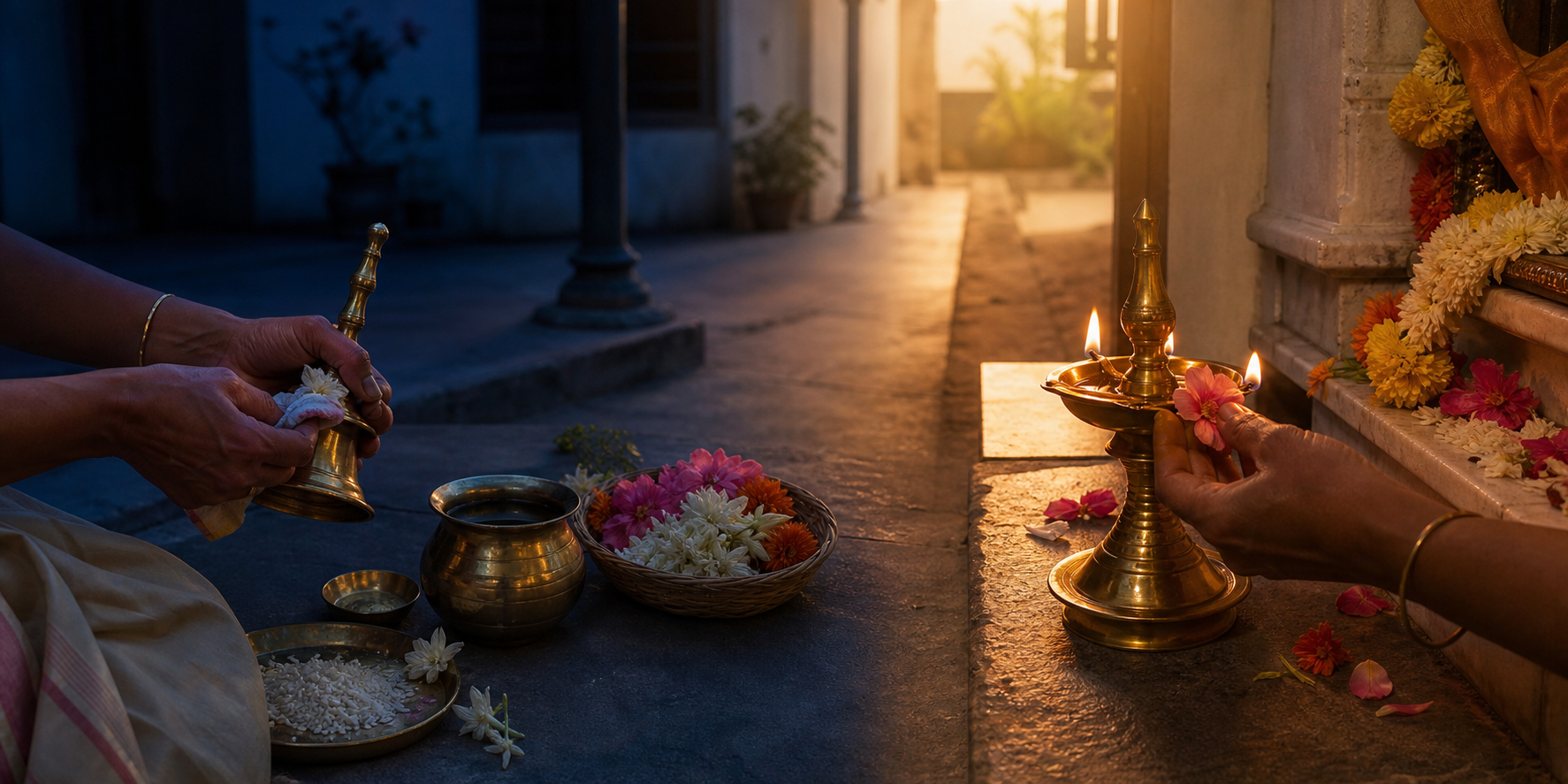
Navreh Mavas offers a practical model of quiet preparation. The observance commonly includes tidying the home, keeping food sattvic, preparing or planning the Navreh thali, lighting a lamp, expressing gratitude, and remembering ancestors according to household custom. These are not items to perform mechanically. Each one turns attention away from unfinished clutter and toward a conscious threshold.
- Clean the shrine and the part of the home where the family will gather. Do not exhaust everyone with an unnecessarily large cleaning project on the sacred eve.
- Ask the family member who knows the tradition to identify what must be prepared before dawn. Record the answer so the practice does not depend entirely on memory next year.
- Prepare the Navreh thali according to your own family or community custom. Because household practices vary, an online checklist should not displace inherited knowledge.
- Light a diya and allow a quiet period for remembrance, prayer, or gratitude. If ancestor remembrance belongs to your family practice, keep it respectful and simple.
- Choose something from the closing year that should not be carried forward as a habit. Give the decision a concrete form by changing the relevant routine, not merely naming a hope.
The eve should feel ordered, not theatrical. Its purpose is readiness. If decorating, cooking, or photographing the occasion leaves no room for contemplation, the supporting activity has overtaken the observance.
On Pratipada: see clearly and make a workable sankalpa
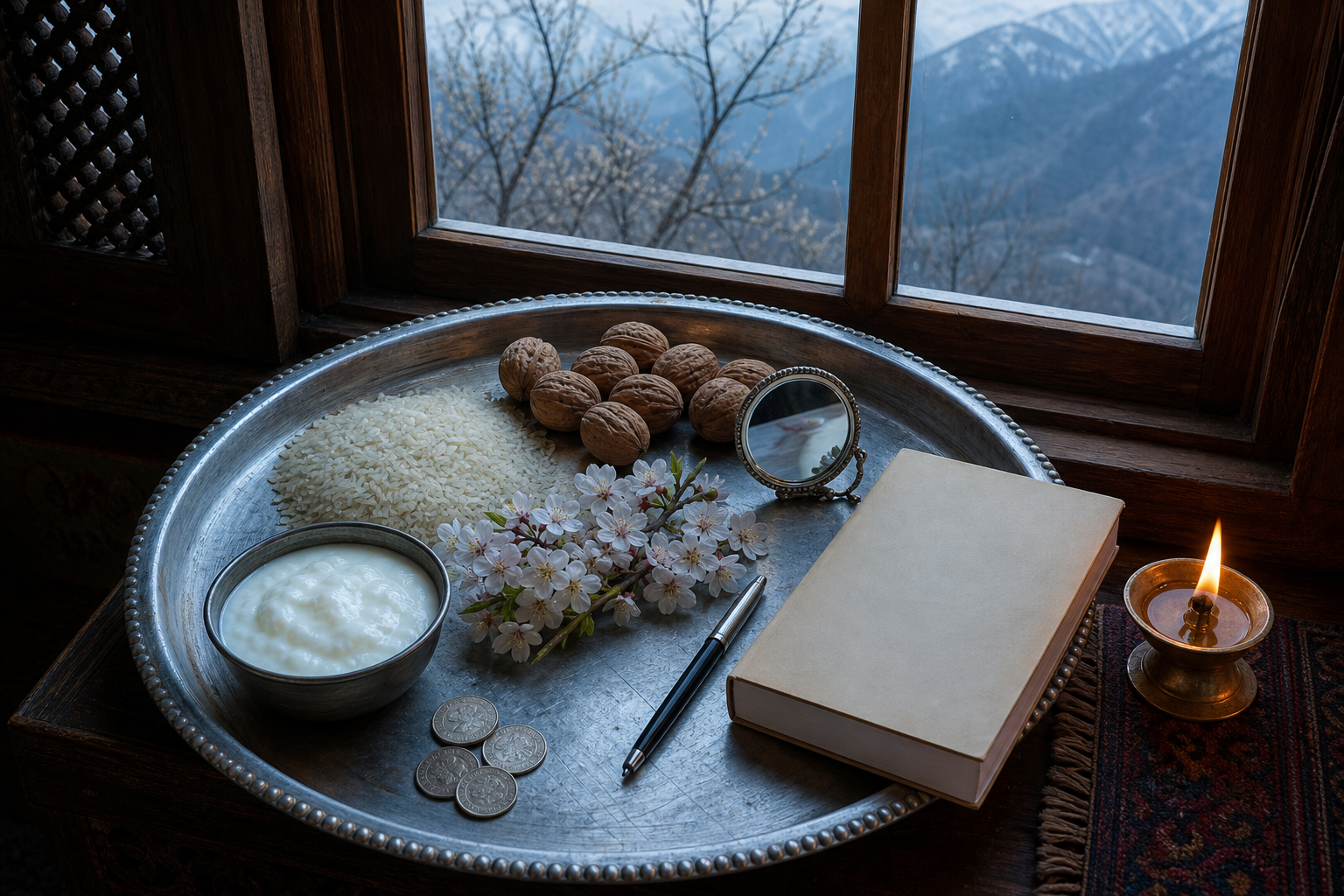
For Navreh, the first sight of the prepared thali at daybreak carries particular family significance. Let that moment remain more than a display. Invite an elder or knowledgeable relative to explain why the household includes what it does, and let younger family members participate in preparing, presenting, or carefully putting away the items.
Pratipada is also a natural time for sankalpa, prayer, learning, and the orderly beginning of a practice. A simple Ganesha puja may be used to honor a beginning where that fits the family’s sampradaya. Japa, meditation, dana, and seva are equally meaningful when performed with clarity rather than as additions to an overfilled ritual schedule.
Make the sankalpa small enough to obey. Replace a vague wish such as becoming more spiritual with a named practice tied to a regular point in your day. Decide where it will happen, what will remind you, and what you will do when travel or work disrupts the routine. A lunar beginning can mark intention, but it does not guarantee success. Abhyasa, repeated practice, is what carries the intention beyond the festival.
When Dwitiya arrives: protect continuity
Dwitiya changes the question from what you are beginning to how you will sustain it. The movement from Pratipada to Dwitiya can therefore guide practical follow-through: put away ritual objects carefully, fulfill promised dana or seva, begin the chosen study, and tell the people affected by any new family routine.
This is especially useful when Pratipada ends during the civil day. You do not have to treat Dwitiya as a spiritual drop-off. The transition from initiation under Pratipada to steadiness under Dwitiya gives the second tithi its own practical role.
Preserve Navreh without turning it into a generic festival
A tradition remains alive when people can repeat it, explain it, and adapt its logistics without erasing its identity. Navreh should therefore be named as a Kashmiri Hindu new-year observance rooted in the Saptarshi Panchang. Its values may resonate across dharmic communities, but that does not make its distinctive calendar and family customs interchangeable with every other new year.
Create a modest household record while the details are fresh. Include:
- the calendar tradition and the location used to obtain the year’s timing;
- what your family does on Navreh Mavas and what it reserves for Navreh morning;
- the contents of your household’s thali, using the names your family uses;
- the prayers, stories, foods, or forms of remembrance that elders consider essential;
- the relatives or community members who can resolve a question next year.
Do not label every remembered detail as an absolute scriptural requirement. Customs vary among households even when they share the quiet pattern of cleaning, sattvic preparation, lamp-lighting, gratitude, and anticipation of the dawn thali. Record whether a detail is a family custom, a community convention, or a panchang rule. That distinction lets descendants preserve the practice honestly.
Give children a real task rather than making them spectators. They can help arrange the sacred space, listen to the explanation of the thali, carry a family greeting, or join an act of dana or seva. The aim is not to stage a lesson during worship. It is to connect a visible action with the meaning of renewal.
The broader dharmic values are best expressed through conduct. Ahimsa can shape how the family speaks during a demanding preparation. Dana can direct some new-year abundance outward. Seva can turn gratitude into responsibility. These shared values create kinship across dharmic traditions while the precise Navreh observance remains Kashmiri and Hindu.
Key takeaways
- Shukla Pratipada begins every waxing fortnight; it becomes New Year’s Day only within a calendar tradition that assigns it that role.
- A tithi can begin or end during a civil date, so a date label alone is not enough for ritual planning.
- Use the panchang for your location and tradition. Never reuse a previous year’s tithi time as though it were permanent.
- For Navreh, treat Navreh Mavas as a period of closure and preparation, then welcome Chaitra Shukla Pratipada with the household’s dawn observance.
- Use Pratipada to make a clear sankalpa and Dwitiya to establish the routine that will sustain it.
- Record which details are panchang rules, community conventions, and family customs. That is how you preserve variation without losing accuracy.
Before the next lunar threshold, open the local panchang early enough to separate calendar questions from household preparation. Write down the tithi transition, call the relative who carries the family memory, and decide what must be ready before dawn. Then the new year can begin as a lived discipline rather than a date noticed too late.
References
- DharmaRenaissance Blog — February 18, 2026 Panchang: Shukla Pratipada-Dwitiya Timings and Auspicious Guidance
- DharmaRenaissance Blog — Navreh Mavas: Sacred Eve of Navreh in Kashmir (2026), Meaning, and Traditions
