

You may love the Divine and still feel out of place in devotional spaces. Perhaps you are quiet when others are expressive, practical when others are contemplative, or more comfortable preparing a meal than leading a kirtan. That does not make your devotion deficient.
Your task is not to imitate the most visible devotee. It is to bring your actual temperament under spiritual discipline. Loving chanting turns your attention toward divine presence, seva gives that love a concrete form, and devotional diversity allows a community to use many capacities without forcing everyone into the same mould.
Your temperament is material for devotion, not an obstacle
A shared spiritual aim does not require a standard personality. Srila Prabhupada’s compact phrase, "Variety is the mother of enjoyment," points toward a serious principle: difference can enrich devotion when it is consecrated rather than made competitive. Temperament, skill, and inclination can become instruments of unity when they are offered as seva.
The Bhagavad Gita’s language of guna and karma, along with svabhava and svakarma, gives this diversity a disciplined frame. Your nature is not an excuse to indulge every impulse, but neither is it an embarrassment to erase. Differentiated natures and actions can become yoga when they are offered without ego. The decisive question is not whether your service resembles someone else’s. It is whether your nature is being purified, directed, and placed at the service of a worthy aim.
This corrects a common mistake in devotional communities: confusing visibility with spiritual importance. A musician may carry devotion through kirtan. A contemplative may sustain it through japa and study. An organizer can make a temple function reliably. A teacher can transmit shastra. A caregiver can hold a family or sangha together. A protector can defend vulnerable people. The public role is not automatically the deeper role, and the quiet role is not automatically the humbler one. Both can be contaminated by ego; both can become seva.
To identify service that fits your nature, ask questions that reveal both aptitude and motive:
- Which necessary work can you perform steadily, including when nobody praises it?
- Which form of service makes you more attentive to others rather than more preoccupied with your image?
- Where do people already rely on your patience, knowledge, courage, organization, artistry, or care?
- Which weakness accompanies your strength? A confident teacher may need deeper listening; a generous caregiver may need boundaries; a contemplative may need practical engagement.
- Does the service support remembrance of the Divine and the welfare of others, or merely keep you busy?
Choose a primary form of seva that uses your strength, then retain a discipline that corrects its shadow. This keeps the language of "being yourself" from becoming spiritual complacency. Dharma receives your individuality, but it also refines it.
Loving chanting is attention before it becomes emotion

If chanting feels mechanical, you may assume that love is absent and the practice is failing. That conclusion is too quick. In Gaudiya Vaishnava theology, the Name, nama, is understood as non-different from the Named, nami. Chanting is therefore approached as an encounter rather than a recital. The practical consequence is simple: give the Name the quality of attention you would give a beloved presence.
Affection cannot be manufactured on command. It can, however, be given conditions in which it can grow. Respectful attention, clear pronunciation, gratitude, ethical conduct, and willingness to serve are all forms love can take before strong emotion appears. A dry practice performed honestly is better than a dramatic mood performed for yourself or an audience.
Use this practical rhythm for personal chanting:
- Set a modest daily vow at a fixed time and place. Choose a commitment you can actually keep instead of an impressive commitment that collapses when life becomes busy.
- Sit in a relaxed but upright posture. Let breathing remain unforced so that physical strain does not become the main object of attention.
- Pronounce the mantra clearly and maintain a steady rhythm. If you use japa mala, the customary strand of 108 beads can anchor repetition without turning speed into the goal.
- Listen to the sound you are making. When the mind wanders, return to the next audible syllable without conducting an argument with yourself.
- Begin with a concrete remembrance of gratitude. End by carrying the disposition of service into a real responsibility awaiting you.
Gaudiya vocabulary distinguishes a preliminary clearing associated with nama-abhasa from the mature luminosity of suddha-nama. You do not need to claim an advanced state in order to practice sincerely. The distinction should produce patience and seriousness, not self-condemnation. Keep returning to the Name while removing what makes your attention careless or your conduct contradictory.
Japa and kirtan support different needs. Japa makes distraction difficult to hide because you repeatedly meet your own mind. Kirtan supplies collective rhythm, call-and-response, and the encouragement of shared devotion. Both are strengthened by affectionate mindfulness rather than volume, speed, or display. If you are leading kirtan, judge the result by whether people can participate and remember, not by whether your musicianship dominates the room.
When chanting becomes dull, diagnose the obstruction precisely. Irregularity calls for a dependable daily window. Distraction calls for clearer listening and a steadier pace. Emotional dryness calls for gratitude, sacred narrative, and service rather than forced sentiment. Interpersonal friction calls for honesty and repair. Repeating more rounds while refusing a necessary apology can preserve the schedule while hollowing out the relationship that chanting is meant to deepen.
Seva makes sacred sound answerable to everyday life
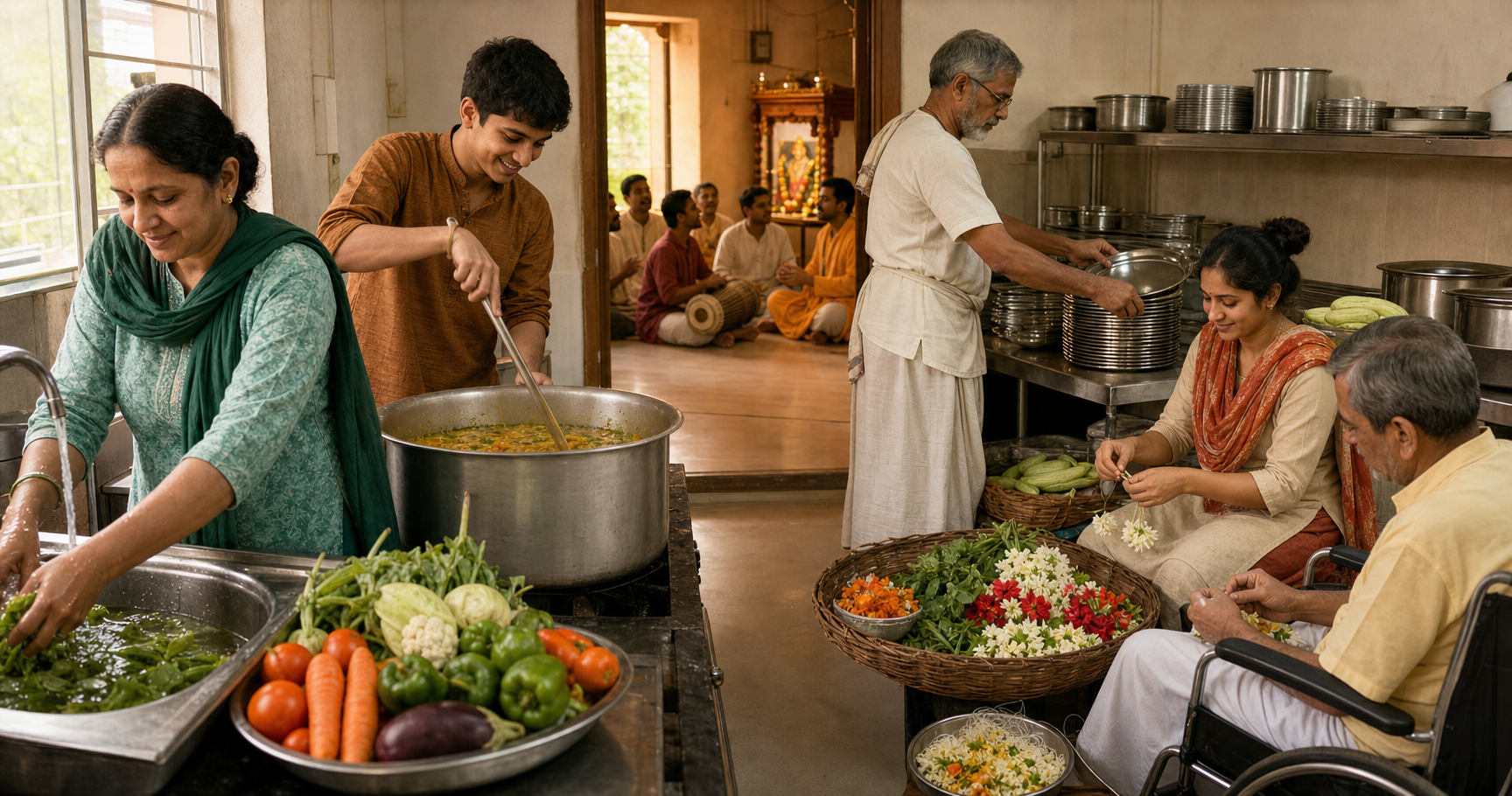
Chanting can calm and concentrate the mind, but Bhakti asks for more than a private spiritual state. The Name should gradually reshape how you speak, listen, work, and respond to inconvenience. Seva gives devotional feeling somewhere to go. It turns remembrance into food prepared, knowledge shared, administration completed, a vulnerable person protected, or a burden quietly carried.
This relationship works in both directions. Chanting can make service less possessive by returning the mind to the true recipient of the offering. Service can make chanting less abstract by giving you real occasions for gratitude, dependence, patience, and surrender. Hearing, chanting, remembering, serving, and sacred companionship reinforce one another; they are not competing departments of spiritual life.
Run a simple check after practice
Do not measure a chanting session only by whether it felt peaceful. Before moving into the rest of your day, ask:
- What responsibility is directly in front of me?
- Can I perform it with less complaint and less demand for recognition?
- Whose contribution have I overlooked because it differs from mine?
- Is there a conversation I need to conduct more truthfully and respectfully?
- What would remembrance change about my next action, not merely my present mood?
These questions keep seva concrete. "Serving humanity" can remain a flattering idea; washing utensils, correcting an administrative error, preparing a class carefully, or listening without interruption cannot. Choose the duty close enough to perform and offer it without turning your helpfulness into control.
Conflict requires particular care. Do not use visible devotion to bypass the harm. Name the problem honestly, hear the other person, make whatever repair is genuinely yours to make, and resume service without demanding immediate emotional closure. Truthfulness, compassion, respect, reconciliation, and service remove obstructions that otherwise blunt affectionate chanting.
Seva also needs discernment. Exhaustion, resentment, and possessiveness do not automatically make service holier. If you accept every task because you cannot tolerate another person’s method, the activity may be feeding identity rather than surrender. Reliable service includes sharing responsibility, allowing others to contribute, and completing the work without making yourself indispensable.
Protect diversity without confusing it with disorder
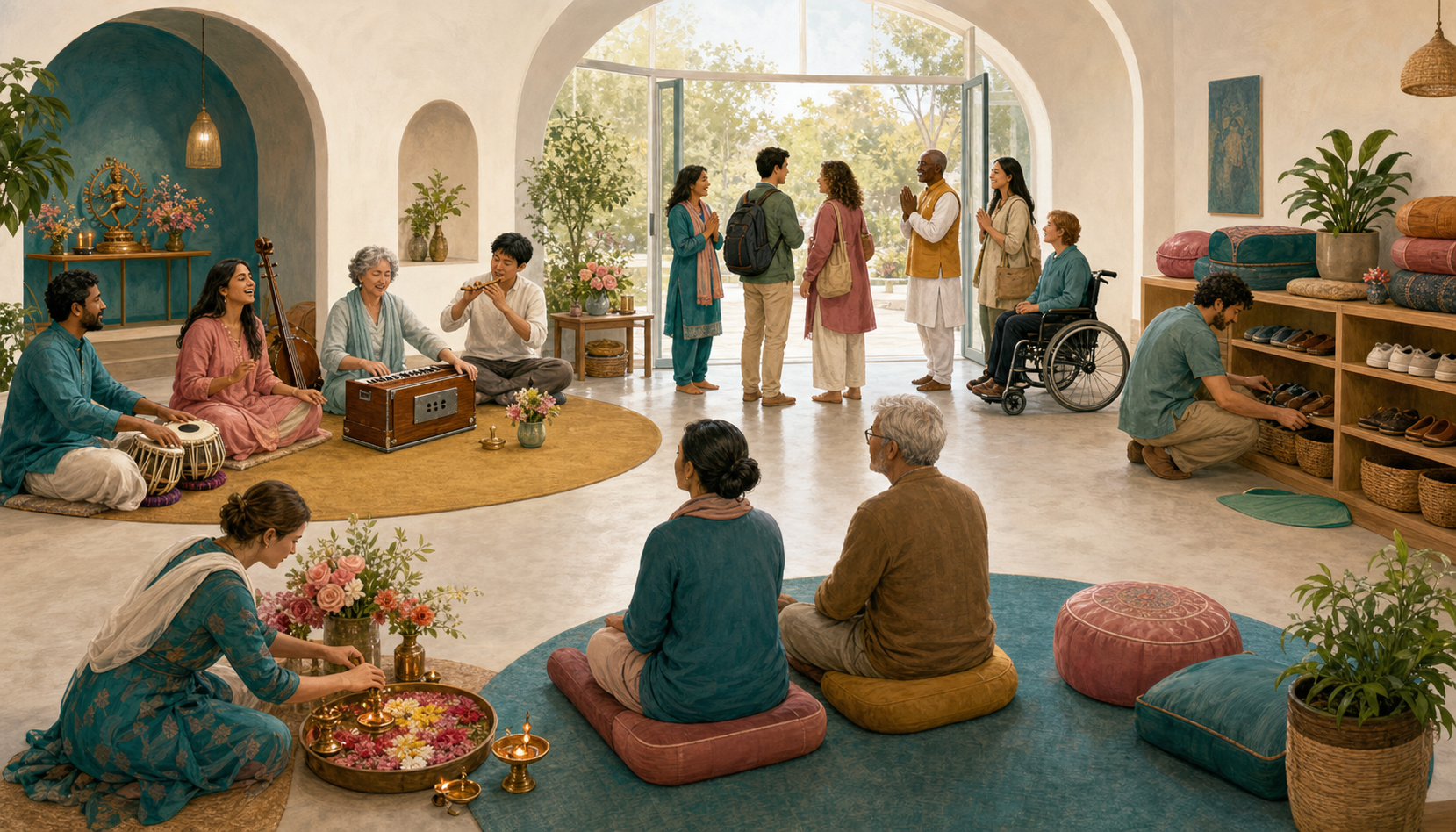
Devotional diversity does not mean that every motive, behavior, or interpretation is equally sound. A community still needs an ethical floor: truthfulness, compassion, responsibility, respect for practitioners, and protection from exploitation. The diversity to preserve is diversity of temperament, aptitude, devotional expression, and appropriate service – not freedom from accountability.
This distinction matters when virtues are turned into personality moulds. A virtue such as tolerance cannot reasonably mean that every woman must be passive, silent, or identical in disposition. Dharmic history includes devotional, intellectual, artistic, administrative, contemplative, and courageous forms of women’s service. Ethical orientation does not cancel agency, creativity, leadership, or differences of temperament.
If you help organize a temple, sangha, study circle, or kirtan gathering, apply the distinction directly:
- Name the shared ethical commitments, but do not promote personal preferences as universal virtues.
- Assign work by aptitude, steadiness, and the actual needs of the community. Do not distribute every meaningful role to the most outgoing people.
- Make quiet service visible enough to be supported, without turning recognition into its reward.
- Treat kirtan as participatory offering rather than a stage on which a few people display spiritual or musical status.
- Give contemplatives room for silence, teachers room for careful study, artists room for beauty, caregivers practical support, and organizers clear responsibility.
- Correct harmful conduct directly. Do not blame "different personalities" when the real problem is disrespect, unreliability, manipulation, or refusal to repair harm.
The same care is needed across Dharmic traditions. Hindu thought can honor a personal orientation to the Divine through Ishta. Jain anekantavada emphasizes the many-sided character of truth. Buddhist upaya recognizes that different capacities may require different skillful means. Sikh practice gives central importance to seva and sangat. These frameworks make room for plurality without requiring spiritual life to become shapeless.
Their theologies should not be flattened into a claim that every mantra means the same thing. Sikh Naam Simran, the recitation of Japji, mantra practices in Buddhist lineages, the Jain Namokar Mantra, and Hindu nama-japa arise within distinct understandings of reality and liberation. Their practical kinship is narrower and more credible: mindful sacred repetition can discipline attention and orient conduct toward compassion and service.
For a multi-Dharmic gathering, state clearly whose chant or liturgy is being used and allow participation to be invitational. Do not manufacture unity by blending sacred forms until their meanings disappear. Let each tradition retain its integrity, then create fellowship through listening, hospitality, protection of dignity, and shared seva. Unity becomes trustworthy when nobody must become spiritually indistinct in order to belong.
Key takeaways
- You do not need a different personality to begin serving. You need to offer your present strengths and discipline their accompanying weaknesses.
- Loving chanting begins with respectful attention, not a performance of emotion. Clear sound, steady practice, gratitude, and ethical conduct give affection room to grow.
- Japa reveals your personal habits of attention; kirtan can deepen remembrance through collective participation. Neither should become a race for speed, volume, or visibility.
- Seva tests whether remembrance is entering ordinary conduct. Look for greater reliability, better listening, honest repair, and less dependence on recognition.
- A healthy Dharmic community protects diverse temperaments while maintaining ethical boundaries and the distinct integrity of each tradition.
At your next period of chanting, make the smallest meaningful change: slow down enough to hear the Name, then carry that remembrance into a necessary act of service that does not need applause. When another devotee serves differently, ask whether the offering advances Dharma before asking whether it resembles yours. That is how affectionate chanting becomes character and devotional variety becomes collective strength.
References
- Dandavats – Unity in Diversity: Harmonizing Distinct Personalities in Dharmic Service and Devotion
- Dandavats – Unlocking the Dhama: Gentle, Forgiving Krsna and the Power of Loving Name-Chanting