
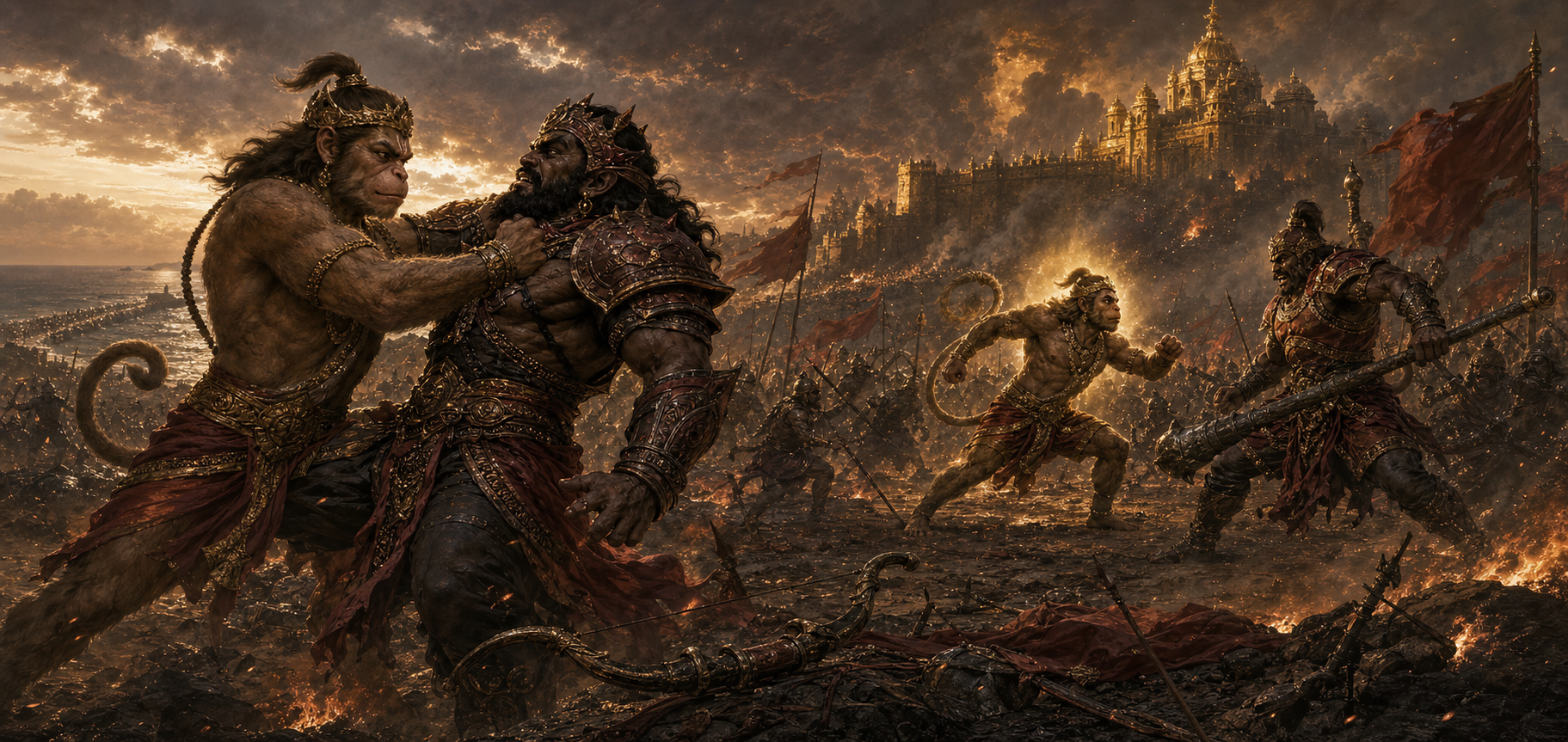
If you remember Kumbhakarna but cannot place his sons in the war for Lanka, the essential answer is simple: Kumbha fights Sugriva, Nikumbha fights Hanuman, and both sons of Kumbhakarna fall after entering battle on Ravana’s behalf.
That answer gives you the plot, but not the reason these comparatively brief encounters matter. The two duels distinguish courage from righteous courage. Kumbha and Nikumbha possess strength, skill, loyalty, and fearlessness. What they lack is a cause capable of giving those qualities a dharmic direction.
Where the brothers enter the war for Lanka
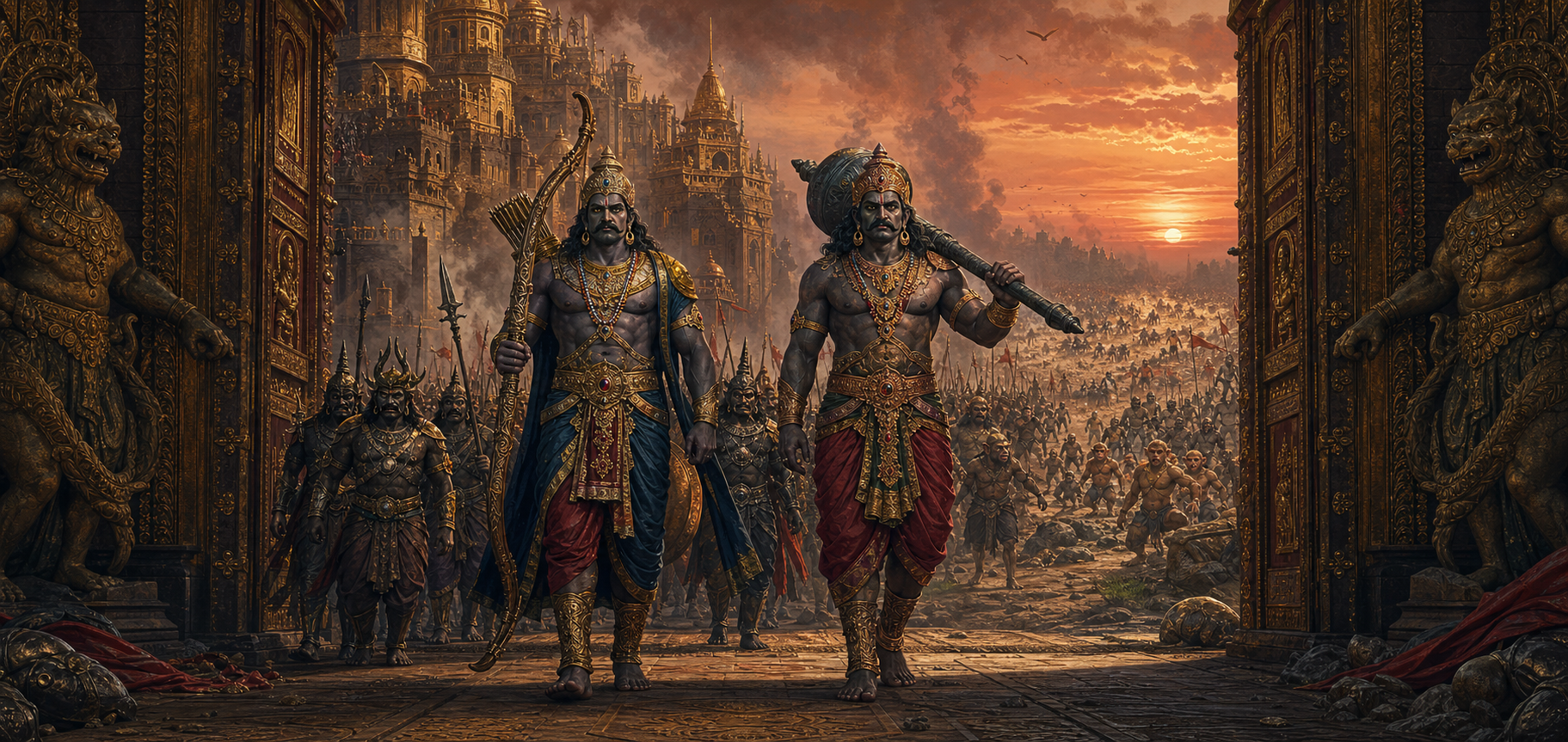
Kumbha and Nikumbha appear in the Yuddha Kanda, after their father Kumbhakarna has been killed. By then, Ravana’s crisis is no longer distant or theoretical. Sri Rama’s forces have crossed the ocean, Lanka’s defenses are under sustained pressure, and one powerful rakshasa after another has been lost. Sending Kumbhakarna’s sons into battle is therefore both a military decision and a psychological one. Ravana needs fighters who can stop the vanaras, but he also needs the prestige of Kumbhakarna’s lineage to restore confidence.
- Kumbha is a son of Kumbhakarna who confronts Sugriva and is slain by the vanara king.
- Nikumbha is Kumbha’s brother and another son of Kumbhakarna. He confronts Hanuman and is killed by him.
- Kumbh and Nikumbh are common vernacular forms of the same names, not separate characters.
The timing explains their emotional intensity. They do not enter a fresh campaign with a carefully developed plan. They enter a collapsing war after the death of their father, carrying a family’s grief and a kingdom’s desperation. Their lineage gives them formidable martial capacity, but lineage cannot decide whether that capacity serves dharma or adharma.
This is also where the sons should not be treated as simple copies of Kumbhakarna. Their father is portrayed with a measure of moral complexity: he retains traces of dharmic awareness even while choosing loyalty to Ravana. The sons are presented more directly through battlefield wrath, inherited obligation, and the demand for vengeance. That difference matters. The Ramayana repeatedly asks not only whether a person understands what is right, but whether that understanding governs action when loyalty, pride, or anger exerts pressure.
The stable narrative sequence is more important than every descriptive variation: Kumbha falls to Sugriva, and Nikumbha falls to Hanuman. Across regional retellings and performance traditions, the order, imagery, weapons, and terminal blows may receive different emphasis. Kamban’s Iramavataram, Tulsidas’s Ramcharitmanas, Yakshagana, Kathakali, and Ramleela all participate in a living culture of reception rather than a single frozen mode of narration.
If two versions seem different, separate the narrative spine from the staging. First identify the warrior, opponent, outcome, and ethical function. Then examine how a particular poet or performance tradition heightens the scene. This method lets you respect variation without mistakenly turning every change of imagery into a contradiction.
Kumbha and Sugriva: inherited might meets kingly command
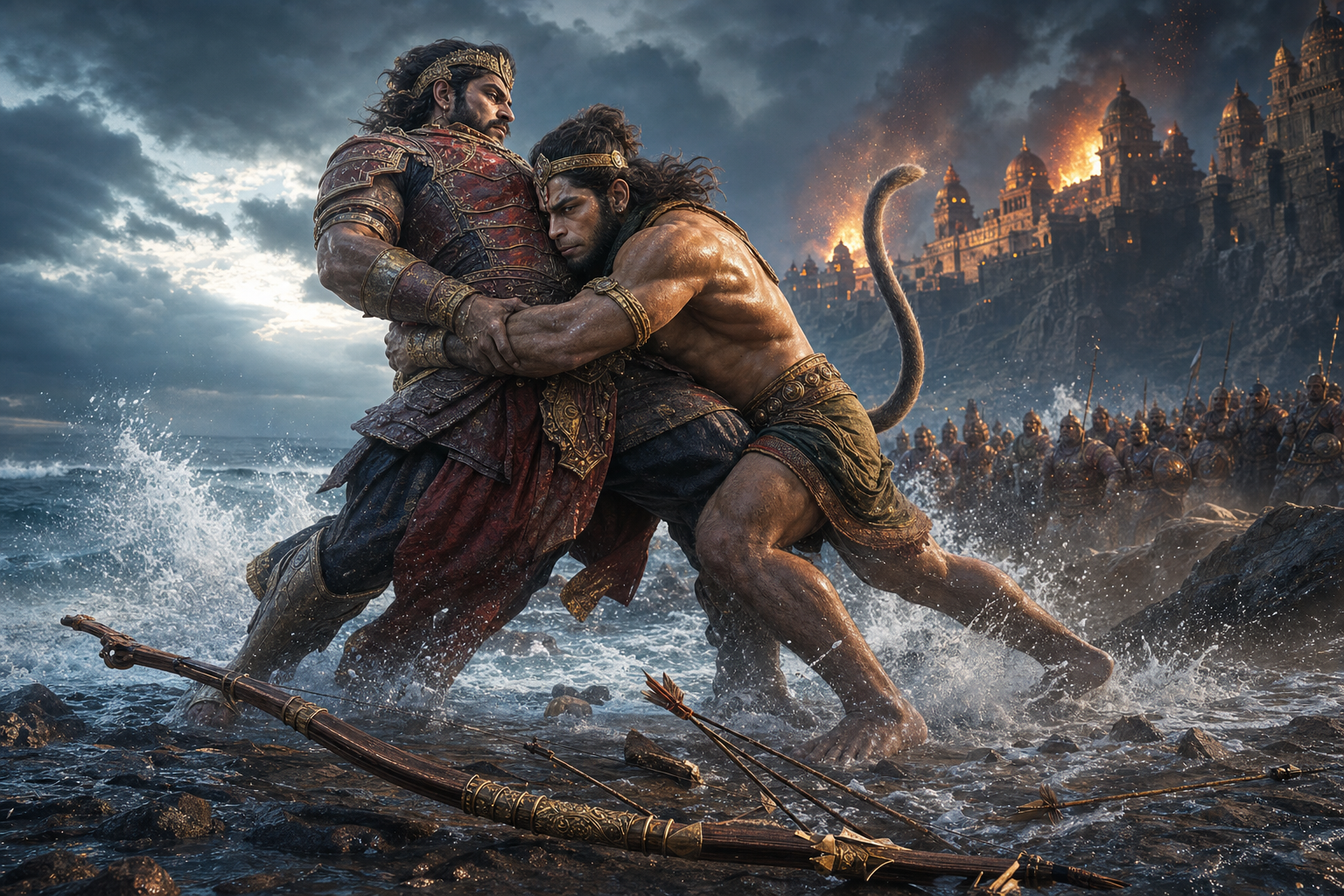
Kumbha enters as a battlefield threat worthy of Kumbhakarna’s name. His assault disrupts the vanara ranks through force, missiles, and the intimidating momentum of a champion expected to reverse Lanka’s losses. The scale of his violence matters because Sugriva does not meet a minor combatant. He accepts responsibility for stopping one of Ravana’s strongest remaining warriors.
The encounter then becomes strikingly physical. Projectile warfare gives way to a close struggle near the seashore, marked by bodily force, gripping, lifting, impact, and endurance. Sugriva ultimately brings Kumbha down with decisive strength. The arboreal imagery associated with the fall makes the rakshasa’s stature clear: Kumbha is not brushed aside but felled like something massive.
The shoreline gives the duel an additional resonance. The ocean is the boundary Sri Rama’s forces have already crossed, proving that Ravana’s apparent security can be overcome. Kumbha now fights near that same horizon. His strength is real, but it cannot restore the moral or strategic barrier that Lanka has lost.
Sugriva’s role is equally important. Readers sometimes remember him chiefly through his alliance with Sri Rama or the earlier struggle for Kishkindha. Here he acts as a sovereign and field commander. He does not merely order others forward. When a powerful enemy is breaking his ranks, he places his own body between that enemy and the force he leads.
That is the specific dharmic contrast to notice. Kumbha uses inherited power to defend Ravana’s order and answer family loss. Sugriva uses royal power to fulfill an alliance, protect his fighters, and advance Sri Rama’s just purpose. Both display courage. Only one warrior’s courage is governed by a rightful duty.
This does not mean righteousness substitutes for martial competence. Sugriva still has to withstand Kumbha, close the distance, and prevail in direct combat. Dharma determines what strength is for; discipline makes that strength effective. Remove either element and the lesson becomes incomplete.
Nikumbha and Hanuman: vengeance meets devotional strength
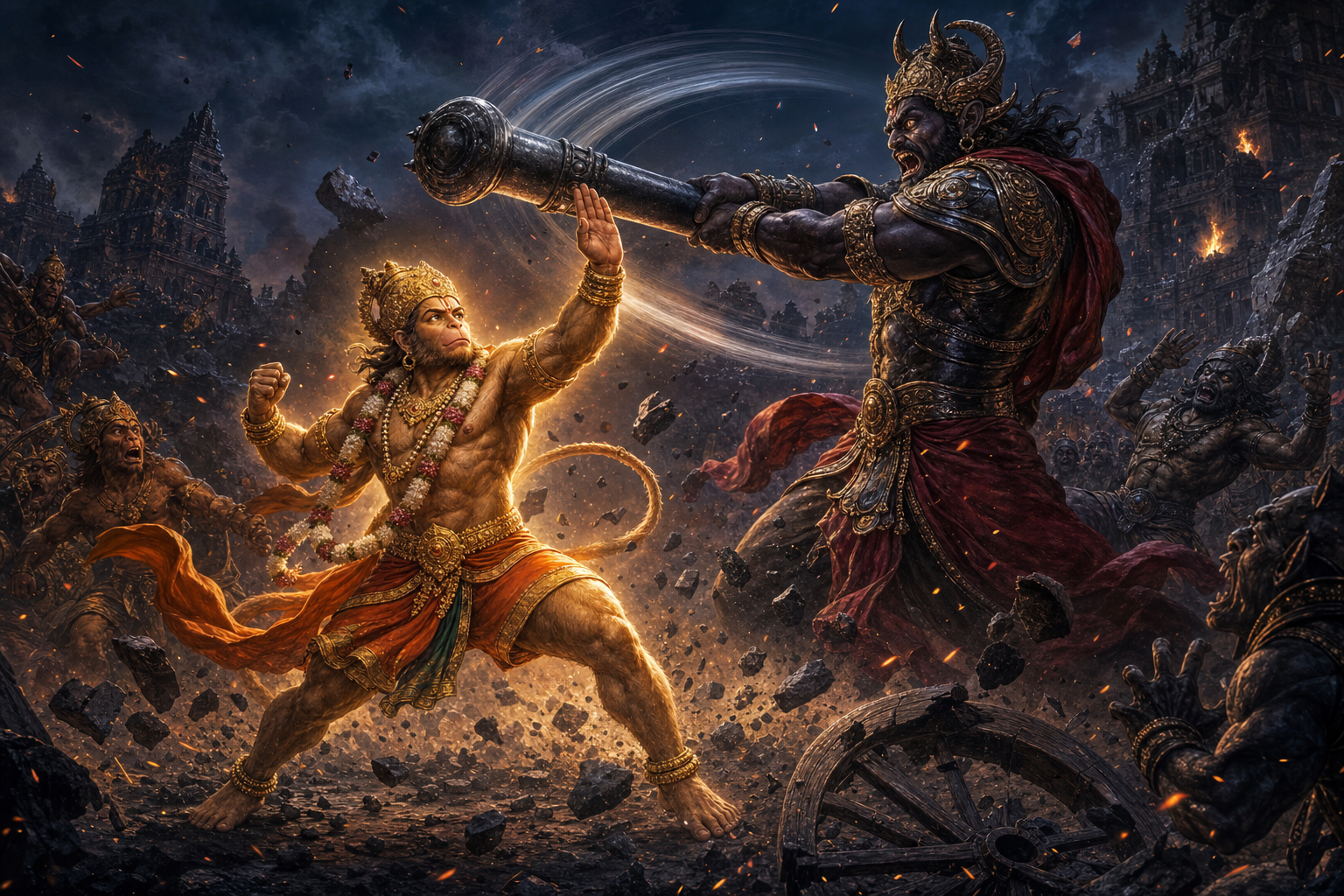
Nikumbha enters under even greater emotional pressure. His father is dead, his brother has fallen, and Ravana’s position continues to deteriorate. His fury therefore carries several motives at once: defense of Lanka, loyalty to Ravana, duty toward his lineage, and vengeance for those already slain. None of these motives makes him cowardly. They do, however, leave anger in command of his strength.
Hanuman’s answer is not passivity. He meets Nikumbha with overwhelming force and takes the encounter into close quarters. Retellings can differ over the exact sequence of seizing, hurling, striking, or rending, but the central outcome remains clear: Hanuman kills Nikumbha in direct combat.
The contrast rests on the inner government of power. Nikumbha’s energy is accelerated by loss and wrath. Hanuman’s energy is ordered by bhakti, his devotion to Sri Rama, and by the duty immediately before him. Hanuman can be ferocious without making personal hatred the purpose of the fight. His power does not need self-display because it is already dedicated.
The two encounters are easy to retain when you place them side by side:
| Encounter | Rakshasa’s momentum | Vanara response | Outcome |
|---|---|---|---|
| Kumbha and Sugriva | Inherited might, battlefield pressure, and filial wrath | A king personally protects and rallies his force | Sugriva slays Kumbha |
| Nikumbha and Hanuman | Escalating vengeance after family losses | Devotional strength is applied in direct combat | Hanuman slays Nikumbha |
The pairing also gives distinct profiles to two vanara leaders. Sugriva’s victory reveals the responsibility attached to kingship. Hanuman’s victory reveals the fearlessness produced by service. Neither character is merely an extension of Sri Rama’s weapons. Each embodies a different way that commitment to a righteous cause becomes action.
The dharmic question is not who fought bravely
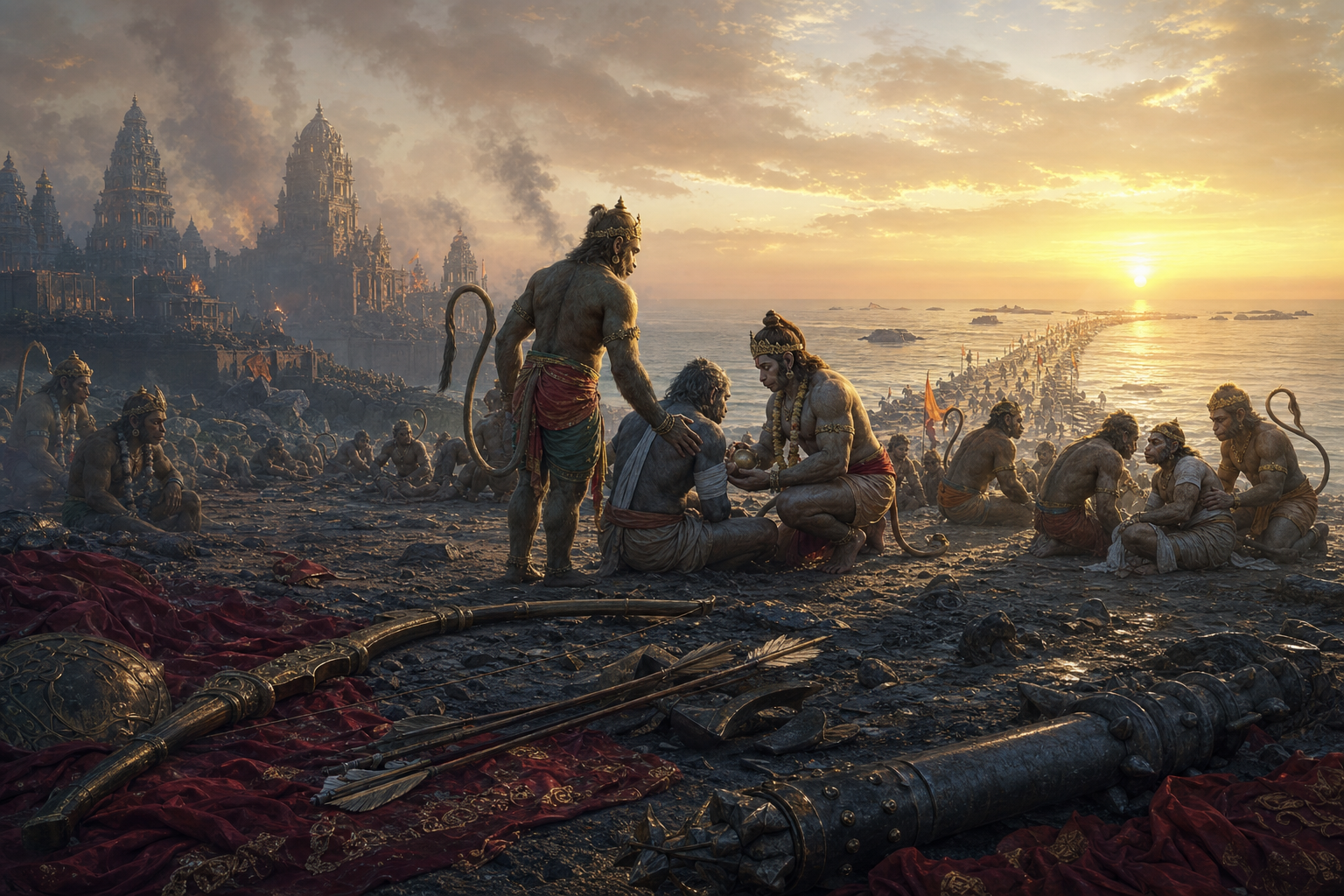
A shallow reading turns every defeated rakshasa into a contemptible figure and every victorious ally into a hero merely because he won. The Kumbha-Nikumbha episode supports a more demanding judgment. The brothers are dangerous and valorous opponents. Their defeat does not prove that they lacked courage; it shows that courage alone cannot make an unjust cause just.
When you read any battle in the Ramayana, four questions help keep the ethical structure in view:
<!– wp:list {