
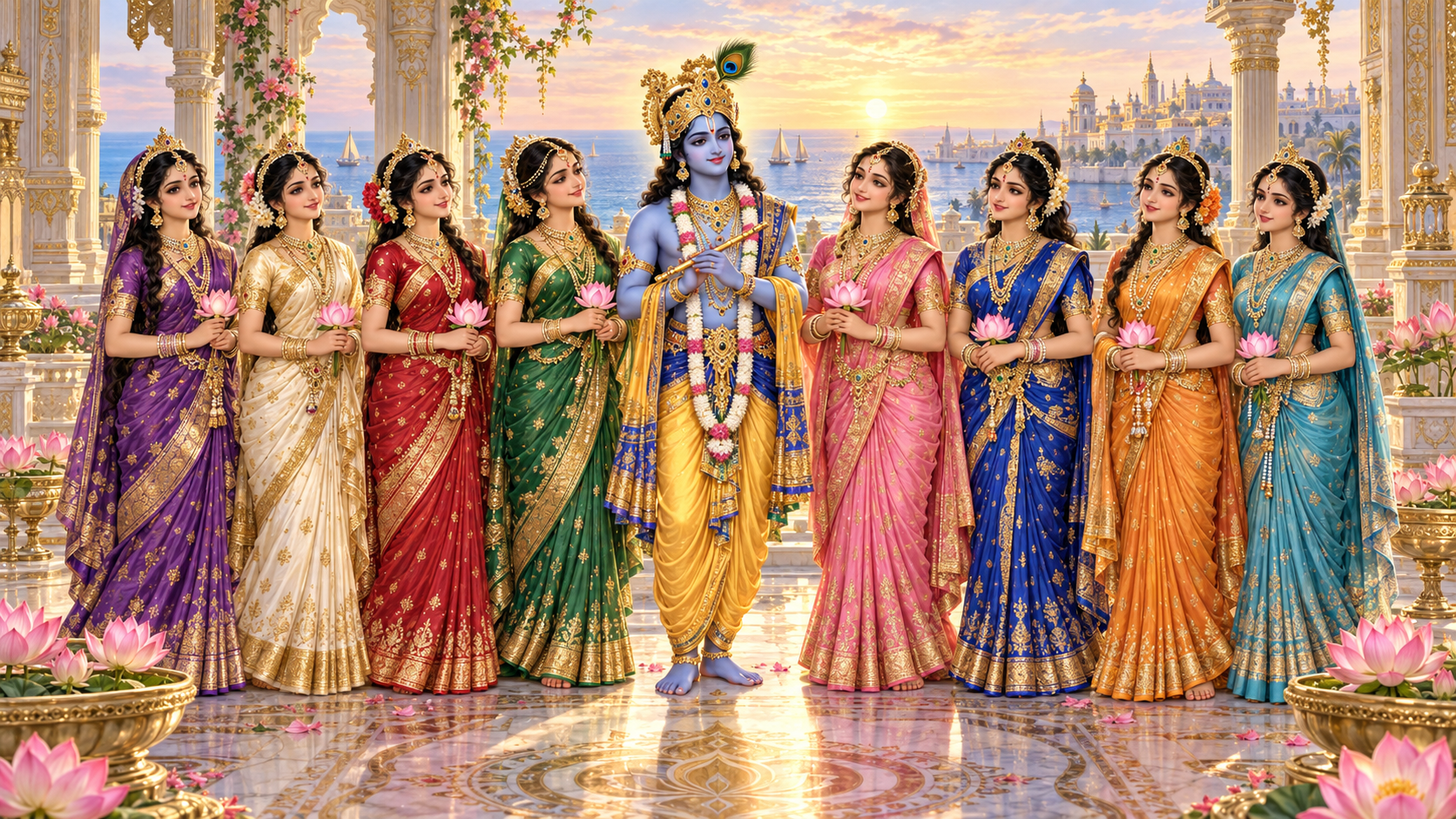
If you have encountered the statement that Krishna’s eight queens are eight forms of Lakshmi, you may be wondering whether each queen corresponds to a separately named Lakshmi. That conclusion does not automatically follow. Their collective identity as manifestations of Lakshmi and a fixed one-to-one chart of eight forms are two different claims.
Keeping that distinction clear gives you a sound way to remember the queens, understand the theology behind their marriages, and avoid repeating attractive but unsupported correspondences.
Begin with the exact list of the Ashtabharya
Krishna’s eight principal consorts are collectively known as the Ashtabharya, meaning the eight wives. They are:
- Rukmini
- Satyabhama
- Jambavati
- Kalindi
- Mitravinda
- Nagnajiti, also called Satya
- Bhadra
- Lakshmana
If you want to memorise the names, learn them as four pairs: Rukmini and Satyabhama; Jambavati and Kalindi; Mitravinda and Nagnajiti; Bhadra and Lakshmana. This is only a memory aid, not a scriptural division or a claim that the paired queens share the same attributes.
Notice the alternate name in the sixth position. Nagnajiti is also called Satya. Treating those as two different queens is an easy way to end up with an incorrect list of nine.
What it means to call the queens forms of Lakshmi
The identification is theological, not merely genealogical. Within the Vaishnava understanding of Krishna’s lila, his queens are not simply entries in a royal household register. Their marriages express the divine relationship of Krishna and Lakshmi through several distinct personalities and narratives.
Hindu thought does not require a divine reality to appear through only one name and personality. One Devi may manifest in several forms without becoming several unrelated deities. The eight queens can therefore remain recognisably distinct while sharing the divine nature of Lakshmi.
- Unity does not erase individuality: calling every queen a manifestation of Lakshmi does not make their names interchangeable.
- Plurality does not imply competition: the presence of eight queens need not be read as eight rival claimants to one divine position.
- Marriage carries theological meaning: the unions belong to sacred narrative and divine lila, not only to the social conventions of kingship.
This gives you a useful two-level reading. At the narrative level, attend to each queen as a particular person. At the theological level, recognise the shared presence of Lakshmi beside Krishna. Losing either level weakens the reading: pure symbolism erases the queens, while pure court history erases the sacred meaning of their unions.
Do not force a chart of eight separate Lakshmi identities
The word ashta, meaning eight, appears in both Ashtabharya and descriptions of eightfold manifestations of Lakshmi. A shared number, however, is not enough to prove a precise correspondence between two lists.
If someone assigns a specialised Lakshmi title to each queen, ask three questions before accepting or sharing the chart:
- Which text states the pairing? A list of queens and a list of Lakshmi forms do not establish a connection merely because both contain eight names.
- Which sampradaya or regional tradition uses it? A legitimate devotional interpretation may belong to a particular lineage without being universal.
- Is the claim explicit or interpretive? A teacher may draw a meaningful symbolic parallel, but that should not be presented as a direct scriptural identification unless the relevant passage actually makes it.
The same discipline applies to ranking the queens. Order in a remembered list does not by itself establish a hierarchy. Nor should one queen be reduced to an abstract quality simply to complete a symmetrical scheme. Begin with what is actually named; add a more detailed interpretation only when its textual or traditional basis is clear.
A practical way to study the eight queens
You can study the Ashtabharya without either flattening their identities or drifting into speculative correspondences. Use this sequence:
- Learn the complete list first. Include both names for Nagnajiti so that Satya does not become an accidental ninth queen.
- Read the relevant Krishna narratives in the Bhagavata Purana and Vishnu Purana. Attend to what each passage actually communicates rather than approaching it with a completed chart in hand.
- Keep narrative and theology in separate notes. Under “narrative,” record what happens and who is named. Under “theology,” record how the episode expresses the relationship of Krishna and Lakshmi.
- Mark the level of every claim. Label it as explicit in the text, taught within a named tradition, or offered as a later symbolic interpretation.
- Preserve the queens’ names in devotional teaching. “Krishna’s eight principal queens are revered as manifestations of Lakshmi” is a clear statement. Add individual pairings only when you can identify their basis.
For a simple devotional remembrance, recite the eight names accurately and contemplate their shared Lakshmi nature without inventing eight specialised labels. This approach is modest, but it protects both bhakti and precision: devotion is not strengthened by claiming more certainty than a tradition or passage provides.
Key takeaways
- The Ashtabharya are Rukmini, Satyabhama, Jambavati, Kalindi, Mitravinda, Nagnajiti or Satya, Bhadra, and Lakshmana.
- They are Krishna’s eight principal queens and are understood collectively as manifestations of Lakshmi.
- Their shared divine identity does not erase their individual names or narratives.
- “Eight queens” does not by itself prove a universal one-to-one correspondence with another list of eight Lakshmi forms.
- When you encounter a detailed pairing, check its text, sampradaya, and status as either explicit teaching or symbolic interpretation.
Start with the eight names, then read each marriage narrative on its own terms. Once that foundation is secure, you can recognise Lakshmi’s unity across the queens without turning a profound theological relationship into an unsupported chart.
References

Leave a Reply
You must be logged in to post a comment.