
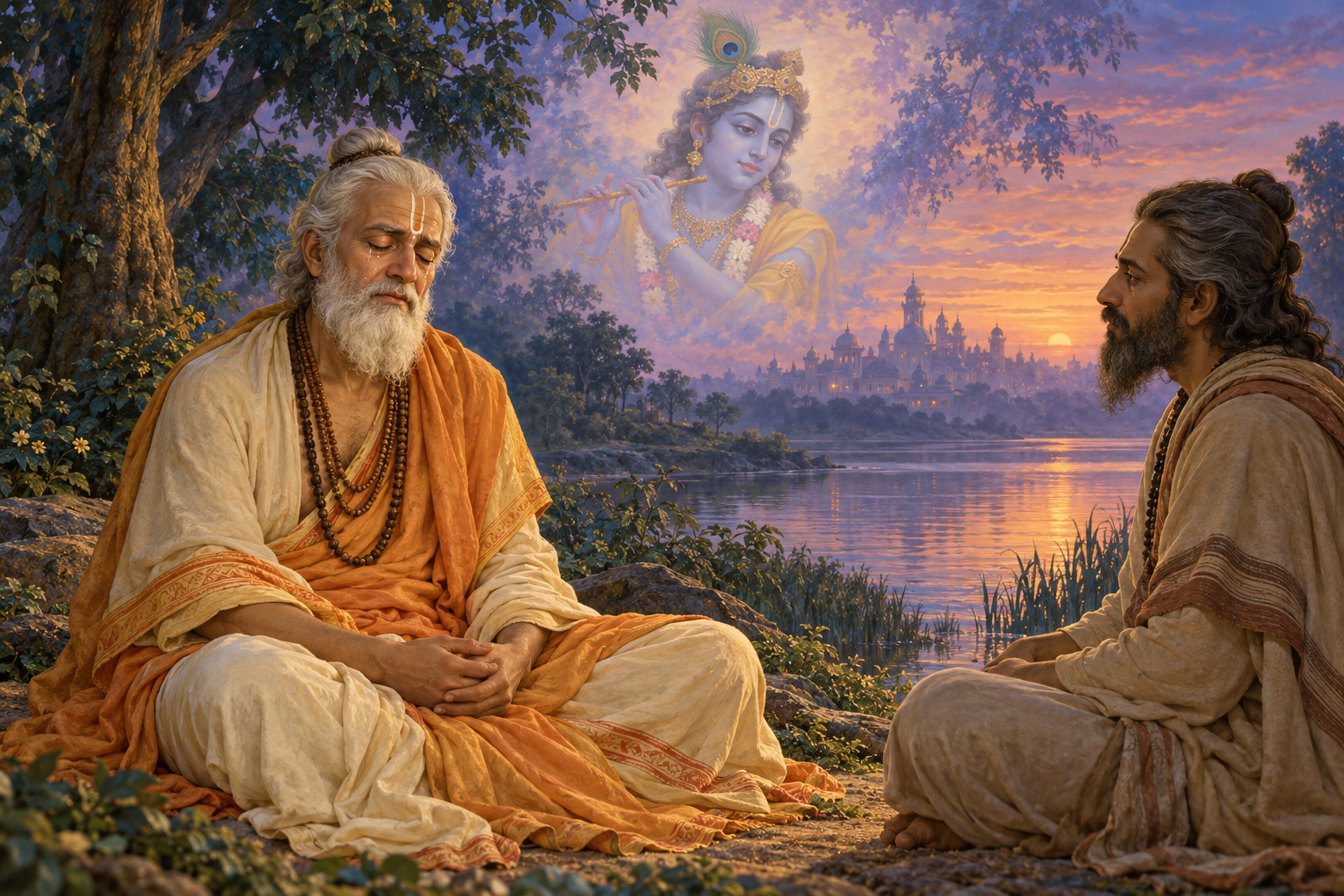
You may reach Uddhava’s recollection expecting an orderly account of Krishna’s final earthly pastimes. Instead, the witness stops speaking. That pause is not missing content. It shows you how a devotee approaches a separation too profound to reduce to information.
If Krishna’s departure leaves you with grief, theological questions, or uncertainty about what remembrance should look like, watch Uddhava before trying to explain him. He lets remembrance take hold, allows silence to do its work, and only then speaks for the benefit of another seeker.
The silence comes before the explanation

Vidura asks about Krishna, but Uddhava becomes silent and deeply absorbed in remembering Krishna’s lotus feet. The order matters: a question awakens remembrance; remembrance interrupts speech; absorbed silence eventually gives way to an answer.
Do not mistake that silence for emptiness. Uddhava is not unable to remember. He is so fully occupied by remembrance that an immediate verbal reply would be inadequate. His attention rests on Krishna rather than on the pressure to produce an explanation.
This distinction changes how you read the scene. A hurried reading asks, “What information does Uddhava provide?” A devotional reading first asks, “What happens to Uddhava when Krishna is remembered?” The second question reveals why his eventual words carry weight: they arise from relationship, not detached recollection.
The practical lesson is not that you should manufacture silence, tears, or an altered state. Uddhava’s bhava cannot be copied as a performance. What you can follow is his refusal to make sacred memory superficial. When a līlā moves you, pause before converting it into an argument, a lesson for someone else, or a social-media quotation.
Why Krishna’s departure is not ordinary extinction

The word “final” needs care here. Within the Vaishnava theology of the Srimad Bhagavatam, Krishna is Bhagavan. His final pastimes mark the withdrawal of his manifest earthly līlā; they do not imply that Krishna’s being comes to an end. “Departure” or “disappearance” therefore preserves a distinction that ordinary death-language can obscure.
Uddhava’s anguish does not weaken that theological claim. Separation is real because visible association has been withdrawn. Remembrance remains possible because the relationship has not been annihilated. His condition holds two truths together: the loss of manifest company is painful, and loving attention to Krishna is spiritually fulfilling.
Two common readings fail by separating those truths:
- Only tragedy: Krishna’s departure is treated as the ending of a remarkable historical life, leaving Uddhava with nothing but memory of someone who no longer exists.
- No grief allowed: Uddhava’s sorrow is softened or ignored because a devotee is assumed to be untouched by separation.
Uddhava fits neither reading. He does not respond as though Krishna has become unreal, and he does not pretend that separation is painless. His remembrance is intense precisely because Krishna is real to him and their relationship matters.
Remember Krishna, not merely the fact that he left
If your attention remains fixed only on the statement “Krishna departed,” absence becomes the subject. Uddhava’s attention moves differently. It settles at Krishna’s lotus feet. The loss is not denied, but neither is it allowed to displace the person who is loved.
This is the heart of smaraṇa, devotional remembrance. It is more than reconstructing a sequence of events. It brings Krishna’s name, form, qualities, deeds, and relationship with his devotees before the mind so that present conduct is changed. Memory becomes part of bhakti when it returns you to Krishna and then moves you toward seva.
You can test your own reading with four concrete questions:
- When the passage ends, is your attention resting mainly on Krishna or on your own emotional reaction?
- Which quality of Krishna has become clearer through the remembered līlā?
- Have you allowed separation to deepen attention, or have you used it only to create dramatic language?
- What act of hearing, chanting, study, care, or duty will carry this remembrance into the rest of your day?
A person can debate chronology while remaining untouched by the object of remembrance. Uddhava directs you toward a harder standard: has remembering Krishna made Krishna more central?
A five-step practice for reading Srimad Bhagavatam 3.2.4

You do not need to imitate Uddhava’s inner state to read this moment faithfully. Use the following sequence to keep attention honest and grounded:
- Read the exchange, not an isolated line. Notice who asks the question, when Uddhava becomes silent, what occupies his attention, and how he eventually returns to speech.
- Separate observation from interpretation. First write down only what Uddhava does: he remembers, becomes silent, and is absorbed in Krishna’s lotus feet. Then consider what those actions mean. This prevents a preferred theory from replacing the actual scene.
- Anchor remembrance in a name. Recall Krishna by a name already present in your practice, such as Acyuta, and let that name keep your attention on him rather than on an abstract idea of loss.
- Allow an honest pause. Sit quietly long enough for your first explanation to settle. Do not force emotion. If nothing dramatic occurs, do not perform devotion for yourself or anyone watching.
- Carry the memory into service. Chant attentively, read the next verse without rushing, explain the passage without exaggeration, or perform an ordinary responsibility as an offering. Choose one action rather than ending with a mood.
This practice will not reproduce Uddhava’s bhava, nor should that be your goal. It disciplines attention so that sincerity is not replaced by imitation. Uddhava’s outward stillness matters because of the inward relationship it reveals, not because stillness itself is a performance to master.
Key takeaways
- Uddhava’s silence is absorbed remembrance, not a failure to answer.
- The pause before his words shows that Krishna’s final pastimes must be approached as līlā and relationship, not merely as historical data.
- Within Bhagavata theology, Krishna’s departure ends a manifest earthly sequence; it does not mean the extinction of Bhagavan.
- Viraha, or separation, permits grief without turning grief into the center of devotion.
- Authentic smaraṇa brings attention back to Krishna and then bears fruit as seva.
- You should follow Uddhava’s honesty and attentiveness without imitating his devotional ecstasy.
The next time you read this account, stop when Uddhava stops. Let his pause set your pace. Remember one name of Krishna, notice one quality revealed by the līlā, and choose one act of service before reading onward. That small discipline turns the account of separation into a living practice of remembrance.
References

Leave a Reply
You must be logged in to post a comment.