
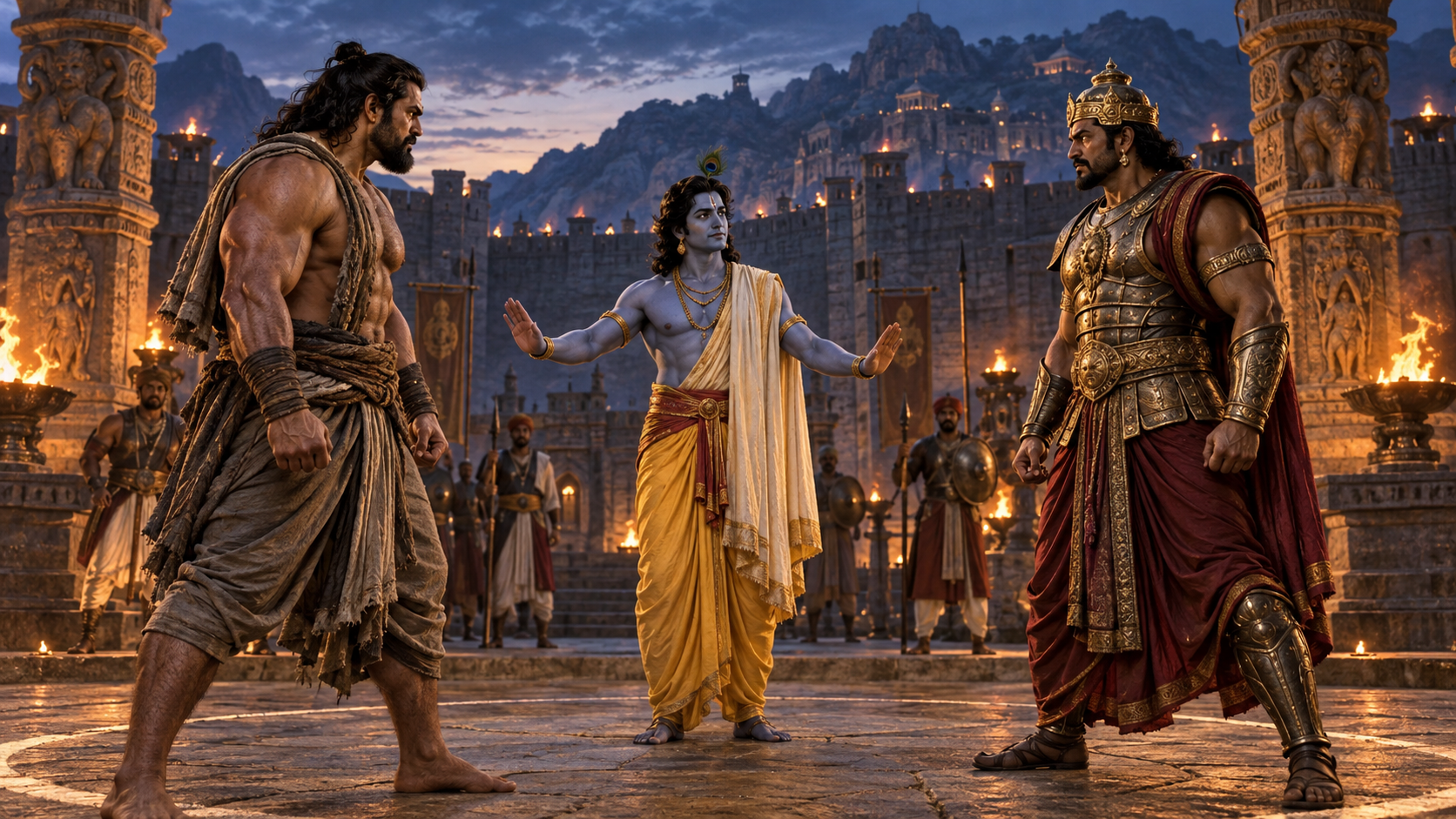
If you are trying to understand why Krishna did not simply send a vast army against Jarasandha, begin with the objective. Yudhishthira needed to remove a grave obstacle to the Rajasuya yajna. He did not need to devastate Magadha merely to prove that he could.
Krishna’s strategic insight was to make the response no larger than the problem required. Strength remained essential, but strength was disciplined by purpose. That is what makes this episode useful for anyone deciding whether to escalate a conflict, negotiate from strength, or search for a more precise way to confront adharma.
Why Jarasandha was more than a military rival
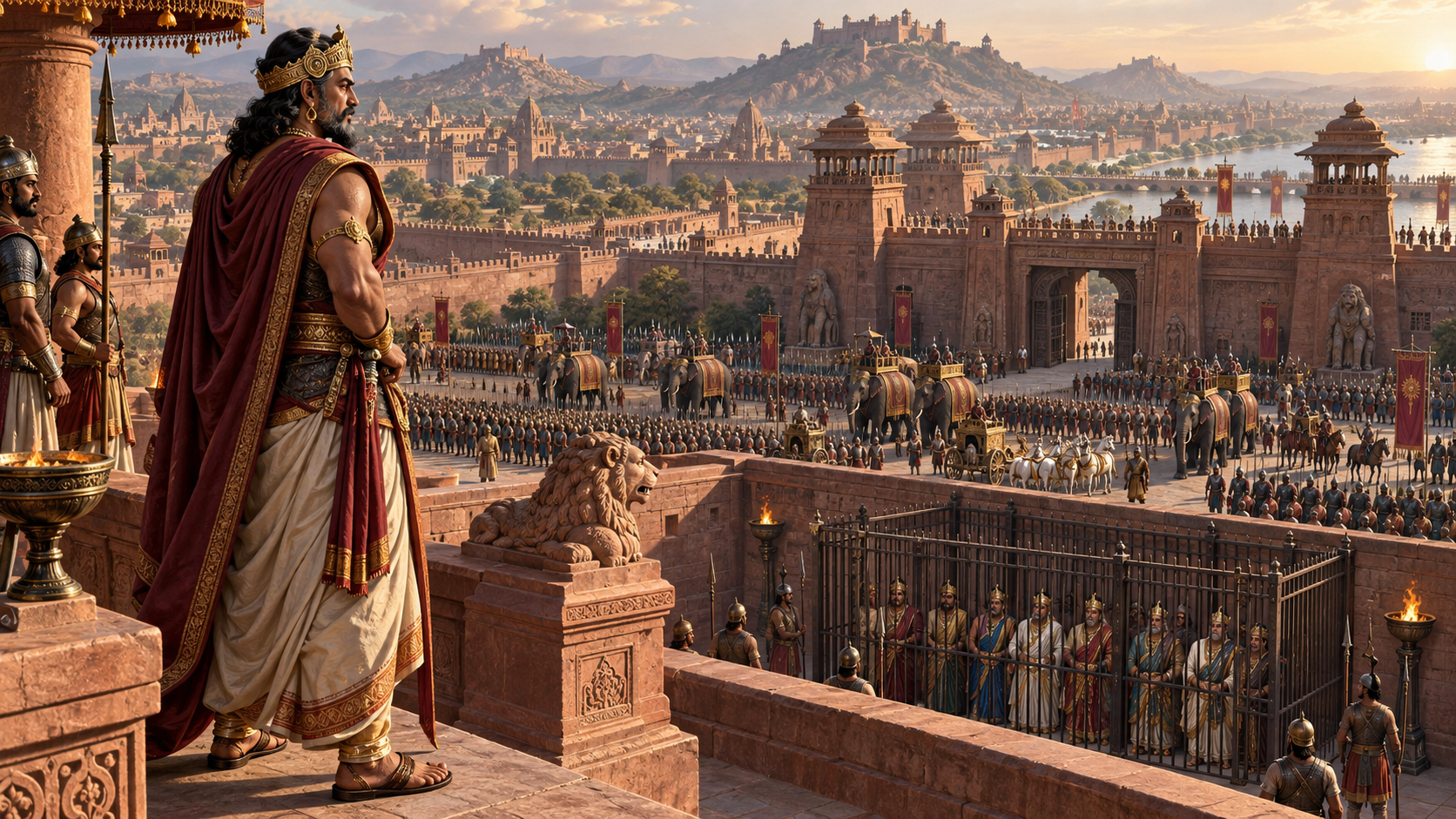
Yudhishthira’s proposed Rajasuya was a claim to sovereign authority, not an isolated domestic ceremony. That claim could not be credible while Jarasandha remained undefeated. The king of Magadha possessed an immense army and had imprisoned many other kings.
This created three connected problems:
- A moral problem: rulers were being held captive by a powerful king.
- A political problem: Yudhishthira could not plausibly claim universal sovereignty while that domination continued.
- A military problem: a conventional campaign against Magadha would mean confronting an enormous army and exposing many people to the costs of war.
The obvious response was therefore not necessarily the wise response. If Yudhishthira measured the challenge only by the size of Jarasandha’s forces, he would accept the contest on Jarasandha’s terms: army against army, destruction against destruction. Krishna instead treated the strategic obstacle and the kingdom surrounding it as distinguishable things.
That distinction matters. The purpose was not to punish every soldier in Magadha, seize land for its own sake, or display superior destructive power. The necessary result was the defeat of the ruler whose power obstructed the Rajasuya and sustained the captivity of other kings. Once you define the desired result that precisely, a general war stops looking inevitable.
Krishna chose decisive restraint, not passive avoidance
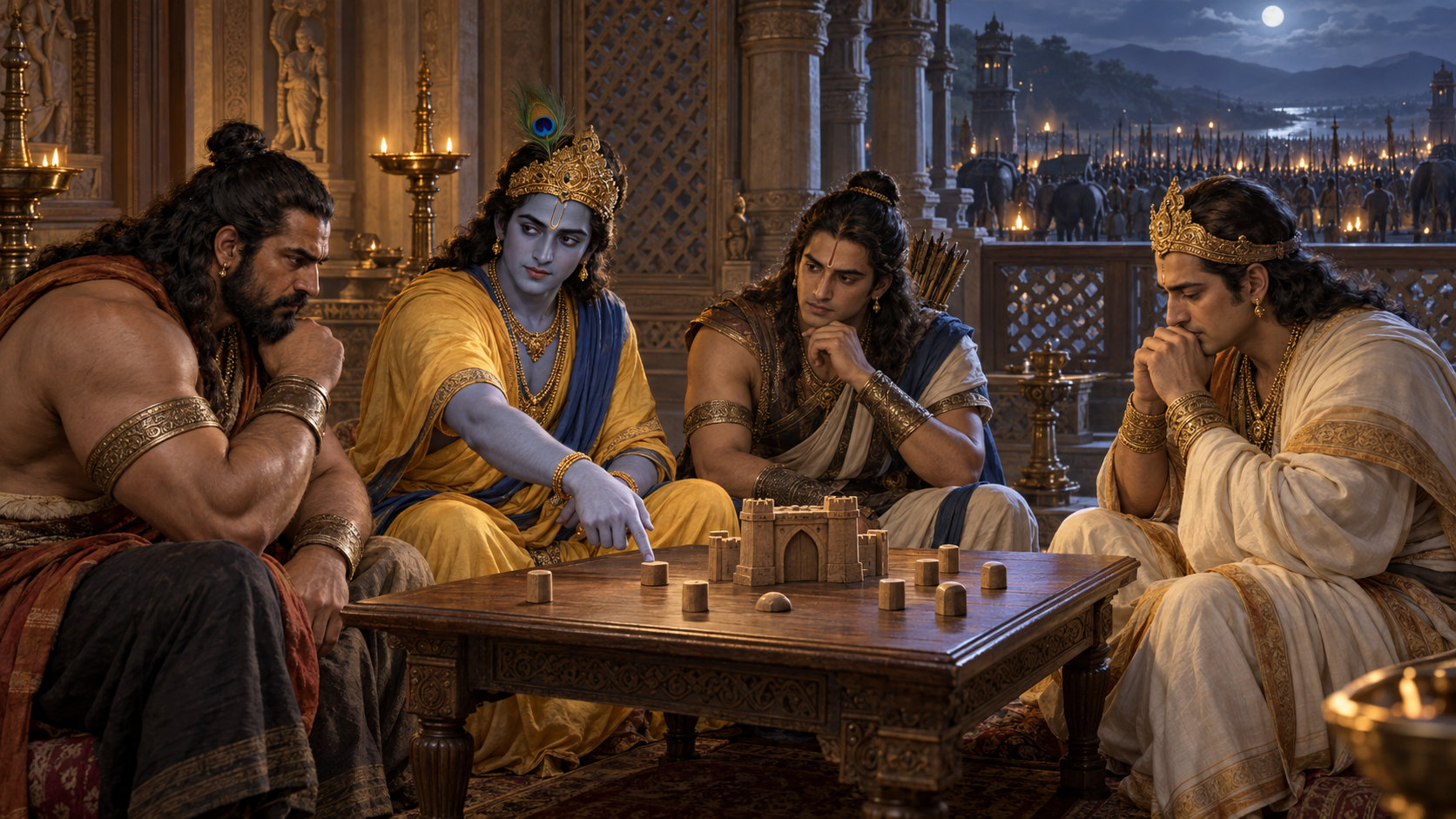
Avoiding needless war is not the same as avoiding confrontation. Krishna did not ask Yudhishthira to abandon the Rajasuya, overlook the imprisoned rulers, or pretend that Jarasandha posed no threat. Jarasandha still had to be defeated. What Krishna rejected was the assumption that defeating him required a war against everyone under his command.
This is the difference between restraint and weakness. Weakness leaves an unjust arrangement untouched because resistance appears costly. Restraint retains the capacity to act but limits that action to what the objective requires. It asks not, “How much force can we deploy?” but, “What is the smallest decisive action that will actually end the obstruction?”
The strategic logic can be expressed as a sequence:
- Name the legitimate objective. Yudhishthira needed a credible path to the Rajasuya and an answer to Jarasandha’s domination.
- Identify the decisive obstacle. The central problem was Jarasandha, not every person or institution in Magadha.
- Separate the obstacle from its protective mass. An immense army made a conventional invasion costly; it did not prove that such an invasion was necessary.
- Use sufficient strength. Restraint works only when the chosen course can still produce a decision. Symbolic opposition would have left the underlying problem intact.
- Refuse unnecessary destruction. Once the actual obstacle can be overcome without a general war, widening the violence becomes difficult to justify.
This is why Krishna’s course can be understood as the diplomacy of strength. He neither rushed into mass warfare nor allowed the fear of Jarasandha’s army to veto action. The possibility of a narrower solution appeared only because he looked beyond the false choice between surrender and total war.
You should also notice the economy of the strategy. A ruler who commits an entire army to every serious challenge spends lives, time, legitimacy, and future security together. Even victory can weaken the victor. Krishna’s approach preserved power by directing it toward the point where it could have decisive effect.
The Dharmic limit: victory does not justify every means
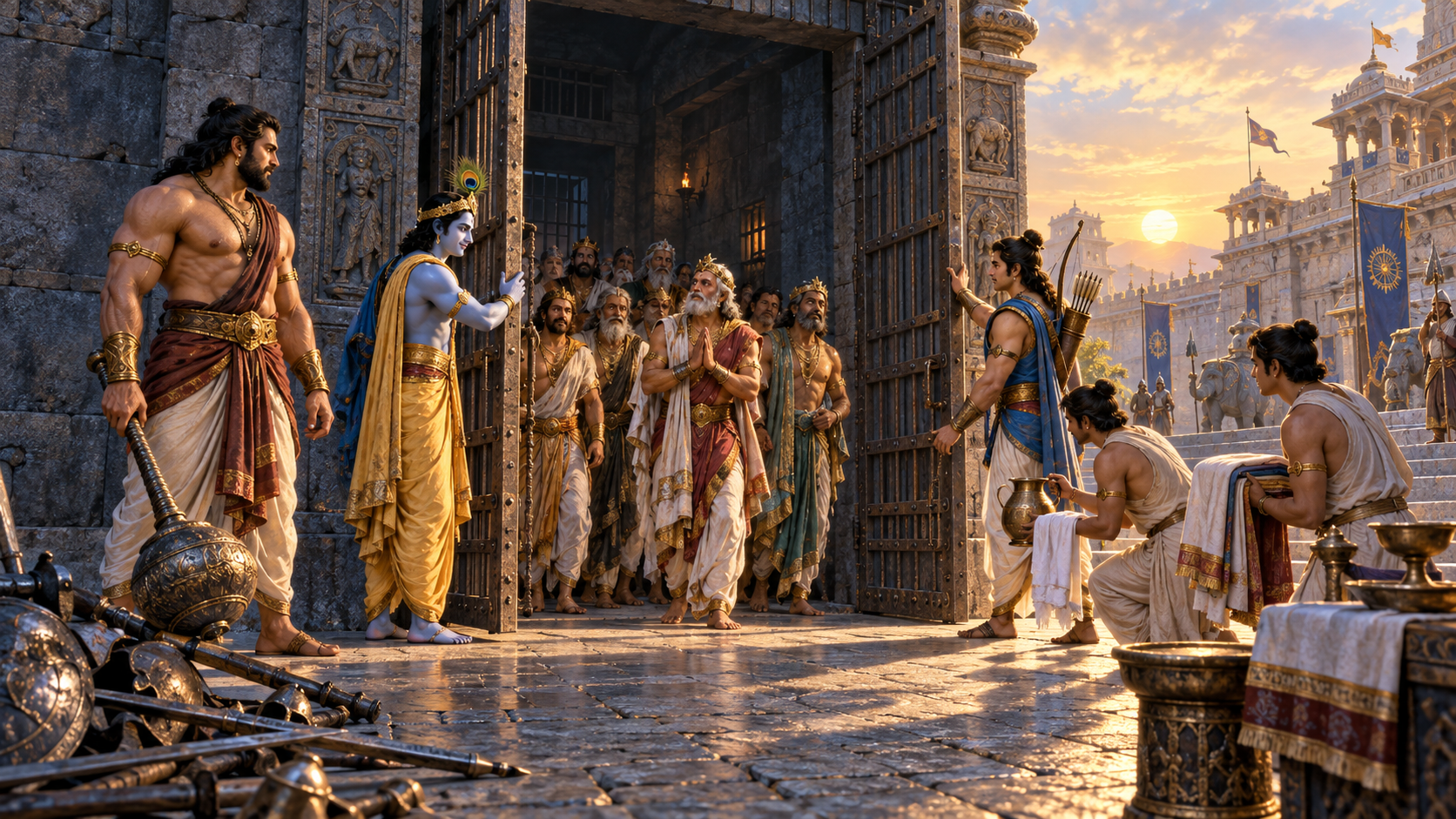
It would be a mistake to reduce this episode to a lesson in cleverness. Outsmarting an opponent is not automatically Dharmic, and efficiency alone does not sanctify a course of action. A strategy must be judged by its purpose, its necessity, the burdens it places on others, and what happens after success.
The Rajasuya concerned ordered and legitimate rule. A path that inflicted needless disorder merely to establish that rule would contradict its own declared end. Krishna’s restraint therefore carried moral as well as military meaning: those who were not the cause of the obstruction should not be made to bear its full cost when a more discriminating course was available.
Four questions help preserve that Dharmic boundary:
- Is the end legitimate? Personal pride, revenge, and public humiliation are not interchangeable with the protection of order or the ending of captivity.
- Is escalation necessary? The existence of a powerful enemy does not by itself prove that the widest possible conflict is required.
- Does the response distinguish the responsible actor from bystanders? A precise strategy tries to place the burden on the source of the obstruction.
- Is there a stopping point? If success continually produces new reasons to punish, occupy, or dominate, the original objective may have become an excuse.
These questions also prevent a dangerous misuse of the story. Calling someone a modern Jarasandha does not give you permission to discard evidence, lawful process, or moral limits. The lesson is not that a righteous person may do anything to an opponent. The lesson is that a legitimate objective should be pursued with enough resolve to succeed and enough discipline to avoid needless harm.
How to use Krishna’s method in a conflict you face

You do not need to be deciding questions of kingship or war to use this framework. It applies whenever anger, institutional momentum, or wounded prestige is pushing you toward a response larger than the result you actually need.
- Write the desired result in one sentence. Use an observable outcome: release the withheld decision, correct the false claim, change the rule, recover what is owed, or stop a defined act. If your sentence says only “defeat them,” the objective is still too vague.
- Locate the actual blocker. Ask whether the problem is a person, a policy, an incentive, a missing decision, or a fear of losing status. Do not turn an entire family, team, institution, or community into the enemy when one narrower obstruction is doing the work.
- List who would pay for escalation. Include people who did not create the conflict. If your plan burdens them heavily, search for a more targeted forum or remedy.
- Choose the narrowest channel capable of producing a decision. Depending on the situation, that may be direct negotiation, a vote, mediation, an appeal, documented accountability, or lawful enforcement. A channel that cannot compel or secure any result is not restraint; it is delay.
- State your consequence clearly. Strength need not be theatrical. A credible boundary, a formal challenge, withdrawal of cooperation, or recourse to the proper authority can be more effective than diffuse hostility.
- Define the stopping condition before acting. Decide what resolution will end the dispute. This prevents a necessary confrontation from becoming an open-ended campaign of retaliation.
Consider a community dispute in which one officeholder is blocking a properly authorized decision. Attacking the reputation of the entire organization may rally supporters, but it also creates new opponents and damages the institution you hope to preserve. Krishna’s strategic question would be narrower: what procedure, authority, or direct test can remove the obstruction without making everyone else a casualty of the struggle?
The same discipline applies to political judgement. Do not confuse the loudest response with the strongest one. Look for the decisive node, examine the cost imposed on nonparticipants, and insist on a clear relation between means and ends. Precision is not softness when it produces the required result.
Key takeaways
- Jarasandha obstructed Yudhishthira’s Rajasuya politically, morally, and militarily because he remained undefeated, held kings captive, and commanded immense strength.
- Krishna refused the false choice between accepting Jarasandha’s domination and launching a general war against Magadha.
- The strategic objective was narrower than territorial devastation: defeat the decisive obstruction without making an entire kingdom bear the cost.
- Restraint is credible only when it is backed by sufficient strength and a willingness to act.
- A Dharmic strategy tests the legitimacy of the end, the necessity of escalation, the effect on bystanders, and the point at which action must stop.
Before you escalate your next serious conflict, write down four things: the exact result you need, the real blocker, the people who would bear the collateral cost, and the condition that will end the dispute. If you cannot name all four, you are not yet ready to choose the size of the response. Krishna’s example begins with that clarity.
References

Leave a Reply
You must be logged in to post a comment.