
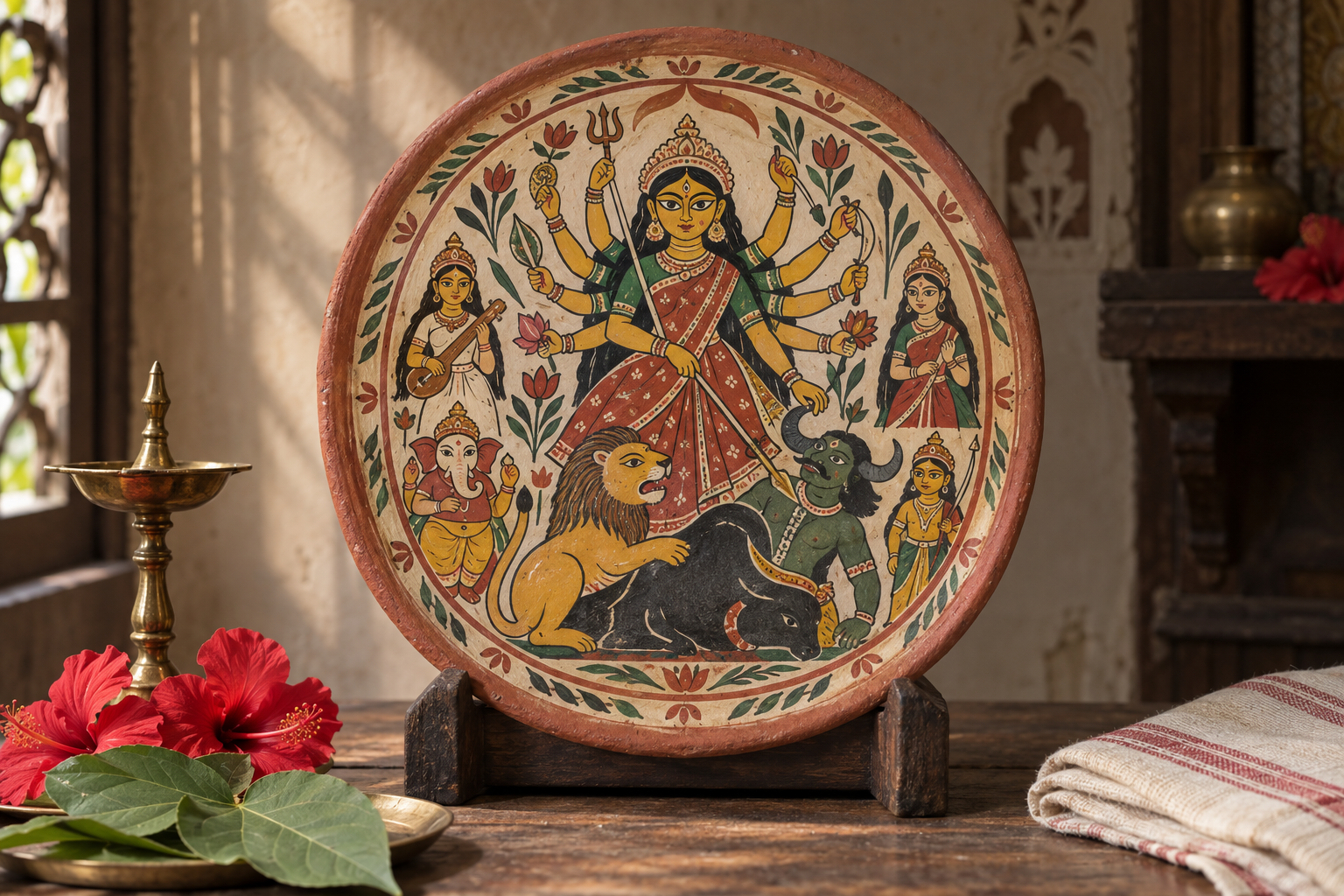
If you encounter Goddess Durga painted on a round clay surface, do not assume you are looking at a lesser substitute for a sculpted murti. You may be seeing a shora: a simple object through which image, material and worship have been brought together.
That distinction matters whether you are visiting a home, viewing a collection, buying devotional art or writing a caption. Once you know what to notice, you can recognise a Durga shora without stripping it of its religious purpose or making claims that the object itself cannot support.
Recognise the shora through material, form and purpose
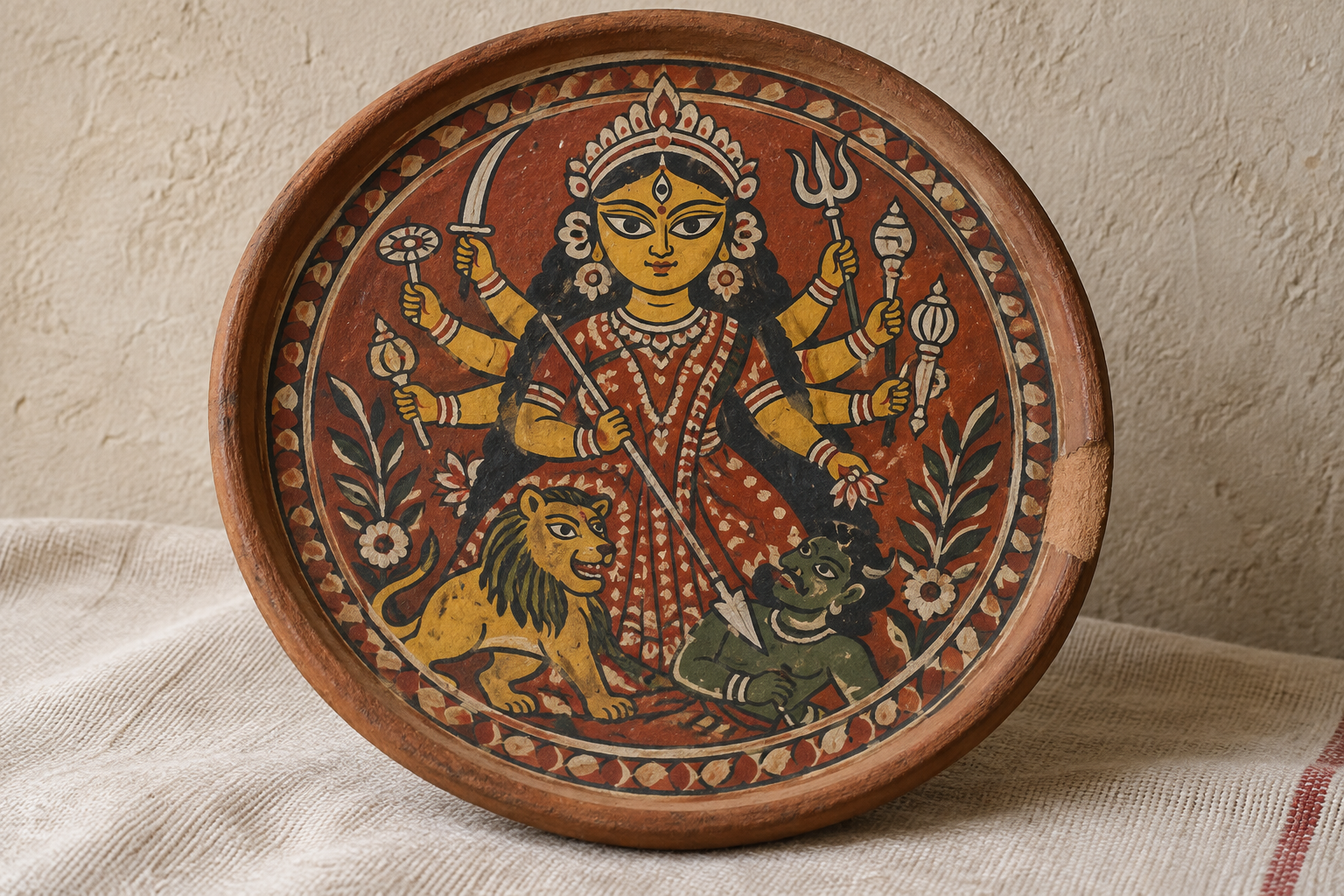
A shora is a round vessel made from terracotta, meaning clay that has been hardened by firing. In this tradition, Durga is painted on the clay surface and may be worshipped through that painted form. The practice is associated chiefly with Bengal and is also seen in nearby regions such as Odisha and Assam.
Use three checks when identifying one:
- Form: The support is a round clay vessel, not merely a circular sheet, board or printed plate.
- Material: The body is terracotta, or baked clay. Paint appears on that fired surface.
- Religious subject and use: The image represents Goddess Durga and belongs to a devotional setting or tradition.
No single check is enough on its own. A round terracotta object is not automatically a Durga shora, and a circular picture of Durga is not automatically painted on one. The name describes a relationship among the clay object, the painted deity and its devotional function.
You should also separate identity from ritual status. An object may clearly be a devotional image without your knowing whether it has been formally installed, worshipped in a particular household or made only for sale. If that history is undocumented, say so. “Durga painted on a terracotta shora; ritual use unknown” is more accurate than an impressive but unsupported claim.
Why a painted clay form can be fully devotional
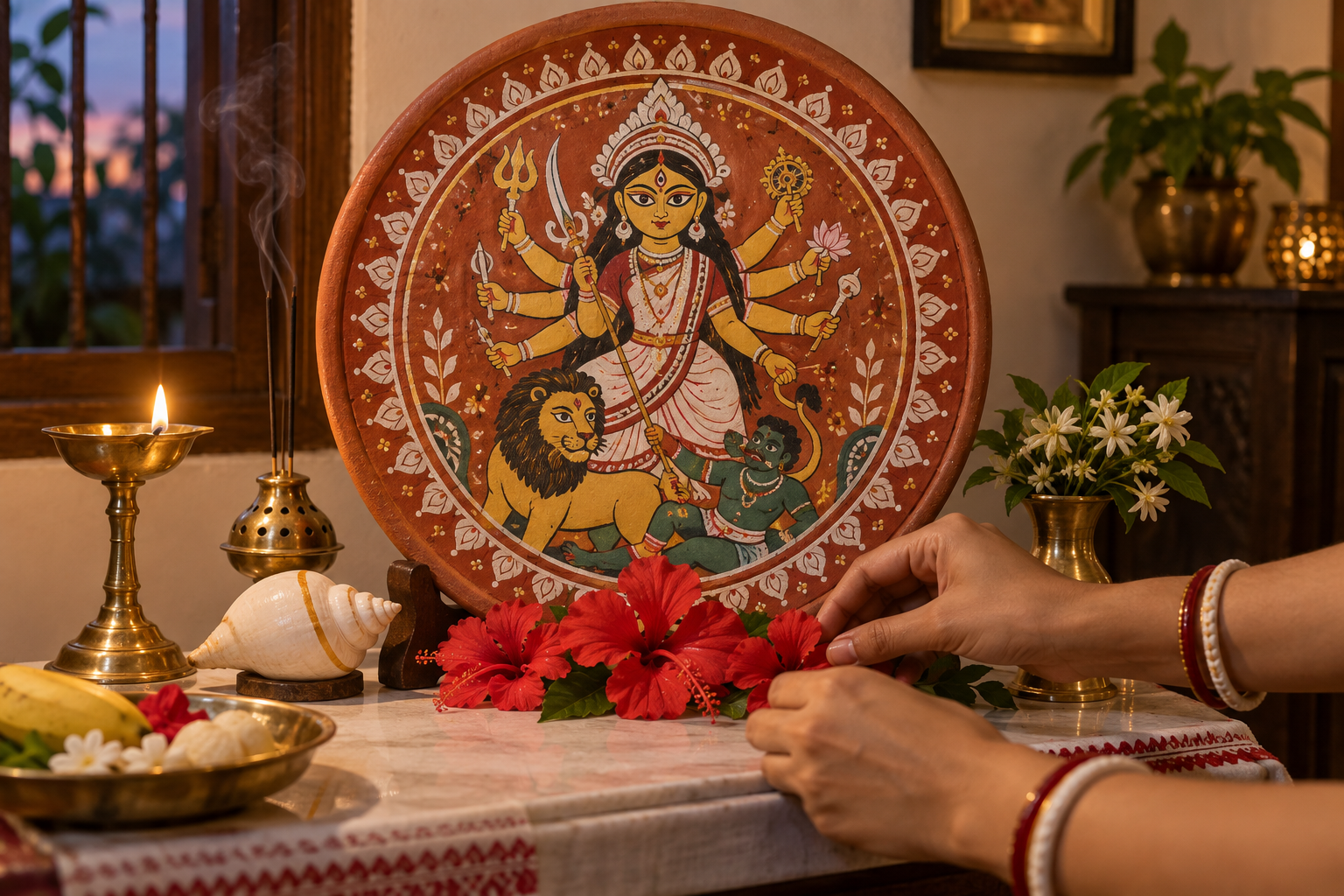
Hindu worship is not confined to one scale or medium. A deity may be approached through a large murti, a small stone or a painting. A Durga shora belongs within this broad capacity to recognise and worship the divine through different forms.
This corrects a common visual bias. Modern viewers often rank a three-dimensional sculpture above a painted object, or an elaborate material above ordinary clay. That hierarchy tells you more about the viewer’s expectations than about the devotional form. Size, price and sculptural depth do not by themselves determine sacred significance.
The shora asks you to pay attention to what devotion does with material. Clay is shaped into a round vessel and hardened. Colour gives Durga a visible form. Worship then turns the painted object into a point of religious attention. The apparent simplicity is not an absence of meaning; it is the means through which meaning becomes accessible.
When you describe such a work, lead with that devotional identity. “Folk art” or “decorative terracotta” may describe aspects of its appearance, but neither phrase is sufficient by itself. A better description is: “A painted terracotta shora depicting Goddess Durga, made within a regional tradition of worship.” That wording keeps the object, deity and purpose together.
Look at the painting without reducing it to decor
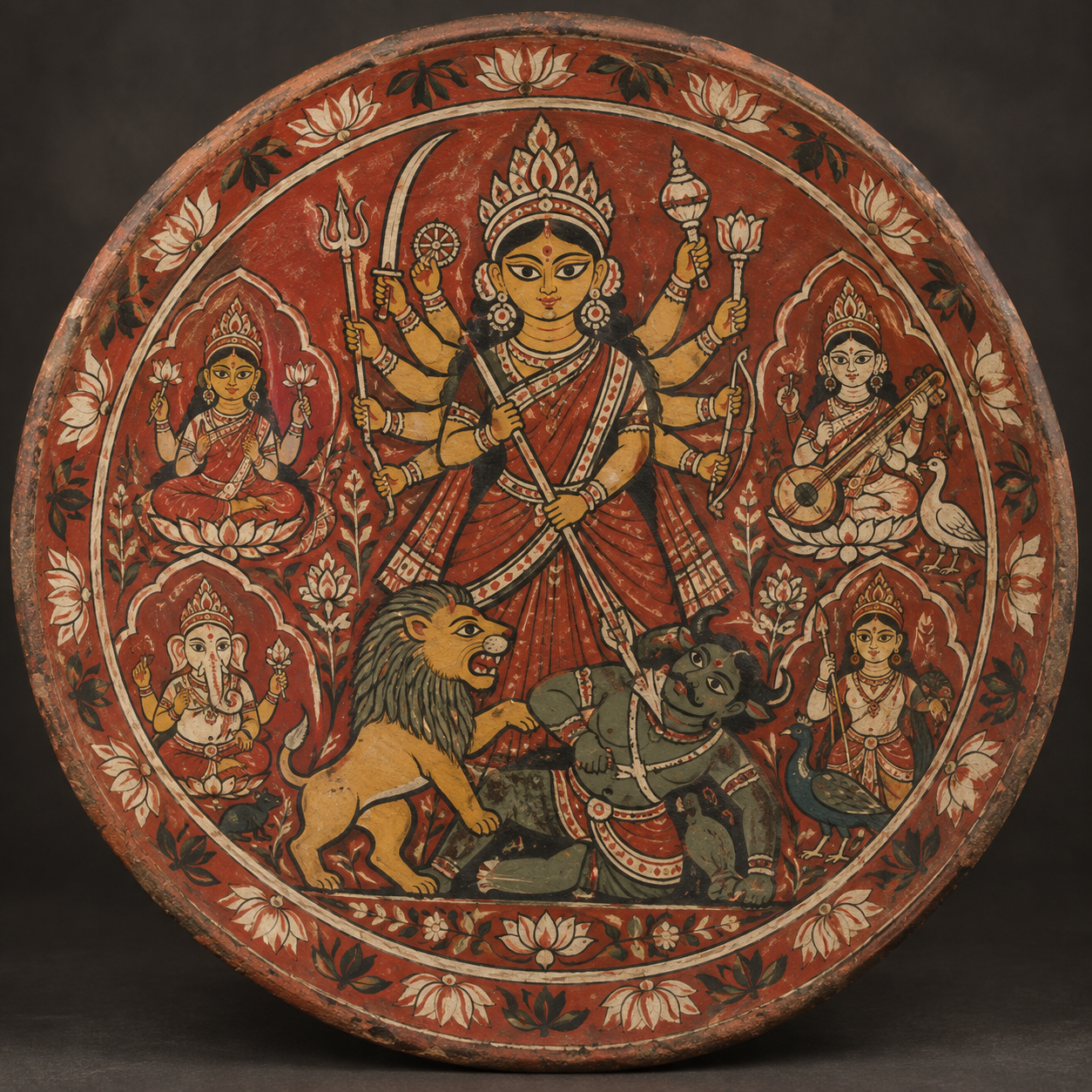
You do not need specialised terminology to look carefully. Start with the physical facts and move toward the religious context. This order prevents an attractive image from becoming detached from the vessel and practice that give it meaning.
- Notice the circular support. The round clay body is not incidental packaging around the painting. Include it when you photograph, display or catalogue the work.
- Identify only what you can see securely. Name Durga when the identification is established, but do not invent a date, locality, maker, sect or ritual history from appearance alone.
- Ask about use. If the shora comes from a household, seller or collection, ask whether it was made for worship, actually worshipped or retained as art. Record the answer as supplied rather than converting family memory into certainty.
- Record the region precisely. Bengal is the central association, while related practice is also found in Odisha and Assam. Use the object’s documented place of origin when available; do not label every example “Bengali” solely because it resembles one.
- Preserve the devotional description. A catalogue entry should state that the painted form could function in worship, even if the present setting is a gallery, archive or private display.
A compact catalogue caption can follow this pattern: “Painted image of Goddess Durga on a round terracotta shora; place and maker [known or unknown]; devotional use [documented or unknown].” Replace the brackets only with information you can verify.
This discipline is especially important online. A tightly cropped photograph may preserve Durga’s face while hiding the round clay support that identifies the form. Whenever possible, include one full-object image before adding close details. The viewer should be able to see both the deity and the vessel.
Handle an inherited or collected shora with context intact
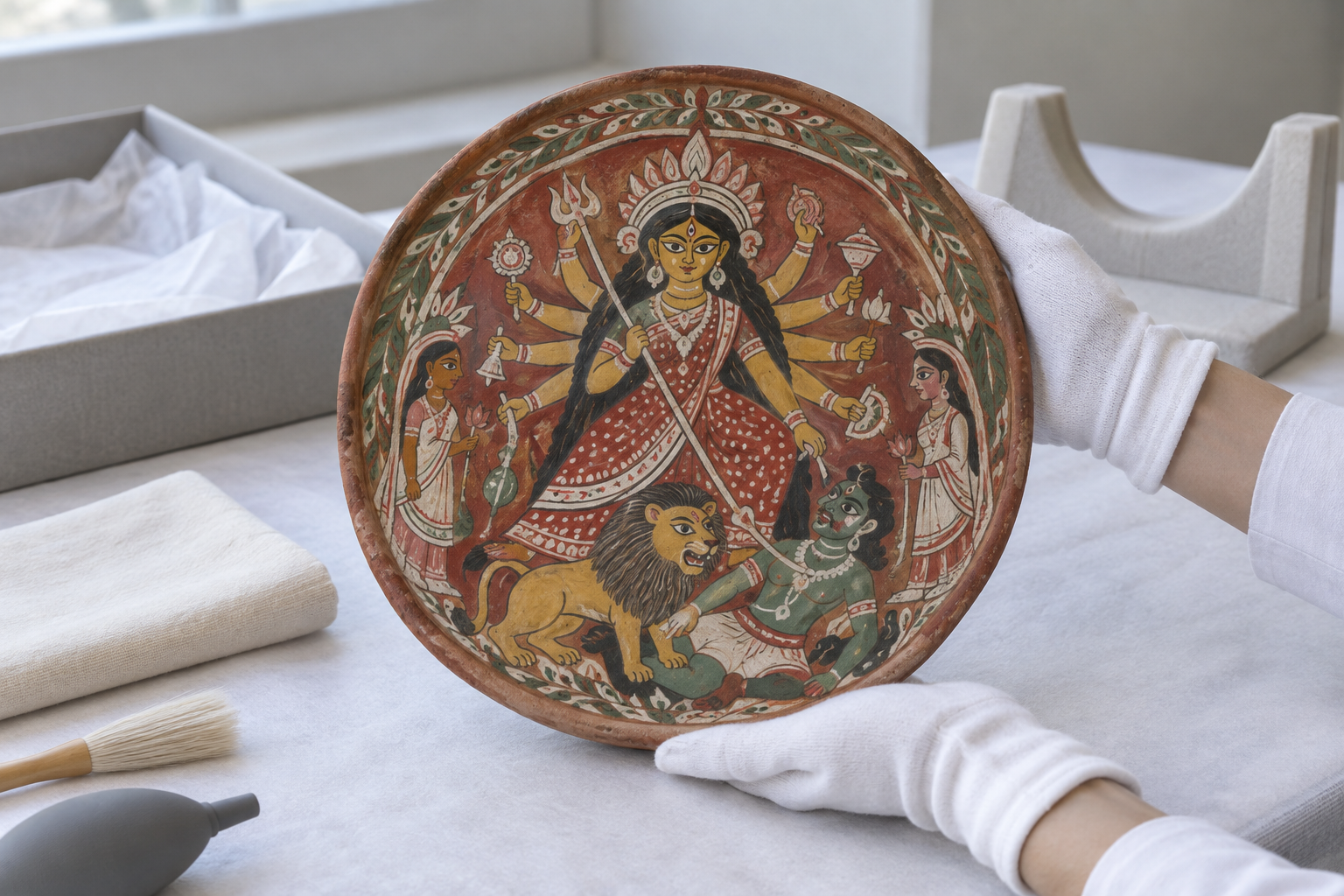
If a shora has come into your care, first determine whether it remains part of active worship. Ask the family or community connected with it before changing its placement, framing or use. A devotional object should not be reclassified as household decor merely because its history was not written on a label.
Keep a simple record even when little is known. Note who supplied the object, where it came from, what they called it, whether they remember it being worshipped, and which details remain uncertain. Preserve those distinctions. “Said by the family to have been used in worship” is honest provenance; “historically consecrated” would be a different and much stronger claim.
Do not treat the fired-clay body as proof that the painted surface can withstand cleaning. Water, scrubbing, household chemicals and amateur repainting can alter or remove paint. If the surface is old, loose or damaged, leave it undisturbed and seek advice from a qualified objects conservator. Conservation should stabilise the object, not make an aged devotional image look newly painted.
If you display it, keep the full round form visible and use a label that names Durga, terracotta and devotional use. If you pass it to another person, give them the history with the object. Even a short, carefully qualified note protects knowledge that appearance alone cannot recover.
Key takeaways
- A shora is a round vessel made from baked clay or terracotta.
- In this tradition, Goddess Durga is painted on the clay surface and may be worshipped in that form.
- The practice is centred in Bengal and is also seen in neighbouring Odisha and Assam.
- Accurate identification requires attention to the round support, terracotta material, painted deity and devotional context.
- If an individual object’s origin or ritual history is unknown, record the uncertainty instead of filling the gap with assumptions.
- Display and documentation should preserve the shora’s religious identity, not present it only as decoration.
The next time you meet a Durga shora, begin with three observations: round fired clay, painted divine form and a tradition of worship. Then ask what is actually known about that particular object. That small act of attention lets you appreciate the art while keeping faith, place and material connected.
References

Leave a Reply
You must be logged in to post a comment.