

Kaula and Sri Vidya are best approached neither as collections of exotic rites nor as interchangeable labels for Tantra. Their representative scriptures describe disciplined, initiatory systems in which theology, bodily practice, sacred sound, ritual form and spiritual realization belong to one field.
Reading the Kularnava Tantra beside the Sri Vidyarnava Tantra reveals a substantial common foundation, but also two different ways of organizing tantric knowledge. The comparison clarifies what the traditions share, where their emphases diverge and why neither scripture functions well as a self-guided ritual manual.
A shared metaphysics with different devotional centers

Both source profiles describe Shiva and Shakti as distinguishable but inseparable aspects of reality. Shiva signifies luminous consciousness, while Shakti signifies consciousness as freedom, expression and manifesting power. The world is therefore not simply an obstacle standing outside the sacred; embodiment and manifestation can become fields of recognition and transformation. This common premise appears in both the Kularnava Tantra profile and the Sri Vidyarnava Tantra profile.
The Kaula account expresses this relationship through Kula and Akula. Kula can indicate lineage, initiated community, the embodied psychophysical system, an aggregate of powers, the manifest universe or Shakti herself. Akula denotes Shiva as the transcendent ground that cannot be contained by an aggregate. Kaula, in this presentation, concerns their inseparability: transcendence is not isolated from manifestation, and manifestation is not independent of consciousness.
Sri Vidya gives the same broad problem a more concentrated devotional and symbolic center. The Sri Vidyarnava presents Lalita Mahatripurasundari as supreme consciousness and creative power. Her name Tripura supports multiple threefold correspondences, including creation, preservation and dissolution; waking, dreaming and deep sleep; and knower, knowledge and known. These correlations train perception to discover unity operating through apparently divided experience.
The traditions should not be collapsed merely because their metaphysical language converges. Kularnava organizes its vision around Kula, Akula, lineage and liberation, whereas Sri Vidyarnava organizes a vast ritual universe around Mahatripurasundari, her mantra forms and the Sri Chakra. The shared premise is the inseparability of consciousness and power; the difference lies in how that premise is ritually, symbolically and pedagogically developed.
Two oceans organize tantric knowledge differently
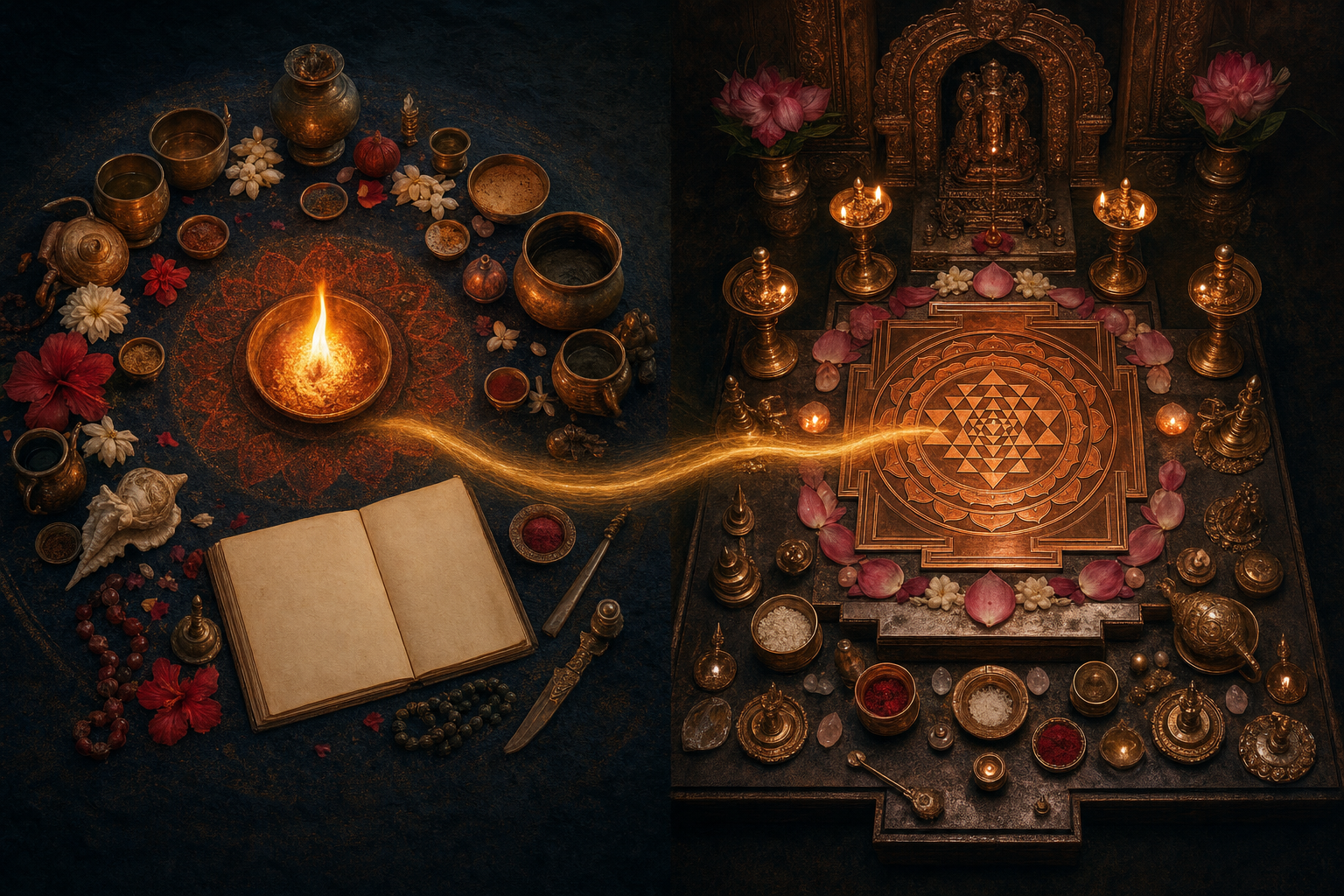
Both titles employ arnava, meaning an ocean, but the metaphor carries different contents. Kularnava is the Ocean of Kula, encompassing the social, bodily, cosmic and metaphysical senses of that term. Sri Vidyarnava is the Ocean of Sri Vidya, which may mean the complete Sri Vidya tradition as well as the many sacred vidyas associated with Mahatripurasundari and other divine forms. The source articles report the following differences in textual architecture and emphasis.
| Dimension | Kularnava Tantra | Sri Vidyarnava Tantra |
|---|---|---|
| Dominant textual character | A revelatory dialogue that combines exhortation, doctrine, initiation and ritual instruction | An encyclopedic compilation that gathers and arranges material from multiple tantric streams |
| Reported architecture | Seventeen ullasas, or expansions of bliss, containing roughly 2,058 verses in the standard recension | Thirty-six shvasas, or breaths, divided between a Purvardha and Uttarardha of eighteen chapters each |
| Opening orientation | Human mortality, the rarity of embodied opportunity and the urgency of practice | The gross, subtle and supreme forms of Mahatripurasundari and their ritual correspondences |
| Organizing symbols | Kula and Akula, the guru, initiation, mantra, the Kaula circle and the embodied path | Mahatripurasundari, sacred mantra structures, the Sri Chakra, its enclosures and related divine forms |
| Overall movement | From existential urgency and metaphysics toward disciplined practice and realization | From a Sri Vidya center into a wider tantric field, before returning to Mahatripurasundari |
This contrast is partly a difference of genre. The Kularnava stages a compassionate question about how embodied beings can escape ignorance and repeated suffering. Its sequence therefore has the force of a spiritual summons. The Sri Vidyarnava behaves more like a repository for readers already conversant with tantric categories, preserving classifications and procedures whose transitions may not resemble a modern introductory course.
Embodiment becomes a method only under discipline

The strongest practical convergence lies in the coordination of body, sound, consciousness and ritual space. Both profiles discuss mantra, nyasa, meditation, initiation, guru-disciple qualifications and forms of ritual embodiment. These are not presented as unrelated techniques. Mantra gives sonic form to divine power; nyasa ritually locates sacred presence in the body; geometry and worship organize a corresponding sacred field; initiation places the practices within transmitted authority.
Kularnava places unusually visible guardrails around this coordination. Its source profile reports repeated warnings that intoxicants, sexuality, ritual substances or deliberate transgression do not confer liberation by themselves. Without self-command, preparation, initiation and competent guidance, practices associated with freedom can instead reinforce confusion. The body is valued as an instrument of awakening, but neither bodily gratification nor bodily rejection is treated as the goal.
Sri Vidyarnava foregrounds integration through three levels of the Goddess: sthula, the visible or gross form; sukshma, the subtle or sonic form; and para, the supreme form as consciousness. The Sri Chakra, mantra and embodied ritual correspond because each expresses Shakti through a different register. Worship thus aims to alter the practitioner’s way of seeing rather than merely secure an external encounter with a deity.
These emphases are complementary rather than contradictory. Kularnava makes the ethical and initiatory conditions of practice especially explicit; Sri Vidyarnava displays the density of correspondences that those conditions are meant to support. The difference may reflect the purposes of the surviving works more than a simple doctrinal opposition between their traditions.
Lineage and textual history limit solitary interpretation

Both scriptures emerge from environments in which authority is transmitted, tested and embodied through the relationship between teacher and disciple. The presence of detailed ritual instructions does not turn either work into an open-access handbook. The qualifications of the participants, the suitability of a mantra and the role of initiation are part of the method rather than optional institutional additions.
The textual histories reinforce that caution. The Kularnava profile reports a commonly used working date of approximately 1000-1400 CE while acknowledging broader estimates. It also distinguishes the standard seventeen-chapter recension from influential modern thematic readings that reorganize the material into eleven sections and omit some technical detail. A thematic presentation can be useful without being identical to a complete verse-by-verse translation.
The Sri Vidyarnava profile describes a similarly unsettled history. The received compilation is attributed to Vidyaranya Yati, but that name does not securely identify one historical person. Proposed dates range from approximately the eleventh century into the later medieval period, and the material preserved by the compilation may be older than its final arrangement. Neither a traditional attribution nor the location of a printed edition, the source cautions, settles the work’s complete provenance.
Responsible reading therefore requires distinctions among scripture, recension, compilation, translation and modern interpretation. It also requires restraint when moving from a text’s philosophical vision to its restricted procedures. The most portable teachings concern disciplined perception, the union of awareness and power, and the need for knowledge to transform conduct. Technical ritual application remains inseparable from lineage context in the sources’ own presentations.
Key takeaways
- Kaula and Sri Vidya share a vision in which consciousness and its manifesting power are inseparable, making embodied life a possible field of realization.
- Kularnava emphasizes Kula, Akula, existential urgency and the safeguards surrounding initiation; Sri Vidyarnava emphasizes Mahatripurasundari, mantra, sacred geometry and layered correspondences.
- Guru, disciple, mantra, nyasa and initiation form a connected discipline in both accounts rather than a menu of independent techniques.
- The two representative scriptures illuminate their traditions without exhausting them, and their uncertain, layered textual histories discourage simplistic claims about origin or uniformity.
Further comparison will be most productive when it follows particular practices, such as mantra or nyasa, across texts and lineages while keeping ethical preparation, editorial history and initiatory context visible.
References
- DharmaRenaissance Blog — Kularnava Tantra Explained: A Transformative Guide to Kula, Guru, and Liberation
- DharmaRenaissance Blog — Sri Vidyarnava Tantra Explained: The Essential Guide to Sri Vidya’s Sacred Ocean