
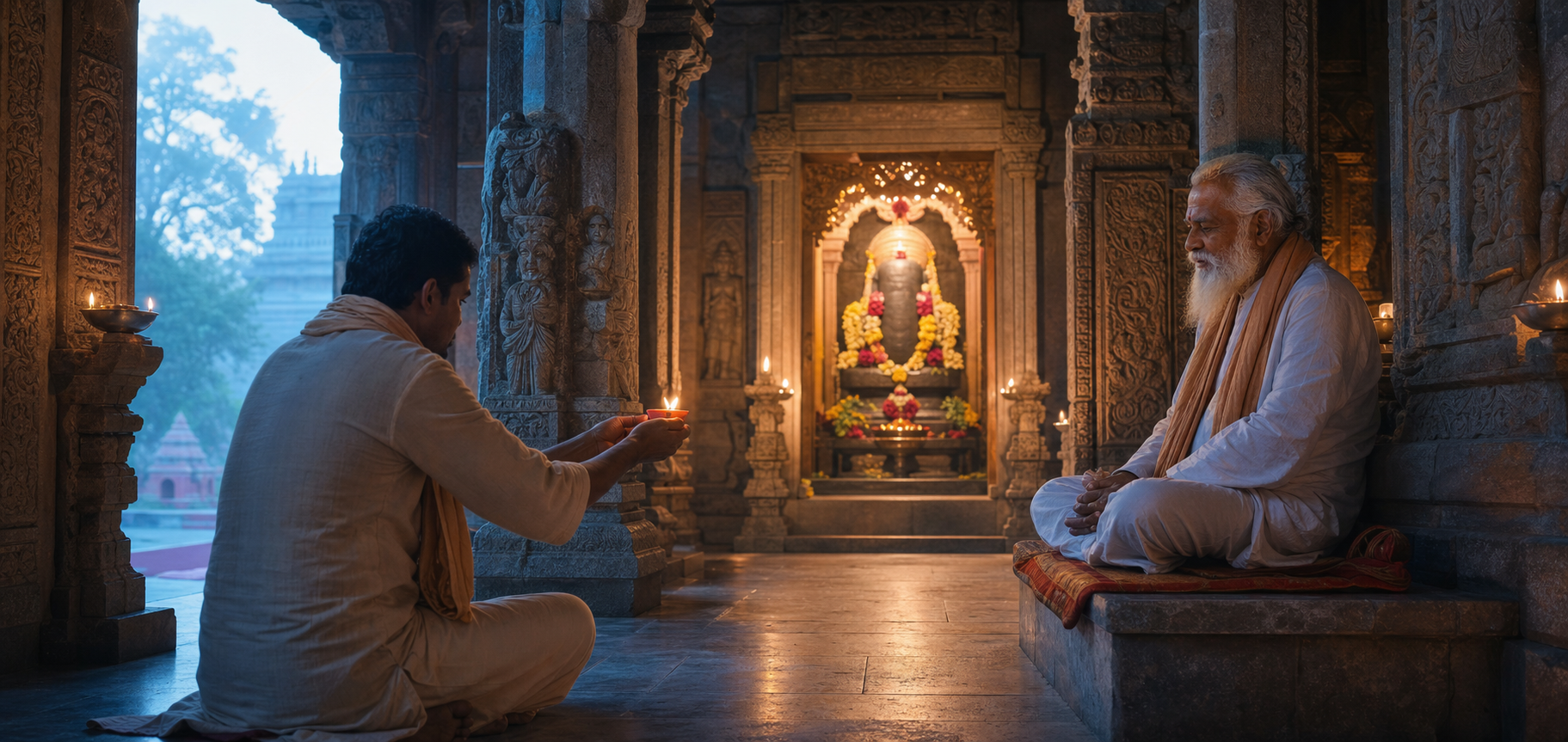
Asking whether the Guru or God should be honored first can make Hindu worship sound like a contest for higher status. The question becomes clearer once ritual order, the transmission of knowledge, devotional reverence, and claims about ultimate reality are examined separately.
The source article presents one established sequence while emphasizing that Hindu traditions do not share a single universal ritual manual. Its most useful conclusion is therefore not a rigid ranking, but a way to understand what honoring the Guru first can mean and what it cannot legitimately demand.
Four different claims can hide inside the word first

Disagreement often begins because the same word is being used for different relationships. A person asking who comes first may be asking about the opening of a ceremony, the source of spiritual instruction, the proper recipient of devotion, or the deepest nature of consciousness. Those questions overlap, but their answers are not interchangeable.
| Kind of precedence | Question being answered | What Guru precedence signifies |
|---|---|---|
| Ritual | Who is remembered at the beginning of a particular practice? | The worshipper acknowledges the teacher or lineage through which the rite was learned. |
| Epistemic | How does the seeker come to understand the deity, mantra, or teaching? | The Guru interprets inherited knowledge and helps correct misunderstanding. |
| Devotional | Why can service to the Guru be treated as service to the divine? | Reverence is directed through the teacher toward the sacred purpose the teacher represents. |
| Metaphysical | Can God, Guru, and the self be understood as non-separate? | Some nondual readings treat their apparent separateness as provisional rather than ultimate. |
Ritual precedence therefore does not automatically establish metaphysical superiority. A salutation offered first may express gratitude for instruction, just as acknowledging a teacher before using a teaching does not imply that the teacher created the truth being taught.
Ritual sequence belongs to a tradition, not a universal ranking
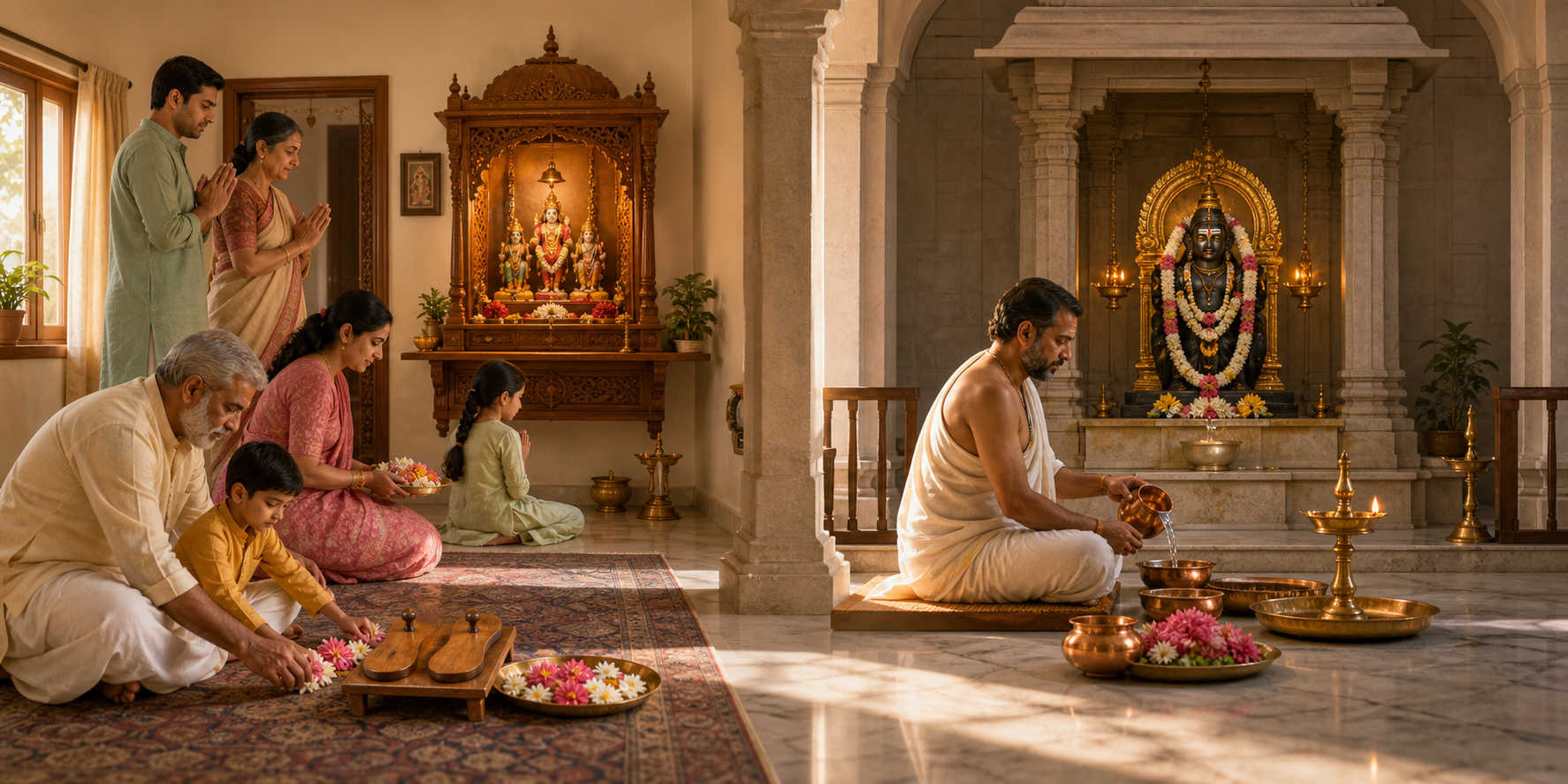
The DharmaRenaissance source describes a framework in which the Guru is remembered first, Lord Ganesha is invoked next, worship proceeds to the chosen deity, and the practice culminates in contemplation of the divinity within. It attributes the teaching behind that sequence to a satsang of Sri Sri Ravi Shankar.
Within that framework, remembering the Guru before Ganesha has a practical logic: the worshipper learned that Ganesha should be invoked, along with the relevant mantra, procedure, symbolism, and discipline, through some channel of instruction. The opening remembrance honors that channel. It need not mean that a human personality has displaced Ganesha or become an independent object of ultimate worship.
The same source also stresses the diversity of Hindu practice. Some traditions begin with remembrance of the Guru, some foreground Ganesha, and others invoke a lineage and an iṣṭa-devatā together. Temple systems, family customs, regional practices, and rites shaped by particular Āgamas, Tantras, or Vedic branches may prescribe different openings.
Consequently, the sound practical principle is fidelity to a recognized tradition rather than the construction of a supposedly universal hierarchy. A householder following an inherited Ganesha-first practice does not have to imitate the sequence of a different lineage merely because that lineage gives the Guru an earlier ceremonial place.
Scripture joins exceptional reverence with clear qualifications
The scriptural passages discussed in the source support a high view of the teacher, but they do not support authority based on title alone. The source reads the Taittirīya Upaniṣad as directing the student to treat the ācārya with deva-like regard, alongside duties of reverence toward mother, father, and guest. In context, this presents teacher-honor as an ethic of gratitude and responsible conduct, not as exemption from moral scrutiny.
The source’s discussion of Muṇḍaka Upaniṣad 1.2.12 supplies a demanding two-part standard. A Guru suitable for liberating knowledge is described as śrotriya, grounded in a transmitted body of sacred learning, and brahmaniṣṭha, established in the reality being taught. The pairing matters: learning without realization can remain merely formal, while a claim of realization without disciplined knowledge can become arbitrary.
Bhagavad Gītā 4.34, as summarized by the article, adds the disciple’s responsibilities: respectful approach, serious inquiry, and service. Inquiry is not an accidental concession in this model. It is part of the relationship itself, distinguishing disciplined receptivity from unquestioning submission.
The article also invokes Śvetāśvatara Upaniṣad 6.23, where devotion to the divine is paired with corresponding devotion to the Guru as a condition through which the teaching becomes luminous. That parallel reverence provides strong support for Guru-bhakti, but it does not by itself require every school to adopt the same metaphysical formula about the numerical identity of Guru and God.
Nondual language does not cancel ethical distinctions

The source reports teachings that discourage seeing God, Guru, and the self as fundamentally separate. Such language is most coherent within a contemplative or nondual setting: the external teacher directs attention toward the consciousness in which divisions among knower, knowledge, and known are ultimately reconsidered.
That metaphysical claim must not be converted into a social claim that anyone using the title Guru is literally beyond criticism. Ultimate non-separation does not erase ordinary distinctions of role, responsibility, consent, or conduct. The source explicitly rejects treating Guru-reverence as a blank cheque for charisma, inherited position, institutional power, or personal demands.
This distinction protects both sides of the tradition. It preserves the depth of Guru-bhakti without reducing it to personality worship, and it preserves intelligent inquiry without reducing the teacher-disciple relationship to suspicion. A genuine teacher is honored for transmitting and embodying a path; the honor is not manufactured by status alone.
A practical rule for worshippers
When uncertainty arises, the relevant questions are less about abstract rank than about the kind of practice being performed, the authority from which it was received, and the qualifications of the person teaching it.
Key takeaways
- In the sequence described by the source, Guru-remembrance precedes the invocation of Ganesha, worship of the chosen deity, and inward contemplation.
- Being first in a ceremony does not necessarily mean being greater than God in an absolute metaphysical hierarchy.
- Different sampradāyas, temples, regions, and families may follow different authorized sequences.
- The source’s scriptural standard combines transmitted learning with realization rather than recognizing a title by itself.
- Respect, inquiry, and service belong together; reverence does not confer immunity from ethical evaluation.
A practitioner who remains unsure can consult the teacher, ritual authority, or inherited household tradition responsible for the practice rather than improvising a sequence from competing slogans. As Hindu communities transmit worship to new generations, maintaining this union of reverence, contextual understanding, and accountability will matter more than declaring a universal winner.