If you have heard that a dying Karna removed gold from his own tooth so he could satisfy one last request for alms, two questions naturally follow. Does this scene occur in the Mahabharata itself? And if it does not belong to the epic’s critical Sanskrit recension, should you still receive it as a dharmic teaching?
The careful answer preserves both textual honesty and cultural memory. The gold-tooth episode is chiefly a regional and oral tradition, while Karna’s extraordinary generosity has a firm foundation within the epic. You do not have to mislabel the story as a Sanskrit verse to understand why generations have remembered Dāna-vīra Karna through it.
The final gift has one moral core and several tellings
Karna falls on the seventeenth day of the Kurukshetra War. His chariot wheel becomes trapped, earlier curses converge upon him, and Arjuna releases the Anjalika-astra under Krishna’s direction. The ethics of that battlefield moment remain debated, but popular memory does not leave Karna only as a defeated warrior. It imagines him facing one more test of character.
A mendicant, often represented as a Brahmin, approaches the wounded Karna and asks for dāna. Some tellings identify the visitor as Krishna or Indra in disguise. Karna has lost his kingdom, weapons, mobility, and ordinary possessions. Finding nothing else to offer, he removes a gold-capped tooth and gives its gold to the petitioner.
The surrounding details change with the region and performance. Karna may extract the tooth with an arrow or a stone. The petitioner may object that a bloodstained gift is ritually unsuitable, prompting Karna to obtain water from the earth and purify it. A divine identity may be revealed at the end, followed by a blessing. These elements should be treated as variants, not forced into one supposedly definitive sequence.
What remains constant is more important than any single prop. A person from whom fortune has taken almost everything still refuses to abandon his vow of giving. The request reaches Karna when self-preservation would be the most understandable response, yet dāna remains part of who he is.
When you hear the story in a pravachan, regional katha, Yakshagana performance, or Kathakali presentation, notice that stable structure beneath the changing details: request, apparent inability, costly discovery, purification, and gift. That is the tradition’s ethical architecture. Debating whether an arrow or stone was used can make you miss what the variation is designed to preserve.
How to separate epic text from living tradition
The simplest way to avoid confusion is to distinguish three layers. Each carries meaning, but they do not make the same textual claim.
- The epic setting: Karna’s fall occurs on the seventeenth day, amid the immobilized chariot wheel, Arjuna’s weapon, Krishna’s counsel, and the accumulated consequences surrounding the war.
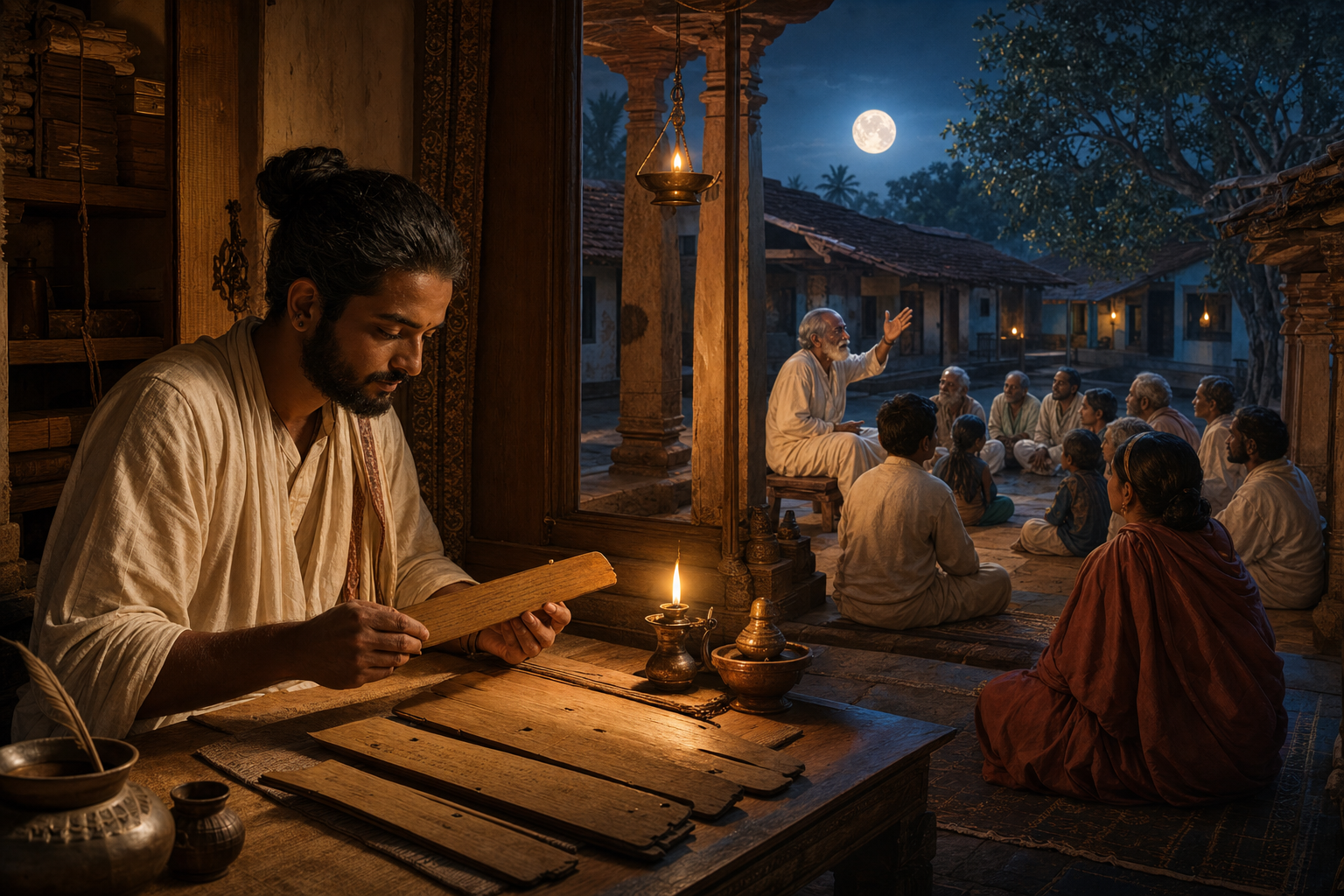
- The epic exemplar of generosity: Karna gives his kavacha and kundala to Indra, who has approached him disguised as a Brahmin. This is the clearest Mahabharata foundation for his identity as an exceptional giver.
- The final-charity tradition: The gold-tooth scene belongs primarily to regional and oral retellings rather than the critical Sanskrit recension. It extends Karna’s established generosity to the threshold of death.
This distinction gives you a reliable way to speak about the episode. Say that a widely cherished tradition remembers Karna’s final gift. Do not introduce it as a direct scene from the critical edition or assign it an invented chapter and verse. At the same time, calling it merely false would confuse textual location with moral significance.
Oral traditions do not need to impersonate critical editions in order to matter. They often interpret a character by concentrating a lifelong disposition into one memorable action. The deathbed gift does precisely that: it takes the generosity already associated with Karna and asks whether it would survive when possession, prestige, and hope of reward had disappeared.
If you teach this story to children or discuss it in a study group, tell it first as a living tradition and then place it beside the kavacha-and-kundala episode. That pairing does not diminish devotion. It gives the listener both the inherited moral image and the textual anchor needed to discuss it responsibly.
This approach also prevents an avoidable argument. You need not choose between treating every popular detail as part of the critical Sanskrit text and discarding every later retelling as worthless. The more accurate position is that the Mahabharata establishes Karna’s liberality, while the final-charity tradition intensifies that trait through moral imagination.
Why the gift matters more than the gold
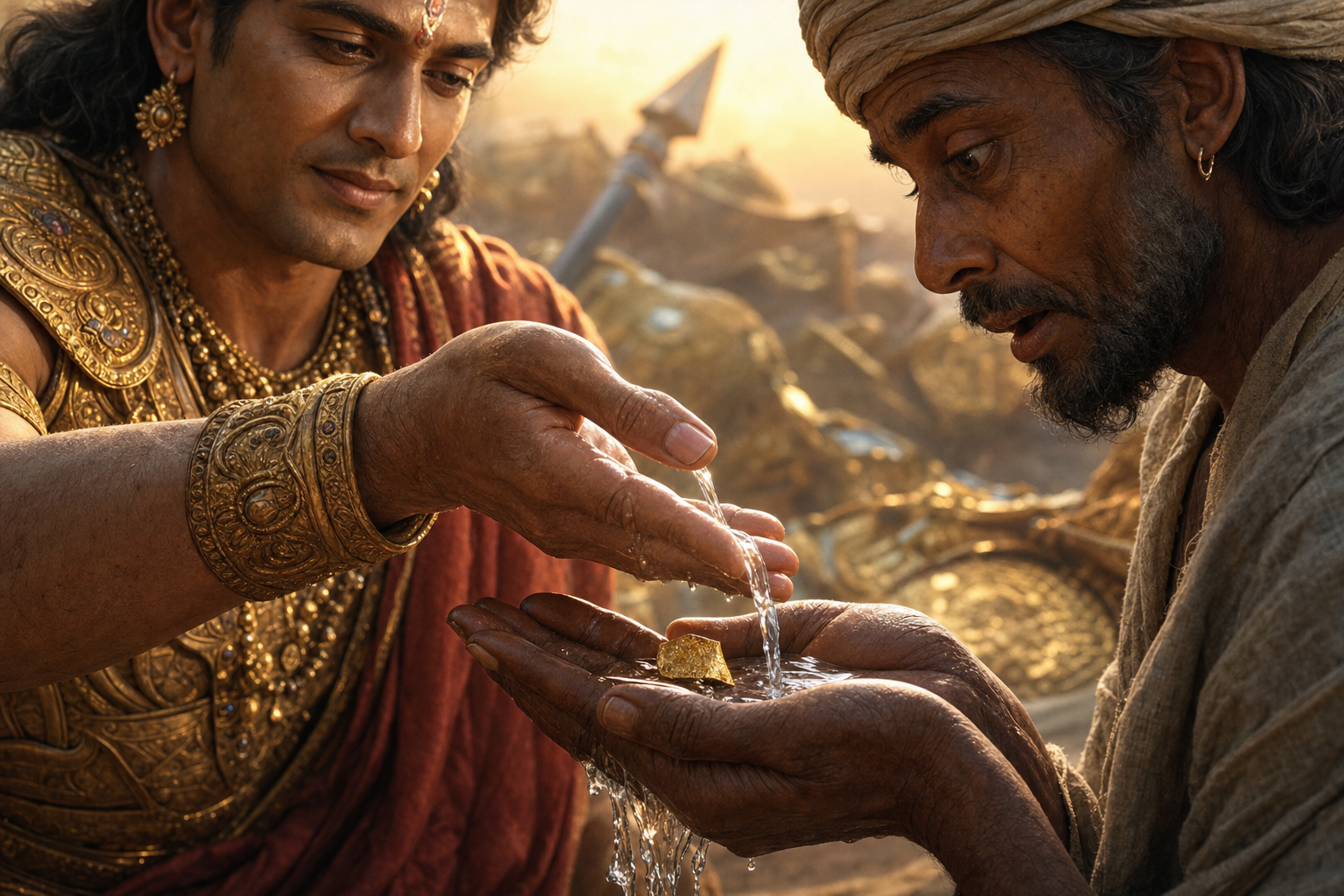
The tooth is a powerful symbol because its gold is not loose wealth. It has become attached to Karna’s body. Gold ordinarily signifies rank, prosperity, and worldly distinction; here it becomes the last available material for renunciation. Karna is not distributing a surplus that he will never miss. He is relinquishing something bound to his embodied identity.
That is why the story shifts your attention from the market value of the gift to the giver’s bhāva, the inward disposition from which the act proceeds. A large donation can still be transactional if it purchases influence, praise, obedience, or a future favour. A materially modest gift can carry greater ethical weight when it answers a real need without turning the recipient into an instrument of the giver’s reputation.
The Bhagavad Gita’s treatment of dāna in 17.20-22 supplies a precise lens. Sāttvika dāna is giving to a worthy recipient, at the right place and time, without expectation of return and with a composed mind. The deathbed tradition is commonly read through this standard because Karna appears to have no worldly future in which repayment could reach him.
Worthy recipient should not be reduced to social rank. In practical giving, it asks whether your gift fits a genuine need and whether the recipient can benefit from it. Right time and place ask whether help arrives when it can still help. Freedom from return asks whether an unspoken bargain is hiding beneath your generosity. A composed mind asks whether you are giving from steadiness rather than vanity, coercion, or theatrical guilt.
The scene also resonates with antyadāna, gifts made near life’s end. Such giving carries special moral force because the giver has little opportunity to recover social or material profit. Karna’s legend radicalizes the idea by presenting a gift drawn from the body itself. It should be read as an image of self-transcendence, not as an instruction to injure yourself or neglect legitimate responsibilities.
This distinction matters. Sacrifice is not automatically dharmic merely because it hurts. The pertinent question is whether the sacrifice serves another person with discernment and dignity. Karna’s remembered act is compelling because steadfast generosity, not pain for its own sake, governs the scene.
The larger Dharmic family gives this lesson several forms without making every tradition identical. Buddhism places dāna-pāramitā at the entrance to the perfections. Jain traditions relate dāna to ahiṃsā and aparigraha, joining compassion to non-attachment. Sikh practice makes selfless provision socially visible through dasvandh and the universal langar. These are distinct paths, but each refuses to treat possession as an entirely private matter.
For you, that shared civilizational vocabulary changes the central question. Do not ask only how much was given. Ask whether attachment loosened, another person’s dignity was protected, and the gift contributed to loka-saṅgraha, the welfare and cohesion of the world.
Karna’s generosity does not settle every dharmic question
Karna is difficult precisely because one radiant virtue does not erase every other moral issue around him. Admiring his dāna does not require you to declare every allegiance, decision, or battlefield action righteous. Nor does criticism of his choices require denial of his generosity.
This is a useful discipline when reading the Mahabharata. Modern argument often turns a character into either a spotless hero or a complete villain, then treats every episode as evidence for the chosen verdict. The epic’s moral pressure is lost when virtue and fault are collapsed into a single score.
Karna’s death raises its own questions. His chariot is immobilized when Arjuna releases the Anjalika-astra. Krishna’s counsel is discussed in the wider context of the war’s accumulated violations, including Abhimanyu’s tragic end. Those considerations belong to the debate about Dharma-Yuddha. The later gold-tooth tradition cannot, by itself, prove that one side of that debate is correct.
What the final gift can establish is narrower and more useful: a person may retain a genuine virtue amid compromised circumstances. Kṣatra-dharma and dāna-dharma meet in Karna without becoming interchangeable. Martial courage cannot substitute for generosity, and generosity cannot retroactively sanctify every martial choice.
Keep three guardrails when discussing him:
- Admire the specific virtue on display without turning admiration into total acquittal.
- Discuss the ethics of Karna’s death with the battlefield context intact rather than using his final charity as a shortcut to a verdict.
- Judge the gift by intention, fitness, and treatment of the recipient, not merely by the fame it brought the giver.
This reading is demanding because it denies you an easy partisan answer. It is also closer to the practical work of dharma. In ordinary life, you will often need to recognize a person’s real goodness without surrendering discernment about their harmful choices. Karna trains that capacity.
A practical dāna discipline you can begin now
You are unlikely to face Karna’s dramatic test, but the structure of his vow can guide ordinary decisions. The point is not to wait for a heroic final moment. It is to build a form of generosity that remains available when convenience disappears.
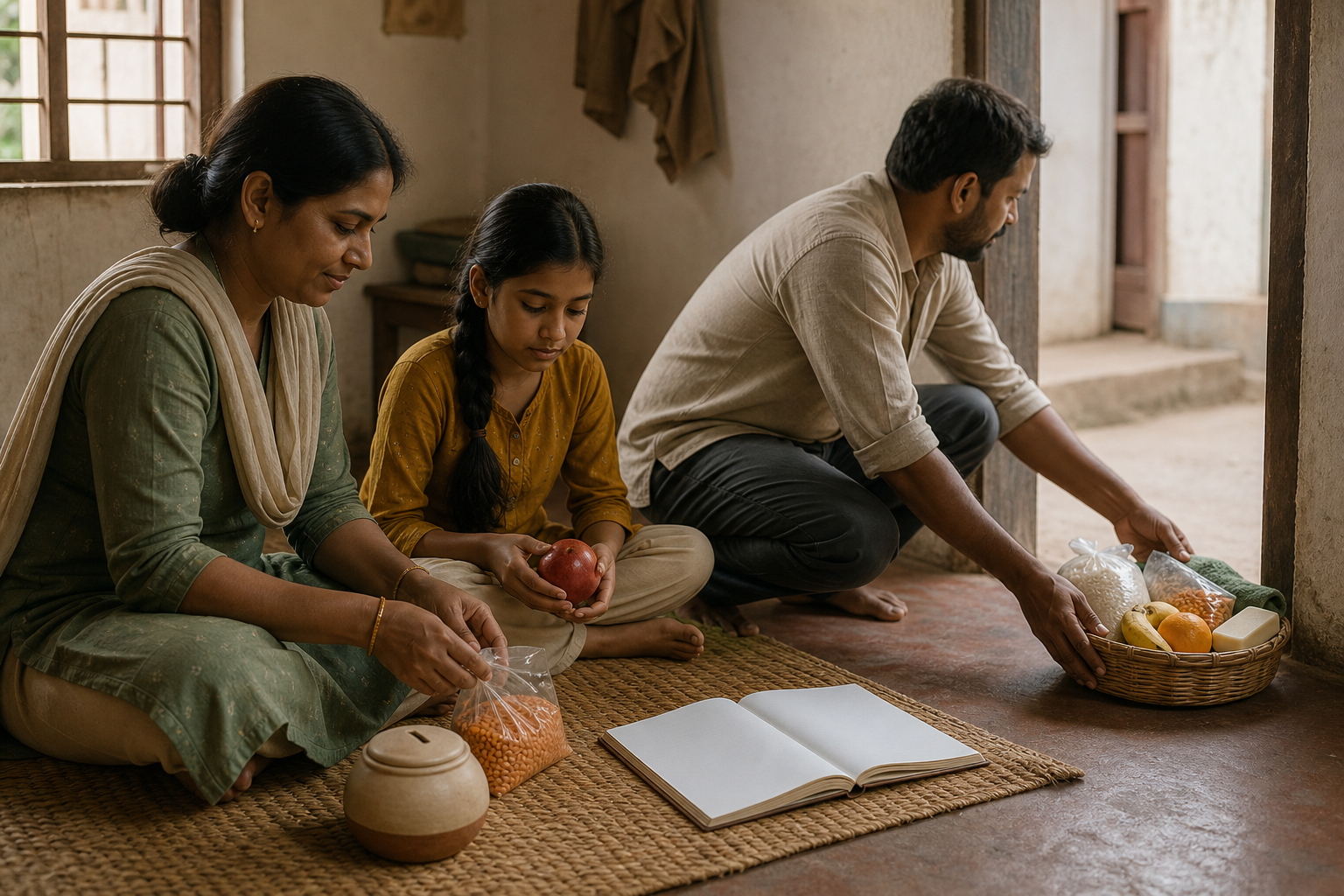
- Begin with the need, not the object you want to give. Ask what would actually help this recipient. Unwanted goods may clear your space without meeting anyone’s need.
- Match the gift to the time and place. Money may be appropriate in one situation; knowledge, practical competence, patient presence, or advocacy may matter more in another. Help that arrives after the decisive moment can be sincere and still be ineffective.
- Remove the hidden return clause. Do not attach an expectation of publicity, loyalty, deference, access, or repayment. If recognition is necessary to make you give, notice that honestly before calling the act selfless.
- Protect the recipient’s dignity. Do not make another person’s hardship into a performance. Ask permission before sharing their circumstances, and do not use gratitude as proof that your gift was appropriate.
- Offer something genuinely valuable without making harm the measure. Time, attention, competence, forgiveness, and courage can be harder to spare than discarded possessions. Give responsibly enough that the act supports dharma rather than creating a preventable burden for those already dependent on you.
- Make the disposition repeatable. Put service into your calendar, commitments, or household practice before a crisis. A vow becomes character through repetition; otherwise generosity remains dependent on mood and surplus.
You can use these steps as a short dāna audit before a substantial gift. Who needs help? Why is this form of help suitable? Why now? What return am I secretly imagining? Will the recipient retain choice and dignity? What part of my attachment am I being asked to release?
The audit also reveals why intention alone is insufficient. Good bhāva should improve the manner of giving, but it does not magically make an unsuitable gift useful. Sāttvika philanthropy joins inward freedom to outward discernment. It cares about both the giver’s attachment and the recipient’s actual welfare.
Karna’s last possession need not be imitated literally. Translate it. If money is easy for you but sustained attention is difficult, attention may be the more revealing gift. If advice is easy but practical labour is needed, offer competence. If resentment is the possession you guard most fiercely, forgiveness may be a form of dāna where it can be given safely and truthfully.
Key takeaways
- Karna’s gold-tooth charity is best described as a cherished regional and oral tradition, not as a scene from the critical Sanskrit recension.
- His earlier gift of kavacha and kundala to Indra provides the firm epic anchor for his identity as Dāna-vīra Karna.
- The changing details of the final-gift story preserve one stable claim: generosity has become Karna’s character rather than a response to abundance.
- Bhagavad Gita 17.20-22 directs attention to the recipient, timing, place, freedom from expected return, and the giver’s state of mind.
- Admiring Karna’s dāna does not require a blanket verdict on his allegiances or on the contested circumstances of his death.
- To practise the lesson, give something fitting and valuable, preserve the recipient’s dignity, and remove the demand for recognition or repayment.
The next time Karna’s final charity is told, you do not need to choose between credulity and dismissal. Name the tradition honestly, receive the virtue it is trying to cultivate, and then test your own vow. Choose one needed gift of money, time, knowledge, presence, forgiveness, or courage, and offer it without turning the recipient into your audience.