
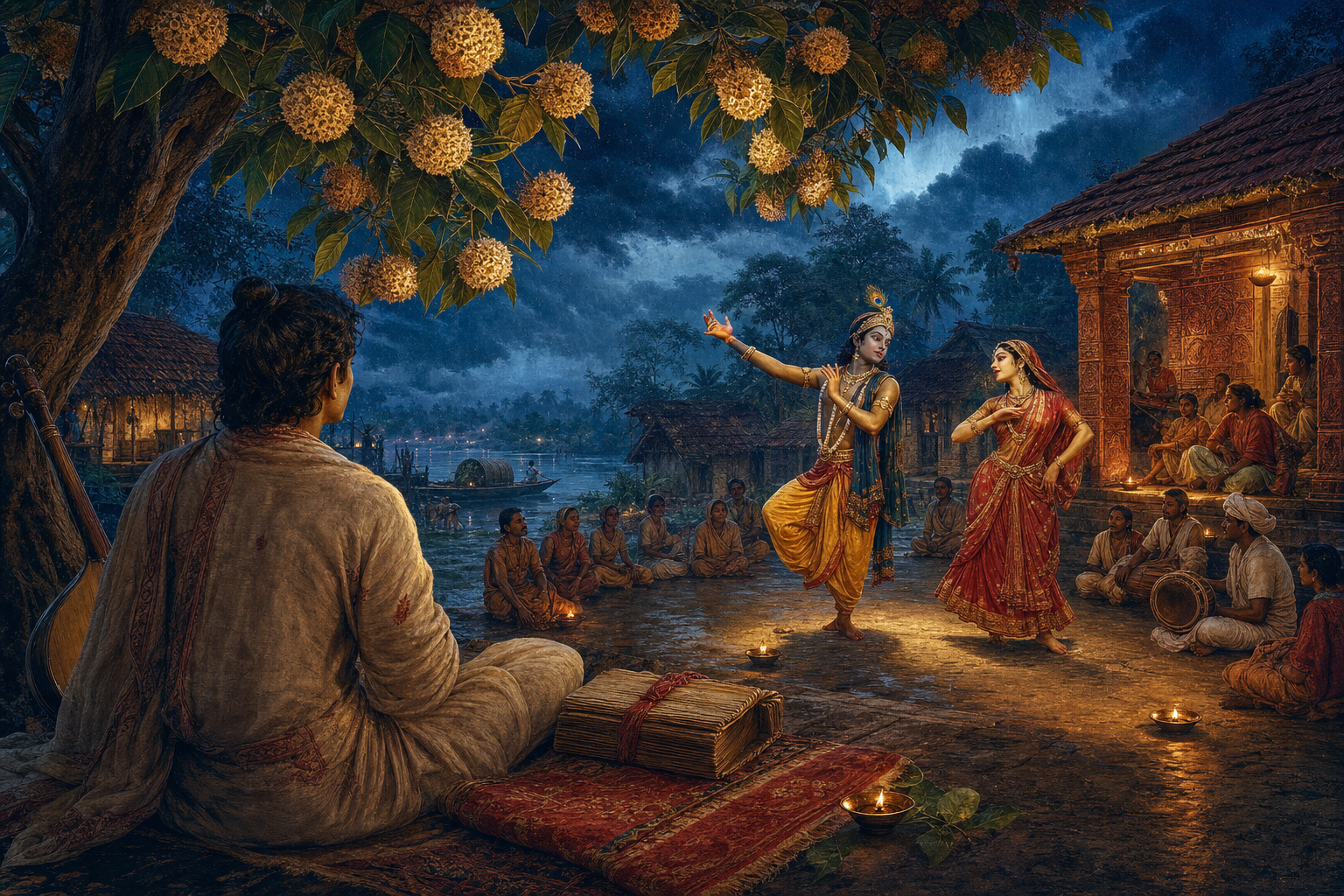
If you came to Bengali Krishna devotion through Chaitanya, Chandidasa can seem like a name in the prologue: important, but difficult to place. You may also wonder how poetry about Radha and Krishna’s intensely personal love becomes a serious language of bhakti rather than ordinary romance.
The answer appears when you read Sri Krishna Kirtana in three dimensions at once: as dramatic poetry, as theology carried by rasa, and as words made for performance. That approach lets you appreciate Chandidasa on his own terms while seeing why his songs mattered to the devotional culture that followed.
Start with the historical Chandidasa you can actually defend
The Chandidasa associated with Sri Krishna Kirtana probably worked in fifteenth-century Bengal and composed in early Middle Bengali. His narrative cycle belongs among Bengal’s earliest influential treatments of Radha and Krishna, preceding the great flowering of Gaudiya Vaishnavism around Chaitanya.
That chronology matters. It shows that Bengal already possessed a developed vernacular language for divine longing before later Gaudiya thinkers gave bhakti-rasa a more systematic theological form. Chandidasa should not be reduced to a rough draft of somebody else’s tradition. He helped create the emotional, linguistic, and performative ground on which later Bengali Krishna devotion could grow.
You should nevertheless keep the attribution cautious. Bengal’s literary record preserves works under the name Chandidas that differ in language, style, and doctrine, leading scholars to distinguish more than one poet bearing that name. The recurring signature Chandidas bole, meaning that Chandidas speaks or says, identifies a poetic voice within a song. It does not by itself prove that every signed composition came from one historical person.
Hold three questions apart when you encounter a pada attributed to Chandidasa: Does its language fit early Middle Bengali? Does it belong to the narrative world of Sri Krishna Kirtana? Is the attribution based only on the signature line? This prevents a common mistake in devotional history: treating a revered name as if it automatically settled chronology and authorship.
The language itself is part of the achievement. Chandidasa did not need to abandon theological depth when writing in a vernacular that people could remember, recite, and sing. Pastoral images, direct speech, lyrical ornament, and abstract spiritual meaning occupy the same poetic space. If a line seems simple, do not assume that its work is simple. Ask what emotion it establishes, what relationship it changes, and what a repeated phrase would do in the mouth of a congregation.
Read Sri Krishna Kirtana as a sequence of emotional turns
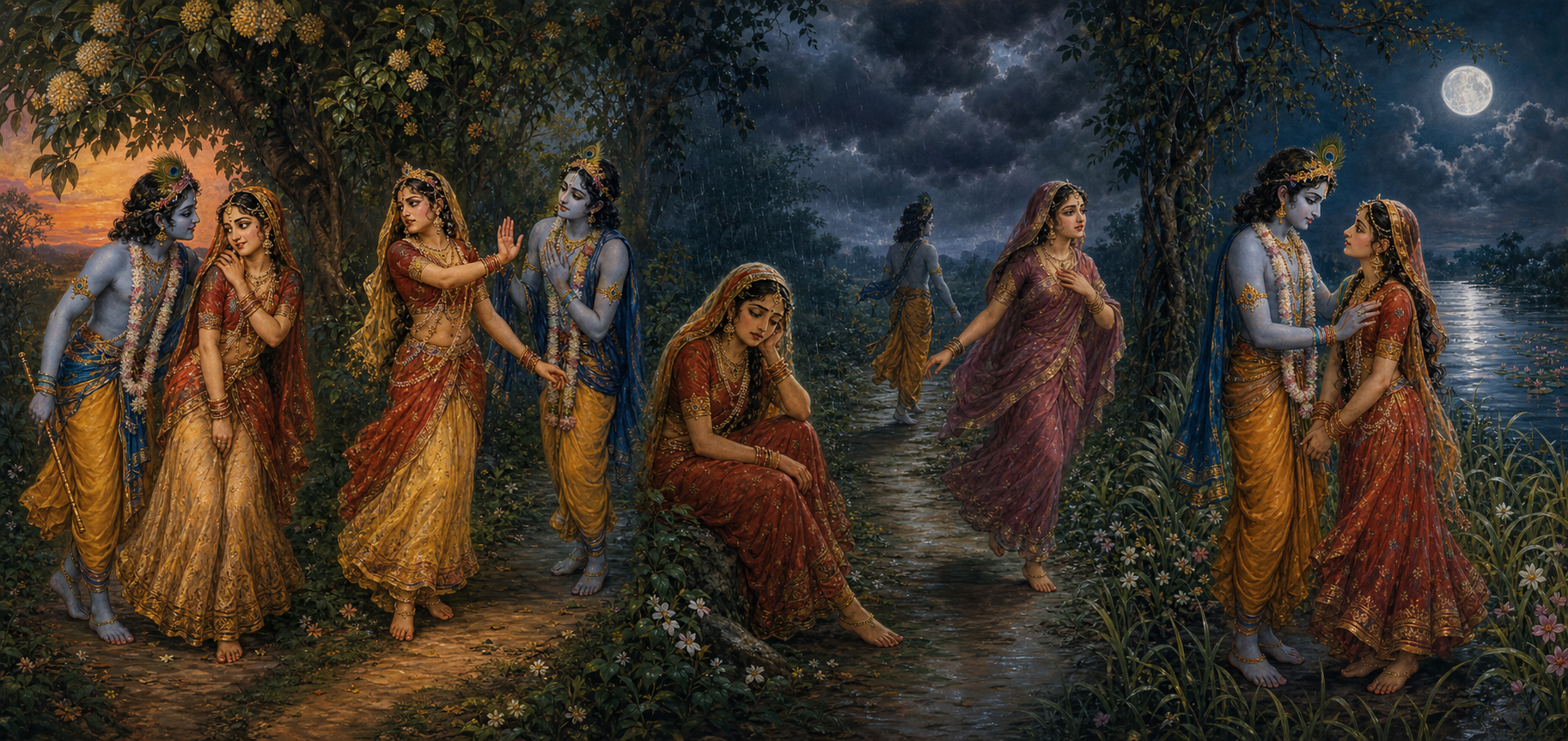
Sri Krishna Kirtana is not merely a heap of isolated devotional lyrics. Its thematically connected padas dramatize episodes in Radha and Krishna’s lila through conversations, pastoral situations, misunderstandings, moral pressures, separation, and reunion. The narrative advances through changes of feeling as much as through external events.
The governing aesthetic is shringara, the rasa of love. Two conditions help you orient yourself: vipralambha, love experienced in separation, and sambhoga, love experienced in union. These are not decorative labels to attach after reading. They tell you how longing, resistance, expectation, encounter, and fulfillment organize the spiritual experience of a song.
Use this five-pass method with an individual pada:
- Identify the voices. Note who speaks, who listens, and whether the desired person is present, absent, or being discussed.
- Name the immediate want. Before reaching for an allegory, state the dramatic need plainly: meeting, reassurance, explanation, resistance, reconciliation, or relief from separation.
- Locate the emotional turn. Find the point at which confidence becomes uncertainty, resistance becomes attraction, pain becomes remembrance, or conflict moves toward union.
- Mark repetition and contrast. A recurring phrase may intensify longing in performance, while a contrast between ordinary village life and overwhelming love may open the theological dimension.
- Read the bhanita last. The signature line can frame what you have heard, place the poet inside the devotional act, or guide the performing community toward the song’s final emphasis.
Only after those five passes should you formulate the theological meaning. A rigid code in which every dramatic detail has one fixed spiritual equivalent will flatten the poetry. Chandidasa’s theology emerges through the movement of experience: desire becomes concentrated, absence deepens attention, conflict tests fidelity, and reunion changes the meaning of what came before.
Reading twice is therefore better than trying to decode everything at once. On the first reading, follow the human drama without embarrassment. On the second, ask how that drama trains the devotee’s attention. This preserves both levels. If you suppress the romantic intensity, rasa loses its force; if you stop at romance, bhakti disappears from view.
Radha’s longing is theology expressed through rasa

Radha occupies the spiritual center of Chandidasa’s Krishna bhakti. Her inner life makes devotion visible under pressure. Longing, hesitation, hurt, steadfastness, and joy are not interruptions to her relationship with Krishna; they are the conditions through which its depth becomes perceptible.
This is why vipralambha should not be treated as an empty interval before the more important event of union. Separation gathers the mind around the absent beloved. It exposes what the heart actually values and turns remembrance from a casual thought into an absorbing discipline. Sambhoga then carries the intensity accumulated through longing rather than simply canceling it.
Radha’s example also corrects a shallow idea of surrender. Devotional surrender is not emotional blankness. Her commitment is expressed through a fully awakened interior life. The poems allow tension and ambivalence to remain present while showing how powerful human emotions can be redirected toward the divine.
That redirection is the crucial distinction when you meet the poetry’s erotic candor. Shringara is neither an embarrassment to be explained away nor a license to treat divine lila as a rulebook for ordinary conduct. Human love supplies a precise and forceful vocabulary for intimacy, vulnerability, exclusiveness, and yearning. Remembrance of Krishna changes the aim of those emotions and makes them instruments of transcendence.
Three questions will keep your interpretation grounded. Does the scene deepen remembrance of Krishna? Does Radha’s response reveal steadiness or transformation through conflict? Does the movement of the song carry the listener from immediate desire toward devotional attention? If none of these is visible, you may be reading the plot while missing the bhakti.
Later Gaudiya Vaishnava theology developed a more explicit account of disciplined devotional rasa, notably in works such as Bhakti-rasamrita-sindhu. That later vocabulary can illuminate Chandidasa, but it should not erase his historical position. Use it as a lens, not as proof that every later doctrine already existed in identical form in a fifteenth-century Bengali song.
Put the songs back into voice, rhythm, and community
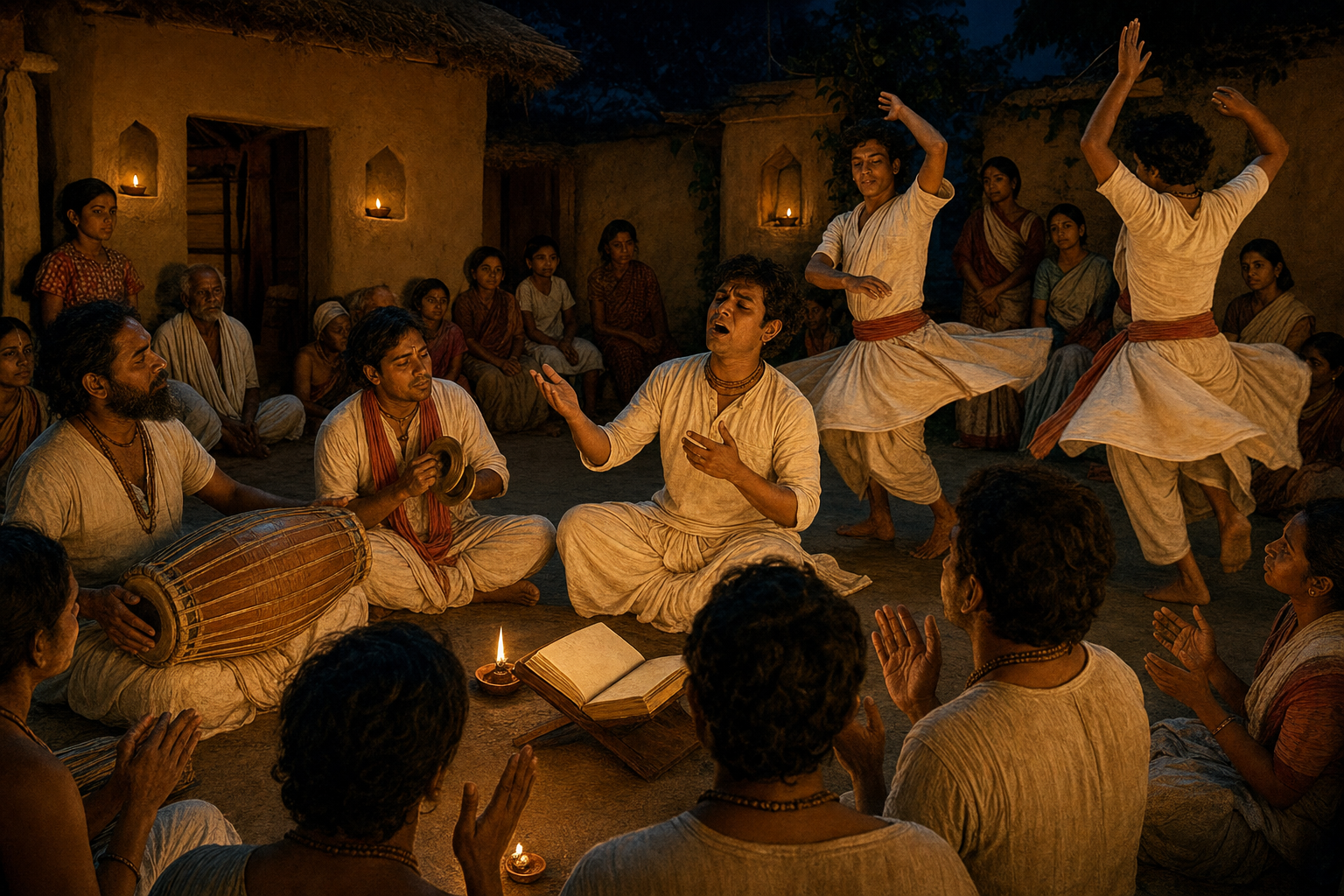
A silent page preserves the words but only part of their life. Sri Krishna Kirtana belongs to a performance environment in which rhythmic phrasing, refrains, call and response, and the sounds of mridanga and kartal could turn an intimate drama into shared devotional participation.
You do not need a reconstructed medieval tune to notice this dimension. Try a modest reading exercise:
- Assign the speaking parts to different readers, or change your voice clearly when the speaker changes.
- Repeat every refrain instead of passing over it as redundant text.
- Keep a steady hand beat so that you can feel where the language gathers momentum or pauses.
- Say the Chandidas bole signature aloud and listen for the shift from dramatic character to poetic or devotional framing.
- Read the pada once more without stopping, allowing repetition to accumulate its effect.
This exercise does not claim to reproduce an original performance. It reveals why the composition’s form matters. Direct diction makes participation possible; repeated language stabilizes a communal response; rhythmic regularity helps memory; and changing voices let listeners enter the emotional situation rather than merely hear about it.
Kirtana therefore acts as more than ornamented storytelling. It joins remembrance, bodily rhythm, listening, and collective response. A private feeling voiced before others can become ethical instruction, consolation, and shared discipline. The community does not need every participant to begin with the same literary education because the song teaches through recurrence and participation.
This is also where comparison across Dharmic traditions can be useful, provided you compare functions without erasing doctrines. Sikh kirtan, Buddhist chanting, and Jain contemplative recitation do not become the same practice merely because all employ the voice. The meaningful resonance lies in how disciplined sound can gather attention, carry sacred memory, and bind a community around spiritual practice. Notice the common civilizational confidence in recitation and song while respecting what each tradition says is being remembered, realized, or praised.
Carry Chandidasa forward without turning him into a footnote
Chandidasa helped establish patterns that later Bengali padavali kirtan could develop: emotionally charged Radha-Krishna imagery, memorable cadence, dramatic address, and theology communicated through song. Later Gaudiya Vaishnava poets and performers inherited a Bengal in which intimate devotion already possessed a vernacular literary and musical vocabulary.
Influence, however, is not identity. Calling Chandidasa merely pre-Gaudiya can make his value depend entirely on what came afterward. A better historical judgment runs in both directions: later traditions help us recognize the significance of his devotional rasa, while his poetry shows that those traditions grew within an already creative Bengali bhakti culture.
The history of transmission requires the same balance. Sri Krishna Kirtana lived for centuries in manuscripts that acquired regional readings, performance adaptations, and scribal additions. Its early twentieth-century rediscovery and critical editing made its importance to Middle Bengali literature clearer. Variation does not automatically make the tradition worthless, but neither should every late reading be projected back onto an original poet. Treat variants as evidence of reception first; decide questions of authorship and priority only with linguistic and textual support.
If you read in translation, choose one that identifies the speakers and retains or clearly explains terms such as pada, lila, rasa, shringara, vipralambha, sambhoga, and bhanita. A smooth translation that removes those distinctions may preserve the storyline while hiding the machinery of the devotion.
Key takeaways
- Place the Chandidasa of Sri Krishna Kirtana provisionally in fifteenth-century Bengal, but do not assign every Chandidas-signed poem to the same author.
- Follow each pada as drama before interpreting it as theology: identify the voices, desire, obstacle, emotional turn, refrain, and signature.
- Use vipralambha and sambhoga to track how separation and union shape devotional attention.
- Read Radha’s emotional intensity as disciplined orientation toward Krishna, not as a detail to sanitize or a social rule to imitate.
- Hear repetition, rhythm, and response as part of the meaning; kirtana turns individual longing into communal remembrance.
- Recognize Chandidasa’s influence on later Bengali Krishna bhakti without collapsing his poetry into a later theological system.
Your next step can be small: take one pada, label its speakers and emotional mode, mark its refrain and bhanita, and then read it aloud. Ask what changes between the first line and the last. In that change, rather than in a detached summary of the plot, you will begin to hear how Chandidasa makes bhakti think and sing through feeling.