
You may have arrived here after seeing Jaimini’s Mahabharata described as a lost epic, a forbidden version, or a rival to Vyasa’s Mahabharata. Before you decide what to read or repeat, separate the modest traditional claim from the much larger claims often built upon it.
The careful answer is that the Mahabharata tradition remembers more than one line of transmission. Jaimini’s name belongs within that memory. Yet a remembered recension, a surviving manuscript, a published book, and a complete alternative epic are not interchangeable things.
Start with the claim the tradition actually makes

The Mahabharata attributed to Maharshi Krishna Dvaipayana Vyasa is traditionally described as having been taught to five disciples, each of whom produced his own recension. The Adi Parva is the stated locus of this transmission account. Within that framework, Jaimini is associated with one of the recensional lines.
This matters because the tradition is not presenting the Mahabharata as a book that suddenly appeared in one printed form. It presents an act of composition followed by teaching, reception, and transmission. The plurality belongs to the remembered history of the epic; it is not automatically evidence of corruption or modern interference.
You should nevertheless keep three levels of claim apart:
- Traditional testimony: Vyasa taught the Mahabharata to disciples, and distinct recensions were associated with their transmission.
- Textual evidence: a particular manuscript, passage, edition, or identifiable body of text can be examined.
- Historical inference: someone proposes how, when, or why one textual line changed, disappeared, or survived.
The first level does not automatically prove every claim made at the second or third. A traditional genealogy can be meaningful without giving us a complete manuscript history. Conversely, the absence of a complete recoverable text does not erase the tradition’s memory of plural transmission.
A recension is not automatically a rival Mahabharata
In textual study, a recension is a distinguishable form of a work within its history of transmission. Recensions can differ in wording, arrangement, emphasis, or included material. The word does not by itself mean that a disciple rejected the teacher, invented an unrelated epic, or founded a competing scripture.
That distinction is especially important here. The traditional architecture is Vyasa, his teaching, his disciples, and their recensions. It is a lineage model. Calling something Jaimini’s recension therefore points first to transmission and attribution, not rebellion against Vyasa.
Four labels that are often blurred together should be kept distinct:
- Recension: a textual form associated with a particular line of transmission.
- Retelling: a new narration that may adapt plot, emphasis, language, or audience.
- Translation: a rendering from one language into another, whether literal or interpretive.
- Edition: a text prepared by an editor from one or more witnesses, sometimes with recorded variants and editorial decisions.
A modern volume can be more than one of these at once. It might translate a later retelling bearing Jaimini’s name, or edit a text attributed to his line. Its title alone cannot tell you whether it preserves an ancient recension in full.
What Jaimini’s name proves, and what it does not
Within the traditional transmission account, Jaimini’s name identifies an attributed recensional lineage. That is the sound starting point. It does not, without further evidence, establish any of the following:
- that a complete Jaimini Mahabharata is presently available;
- that every work called Jaimini Bharata contains the whole recension remembered by tradition;
- that every variant attributed to Jaimini preserves his exact words;
- that missing material was deliberately censored;
- that the Jaimini line was intended to displace Vyasa’s authority;
- or that one modern publication represents the entire history of that line.
The words lost and forbidden are particularly easy to misuse. A text may fail to survive completely for many possible reasons: manuscripts can perish, copying can become selective, portions can circulate separately, or one transmission line can be absorbed into another. These are possible mechanisms, not established explanations for Jaimini’s recension.
Calling a text forbidden makes an additional claim. It implies an agent, an act of restriction, and usually a motive. Unless those elements are supported by identifiable evidence, the word supplies drama rather than history. The disciplined formulation is simpler: the tradition remembers a Jaimini recension, while the recoverable extent and history of that recension must be demonstrated text by text.
This does not diminish the tradition. It protects it from an avoidable mistake: turning a precise inherited claim into a sensational assertion that the available evidence cannot carry.
How to assess a claimed Jaimini text
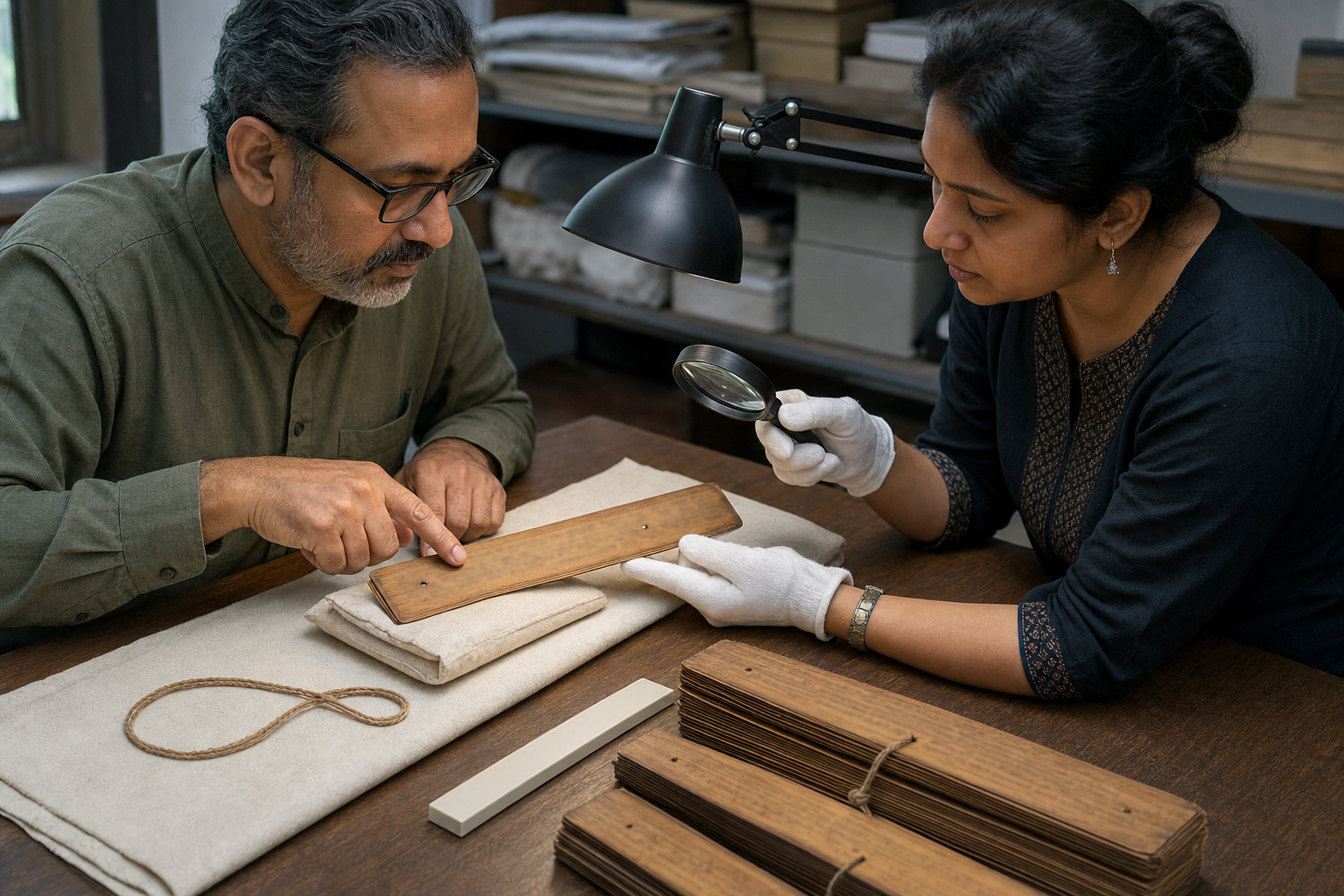
If you encounter a book, scan, video, or online claim about Jaimini’s Mahabharata, use the following sequence. It lets you evaluate the object in front of you without dismissing its devotional value or granting it an identity it has not established.
- Write down the exact claim. Is this being presented as the complete recension, a surviving portion, a later text attributed to Jaimini, a translation, or a modern retelling? Do not let those descriptions slide into one another.
- Identify the textual object. Look for the exact title, language, script, editor, translator, publisher, and edition. A discussion about a named manuscript is different from a discussion about a popular narrative carrying a traditional name.
- Ask how the attribution is established. Does Jaimini’s name occur within the text, in a colophon, in a manuscript catalogue, in a commentarial tradition, or only on a modern cover? These forms of attribution do not all carry the same weight.
- Check the scope. Determine whether the item claims to represent the whole Mahabharata, one section, selected episodes, or a summary. A surviving part cannot silently become proof that a complete alternate epic is in hand.
- Look for the editor’s method. A serious edition should tell you which textual witnesses were used, how variant readings were handled, and where reconstruction or conjecture entered. If none of that is disclosed, treat claims of textual completeness cautiously.
- State your conclusion at the level the evidence permits. Say, for example, that a work is traditionally attributed to Jaimini, that a particular edition presents material under his name, or that a claimed relationship remains unverified. Precision is more useful than either credulity or blanket dismissal.
One quick warning sign is a claim that jumps directly from the Adi Parva’s transmission account to the assertion that a particular modern book must be Vyasa’s disciple’s complete text. Several missing links lie between those propositions: the identity of the textual witness, its date and provenance, its scope, and the history of its attribution.
Another warning sign is an argument based only on unfamiliarity: “Most people have not heard of this, therefore it was suppressed.” Public unfamiliarity can show that a tradition is neglected, but it cannot identify the cause of that neglect. Suppression requires its own evidence.
Key takeaways for a careful Dharmic reader
- The remembered transmission of the Mahabharata includes multiple disciple-associated recensions.
- Jaimini’s name signals a traditional line of attribution; it does not by itself certify the identity or completeness of a modern text.
- A recension, retelling, translation, and edition answer different questions and should not be treated as synonyms.
- A text can be incomplete or lost without having been forbidden. Deliberate suppression is a separate historical claim requiring evidence.
- The best question is not merely “Is this authentic?” but “What exactly is this object, and how is its relationship to Jaimini established?”
Plural transmission need not weaken your regard for the Mahabharata. It can instead sharpen it. A living scriptural civilization may preserve continuity through teachers, reciters, manuscripts, regional forms, and remembered lineages rather than through one modern notion of a perfectly uniform book.
That plurality does not mean that every attribution is equally strong or that evidence no longer matters. Reverence and textual discipline belong together. When you next meet a claim about Jaimini’s Mahabharata, identify whether it rests on traditional testimony, an examinable text, or historical inference. Then repeat only what that level of evidence can support.