

You read a Krishna leela, feel its beauty, and then return to a day ruled by hurry, irritation, and habit. The difficult question is not whether Srimad Bhagavatham can move you. It is whether that movement survives the next disagreement, temptation, duty, or opportunity to serve.
Lived bhakti begins at that point of contact. A remembered story changes the way you respond; admiration becomes practice; and devotion becomes visible in humility, truthfulness, self-restraint, compassion, and seva. You do not need to manufacture an intense spiritual mood. You need a reliable way to carry what you read into what you do.
Bhakti begins where the story meets your conduct
Srimad Bhagavatham brings together Sri Krishna’s divine play, the steadfastness of devotees, and an ethical vision shaped by dharma. Its accounts of Krishna’s childhood in Gokul, the lifting of Govardhana, and the subduing of Kaliya do more than create wonder. They place courage, protection, compassion, and trust in divine grace before the reader’s mind.
Wonder matters, but wonder alone is not transformation. You can love a sacred story while continuing to speak harshly, avoid an inconvenient responsibility, or use religious knowledge to win arguments. The proper test is not how elevated you felt while reading. Ask what the remembrance interrupted afterward.
Perhaps Govardhana returns to mind when someone vulnerable needs support. Perhaps Kaliya’s subduing makes you notice a poisonous pattern that you have been excusing. Perhaps Krishna’s playfulness in Gokul corrects a spiritual seriousness that has become cold or brittle. These are not attempts to reduce leela to a slogan. They are ways of allowing divine remembrance to enter an ordinary decision.
Use a simple standard: if the reading is alive in you, it should make at least one response more dharmic. That response might be restraint instead of retaliation, truthful speech instead of convenient distortion, service instead of indifference, or prayerful steadiness instead of panic. The change may be quiet. Quiet does not make it insignificant.
Bhakti is not a bargain in which correct behavior purchases grace. Nor is it a private emotion with no claim on behavior. The Bhagavatham holds devotion and disciplined living close together. Your conduct is therefore not a price paid for devotion; it is one place devotion becomes embodied.
Use a reading sequence that ends in a real decision
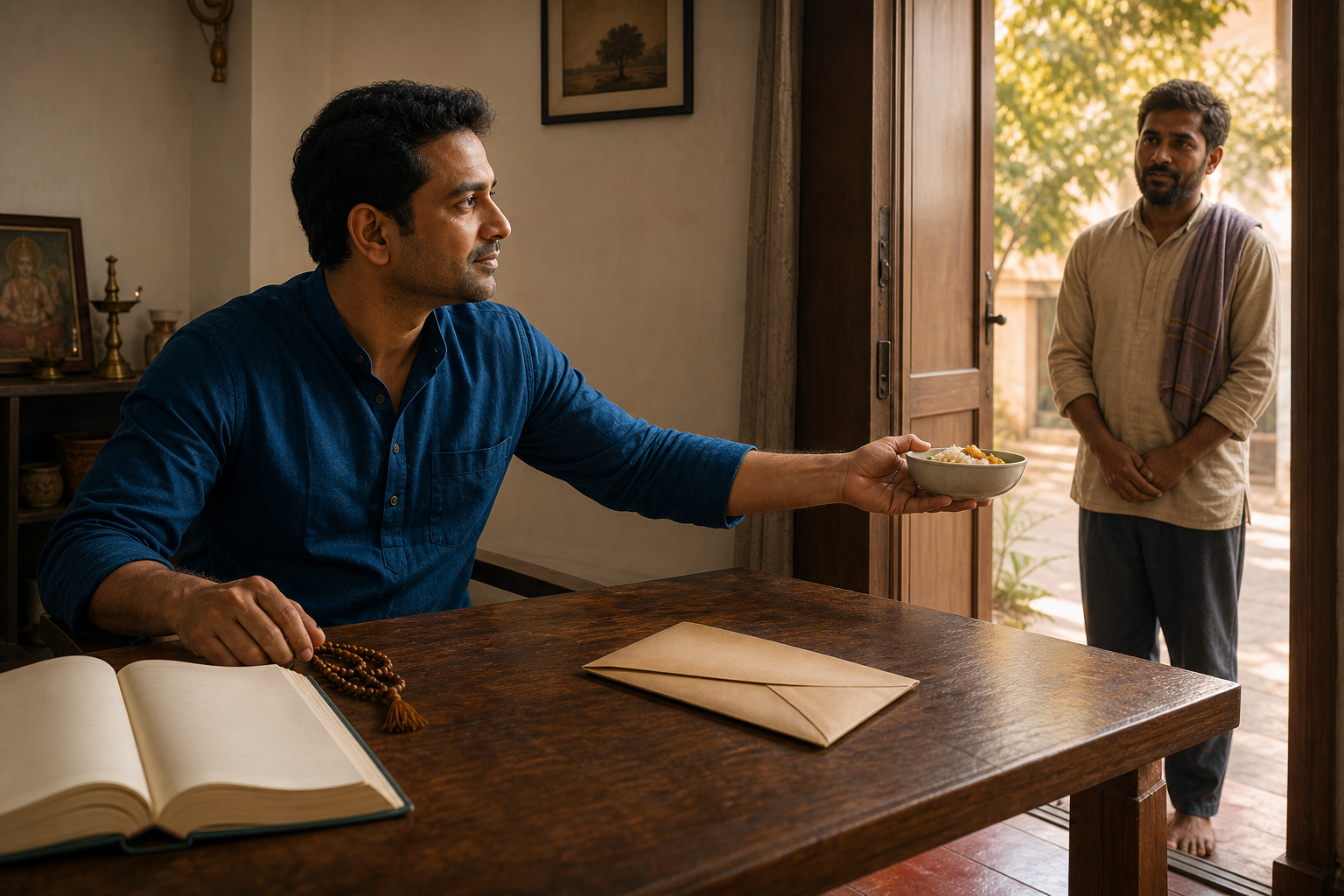
Reading more is not always the answer. A short episode that remains available to memory can shape you more deeply than a long passage consumed without reflection. Choose a bounded narrative, then move through the following sequence.
- Arrive before you interpret. Settle your attention and read without immediately searching for a lesson. Notice the people involved, the pressure in the scene, the response to that pressure, and the form taken by protection, courage, surrender, or compassion.
- Retell the episode from memory. Close the text and state the movement of the story in plain language. If you cannot retell it, you probably cannot remember it when a difficult moment arrives. Return to the passage without treating that return as failure.
- Name the point that resists you. Do not ask only what you liked. Ask what challenged your present way of living. Did the episode expose fear, pride, resentment, the wish to control, reluctance to serve, or a gap between what you profess and what you practice?
- Choose an observable expression of bhakti. Avoid a vague resolve such as being more spiritual. Name a response you will recognize when the opportunity appears: listen without interrupting, tell the truth that convenience tempts you to soften, complete an unglamorous duty, refrain from a cutting reply, or help someone without seeking recognition.
- Offer the action. Place the decision within devotion through the prayer, remembrance, meditation, or form of address natural to your household and sampradaya. This keeps the exercise from becoming mere self-improvement.
- Review without self-deception. After the relevant situation has passed, ask whether you remembered and how you responded. If you failed, name the failure plainly, repair what can be repaired, and return to practice. If you acted well, receive that progress without turning it into superiority.
A small notebook can make this concrete. Give each reading four brief entries: the episode, the quality you noticed, the situation in which you need it, and the action you intend to take. Later, add what actually happened. This record is not a spiritual scorecard. It helps you detect the exact point where inspiration is being lost between memory and action.
Keep the vow proportionate. If anger is the difficulty, do not promise never to become angry again. Decide what you will do at the first sign of it. You might pause before answering, refuse the sentence meant only to wound, or return to the conversation after agitation settles. A modest vow kept in a real situation trains remembrance more honestly than a dramatic promise forgotten by evening.
Let the leelas and devotee lives ask different questions

Not every narrative should be pressed into the same moral formula. Krishna’s leelas open the heart to divine play, protection, courage, compassion, and grace. The lives of Prahlada, Dhruva, and Gajendra place steadfast devotion and surrender before us. Both kinds of narrative can shape conduct, but they approach the reader from different directions.
When you read a Krishna leela
First allow the leela to remain leela. Do not rush past beauty, affection, play, or astonishment in order to extract an ethical instruction. Bhakti includes relationship with the Divine, not merely compliance with a rule.
Then ask a practical question suggested by the episode. While reflecting on Govardhana, consider where protection has become your duty: who is exposed, what burden can you help carry, and whether fear of inconvenience is disguising itself as helplessness. While reflecting on Kaliya, consider what repeatedly poisons attention, speech, or relationships, and what courageous restraint would prevent you from feeding it again. When recalling Krishna’s childhood in Gokul, notice whether your devotional life still has room for tenderness, delight, and familial affection.
These questions are prompts, not exhaustive interpretations. A sacred narrative is larger than the immediate lesson you draw from it. Return to the same leela at another stage of life and let it question you differently.
When you read about a steadfast devotee
Turn attention from the dramatic setting toward the stability of devotion. Ask what happens to your practice when approval disappears, a desire remains unfulfilled, or control fails. Do you remember the Divine only while circumstances confirm your plans? Does devotion make you steadier, or do you use it to demand a preferred outcome?
Then apply three tests associated with the Bhagavatham’s ethical guidance:
- Humility: Has devotion made you easier to correct, or merely more certain that you should correct others?
- Truthfulness: Can you describe your motive without giving it a more noble name? Service done for praise should not be disguised from yourself as selflessness.
- Self-restraint: Which impulse must lose its automatic authority over your next action? Name the impulse and the situation that usually releases it.
Surrender should not be confused with passivity. In lived bhakti, surrender releases the insistence that everything must obey your preference; it does not erase your dharmic responsibility. You still speak truth, protect where protection is due, serve, apologize, repair harm, and complete the work in front of you.
Build bhakti into the home without making it a performance
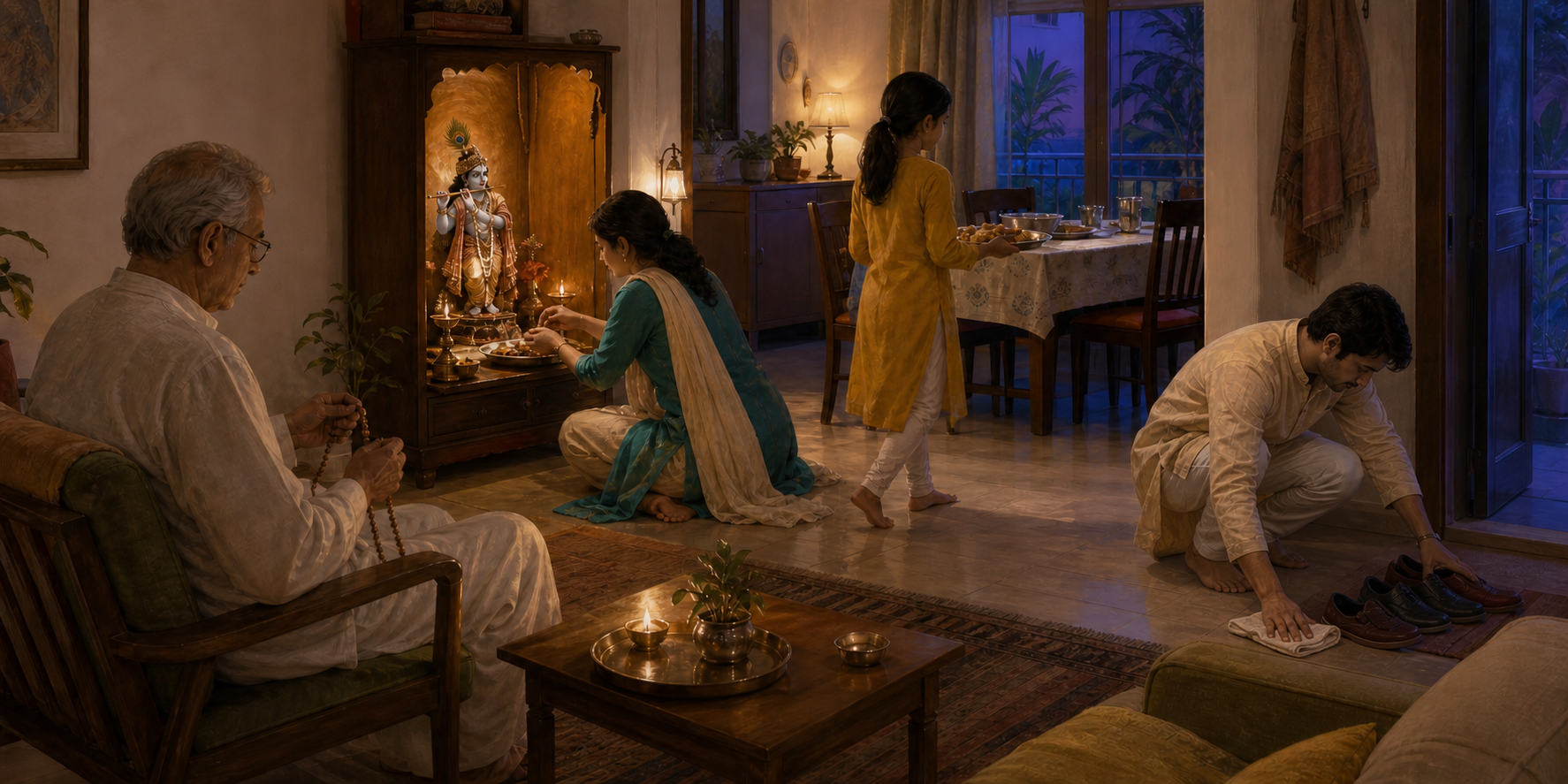
Families have long found an accessible doorway into the Bhagavatham through Krishna’s childhood and the stories of devotees. A household reading becomes formative when everyone is allowed to encounter the narrative, not merely repeat the approved answer.
After sharing an episode, resist the urge to deliver a long moral lecture. Invite each person to name what they noticed. A child may notice fear, play, unfairness, or protection before an adult notices theology. Ask where a similar choice appears in family life. Then agree on an act of remembrance or seva that belongs naturally to the household: caring for someone who is tired, completing a neglected responsibility, sharing food, speaking more gently, or giving attention to a person who is regularly overlooked.
Keep participation free of devotional competition. Do not compare who remembers more names, feels more emotion, or performs the most visible service. Comparison turns attention away from Sri Krishna and toward status. Give quiet service its proper dignity, and let questions remain questions when a family member is not ready with an answer.
If you practice alone, the same principle applies. Let remembrance leave the private interior of your mind. Choose a duty, relationship, or act of care through which devotion can take form. Seva does not have to be public to be real, and meditation does not have to produce a dramatic experience to steady the mind.
The Bhagavatham’s emphasis on non-violence, compassion, truth, and disciplined living also gives you a constructive way to meet practitioners from other Dharmic traditions. These ethical resonances can support mutual respect among Hindus, Buddhists, Jains, and Sikhs. They should not be used to pretend that all four traditions have identical theology, scripture, or practice.
Precision is more respectful than flattening. In a shared discussion, say what a Krishna leela asks of you as a Hindu devotee. Then listen to how another practitioner understands compassion, truth, discipline, or non-violence within that practitioner’s own tradition. Shared values become a meeting ground when no one is required to surrender distinctiveness.
There will also be periods when reading feels dry. Do not interpret the absence of emotion as proof that devotion has vanished. Continue with an honest minimum: remember the episode, offer the task in front of you, restrain a harmful response, or perform a quiet act of seva. Feeling may accompany bhakti, but dependable remembrance prevents feeling from becoming its only measure.
Key takeaways for making bhakti lived
- Read a bounded episode slowly enough to remember its movement after the text is closed.
- Ask what the narrative challenges in your present conduct, not only what you find beautiful or agreeable.
- Translate reflection into an observable response connected to a real duty, relationship, temptation, or opportunity to serve.
- Receive Krishna’s leelas as divine play and relationship before drawing a practical lesson from them.
- Use the lives of steadfast devotees to examine the stability, humility, truthfulness, and surrender within your own practice.
- Share Bhagavatham stories at home through questions and service, without turning devotion into a quiz or competition.
- Recognize ethical kinship across Dharmic traditions while speaking accurately about their distinct paths.
- When devotional feeling is absent, keep remembrance alive through disciplined action rather than manufacturing emotion.
Begin with the next episode you genuinely want to read. Before opening it, name a relationship or duty in which your dharma is under strain. Afterward, complete this sentence: Because I remembered this, when ___ happens, I will ___. Keep it where you will see it until the situation arrives. The moment remembrance changes your response, a beloved story has begun to become lived bhakti.
References
