
You may know the rooftop cry “Guru Ladho Re” but still wonder why two coins could settle a dispute about spiritual succession. Was Bhai Makhan Shah Lubana simply setting a clever trap, or did his test reveal something deeper about recognizing rightful authority?
The answer lies in the sequence: a promise made in mortal danger, a disciplined search in Baba Bakala, a private moment of recognition, and then a public declaration. Read in that order, the episode gives you a practical framework for discernment without reducing faith to blind acceptance or turning spiritual recognition into a game of secret signs.
What Bhai Makhan Shah was trying to resolve at Baba Bakala
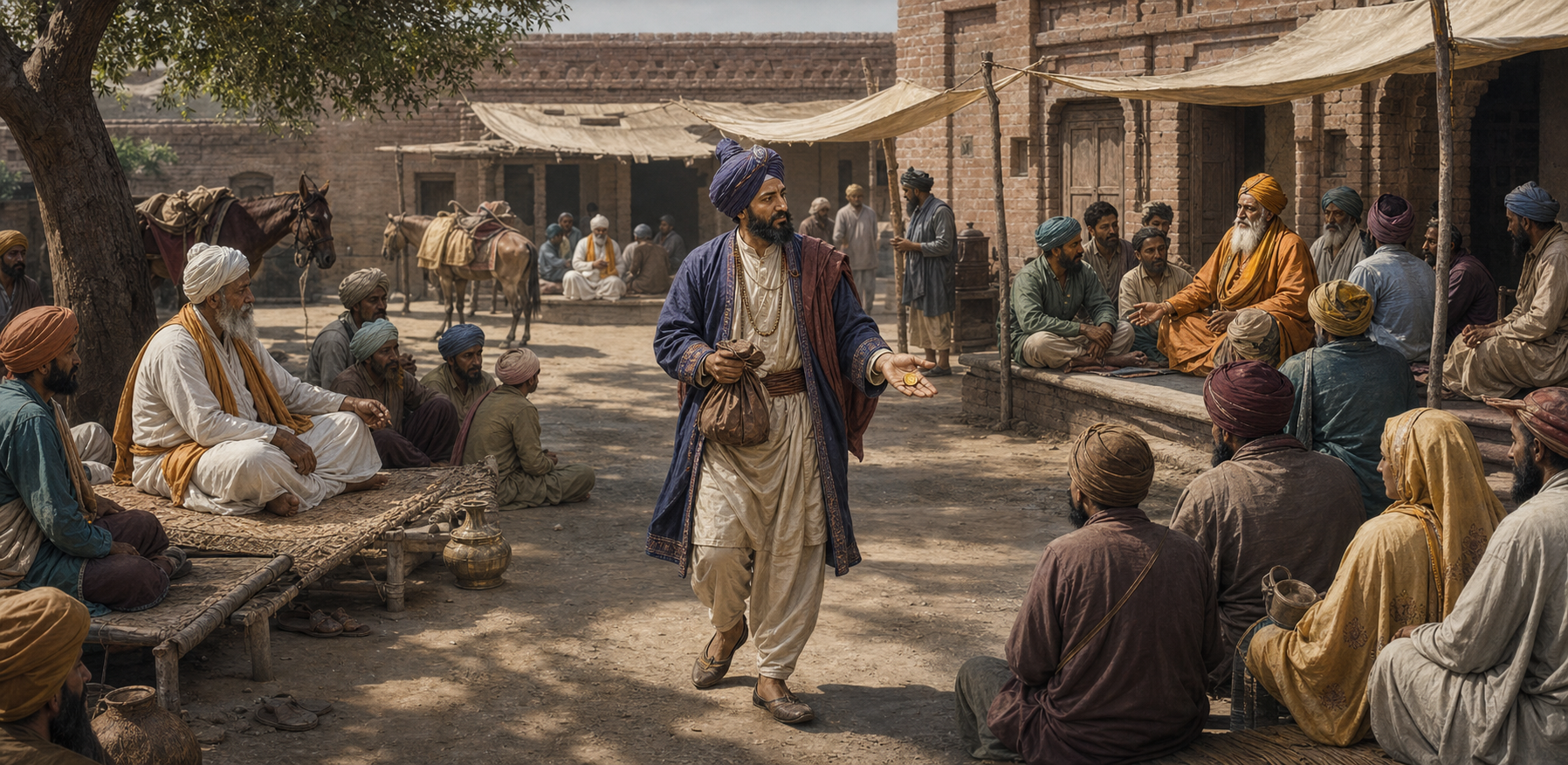
After Guru Har Krishan Ji passed away in 1664, his words “Baba Bakala” were understood to indicate that the next Guru would be found in the Punjab village of Bakala. The direction identified a place, but it did not publicly name the person. Multiple claimants consequently presented themselves, leaving the sangat with a problem of recognition.
Bhai Makhan Shah was a trader and traveler who had survived a dangerous storm at sea. During the crisis, he had vowed that, if saved, he would offer 500 mohar to the true Guru. That vow gave his search a precise moral stake. He was not merely curious about who held a respected position. He had an obligation to fulfill, and fulfilling it required him to identify the rightful recipient.
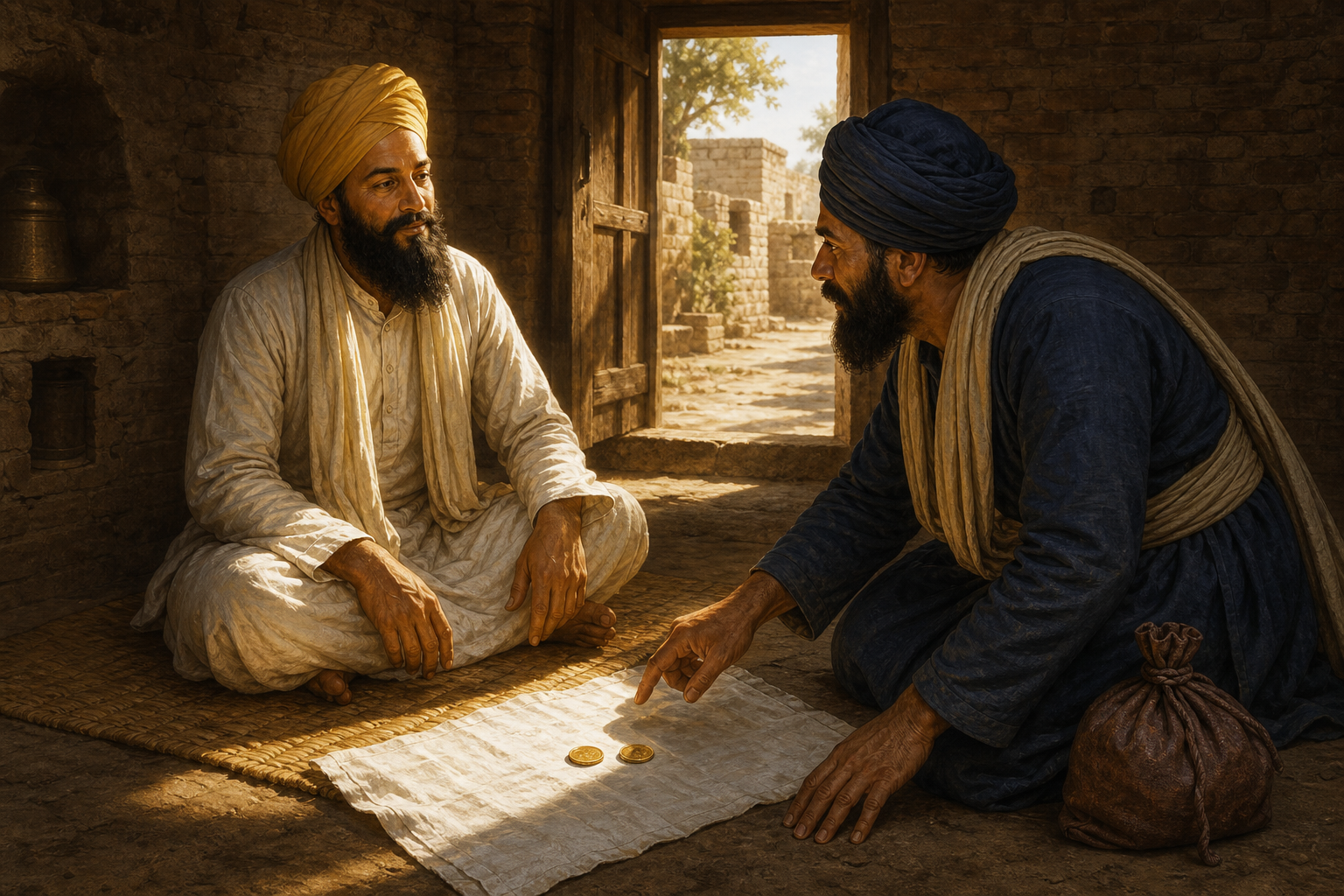
At Baba Bakala, he approached the claimants and offered each only two coins. Anyone could accept two coins from a visitor. The person who knew that Makhan Shah’s actual promise was 500 mohar would be different. The test therefore turned an unspoken obligation into a criterion for recognition.
His search eventually led him away from the visible contest of claimants to the reclusive Guru Tegh Bahadur Ji. When Makhan Shah placed two coins before him, Guru Tegh Bahadur asked for the remainder of the 500 mohar that had been promised during the storm. For Makhan Shah, this was the confirmation he had sought.
The distinction matters. Makhan Shah did not manufacture a Guru by devising a successful contest. Within Sikh tradition, the Guru already was the Guru. Makhan Shah’s task was to recognize that reality amid competing claims and then help the sangat recognize it as well.
Why the two-coin test was more than a clever trick

If you focus only on the hidden number, the episode can look like a supernatural guessing test. That reading misses the ethical center. The number mattered because it represented Makhan Shah’s own word. He had promised 500 mohar when his life was in danger; once safe, he could not quietly revise the promise to two.
The test joined three things that are often separated: truth, obligation, and discernment. Makhan Shah wanted truth about the succession, but he sought it through an obligation that exposed his own integrity. Recognition did not permit him to keep the remaining wealth. It required him to surrender it as promised.
This gives you a useful way to distinguish sincere discernment from self-serving confirmation. A self-serving test is designed so that the answerer earns your approval while you risk nothing. Makhan Shah’s test worked in the opposite direction. The successful answer increased his responsibility from two coins to 500 mohar.
That is the detail to remember whenever you hear the episode retold. The two coins were not a bargain. They exposed the difference between what Makhan Shah offered publicly and what he remained bound to give. Guru Tegh Bahadur’s response brought the whole obligation back into view.
There is also a caution here. Quietness by itself does not prove spiritual authority, just as visibility does not disprove it. Nor should you trust a modern teacher, institution, or public figure solely because of a coincidence or a private sign. The force of this Sikh narrative comes from its complete setting: the preceding indication of Baba Bakala, Makhan Shah’s vow, his consistent search, Guru Tegh Bahadur’s knowledge of the unspoken obligation, and the recognition of the sangat.
What changed when Makhan Shah cried “Guru Ladho Re”
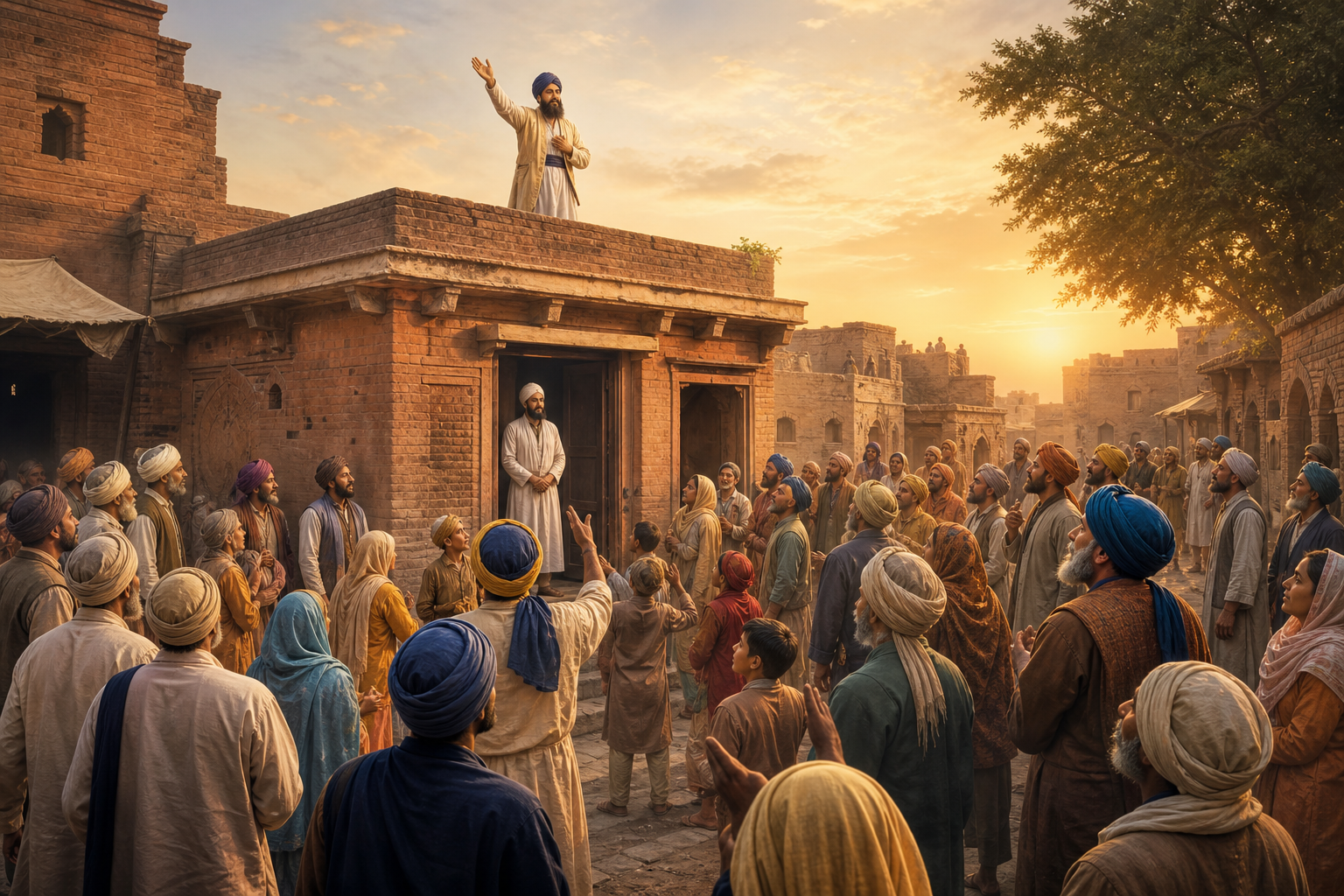
Makhan Shah could have treated the encounter as private reassurance, paid his vow, and left. Instead, he went to a rooftop and proclaimed that the Guru had been found. His cry, remembered as “Guru Ladho Re,” carried recognition from a secluded meeting into the life of the sangat.
This public step was not an ornamental ending. It addressed the original problem. The community faced confusion because several people claimed authority. Private certainty could guide Makhan Shah, but it could not by itself restore communal clarity. He had to put his name and reputation behind what he had recognized.
His declaration also shows that discernment and courage are separate duties. You can arrive at a sound conclusion and still fail to act on it. Makhan Shah first investigated, then recognized, then fulfilled his vow, and finally spoke. Each action completed something the previous one could not.
The episode therefore does not celebrate skepticism for its own sake. Testing was necessary because claims had multiplied, but testing was not the destination. Once Makhan Shah received the confirmation he sought, continued suspicion would have become avoidance. Discernment had to end in commitment.
That commitment carries added historical weight because the Guru recognized at Baba Bakala would later be remembered for defending religious freedom and human dignity. The secluded figure whom Makhan Shah sought was not defined by pageantry. His authority would be expressed through responsibility for others.
Key takeaways for your own practice of discernment
- Define your obligation before you evaluate the claimants. Makhan Shah’s promise existed before he reached Baba Bakala. Writing down your principles, duties, or decision criteria in advance makes it harder to change them merely because a persuasive personality appears.
- Apply the same initial standard consistently. Makhan Shah offered the same two coins while examining competing claims. If you excuse one person from standards you apply to everyone else, you are protecting a preference rather than testing it.
- Do not confuse display with authority. Guru Tegh Bahadur was found in seclusion rather than at the center of the competition for attention. Look past titles and visibility, but do not make the opposite mistake of treating obscurity alone as proof.
- Choose a criterion that can correct you. Makhan Shah’s test did not merely confirm what was convenient. Its successful result required him to give the full 500 mohar. A meaningful test should be capable of overturning your preference and increasing your responsibility.
- Separate personal confirmation from public responsibility. The meeting gave Makhan Shah certainty; the rooftop proclamation helped the sangat. Before making a public claim, know what you have actually verified and be prepared to stand behind it.
- Stop testing when honest recognition has occurred. Endless suspicion can imitate discernment. Once reliable grounds converge, the next duties are commitment, accountability, and action.
These principles should not be used to flatten a distinct Sikh succession narrative into a generic self-help parable. The relationship of the Sikh Gurus to the sangat has its own theological and historical meaning. The broader dharmic lesson becomes useful only after that specificity is respected.
You can apply the lesson without trying to recreate Makhan Shah’s hidden test. When evaluating a guide or institution, examine conduct over time, consistency between teaching and action, treatment of the community, and willingness to accept accountability. A secret sign is not a safe substitute when money, power, or major life decisions are involved.
The next time you hear “Guru Ladho Re,” listen for the duties contained inside the cry. Keep the promise you made in difficulty. Test competing claims without becoming cynical. Recognize substance even when it stands outside the spectacle. Then, when the grounds are sound, act with enough clarity that your discernment serves more than yourself.
References
