
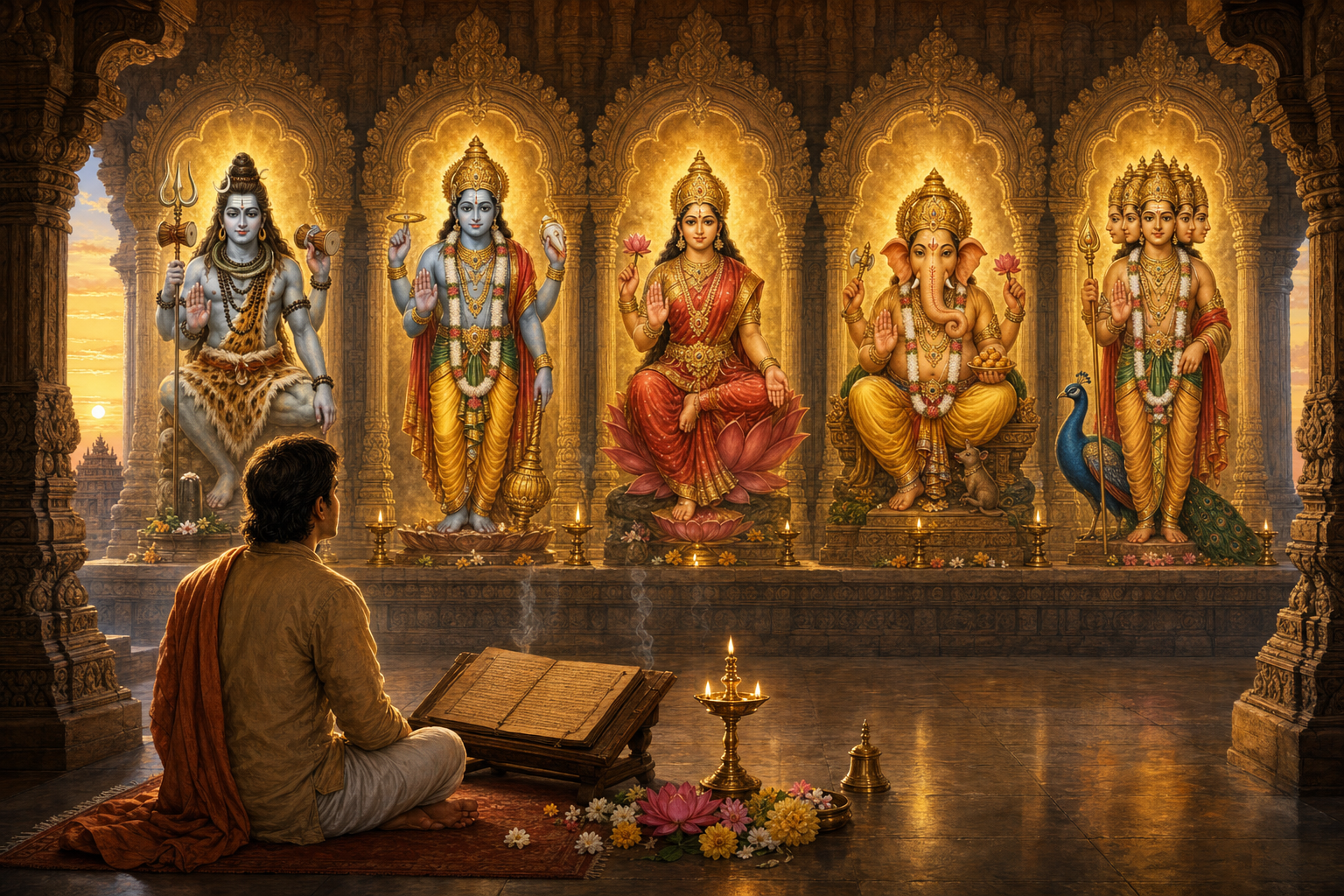
You recognize Shiva, Vishnu, Devi, Ganesha, or Murugan, but then a detail stops you: six faces, twelve arms, a spear, an animal vehicle, a serpent beneath a foot. Should you read it literally, symbolically, philosophically, or devotionally?
The useful answer is not to choose only one of those readings. A Hindu divine form is layered visual theology. You can read it responsibly by moving in a clear order: establish the theological setting, find the narrative, examine names and numbers, relate the attributes to one another, and then ask how the form is encountered in worship. That method protects you from two equal mistakes: dismissing the image as fantasy and inventing meanings with no scriptural or traditional anchor.
Start with the theological grammar: one reality, many forms
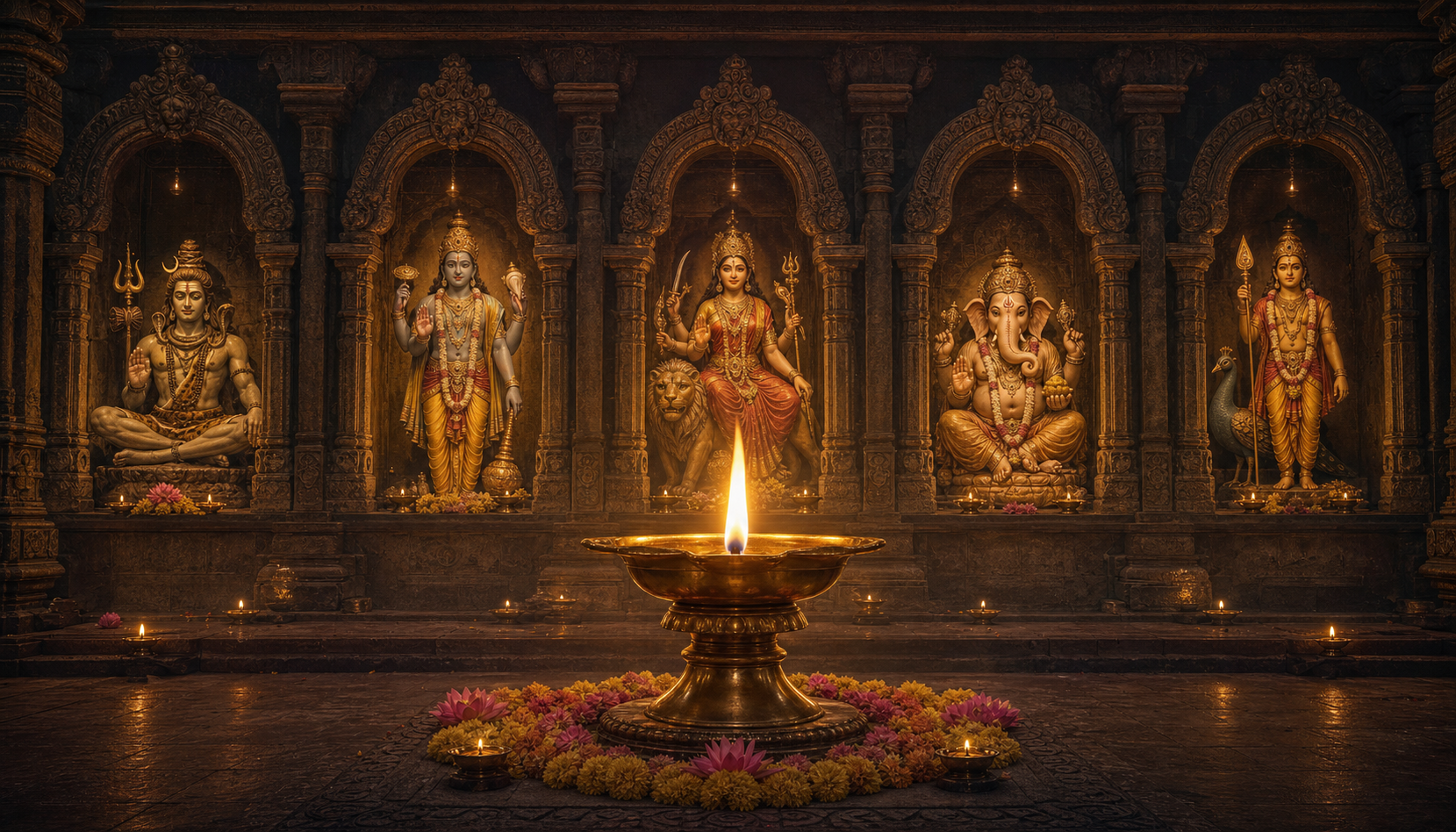
When you encounter many devas and devis, do not begin by imagining a collection of rival supreme beings. The Rig Veda 1.164.46 gives the governing intuition: reality is one, though the sages name it in different ways. Diversity of name and form expresses the inexhaustibility of the sacred; it does not, by itself, imply competing ultimate realities.
The familiar claim that Hinduism has 330 million gods obscures this grammar. In Bṛhadāraṇyaka Upaniṣad 3.9.1-9, the classical enumeration is thirty-three devas: eight Vasus, eleven Rudras, twelve Ādityas, Indra, and Prajāpati. The Sanskrit word koṭi can denote a class or category as well as, in later and modern usage, a crore. Reading 33 koṭi only as 33 times ten million turns a theological classification into a census.
A second distinction helps you understand why form matters. Nirguṇa Brahman points to the absolute beyond limiting qualities and forms. Saguṇa Īśvara is the divine approached through qualities, names, relationships, and visible forms. A murti therefore need not compete with the formless. It gives the mind and heart a definite way to approach what cannot be exhausted by any definition.
The Bhagavad Gita 7.21 places devotion to a chosen form within the agency of the Supreme: the devotee’s faith in that form is steadied at the divine source. This makes plurality intelligible without requiring every sampradāya to explain the relationship in the same way.
The Vedāntic schools do disagree about what unity means. Advaita Vedānta treats Brahman as ultimately nondual and plurality as dependent appearance. Viśiṣṭādvaita understands real diversity as included within the one reality rather than outside it. Dvaita preserves an enduring distinction between God, individual souls, and matter; its unity is not identity but divine sovereignty. Gauḍīya Vaiṣṇava thought uses acintya-bhedābheda for an inconceivable relation of difference and non-difference. Do not flatten these positions into a slogan. The practical common ground is narrower and more accurate: divine multiplicity belongs within an ordered sacred whole, but traditions explain that whole differently.
If someone asks whether Hinduism is monotheistic or polytheistic, the clean answer is that the binary is too crude. Ask which level is under discussion: the ultimate ground, the Supreme Lord of a particular sampradāya, the many accessible divine forms, or the local and familial relationships through which worship is lived. Once the level is named, the apparent contradiction usually disappears.
Use five questions to read a divine form responsibly
You do not need to decode every detail at once. Work from the strongest traditional anchor outward. The following sequence can be used in a temple, while reading a Purāṇa, or when explaining an unfamiliar murti to a child.
| Layer | Question to ask | What the answer prevents |
|---|---|---|
| Identity | Which name or epithet is being presented? | Treating every form of a deity as interchangeable |
| Narrative | Which event makes this feature intelligible? | Inventing symbolism before finding the story |
| Structure | Do the number, direction, posture, or repeated elements form a pattern? | Reading multiple heads or arms as anatomical oddity |
| Attributes | How do the weapon, vehicle, companions, and gestures qualify one another? | Assigning an isolated meaning to a single object |
| Practice | Where is the form invoked through mantra, consecration, festival, or pilgrimage? | Reducing living worship to an art-history label |
1. Begin with the name
A divine name often tells you which aspect has been brought forward. Kārttikeya, Skanda, Subrahmaṇya, Murugan, Kumāra, Śaṇmukha, Devasenāpati, and Guha refer to the same broad divine personality, but they do not place the same idea at the center. Śaṇmukha identifies the six-faced form. Devasenāpati presents the commander of the devas. Guha points toward hiddenness and the cave of the heart. Before interpreting an image, identify the name used in that temple, hymn, inscription, or festival.
2. Find the narrative anchor
Symbolic readings become more reliable after you know the story that establishes the form. Ask what problem required this manifestation, how the form appeared, and which relationships define it. A narrative may explain a feature directly; later philosophical, yogic, or ethical readings can then deepen it without replacing its first function.
3. Examine number and direction
Repeated numbers are rarely decorative, but they do not always have one exclusive meaning. A number may connect a form to mothers, directions, syllables, schools of thought, virtues, inner supports, sacred places, or stages of a festival. Keep the kinds of claim separate. A Purāṇic birth episode, an Āgamic directional correspondence, and a yogic meditation are related layers, not automatically three versions of the same historical statement.
4. Read attributes as a constellation
A weapon may signify protection in a narrative, discriminating insight in contemplation, and disciplined power in ethical reflection. Its meaning is sharpened by the hand that carries it, the deity’s posture, the vehicle nearby, and the adversary or impulse being subdued. Read the complete arrangement before turning one attribute into a universal definition.
5. Look for the lived interpretation
Mantra, festival, pilgrimage, and temple convention show which meanings a community actually carries into practice. Regional variation is therefore evidence, not noise. A child form seated with divine parents may express intimacy; a many-armed warrior form may emphasize protection and command. The difference can be one of devotional mood and function rather than contradiction.
Use one further test whenever you encounter a confident symbolic claim: ask whether it comes from the central narrative, an iconographic convention, a sectarian liturgy, a philosophical or yogic interpretation, or a personal moral application. All five can be valuable, but calling them all equally scriptural makes the explanation less trustworthy.
Read Kārttikeya’s six faces one layer at a time
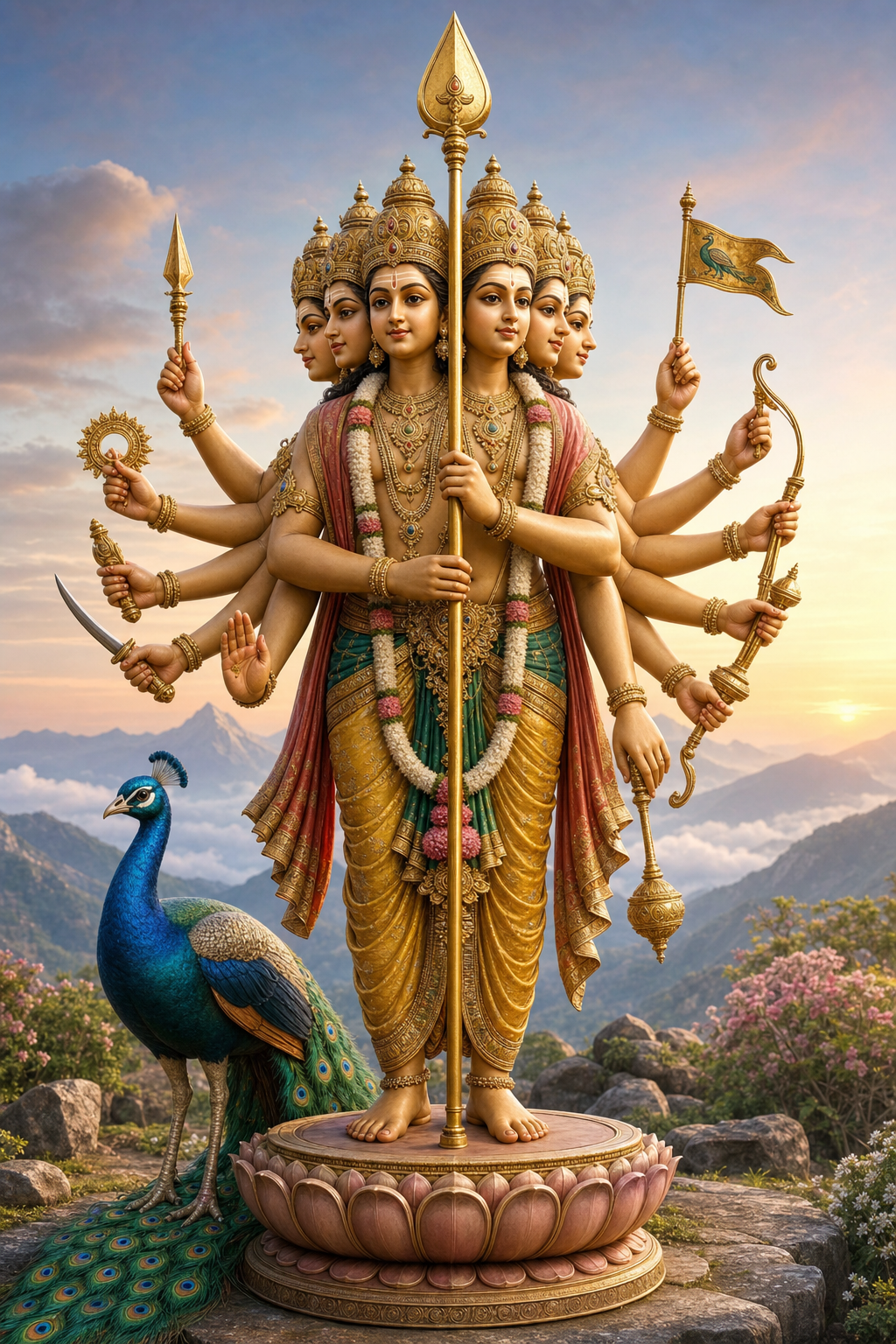
Kārttikeya offers a complete demonstration of this method because his six-faced form joins narrative, direction, mantra, philosophy, yoga, pilgrimage, and ethical instruction without collapsing them into a single code.
The birth story establishes the six
In widely told Purāṇic accounts, Tārakāsura can be defeated only by a son of Śiva. Fiery energy from Śiva is borne through Agni and Vāyu, cooled through Gaṅgā, and placed in the reed-filled Saravaṇa. Six infants arise and are cared for by the six Kṛttikās. When Pārvatī embraces them, they become one child with six faces.
This story should be your first interpretive anchor. Six faces preserve the child’s relationship with six mothers: each can behold, nurture, and receive the affection of the child. Before the form becomes a diagram of metaphysics, it expresses gratitude, inclusion, and the integration of many maternal relationships into one identity.
You can follow the pan-Indic Purāṇic setting through the Skanda Purāṇa and Śiva Purāṇa, and its Tamil devotional life through the Kanda Purāṇam, Tiruppugazh, and Skanda Sashti Kavasam. Kālidāsa’s Kumārasambhava belongs to the wider literary imagination of Kumāra. These textual settings do not erase local temple traditions; they give you points of orientation while those traditions show how the form is lived.
Direction, mantra, philosophy, and yoga deepen the form
As Devasenāpati, the commander, Śaṇmukha requires complete awareness. His faces are therefore read as surveying east, west, north, south, zenith, and nadir. Some Āgamic and iconographic mappings give the upward-looking face a connection with Īśāna, the principle of oversight and grace. The martial meaning is not aggression without limit; it is vigilance that leaves no direction ignored.
Tamil liturgical practice also associates the six faces with the six syllables of Saravaṇa-bhava. Form and sound reinforce one another: the devotee sees a sixfold form and invokes it through a sixfold mantra. This is a stronger traditional connection than a resemblance noticed only by a modern observer because it is carried in worship.
An interpretive strand correlates the faces with the six classical darśanas: Nyāya, Vaiśeṣika, Sāṃkhya, Yoga, Mīmāṃsā, and Vedānta. Read carefully, this does not mean that the schools teach an identical doctrine. It means that disciplined reasoning, attention to categories, analysis of reality, transformative practice, ritual responsibility, and metaphysical synthesis can be held within a larger vision. The six faces offer an image of intellectual integration without methodological erasure.
Another correspondence connects them with six divine excellences: jñāna, śakti, bala, aiśvarya, vīrya, and tejas – knowledge, potency, strength, lordship, heroic energy, and radiance. This turns the icon into a demanding account of leadership. Strength without knowledge is incomplete; authority without disciplined energy is unstable; radiance without responsibility is merely display.
Yogic readings add another explicitly interpretive layer. The name Guha, the hidden one, points toward the cave of the heart, while some traditions relate the six faces to six inner supports or chakras. Treat this as a contemplative mapping rather than the literal plot of Kārttikeya’s birth. The distinction lets you value the yogic meaning without mislabeling its function.
The spear, peacock, serpent, and arms complete the teaching
Śaṇmukha is commonly shown with twelve arms, the vel or spear, and a peacock vehicle. The vel carries the force of decisive, penetrating insight: it cuts through confusion as the warrior cuts through a threat to dharma. The peacock and serpent beneath it can be read as disciplined command over pride and impulsive energy. Those energies are brought under intelligent direction rather than merely denied.
The attributes keep the six faces from becoming a symbol of passive omniscience. Awareness must become action; action must remain governed by discernment. If you use the form for ethical reflection, keep that sequence intact. Do not extract courage from the warrior while leaving out clarity, restraint, and responsibility.
Pilgrimage and festival make the meaning bodily
The sixfold pattern is walked through the Arupadai Veedu, the Six Abodes of Murugan: Thirupparankundram, Tiruchendur, Palani, Swamimalai, Tiruttani, and Pazhamudircholai. Pilgrimage turns a number seen on the divine face into sacred geography traversed by the devotee.
Festival time supplies another layer. Skanda Sashti enacts a six-day campaign culminating in victory over Surapadman. Thaipusam places emphasis on Pārvatī’s gift of the vel and therefore on disciplined divine power. Karthigai Deepam recalls celestial fire and the Kṛttikās. When you meet the deity during one of these observances, begin with the aspect the festival itself foregrounds.
A Somāskanda panel may instead show the young Skanda seated between Śiva and Pārvatī, sometimes in a single-faced child form. That does not invalidate the six-faced warrior. It presents another relational and theological mood. The right question is not which image is the only correct one, but what relationship and function each form makes visible.
Let the form organize your sādhana, not just your notes
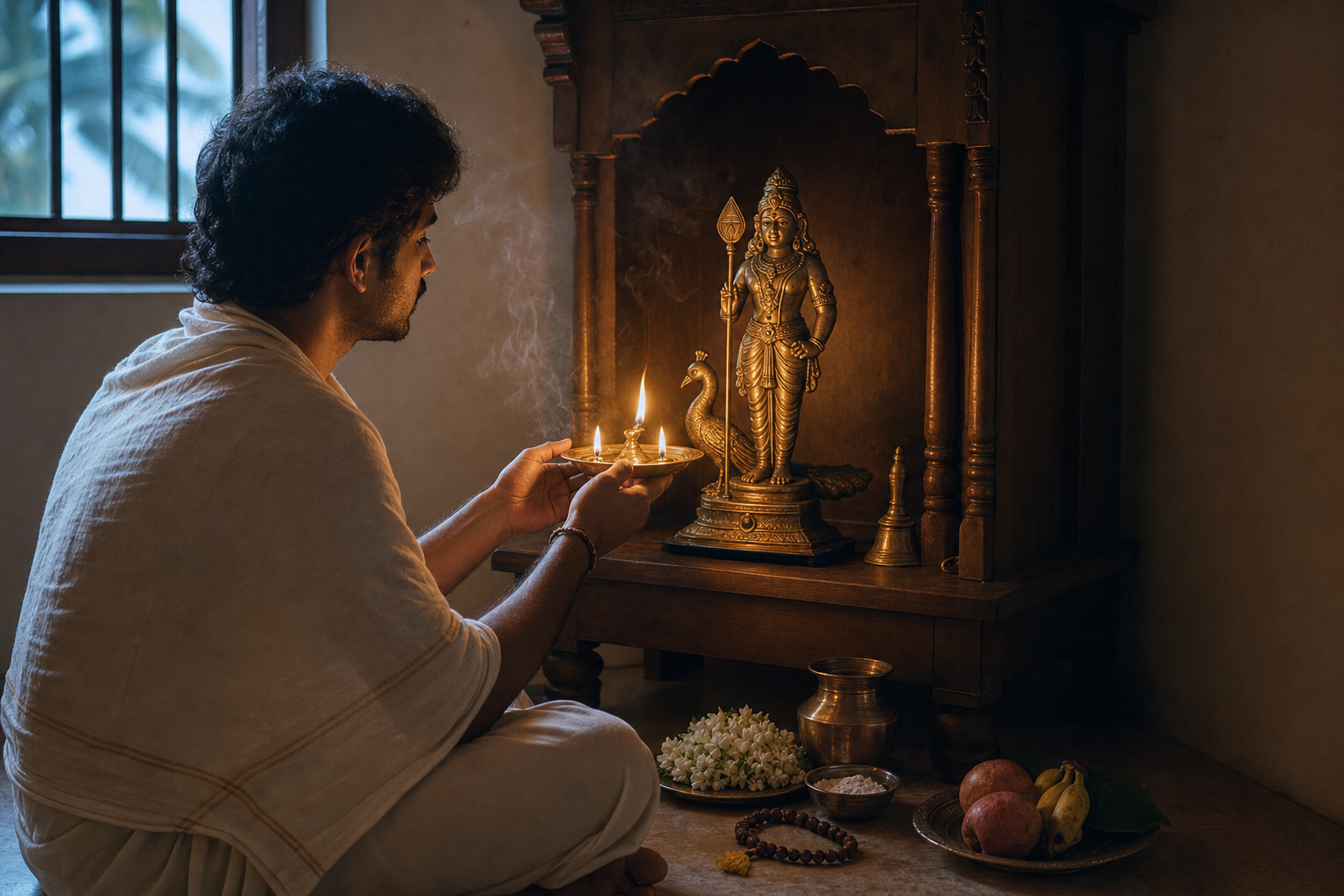
Iconography has done only half its work when you can explain it. In temple practice, a murti approached after prāṇa-pratiṣṭhā is a focal locus of divine presence, attention, and relationship. The image steadies perception so that worship can cultivate devotion, gratitude, discernment, and ethical change. The movement is from the gross or sthūla toward the subtle or sūkṣma, and from name-and-form toward an awareness not confined by name-and-form.
The iṣṭa-devatā framework gives you a practical center. Your cherished form may arise through temperament, family tradition and kula-devatā, local tradition and grāma-devatā, or the needs of a stage of life. Concentrating on one form develops ekāgratā, steadiness of attention. Respect for other forms keeps that concentration from hardening into sectarian contempt.
A workable personal discipline has four parts:
- Name your center. Identify the form that actually anchors your regular worship instead of changing focus whenever a new symbol attracts you.
- Learn one grounded layer. Begin with the relevant narrative, name, mantra, or established temple tradition. Do not call a private association scriptural merely because it feels profound.
- Carry one quality into conduct. With Kārttikeya, you might contemplate vigilance through the six directions, discernment through the vel, or integrated leadership through the six excellences. Then identify the decision or duty in which that quality is presently required.
- Keep a wide circumference. Honor other devas and devis without pretending that their forms, stories, and sampradāyas are interchangeable. Reverence does not require erasing distinction.
This balance answers a common household question: there is no need to remove every other divine form in order to worship one deeply. Give your daily sādhana a center, while allowing festivals, family observances, pilgrimage, and hospitality toward other traditions to preserve breadth. Depth and plurality serve different purposes.
Use transformation as your final interpretive test. If the vel remains only a weapon label, the reading is unfinished. If it sharpens discernment without encouraging cruelty, the symbol has entered practice. If six faces make you more alert to neglected duties rather than merely impressed by supernatural power, the icon has begun to teach.
Key takeaways
- Read multiplicity within the theological level being discussed; do not treat every divine form as a rival claimant to ultimate reality.
- Begin with the form’s name and narrative before adding philosophical, yogic, or personal symbolism.
- Read numbers, directions, weapons, vehicles, gestures, mantra, festival, and pilgrimage as connected layers.
- Distinguish a Purāṇic origin story from an Āgamic convention, liturgical association, later interpretation, or personal ethical application.
- Use an iṣṭa-devatā for devotional depth while preserving respect for other forms and sampradāyas.
At your next darśan, choose one visible feature and trace it through the five questions: name, narrative, structure, attributes, and practice. Then carry one resulting obligation into your next real decision. You do not need to solve the whole murti. You need to let one well-grounded meaning move from sight to attention, and from attention to dharmic action.
References
- DharmaRenaissance Blog – Beyond 330 Million Gods: How Hinduism Unites Many Deities into One Supreme Reality
- DharmaRenaissance Blog – Why Karthikeya Has Six Heads: Puranic Origins, Iconographic Meaning, and Dharmic Unity