
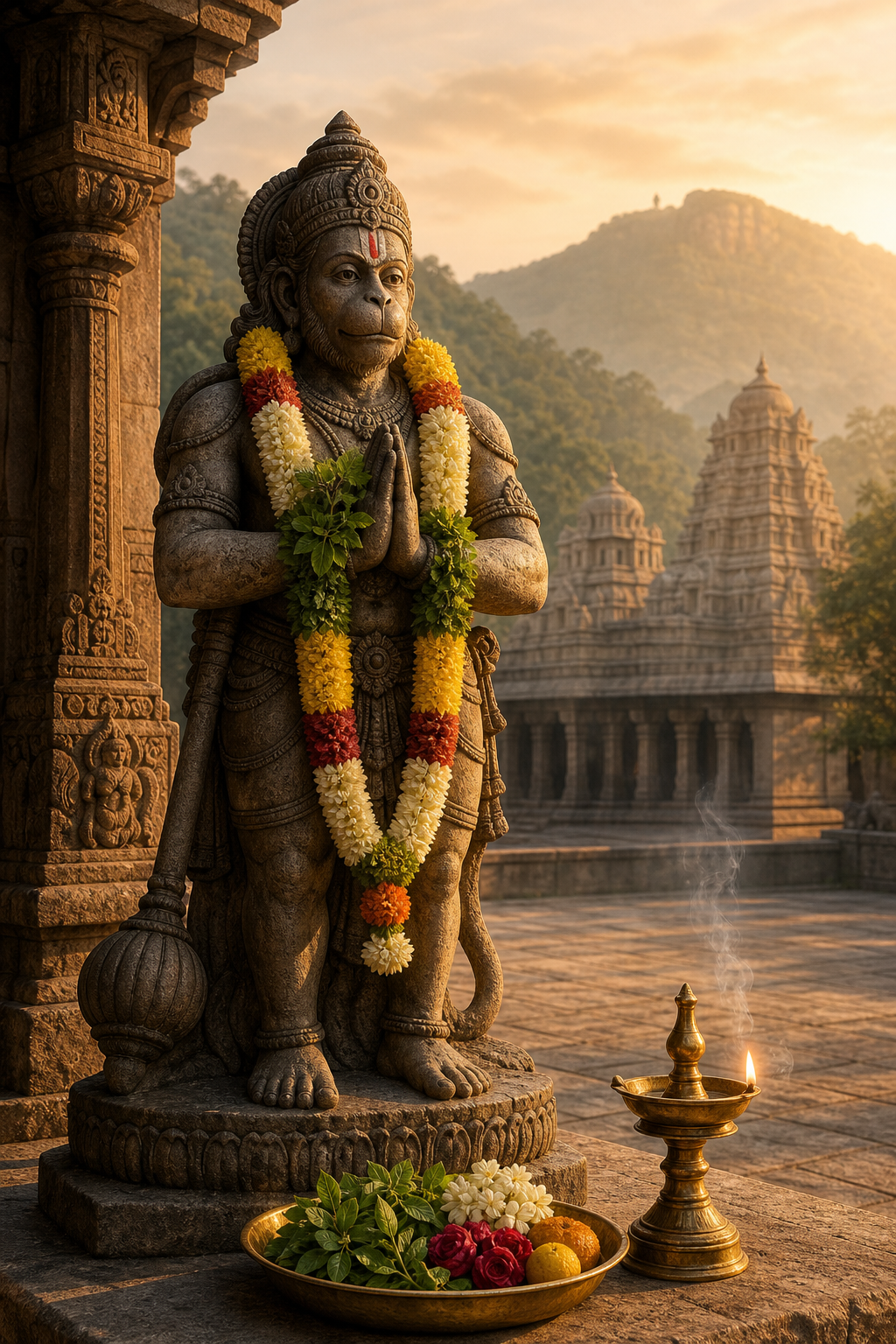
If you are planning May worship around Hanuman and have encountered different festival dates, do not force every calendar into a single answer. Mark two distinct events: the Saptami-to-Ashtami transition on May 9 and Tirumala’s Hanuman Jayanti observance on May 12.
That distinction gives you a practical plan. Use May 9 for tithi-sensitive sadhana and preparation. Use May 12 for Hanuman-focused worship if you follow the Tirumala tradition. In both cases, your city-specific Panchang and your own parampara should decide the finer details.
Mark May 9 and May 12 for different reasons
| Date | Panchang or temple cue | What you should do |
|---|---|---|
| Saturday, May 9, 2026 | Krishna Paksha Saptami prevails at sunrise and Ashtami begins at 9:28 AM in most regions. | Verify the transition in a local Panchang, then separate sunrise-based observance from any rite that requires Ashtami to be actually present. |
| Tuesday, May 12, 2026 | Tirumala observes Hanuman Jayanti on Vaishakha Bahula Dasami, with Pattu Vastrams for Sri Japali Hanuman and special worship for Sri Bedi Anjaneya Swamy. | Choose this date for Hanuman worship when following Tirumala’s temple tradition; do not assume that it replaces your region’s established Hanuman Jayanti date. |
May 9 is not an alternative Hanuman Jayanti. It is an important Panchang boundary within Krishna Paksha. May 12 is the specific Hanuman observance at Tirumala. Keeping those purposes separate prevents a common planning mistake: treating every spiritually significant date in the same week as part of one festival.
Different Hanuman Jayanti dates across Bharat are not evidence that one community has calculated the festival incorrectly. Many regions celebrate on Chaitra Purnima, while Tirumala follows Vaishakha Bahula Dasami in accordance with its local temple tradition. Parampara, Agama and lokachara preserve different ritual calendars within a shared devotion to Hanuman.
The month name can also differ between calendars. Northern traditions often use Purnimanta reckoning, while several southern traditions use Amanta reckoning. If two Panchangs agree about the tithi but use different month labels, first check their month-reckoning system instead of concluding that one must be wrong.
Read the May 9 tithi before choosing a clock time

A tithi is an astronomical interval, not a civil date running from midnight to midnight. Each tithi represents twelve degrees of changing angular separation between the Moon and the Sun. Saptami occupies the interval from 72 degrees to 84 degrees; Ashtami begins when the separation reaches 84 degrees and continues to 96 degrees. The stated 9:28 AM transition on May 9 marks that boundary.
This produces two correct but different ways of speaking about the day. Under the widely used udaya-tithi convention, the tithi present at local sunrise names the observance day. May 9 can therefore be called a Saptami day even though Ashtami begins later that morning. A ritual requiring Ashtami to be present, however, may need to occur after the transition. Your sampradaya’s rule determines which criterion matters.
Do not transfer 9:28 AM blindly to another city or country. Longitude, time zone, local sunrise, astronomical method, ayanamsha and calendrical convention can produce modest differences. Diaspora households especially should use a Panchang calculated for their own location rather than converting an Indian clock time by hand.
- Set the Panchang location to the city where you will perform the observance, not the location of a temple you are watching online.
- Confirm the local sunrise and identify the tithi prevailing at that moment.
- Record the tithi ending time in the displayed time zone.
- Ask whether your intended rite follows udaya-tithi, requires the desired tithi to be currently present, or follows a temple-specific rule.
- Check Nakshatra, the Moon’s Rashi and any locally calculated avoidance periods only after the tithi question is settled.
Rahu Kaal, Yamaganda and Gulika should not be copied as fixed clock ranges from a generic graphic. Their intervals are derived from local daylight and the weekday. Abhijit Muhurta is likewise calculated around local solar noon. If you need a muhurta for an undertaking on May 9, use a city-specific table and apply the rules accepted by your family or acharya.
The practical hierarchy is simple: establish place, sunrise and tithi first; apply the relevant observance rule second; consult the remaining Panchang limbs and muhurta periods third. This keeps the calendar in service of dharma instead of turning it into a collection of disconnected auspicious labels.
Build a coherent two-date sadhana instead of improvising
May 9: move from outward order to inward vigilance
If your local Panchang confirms the 9:28 AM transition, keep the earlier Saptami period steady and uncluttered. A simple morning can include arghya to Surya, a short reading from a text already present in your daily practice, sattvic food and the responsible completion of an unfinished duty. There is no need to manufacture an elaborate festival where your tradition prescribes none.
After Ashtami begins, turn toward quieter discipline. Many devotees observe the monthly Krishna Paksha Ashtami as Kala Ashtami with devotion to Bhairava. If that belongs to your lineage, follow its established vrata or puja procedure. If it does not, use the period for japa, careful speech, self-examination and an act of protection or service that does not harm another being.
Because May 9 is a Saturday, patience, accountability and measured action provide a sound ethical frame. You might settle a neglected obligation, help an elder, contribute to a community kitchen or choose the seva you will complete after Hanuman worship on May 12. The point is to make the approaching observance concrete before devotional enthusiasm arrives.
May 12: keep home worship complete but manageable
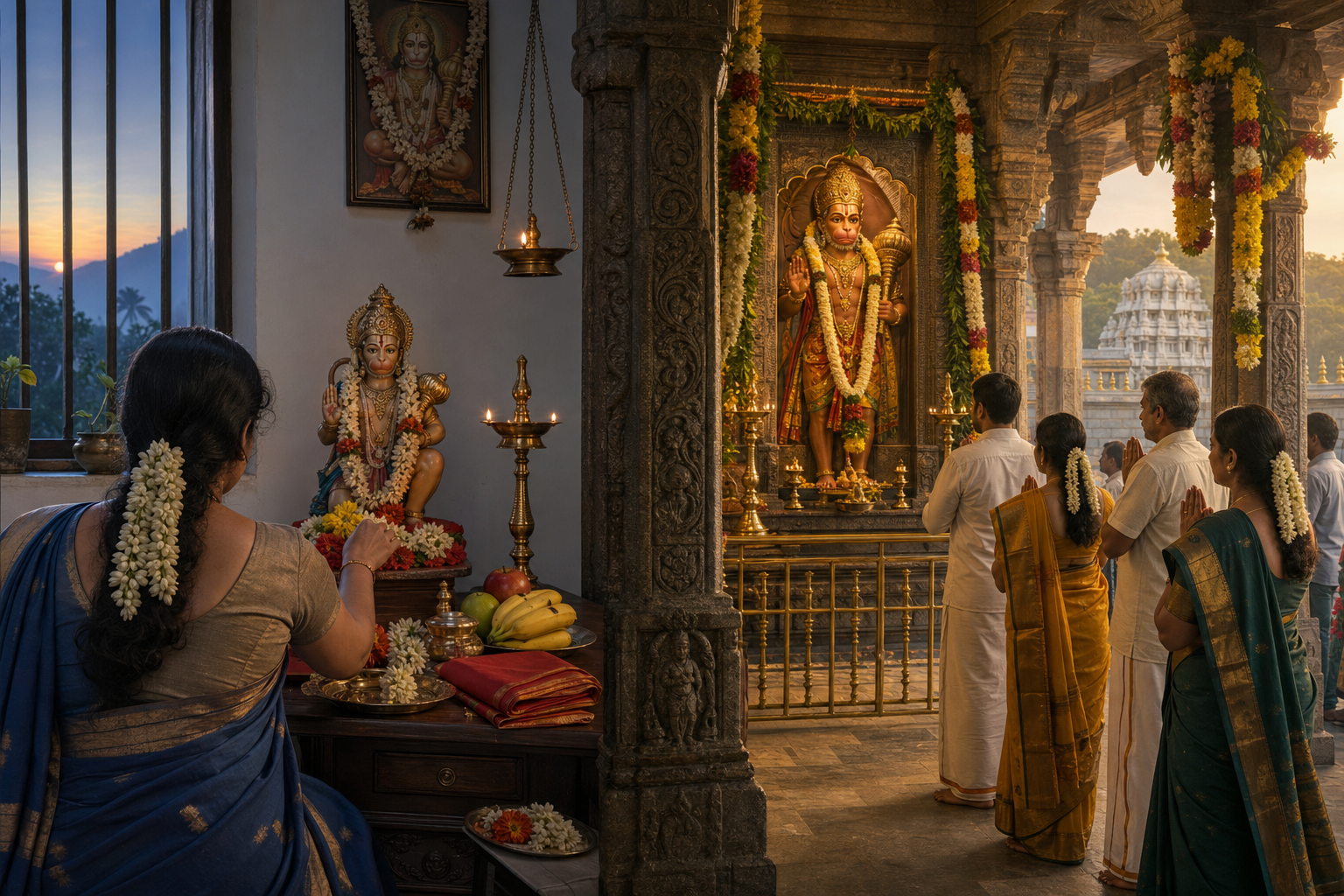
Tirumala’s temple liturgy can include shodashopachara, Abhishekam, alankaram, archana, parayanam, naivedyam and deepa-harati. These are disciplined forms of worship conducted under temple protocols. A household does not need to reproduce the entire Agamic sequence from an online checklist. Follow the procedure your family has received and choose a smaller practice you can perform with attention.
- Begin with a clear sankalpa. State that you are observing Hanuman Jayanti according to the Tirumala date if that is the calendar you have chosen.
- Choose one principal recitation. Hanuman Chalisa is suitable for a compact observance; Sundara Kanda parayanam suits a household or group able to give it the required time and concentration.
- Reflect on one of the qualities associated with Hanuman: shraddha, bala, buddhi or dhriti. Name the behaviour through which you will practise it.
- Offer naivedyam and perform deepa-harati only in the manner already accepted in your household tradition.
- Complete an act of seva after the recitation. This prevents devotion from ending when the lamp is extinguished.
The Pattu Vastrams offered to Sri Japali Hanuman express purity, honour and vastra-samarpana as service to the deity’s living presence. At home, the lesson is not that you must purchase silk. Offer the best care you can honestly sustain: a clean place of worship, attentive recitation, disciplined conduct and service without display.
Sri Bedi Anjaneya Swamy’s local tradition adds another useful meditation. The image of Hanuman’s immense energy being lovingly restrained points toward strength governed by dharma. If your recurring problem is distraction, anger or unfinished work, make self-mastery the content of your vrata rather than asking only for external protection.
Plan Tirumala darshan as two different site visits

Sri Japali Hanuman and Sri Bedi Anjaneya Swamy are not interchangeable stops. Japali Theertham is a forest shrine on the Tirumala-Papavinasanam route, associated with sage Jabali and set beside a natural theertham. Reaching it involves a moderate walk from the roadside drop-off along a marked natural trail. Sri Bedi Anjaneya Swamy stands near the main Srivari Temple precincts and is better coordinated with your plans for Srivari darshan.
For Japali Theertham
- Wear footwear appropriate for a forest path rather than planning as though the shrine were beside the road.
- Carry water and account for the warmth of mid-May before beginning the walk.
- Avoid disposable plastic and keep the theertham and surrounding forest quiet and clean.
- Allow more time than the walking estimate alone; festival footfall and regulated movement can slow access.
- Do not assume that TTD’s ceremonial presentation of Pattu Vastrams guarantees a personal view of every ritual.
For Sri Bedi Anjaneya Swamy
- Arrive early if a quieter darshan matters, especially when travelling with seniors or children.
- Coordinate the visit with your Srivari queue plan rather than treating it as an isolated appointment.
- Follow the current TTD dress code, queue directions and photography restrictions.
- Use only designated places for lamps or offerings; permission at one shrine does not establish permission everywhere in the precincts.
Exact puja, parayanam, access and traffic arrangements belong to the official TTD advisory for the observance. A festival date tells you when to travel, but it does not establish a seva time or guarantee access. Check the advisory before departure and again when you reach Tirumala, because crowd-management instructions can affect the order of your visits.
Key takeaways
- May 9 and May 12 serve different purposes: the first is a Saptami-Ashtami Panchang transition, while the second is Tirumala’s Hanuman Jayanti.
- On May 9, Saptami prevails at sunrise in most regions and Ashtami begins at 9:28 AM, subject to local calculation.
- Udaya-tithi can name the civil observance day, while a particular rite may require the desired tithi to be actually present.
- Tirumala’s May 12 observance on Vaishakha Bahula Dasami reflects temple parampara; it does not invalidate other regional Hanuman Jayanti dates.
- At home, choose one attentive recitation and one concrete act of seva instead of imitating an entire temple liturgy.
- For Tirumala, plan Japali Theertham as a forest-path visit and Sri Bedi Anjaneya Swamy as part of the main temple-precinct itinerary.
Put both dates in your calendar with different labels. Add your city’s Panchang beside May 9, your chosen recitation and seva beside May 12, and the current TTD advisory beside any pilgrimage plan. That small preparation will let timing, tradition and devotion support one another.
References
- DharmaRenaissance Blog — May 9, 2026 Panchang: Saptami to Ashtami Timing, Shubh Muhurat Cues and Ritual Guidance
- DharmaRenaissance Blog — Hanuman Jayanti 2026 at Tirumala: TTD silk vastrams for Japali Hanuman, auspicious pujas