

You may encounter Sahasramukharavana in a regional Ramayana retelling or performance and wonder whether the thousand-headed king is simply the familiar ten-headed Ravana made larger. That reading catches the spectacle but misses the challenge. His extravagant body asks a harder question: what happens when extraordinary discipline increases a person’s power without correcting the purpose behind it?
The answer matters beyond mythology. Sahasramukharavana gives you a precise way to distinguish capacity from character, austerity from purification, and control over a domain from mastery of the self. His thousand heads, two thousand hands, fierce tapas and island sovereignty form one connected symbolic argument.
Read the thousand-headed king on his own terms
Sahasramukharavana is described as an asura sovereign with a thousand heads and two thousand hands, ruling an island-realm called Trilokpuri. He belongs to later and regional Ramayana worlds that include vernacular cycles, ritual theatre and puppetry. He is therefore better approached as a distinct development of the Ravana archetype than as a universal detail found in every telling.
This distinction protects you from two opposite errors. The first is to dismiss every unfamiliar form as an invention with no interpretive value. The second is to treat one regional form as though every Ramayana tradition must contain it. Indic narrative culture has long allowed inherited figures to enter new constellations, where an intensified form can expose a theme that was already present in the wider tradition.
The familiar Daśānana already joins learning, ambition, devotion, sovereignty and transgression in one formidable personality. Sahasramukharavana magnifies that tension. More heads do not merely mean a stronger villain. They give visible form to cognition without measure, while the multiplied hands turn that cognition into nearly unrestricted agency.
When you meet this figure in a text, painting or performance, use three checks before interpreting him:
- Identify the particular retelling or performance tradition instead of assuming that all Ramayanas use the same details.
- Separate what the narrative states from what the imagery invites you to contemplate. A symbolic reading can deepen the form without replacing the story.
- Use Daśānana as a point of comparison, not as a substitute. Ask what becomes newly visible when ten heads become a thousand.
That last question moves you from arithmetic to meaning. Sahasramukharavana is not significant because someone has performed a larger count. He is significant because the story has pushed intelligence, appetite, command and reach toward a cosmic scale.
Tapas produces capacity, not a certificate of righteousness
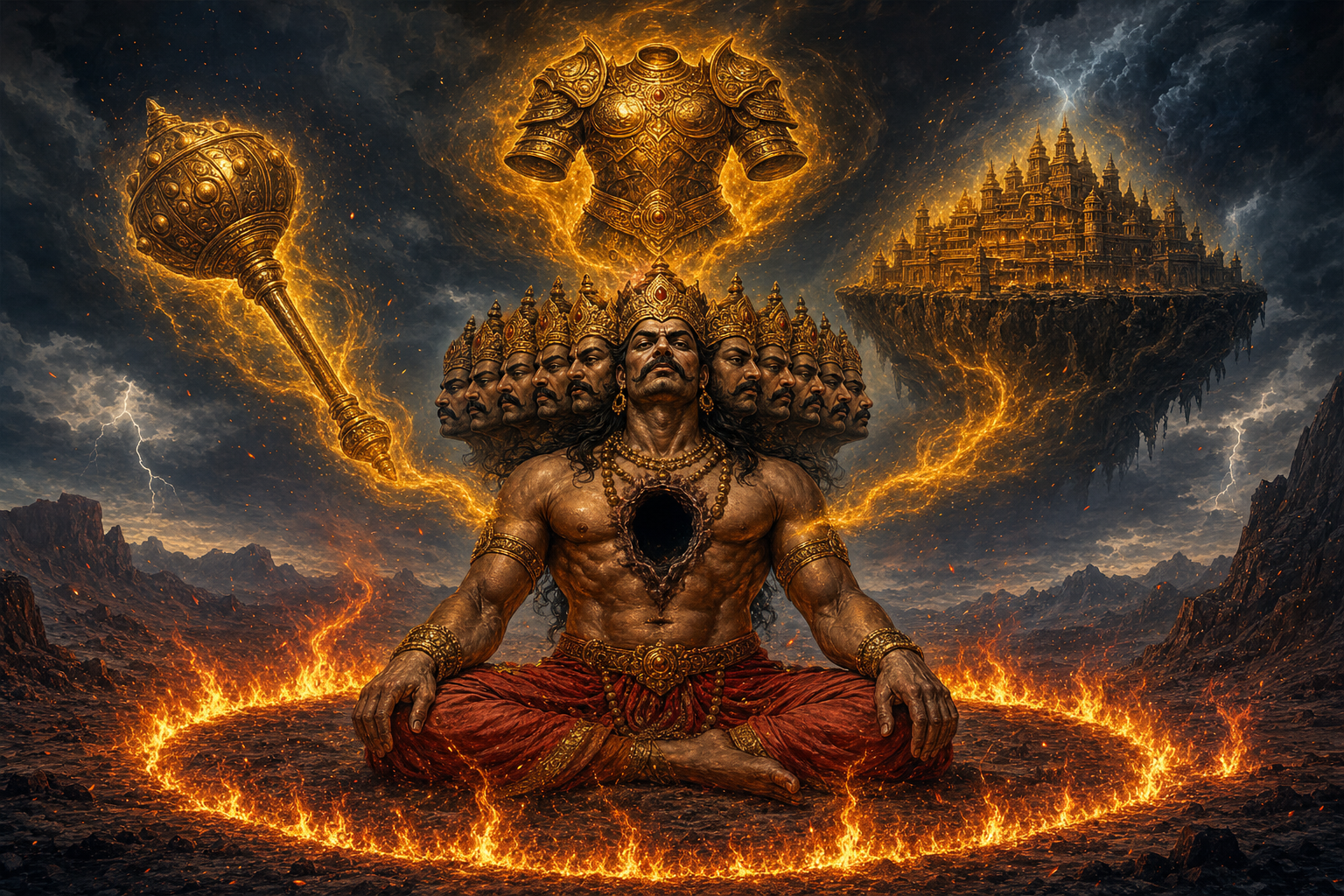
Tapas is often translated as austerity or penance, but its underlying image is heat: concentration powerful enough to transform the one who sustains it. In Sahasramukharavana’s world, this heat can ripen knowledge, endurance, vision and force. It can also intensify an ambition that was disordered from the beginning.
This is the ethical hinge of the story. The acquisition of power through tapas does not prove that the seeker’s purpose is dharmic. A boon acknowledges the potency of concentrated effort; it does not turn domination into justice. Discipline answers the question of whether the will can become effective. Dharma answers the different question of what that effective will ought to serve.
The Bhagavad Gita’s distinction among sattvic, rajasic and tamasic austerity provides a useful diagnostic. Sattvic tapas is joined to clarity, truth, restraint, humility and non-injury. Rajasic tapas seeks recognition, advantage or reward. Tamasic tapas grows from delusion and can injure oneself or others. The outward severity of a practice is therefore insufficient evidence of its spiritual quality.
If you want to evaluate a vow, discipline or campaign in this light, do not begin by asking how difficult it is. Ask three more revealing questions:
- Aim: Is the discipline ordered toward purification, truth and service, or toward prestige, invulnerability and control?
- Means: Does it preserve restraint and non-injury, or does intensity become an excuse for cruelty, humiliation or reckless self-harm?
- Fruit: Does greater capacity produce clearer judgement and greater humility, or agitation, entitlement and contempt for limits?
Sahasramukharavana fails at the level that matters most: orientation. His tapas is formidable, but its power is drawn into a project of cosmic possession. The narrative thereby refuses a common spiritual mistake. It does not confuse an unusual achievement with liberation, or endurance with wisdom.
This principle also explains why fierce practice can make an existing tendency more dangerous. Concentration reduces hesitation and increases effectiveness. If anger, vanity or hunger for command remains unexamined, discipline gives that tendency a longer reach. Tapas acts as an amplifier; it does not choose the signal.
A thousand heads signify total reach, not just excess anatomy
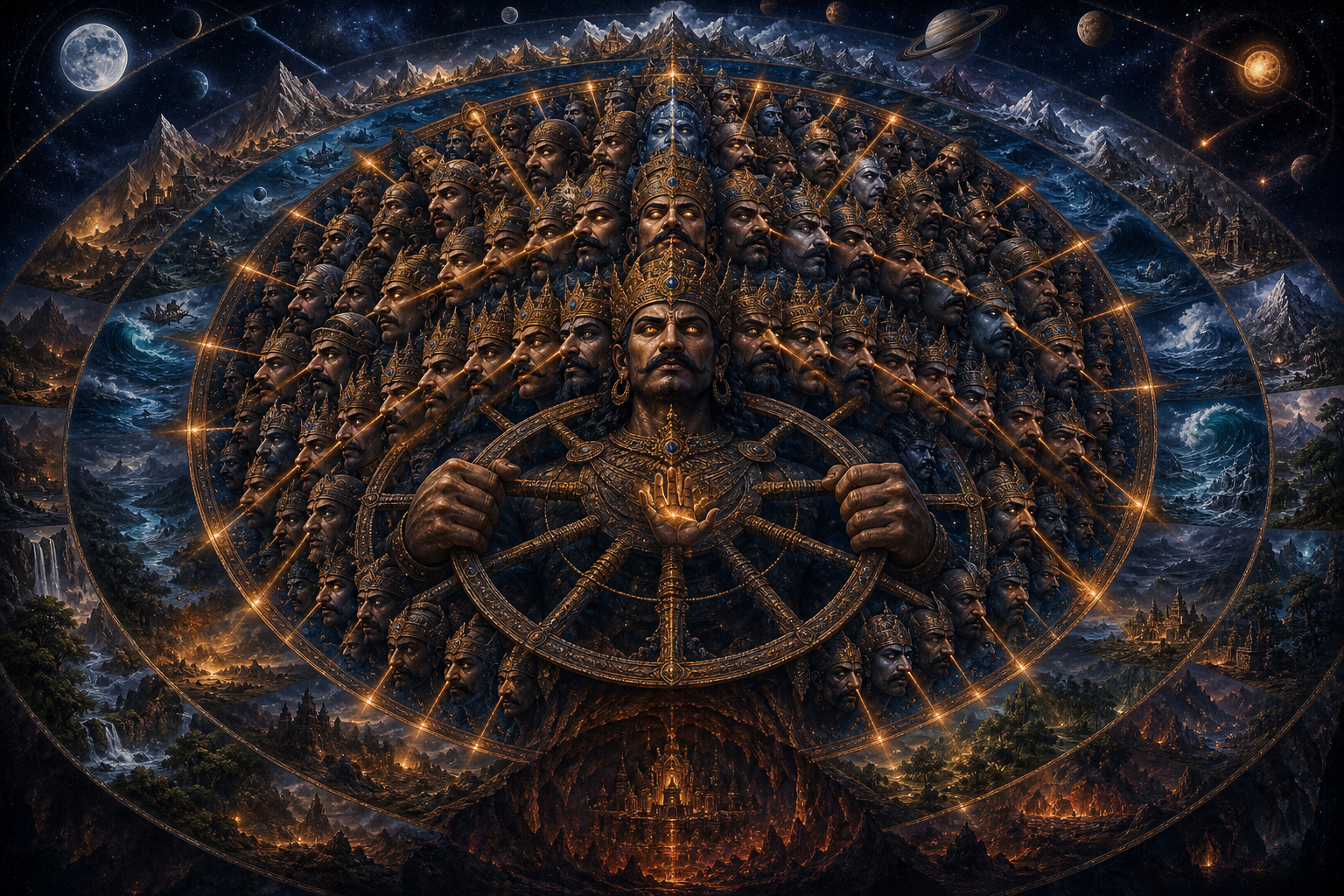
The name joins sahasra, thousand, with mukha, face or head. Within sacred and poetic language, a thousand often indicates totality, abundance or an extent beyond ordinary counting. The physical form belongs to the narrative, but the number also tells you how the form should be contemplated.
Heads and hands contribute different elements to the image:
- The thousand heads suggest multiplied perception, calculation, counsel and thought. Psychologically, they can represent proliferating mental constructions, or vikalpa: possibilities, arguments and desires that continually generate one another.
- The two thousand hands suggest execution, intervention and force. They turn thought into action and intention into karmic consequence.
- Their union depicts intelligence and operational power fused into imperial will. The danger lies not in thought or action by itself, but in their coordination under an appetite for dominion.
The number carries an additional resonance because thousandfold imagery also marks sacred plenitude. Purusha is hailed as thousand-headed; sahasranāma traditions praise a deity through a thousand names; and yogic imagery places the thousand-petalled sahasrāra at the crown. Sahasramukharavana consequently appears to rival the visual grammar of cosmic completeness.
Similarity of form, however, is not identity of meaning. Sacred thousandfoldness can express an underlying unity appearing everywhere. The asura’s thousandfoldness can be read as the opposite movement: awareness scattered among innumerable designs, with each design demanding instruments of action. One is plenitude gathered into truth; the other is proliferation gathered into appetite.
This contrast is especially useful when considering sahasrāra. It would be careless to claim that the monster is merely a coded diagram of a blocked chakra. A more disciplined comparison notices two trajectories. Sahasrāra symbolizes the harmonization of awareness, while the asura’s many heads dramatize awareness multiplied without being morally unified. More perception is not necessarily greater vision.
The same principle helps you read visual and performance traditions. Artists cannot always display an actual thousand heads or two thousand hands, nor do they need to. Tiered masks, recurring profiles, mirrored processions, radiating arms and layered silhouettes can signal innumerability through rhythm and repetition. If an image shows an emblematic cluster rather than a literal count, examine the pattern before declaring the representation inaccurate. The iconographic task is to make overwhelming reach visible.
Trilokpuri turns cosmic rule into a test of self-rule

Trilokpuri is imagined as an island polity. Its name evokes the three worlds, while its location fits a cosmography in which island-realms and surrounding seas mark transitions between jurisdictions. Sahasramukharavana’s kingship therefore reaches beyond ordinary territorial government. It presses toward a claim over heaven, earth and the intermediate realm.
This is political theology in narrative form. Kshatra, the force of sovereignty, can defend order and administer justice. It becomes destructive when it treats acquired power as its own moral justification. Dharma measures a ruler by the right use of authority, not by the size of the realm, the brilliance of the court or the difficulty of the austerities through which power was obtained.
You can also turn Trilokpuri inward as a contemplative lens. The three domains may be read as body, speech and mind, or as the field shaped by the three guṇas. This does not have to be treated as a literal definition of the place-name. It is a disciplined application of the story’s central question: will sovereignty mean governance of oneself or possession of others?
Self-rule is visible in coordination. The body does not violate what the mind recognizes as right. Speech does not disguise what action is doing. Strength remains answerable to truth even when no rival can impose a limit. By contrast, the thousand-headed sovereign represents coordination without moral integration: immense faculties working together for a disordered end.
Three Dharmic counterpoints clarify the failure
Hindu, Buddhist, Jain and Sikh traditions should not be flattened into one doctrine. Each has its own vocabulary, practices and account of liberation. Yet three counterpoints make Sahasramukharavana’s failure easier to diagnose:
- Buddhist compassion redirects multiplied agency. The thousand-armed Avalokiteśvara coordinates perception and action for the relief of suffering. The scale resembles the asura’s superhuman reach, but its ethical direction is reversed. Energy and determination become liberating when disciplined by compassion and non-harming.
- Jain analysis tests the quality of concentration. Raudra dhyāna is wrathful or injurious absorption, whereas śukla dhyāna is pure, liberating contemplation. Severe tapas joined to violence, possession or wrong view can deepen bondage despite its intensity. Ahiṃsā is not an optional ornament added after power has been gained.
- Sikh discipline joins remembrance to service. Simran gathers attention around Truth, while seva directs strength toward selfless service. Courage remains necessary, but courage severed from humility and justice can become another form of self-expansion.
These lenses converge on a narrow but important judgement: spiritual energy must be assessed by its orientation. The crucial contrast is not weakness versus strength. It is power made answerable to truth versus power attempting to replace truth.
Key takeaways for reading the symbolism clearly
- Treat Sahasramukharavana as a context-specific Ramayana figure, not as a simple enlargement of Daśānana or a detail that every recension must share.
- Read the thousand heads as totalized cognition and the two thousand hands as totalized agency. Their relationship matters more than a literal visual count.
- Judge tapas by aim, means and fruit. Difficulty demonstrates resolve, but it does not establish purity or righteousness.
- Distinguish sacred plenitude from asuric accumulation. Thousandfold imagery can express integrated awareness or an audacious imitation of cosmic completeness.
- Read Trilokpuri outwardly as a claim to cosmic sovereignty and inwardly as a test of whether body, speech and mind are governed by dharma.
- Use compassion, ahiṃsā, remembrance, service and humility as checks on any discipline that increases personal or political power.
Before you intensify a religious practice, intellectual project or public cause, write down three things: the good it is meant to serve, the boundary you will not cross to achieve it, and the change in conduct that would show greater humility rather than greater entitlement. If those answers are unclear, more intensity is premature. Sahasramukharavana’s warning begins precisely where impressive discipline tempts us to stop asking what the discipline is for.