
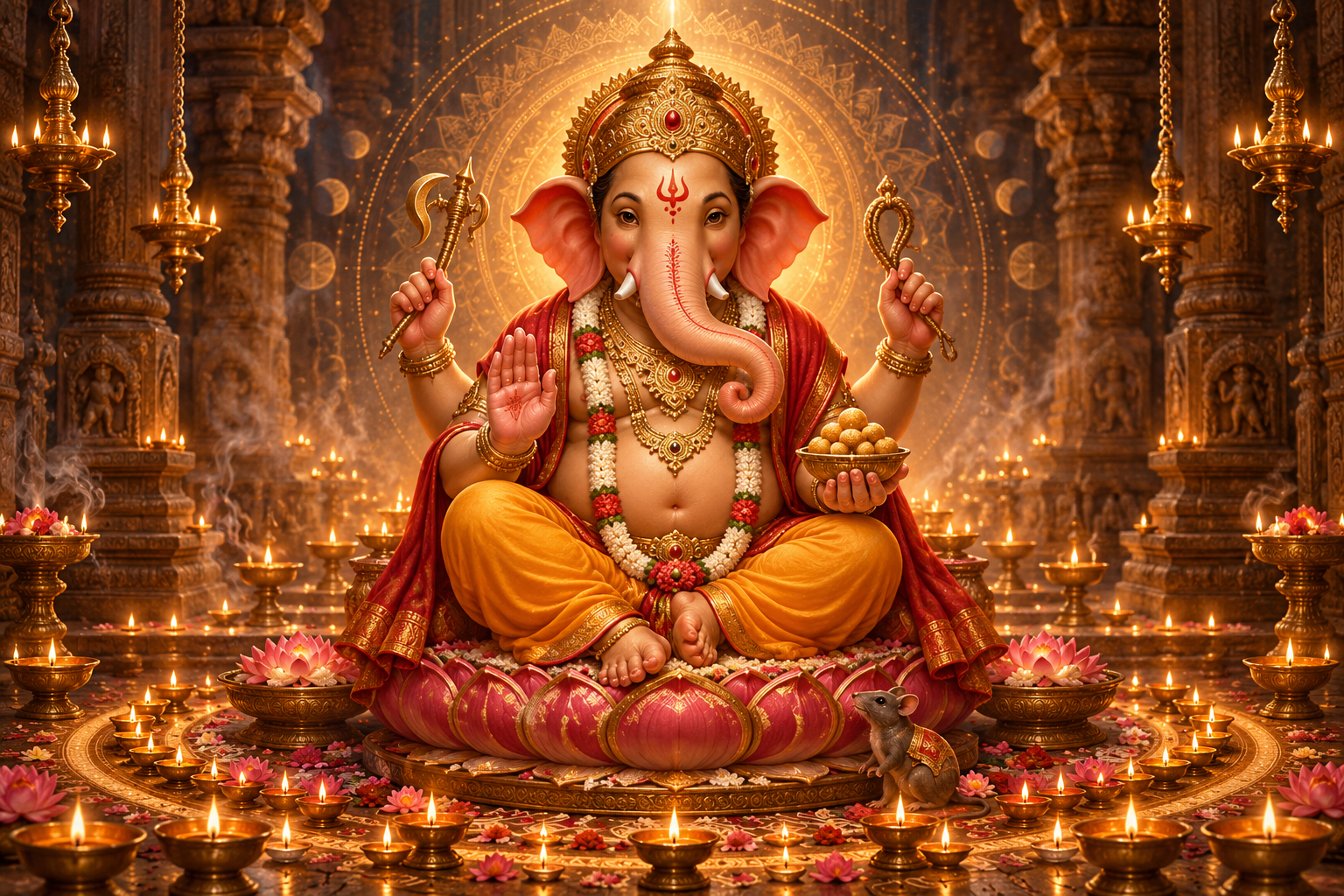
If you approach the Mudgala Purana expecting only a longer collection of familiar Ganesha stories, you will miss its most useful move. The central question is not simply what Ganesha does when an obstacle appears. It is what religious life looks like when Ganesha becomes the primary lens through which the devotee understands divine action, human difficulty, and spiritual response.
That shift matters whether you are studying the text, preparing a discourse, or trying to deepen your own upasana. Within this ancient Upapurana devoted primarily to Ganesha, his religious history, significance, and forms receive sustained attention. Read those elements together, and Ganesha emerges as more than a deity invoked at the threshold of another undertaking. He becomes the centre of the theological inquiry itself.
Primary devotion changes the question you bring to Ganesha

Many devotees first encounter Ganesha as the remover of obstacles and the devata remembered at an auspicious beginning. That relationship is real and valuable, but it can become narrowly functional. You have a difficulty, you seek Ganesha’s help, and you measure the encounter by whether the difficulty disappears.
A theological reading goes further. It asks what the obstacle reveals, what kind of divine action Ganesha represents, and whether the decisive change occurs in the circumstances, in the seeker, or in both. Instead of reducing Ganesha to a solution for blocked plans, you begin to notice how a Ganesha-centred religious vision interprets the plan, the blockage, the person pursuing it, and the wisdom required to proceed.
Use three questions whenever you study an episode:
- What changes in the external situation?
- What changes in the understanding, conduct, or disposition of the person involved?
- What does Ganesha reveal here beyond the familiar function of removing an impediment?
If your interpretation answers only the first question, it may explain the plot without reaching the theology. Return to the episode and look for the relationship between divine action and inner order.
At the same time, do not turn primary devotion into a hierarchy that a passage has not established. The safe conclusion is that Ganesha occupies the principal devotional and interpretive position in this work. That fact alone does not prove every larger claim someone may make about metaphysical rank, the status of other devatas, or the equivalence of terms drawn from another tradition. Those claims require passage-level evidence.
Ganesha’s forms are a theological vocabulary, not a picture list
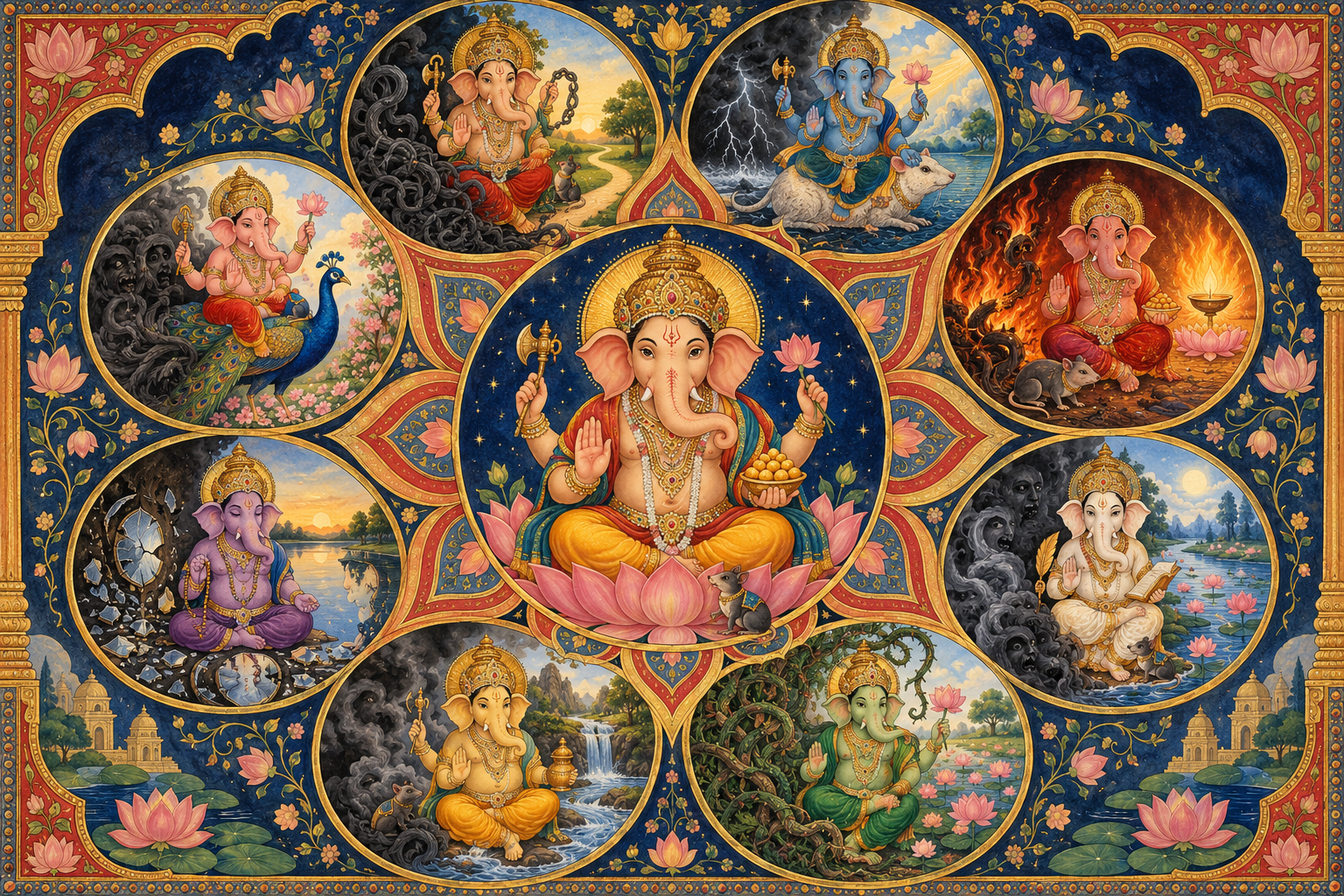
Descriptions of divine forms are easy to consume as iconographic trivia: a name, an image, several attributes, and perhaps a ritual association. That approach records appearances but may miss why plurality matters. A form should lead you to ask how one divine identity becomes intelligible in a particular setting.
Treat each form as a possible theological statement. Its name, attributes, action, setting, and effect may work together. The form is then neither a decorative costume nor necessarily a separate deity. It is a distinct way in which the devotee is invited to recognise Ganesha. The exact conclusion, however, must come from the passage rather than from a system imposed beforehand.
For every form you encounter, make a six-part note:
- Record the exact name and spelling used by your edition or translation.
- List only the attributes actually described in the passage.
- Identify the situation, condition, or problem surrounding the appearance.
- State the action attributed to Ganesha.
- Note any response required from the devotee or other participant.
- Record the outcome without adding an interpretation yet.
Compare your notes only after you have completed several entries. You can then test whether the forms distinguish different situations, kinds of action, devotional relationships, or symbolic meanings. If a pattern is genuinely present, the comparison will reveal it. If it is not, you will have avoided forcing unrelated forms into an attractive but unsupported scheme.
This method also protects you from a common attribution error. A list of Ganesha forms found in another tradition may still be spiritually valuable, but a shared deity or familiar name does not prove that the list belongs to the Mudgala Purana. Before repeating such a claim, look for a chapter, passage, or traceable edition.
Read narrative, ritual, and doctrine in the same pass
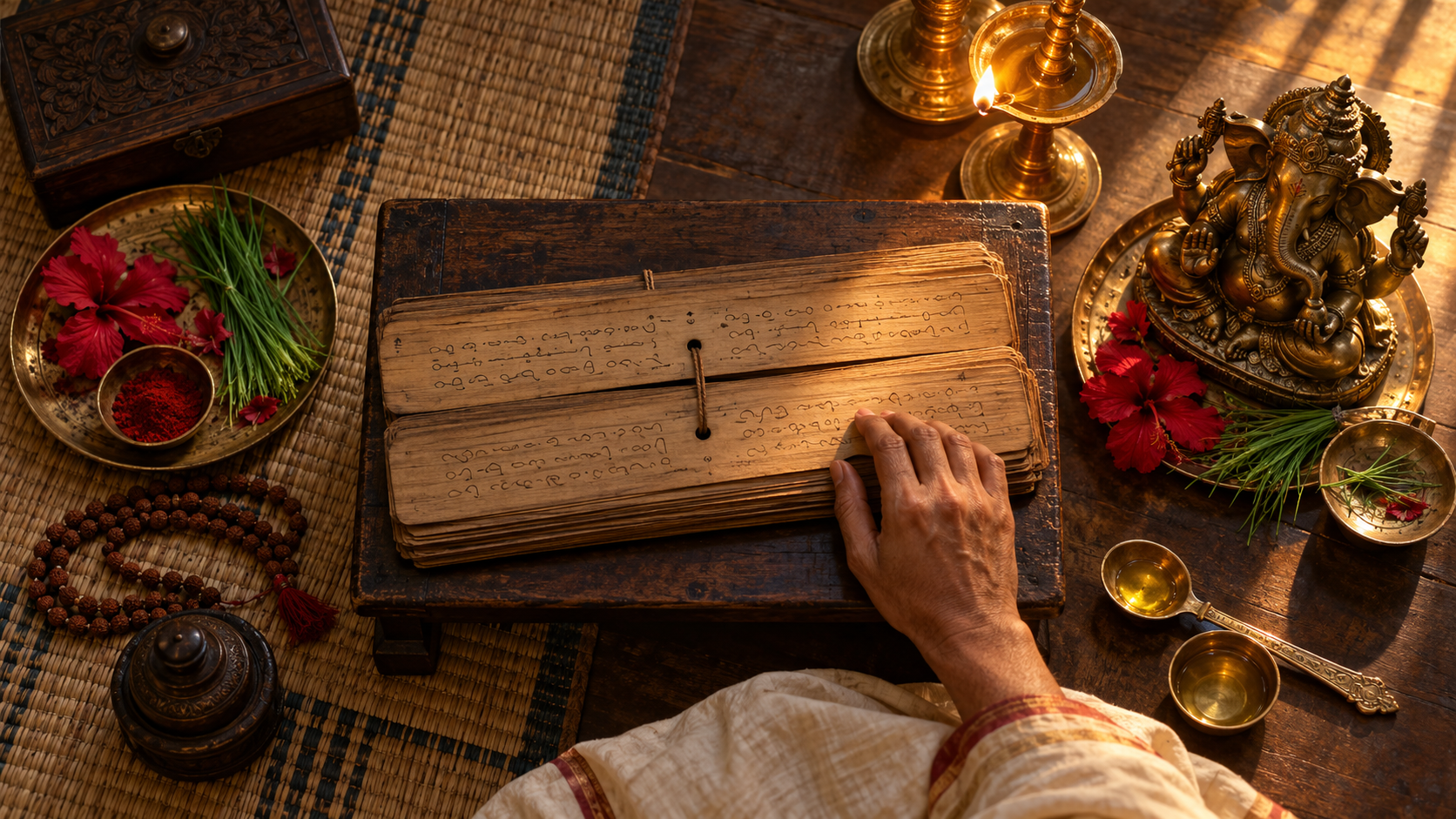
Puranic theology usually reaches the reader through more than abstract propositions. A narrative shows relationships and consequences. A divine form concentrates meaning. Ritual turns that meaning into embodied remembrance. If you isolate any one layer, you can end up with a story emptied of theology, a symbol detached from worship, or a practice repeated without understanding.
A disciplined reading therefore needs three passes:
- On the narrative pass, establish what happens, who acts, and what changes. Do not interpret before you can retell the sequence accurately.
- On the theological pass, ask what the episode discloses about Ganesha’s identity, agency, and relationship with the devotee.
- On the devotional pass, identify what the passage actually asks a practitioner to remember, cultivate, recite, offer, or do. Leave this blank if no practice is stated.
The blank space in that final step is important. Do not manufacture ritual instructions from a symbolic episode. If a mantra, offering, observance, or sequence is not present in the passage available to you, say that plainly. Devotional enthusiasm does not turn an inference into a textual prescription.
Keep two columns in your notebook: text and inference. Under text, record the event, term, form, or instruction your edition actually supplies. Under inference, record what you think it means. This simple separation prevents a personal insight from being repeated later as though it were a translation. It also makes your teaching more trustworthy because another reader can see where the wording ends and your interpretation begins.
Keep the Mudgala Purana distinct from the Skanda Purana
Confusion between similarly discussed Puranic materials can quietly distort the whole reading. Keep the Ganesha-centred Mudgala Purana separate from the Skanda Purana, whose focus is Murugan, also known as Skanda or Kartikeya, and which includes material associated with Skanda Sashti. The distinction is theological as well as bibliographic: moving a passage into the wrong textual setting changes the devotional world in which its claim belongs.
Before attributing a teaching, form, or ritual to the Mudgala Purana, check four things:
- Does the citation name the work explicitly, or does it merely say that the material is Puranic?
- Does it provide a chapter, section, page, or other location that can be checked?
- Does the central deity and narrative setting match the claimed textual context?
- Can you identify the edition or translation from which the wording came?
A search result, social-media graphic, or unsourced devotional chart can give you a lead. It cannot settle attribution. When the location cannot be verified, describe the material as a later devotional teaching or an unverified association rather than assigning it confidently to the Mudgala Purana.
Edition awareness matters as well. Transliteration can vary, explanatory language may belong to a translator, and a paraphrase can sound more definite than the underlying wording. Record the edition whenever you quote. If a Sanskrit term carries the argument, preserve the term alongside the translation so that readers can evaluate the interpretation.
Key takeaways
- Approach Ganesha as the centre of the theological inquiry, not only as a divine helper called before another activity.
- Read each form through its name, attributes, setting, action, required response, and outcome before comparing it with other forms.
- Separate textual statements from your inferences, especially when turning narrative symbolism into devotional practice.
- Do not import lists, rituals, or doctrines from another Ganesha tradition without a traceable passage.
- Keep the Mudgala Purana and Skanda Purana distinct; their central deities and devotional settings are not interchangeable.
Begin with one short passage rather than a large catalogue of names. Complete the six-part form note and the three reading passes, then finish one sentence in your own words: Here Ganesha is revealed as… Keep only the words you can support from the passage.
If the result says nothing beyond removal of an obstacle, read once more for what changes in the seeker and what the chosen form contributes. Repeated patiently, that practice will let Ganesha’s forms become a coherent theological vocabulary rather than a collection of disconnected images.
References

Leave a Reply
You must be logged in to post a comment.