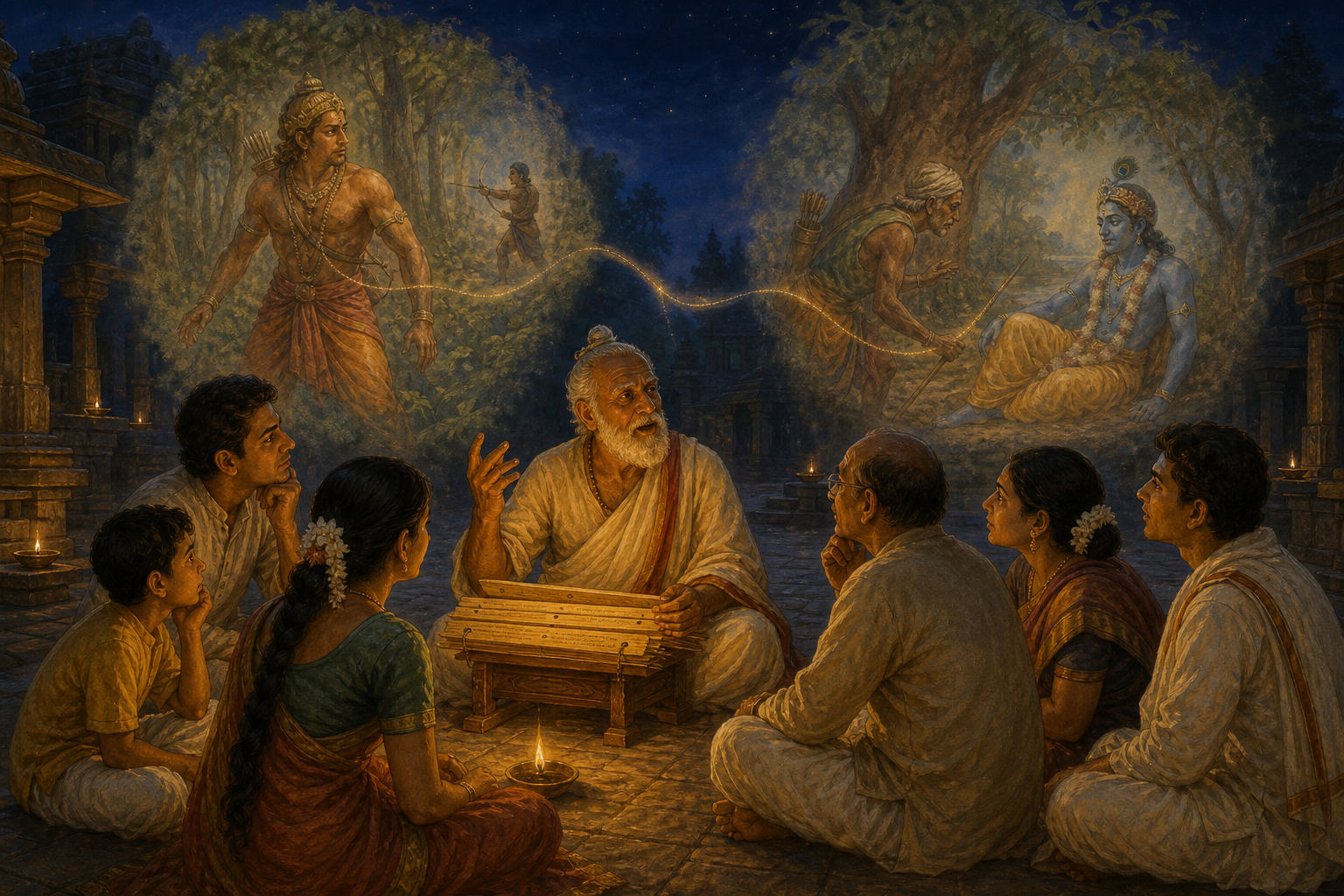
If you have heard that Vali returned as Jara so that Rama’s arrow could be answered by an arrow aimed at Krishna, you may be wondering what the two epics actually teach. Is karmic justice an exact exchange of injuries, and does the same rule bind an avatara?
The careful answer is more illuminating than a simple yes. The Ramayana gives us Vali’s contested death, and the Mahabharata gives us Jara’s mistaken shot and Krishna’s earthly departure. The rebirth connection comes from later devotional and regional traditions. Read with that distinction intact, the episodes teach responsibility, scrutiny of means, and moral restoration rather than cosmic revenge.
Separate the epic events from the interpretive bridge
In the Kishkindha Kanda of the Ramayana, Rama strikes Vali from concealment while assisting Sugriva. Vali objects to the manner of the attack. Rama answers by invoking kshatra-dharma, sovereign authority, and the protection of social order. The encounter therefore contains both a justification and a challenge to that justification.
In the Mausala Parva of the Mahabharata, the hunter Jara mistakes Krishna’s foot for a deer and releases an arrow. The event completes Krishna’s earthly leela. The Mahabharata’s critical text identifies Jara simply as a hunter; it does not identify him as Vali reborn.
The Vali-Jara identification belongs to a later layer of interpretation. Purana-oriented commentary, regional retellings, and some Vaishnava traditions connect the two figures. That connection has spiritual and literary force, but its force does not make it explicit in the critical text of the Mahabharata.
When you encounter a claim about the episodes, sort it into one of three levels:
- The epic event: what the Ramayana or Mahabharata actually narrates.
- The received tradition: how later communities, commentators, and retellings connect the events.
- The philosophical inference: what the connection may teach about karma, dharma, power, or responsibility.
This distinction does not ask you to discard a devotional reading. It lets you hold that reading honestly. If someone says the Mahabharata explicitly declares that Jara was Vali, ask which recension, commentary, or retelling is meant. If the answer is a later tradition, describe it that way. Precision protects both the epic and the living tradition from being made to claim more than either claims for itself.
Karma is moral causation, not licensed retaliation
The popular image of karma as an invisible official handing back identical rewards and punishments is too crude for these episodes. Karma concerns action and consequence. It includes intention, but it also makes you examine the means you choose, the effects you produce, and the responsibility that remains afterward.
Rama and Jara make the distinction especially clear. Rama acts deliberately and gives a reasoned defence of his conduct. Jara acts through mistaken perception. You should not judge a deliberate act of statecraft and an accidental shooting as though their intentions were identical. Yet unintended harm still has an effect. Intention helps identify the moral character of an act; consequence helps identify what must be acknowledged or repaired.
Nor does a good aim automatically sanctify every method. Rama’s stated purpose and Vali’s objection coexist because dharma asks more than whether an actor wanted a desirable outcome. It also asks whether the actor possessed the relevant authority, whether the chosen means fitted the duty, and whether power was exercised with accountability.
This is why the Vali-Jara symmetry should not be used as permission for revenge. Karma does not appoint you as the private collector of another person’s debt. Mirroring an injury merely creates another action with its own intention, means, and consequences. A restorational response instead protects those at risk, accepts legitimate responsibility, and repairs what can still be repaired.
The wider Dharmic family expresses moral causation in different ways. Buddhism speaks of karman and the ethical shaping of experience. Jain traditions examine karmic bondage and give ahimsa a central liberating role. Sikh teachings connect karam and hukam with accountability under divine order. These are meaningful parallels, not interchangeable doctrines. Their shared warning is that conduct matters; their differences should not be erased to manufacture a single formula.
When you use the word karma in an argument, complete three sentences before reaching a verdict: the relevant action was; the intention appears to have been; the responsibility now is. If you cannot fill in those blanks without speculation, you do not yet know enough to call the outcome karmic justice.
Read Vali’s objection and Rama’s answer together
The ethical strength of the Vali episode lies in its preserved tension. Vali does not die without questioning the concealed attack, and Rama does not answer merely by asserting superior power. He locates his decision within a ruler’s duty and a conception of social order. The narrative makes you hear the objection and the justification in the same moral space.
Two shortcuts weaken that encounter. One says that Rama is an avatara, so the method cannot be questioned. The other says that concealment alone settles the entire issue and makes Rama’s explanation irrelevant. The first silences the ethical inquiry preserved in the episode. The second ignores its serious engagement with duty, authority, and governance.
A better reading tests the action through four questions:
<!– wp:list {