
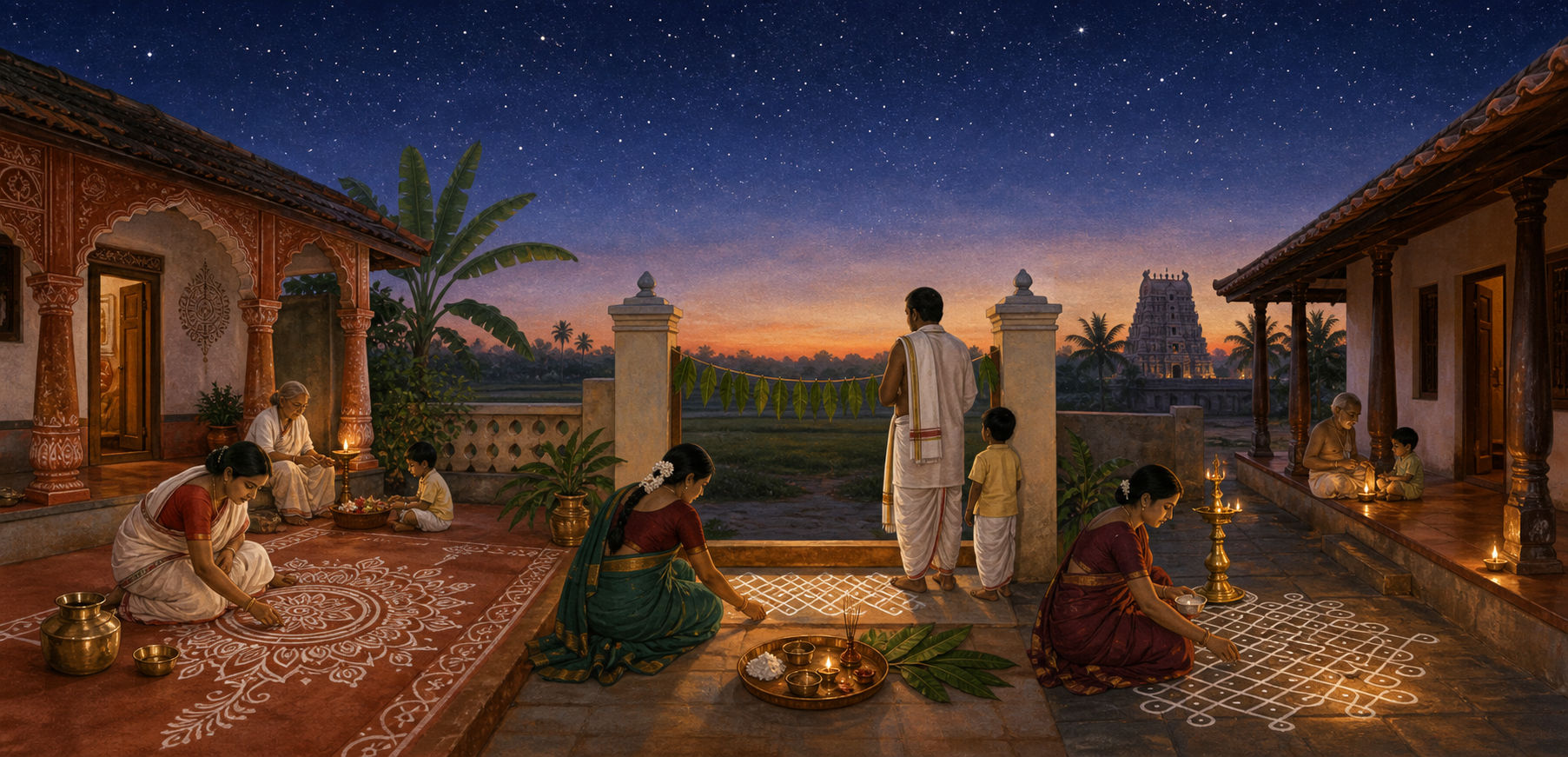
Your family message says Poush Amavasya. A Telugu calendar says Margashirsha. A Tamil calendar says Margazhi. Before you decide that one of them must be wrong, ask a better question: are they naming the same sacred interval through different regional systems?
If you are deciding when to perform tarpan, keep a vrata, visit a temple or gather your family, you need more than a date copied from a calendar. Separate the civil date, the tithi or nakshatra, the regional month name and the ritual custom. Most apparent contradictions become understandable once those four coordinates are visible.
The four coordinates behind a Hindu observance

A Gregorian date is useful for arranging leave, travel and family plans. It does not, by itself, explain why an observance belongs on that date. Hindu sacred time is commonly organized through several overlapping coordinates:
- The civil date tells you where the observance falls on the Gregorian calendar used for everyday scheduling.
- The tithi identifies a lunar-day interval. Amavasya, for example, closes Krishna Paksha and is followed by the transition into Shukla Paksha.
- The nakshatra identifies the lunar mansion governing a stellar observance. Thiruvathira and Arudra Darisanam are anchored to the Thiruvathira or Arudra nakshatra.
- The regional month system supplies names such as Poush, Margashirsha, Dhanu or Margazhi.
- The observance rule tells you which part of the interval matters and how your family, sampradaya or temple marks it.
The mistake is to treat these as rival answers to one question. They answer different questions. A civil date answers, “When should we put this on the schedule?” A tithi or nakshatra answers, “What sacred interval gives this observance its identity?” A month name answers, “Where does our regional calendar place it?” The ritual tradition answers, “What should we actually do?”
This also explains why a calendar can be correct yet incomplete for your purpose. A printed date may be enough for planning a family meal, but not for a rite that must occur while a particular tithi is active. Exact tithi start and end times can vary by location, so timing-sensitive worship should be checked in a reliable panchang calculated for the place where you will observe it.
How one sacred interval acquires several regional names
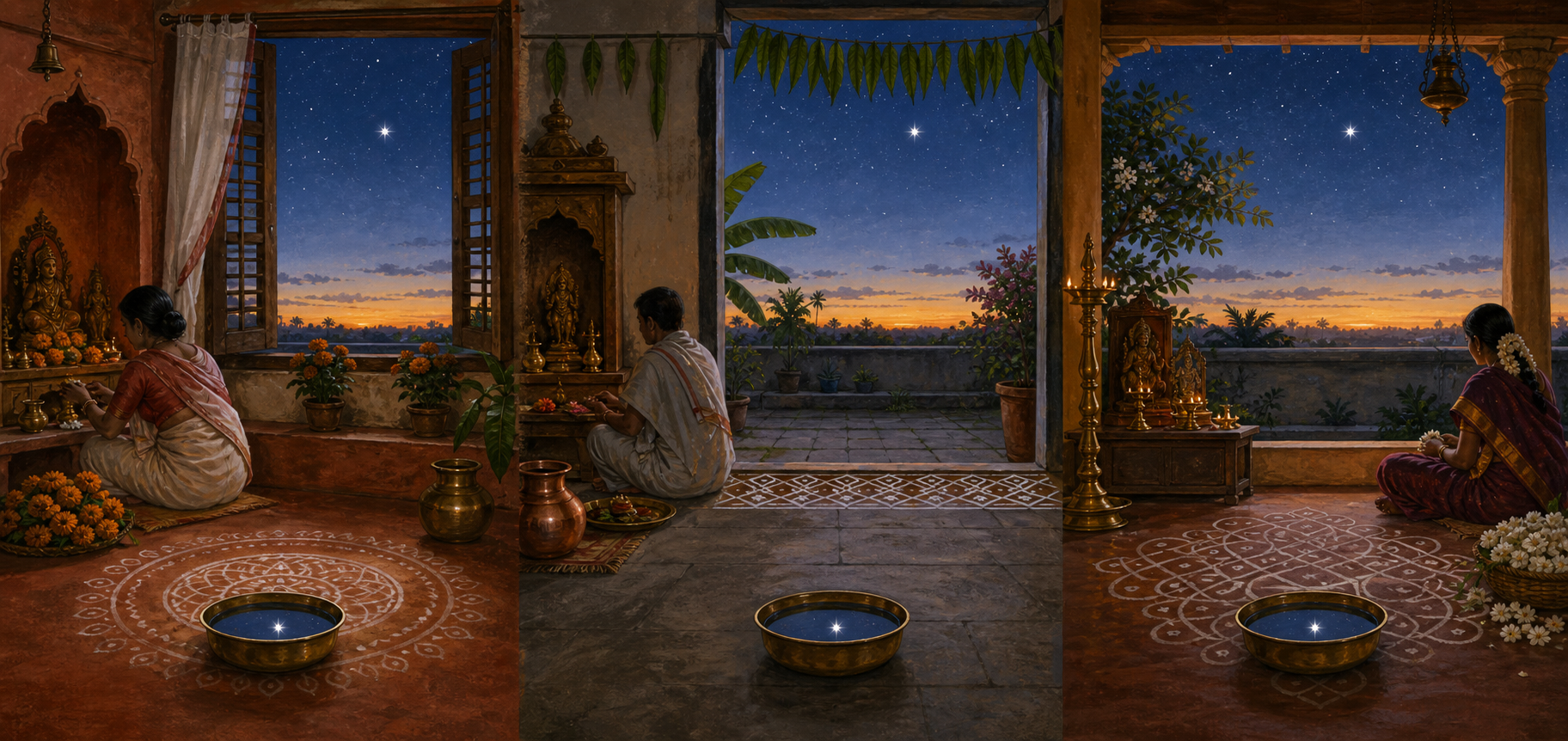
Two examples show the pattern clearly. One is tithi-based; the other is nakshatra-based.
| Observance and civil date | Regional calendar framing | Shared anchor | What you should verify |
|---|---|---|---|
| Amavasya, 19 December 2025 | Poush in North Indian purnimanta usage, with some Margashirsha usage; Margashirsha in Telugu, Kannada, Marathi and Gujarati amanta calendars; Margazhi in the Tamil calendar | Amavasya tithi | The local start and end of the active tithi |
| Thiruvathira and Arudra Darisanam, 3 January 2026 | Thiruvathira in the Malayalam month of Dhanu; Arudra Darisanam in the Tamil month of Margazhi | Thiruvathira or Arudra nakshatra and devotion to Shiva | The local nakshatra interval and the household or temple schedule |
On 19 December 2025, the same Amavasya tithi carried different month labels. North Indian purnimanta practice identified it as Poush Amavasya, although Margashirsha also appeared in some regional usage. Telugu, Kannada, Marathi and Gujarati amanta calendars placed the tithi in Margashirsha, while the Tamil calendar placed the date in Margazhi.
That does not create several different new moons. Amanta and purnimanta conventions locate month boundaries differently, so the month label can change even while families are referring to the same tithi. The practical lesson is simple: when two calendars disagree over a month name, compare the tithi and location before comparing the printed label.
The Thiruvathira-Arudra observance on 3 January 2026 reveals another kind of regional relationship. Kerala marked Thiruvathira during Dhanu, while Tamil Nadu marked Arudra Darisanam during Margazhi. Both were oriented to the same stellar moment and to Shiva, but the names and ritual emphases reflected distinct regional inheritances.
Names therefore do more than translate a date. They carry language, inherited memory, temple culture, food, music, dance and theology. Calling the Tamil observance Arudra Darisanam foregrounds the darshan of Nataraja and the Ananda Tandava. Calling the Kerala observance Thiruvathira evokes household vrata, Shiva Puja, Thiruvathirakali and characteristic foods. The shared nakshatra connects the traditions; it does not erase what makes either one recognizable.
A reliable method for choosing the calendar you should follow
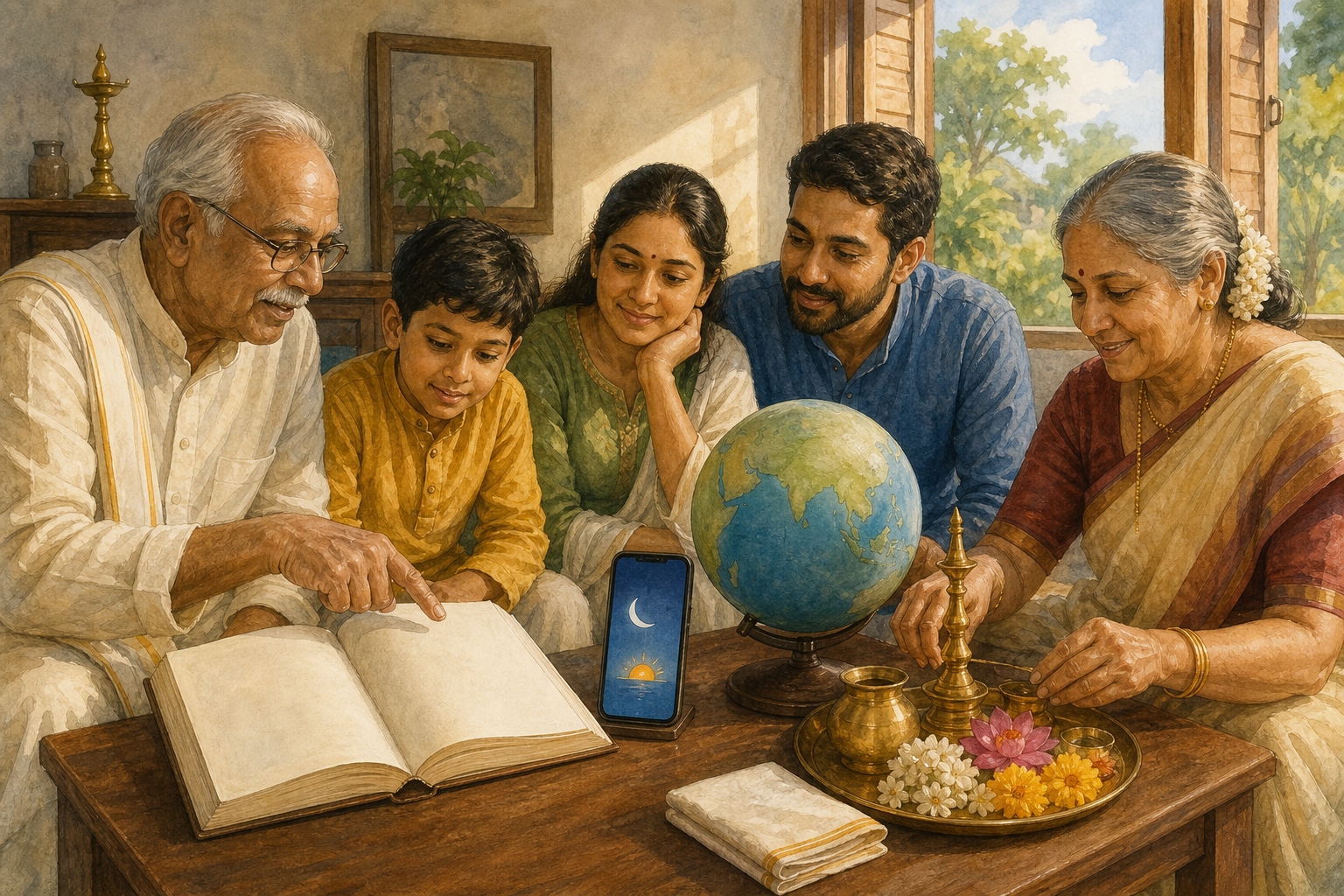
When several dates or names appear, do not settle the question by choosing the most familiar-looking graphic or the result with the largest audience. Use a short decision process that preserves both calendrical accuracy and your own parampara.
- Define the observance precisely. “December new moon” is not as useful as “Amavasya tarpan for a family following a Marathi amanta calendar in Toronto.” Region, purpose and place all matter.
- Identify the governing anchor. Ask whether the observance is determined by a tithi, a nakshatra or a temple schedule. Do not substitute the month name for the astronomical anchor.
- Use a panchang for the location of worship. A calendar calculated for another city may display a different start or end time because the relevant interval is translated into local clock time.
- Apply the rule of your family or institution. For a household vrata, inherited family practice is the relevant ritual authority. For temple worship, use the temple’s announced schedule. For a tithi-sensitive ancestral rite, confirm the active tithi and the convention your family follows.
- Record both the regional and civil labels. Write “Thiruvathira in Dhanu – 3 January 2026” or “Arudra Darisanam in Margazhi – 3 January 2026.” This keeps the sacred identity visible without making relatives decode the calendar.
Questions that expose the real disagreement
If two people still have different answers, ask these questions in order:
- Are both calendars calculated for the same location?
- Are they using the same regional month system?
- Are they identifying the same tithi or nakshatra?
- Do they show the start and end of that interval, or only a civil date?
- Is one calendar giving an astronomical interval while the other is publishing a temple or community program?
- Which convention has your family historically used for this particular observance?
These questions prevent a calendrical difference from turning into an unnecessary argument about religious correctness. A purnimanta month label cannot settle an amanta naming question, and a general festival date cannot overrule the schedule of the temple where the ritual will occur. Compare like with like.
What not to do
Do not rely on a date-only screenshot for a timing-sensitive rite. It usually omits the location, month convention and active interval. Do not assume that the English transliteration you know is the universal name. Thiruvathira, Thiruvathirai and Arudra can point toward a shared stellar reference while preserving regional pronunciation and usage. And do not turn one household’s customary practice into a compulsory rule for every Hindu family.
Keep the sacred anchor firm and the expression regional
Calendrical unity does not require ritual uniformity. Once you have found the correct tithi or nakshatra, let your regional tradition tell you how to inhabit that sacred time.
For an Amavasya observance
First confirm the active Amavasya tithi locally. If pitru tarpan belongs to your family practice, prepare the customary water and sesame offering rather than treating the entire civil day as automatically equivalent. Other commonly chosen practices include lighting a diya, japa, meditation, daan and a sattvic meal. The useful distinction is between the calendrical requirement and the devotional options: the tithi supplies the sacred interval, while your family tradition determines which rites you undertake.
The quiet discipline associated with Amavasya is especially suited to remembrance, gratitude for lineage and a clear sankalpa for the next cycle. Keep the observance unhurried. A modest practice performed attentively is more coherent than collecting unrelated rituals because they appeared on several calendars.
If your lineage includes fasting, follow the form appropriate to your circumstances and existing health guidance. Prayer, a sattvic meal, remembrance and charity remain meaningful ways to observe when a strict fast is unsuitable.
For Thiruvathira in Kerala
Thiruvathira centers Shiva while giving the observance a strongly domestic and communal texture. Women traditionally undertake Thiruvathira vratham for marital well-being and family harmony. Homes and temples may include early Shiva Puja, lamp-lighting and prayer, while communities gather for the circular group dance known as Thiruvathirakali. Puzhukku and koova payasam give the day a recognizable culinary form.
If this is your inherited observance, plan around the nakshatra rather than copying only the Gregorian date into future years. Decide in advance whether your family will worship at home, attend a Shiva temple or join a community gathering. Prepare the customary food and dance program because they carry the Kerala expression of the festival, not because every Shiva devotee elsewhere must adopt them.
For Arudra Darisanam in Tamil Nadu
Arudra Darisanam places particular emphasis on special abhishekam and darshan of Nataraja. Chidambaram is the most celebrated temple setting associated with this observance, and Shiva’s Ananda Tandava expresses the cosmic rhythm of creation, preservation and dissolution. If you are attending a temple, its announced abhishekam and darshan times should govern your practical schedule.
At home, Shiva Puja, a lamp and recitation of stotras can keep the same devotional axis without pretending to reproduce a major temple’s full ritual program. The convergence of Thiruvathira and Arudra Darisanam gives families a good model for Hindu unity: recognize the same Shiva-centered nakshatra while allowing Kerala and Tamil traditions to speak in their own ritual languages.
How to express dharmic kinship without flattening traditions
Sacred calendars train attention through repeated pauses for remembrance, restraint, worship and service. Those disciplines have genuine resonances across the dharmic family. Buddhist Uposatha emphasizes mindfulness, Jain practice gives weight to reflection and self-restraint, and Sikh life joins simran with seva.
If you are organizing an inter-dharmic gathering, let each community name its own practice first. You can then identify shared ethical commitments such as compassion, disciplined living and service. Do not describe one tradition’s rite as merely another version of a Hindu vrata. Kinship becomes stronger when similarity is acknowledged without erasing difference.
Key takeaways
- Different regional month names can identify the same tithi or nakshatra; the difference is not automatically an error.
- Use the Gregorian date for scheduling, but use the governing tithi or nakshatra to understand the sacred basis of the observance.
- Check exact start and end times in a reliable panchang calculated for the place where you will worship.
- Let family parampara govern household rites and let the temple’s announced schedule govern temple participation.
- When sharing a date, include the observance name, regional month, civil date, location and active sacred interval.
- Preserve regional forms. Shared sacred time can unite Hindu communities without making their rituals identical.
Before your next observance, make one complete calendar entry: name, place, tithi or nakshatra, local interval, regional month and family rule. That entry will serve you better than a folder of unexplained date screenshots, and it will give the next generation enough context to continue the observance with understanding.
References
- DharmaRenaissance Blog – Thiruvathira 2026 in Kerala (Dhanu Month): Sacred Arudra Darisanam Date, Rituals, Meaning
- DharmaRenaissance Blog – Amavasya on 19 December 2025: Regional Calendar Names, Ritual Guidance, and Dharmic Harmony
