
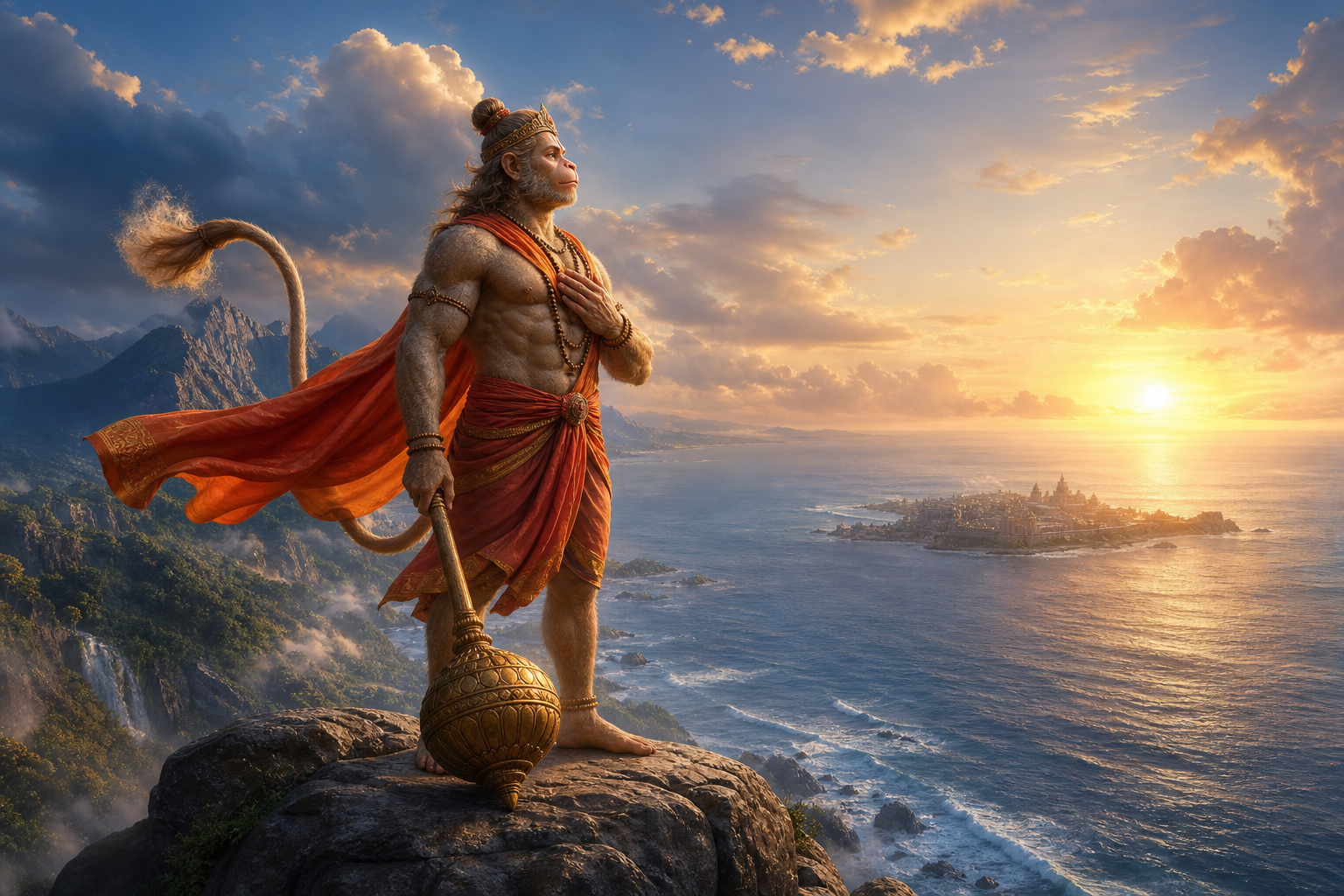
You have probably encountered two very different ways of speaking about Hanuman. One gives you lists of divine boons and astonishing abilities. The other gives you lively stories in which Lanka burns, Ravana is humiliated, and even his ten beards become part of the joke. If you are trying to understand which details belong to which Ramayana, a single list will not help.
A better approach is to separate three questions: What can Hanuman do? What directs those abilities? Where does a particular episode belong in the wider Ramayana tradition? Once you make those distinctions, the variations stop looking like contradictions. They begin to reveal how Dharmic storytelling preserves a moral center while allowing different communities to illuminate it in different ways.
Hanuman’s greatest power is directed power
Hanuman’s abilities are extraordinary, but the Ramayana does not ask you to admire raw force in isolation. Ravana also possesses immense strength, learning, authority, and unusual capacities. The decisive distinction is direction. Ravana bends power toward possession and self-exaltation. Hanuman places power in the service of Rama, Sita, and dharma.
This is why a catalogue of Hanuman’s powers can be accurate yet still miss the character. His strength matters because he can restrain it. His speed matters because he carries out a sacred mission. His ability to alter his form matters because he adapts himself to the needs of the moment. His courage matters because it remains answerable to devotion.
- Strength becomes protection. Hanuman does not use force merely to establish that he is stronger than an opponent. He uses it when the mission requires obstacles to be overcome.
- Movement becomes purposeful action. The child who can leap toward the sun becomes the servant capable of crossing an apparently impossible distance for Rama’s cause.
- Change of form becomes adaptability. Greatness is not always expressed by becoming visibly larger. Hanuman can make himself inconspicuous when secrecy, observation, or a gentle approach is required.
- Intelligence becomes discernment. Finding Sita is not simply a physical achievement. Hanuman must observe carefully, identify her correctly, choose when to approach, and speak without deepening her fear.
- Courage becomes disciplined resolve. He can act boldly in hostile territory without mistaking recklessness for bravery.
When you teach Hanuman’s powers to a child, discuss them in these pairs: ability and purpose. Do not stop at the claim that Hanuman could become vast or cross the ocean. Ask why he did so, why he sometimes remained small, and whose welfare governed his choice. That second question turns a marvellous episode into ethical instruction.
The childhood boons explain capacity, not character
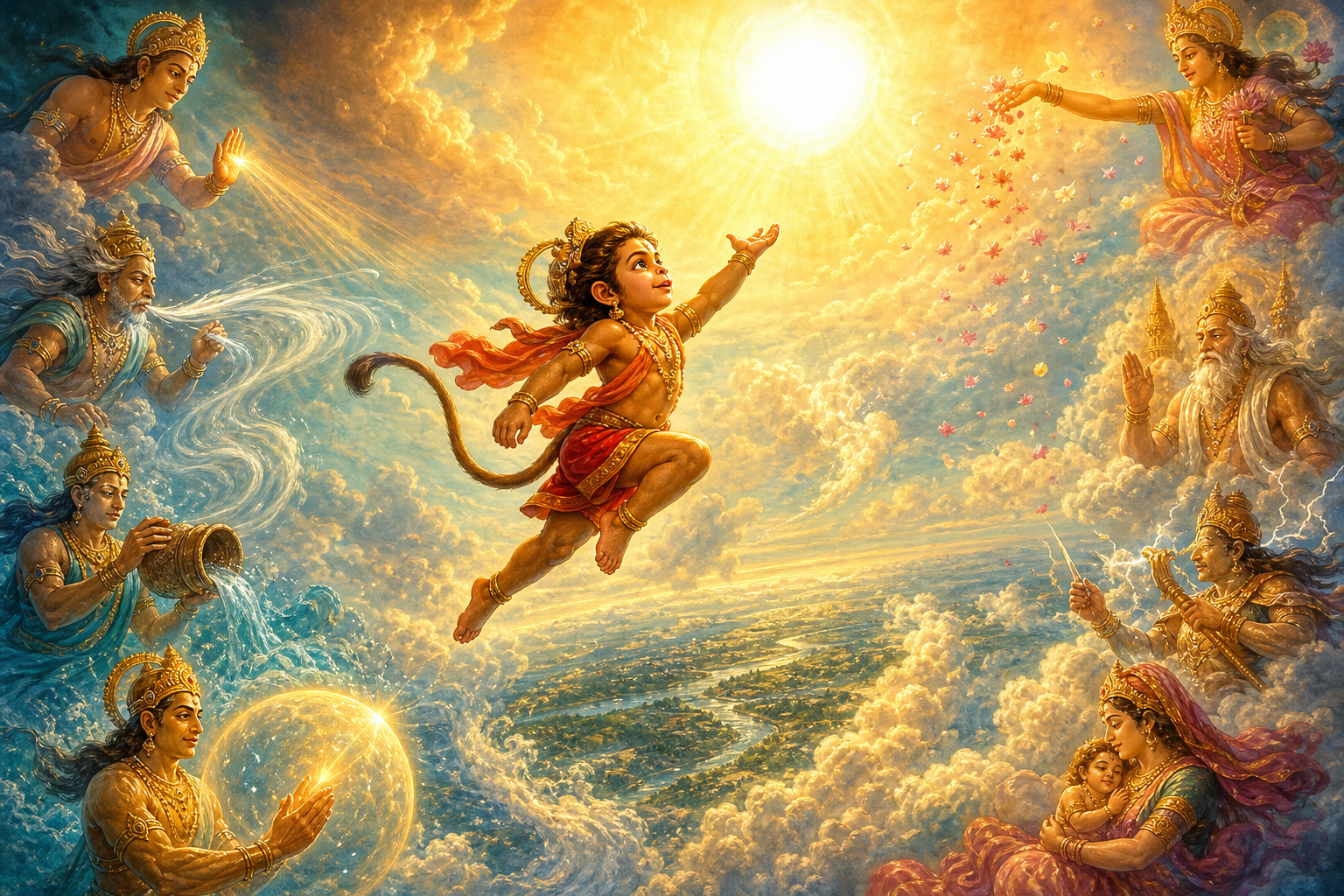
The familiar childhood sequence begins when Hanuman mistakes the sun for a fruit, leaps into the sky, and is struck by an alarmed Indra. Traditions associated with the Kishkindha Kanda and Uttara Kanda connect this event with the divine boons that help account for Hanuman’s extraordinary capacities.
The scene establishes several things at once. Hanuman’s daring is present before he receives a mission from Rama. His reach exceeds ordinary limits even in childhood. The divine response then places that astonishing vitality within a larger cosmic order. The boons do not manufacture devotion, however. They provide capacity. Hanuman’s later choices reveal what that capacity is for.
This distinction prevents a common misreading. Hanuman is not great merely because the devas made him difficult to defeat. If supernatural protection alone created moral greatness, every powerful being in the Ramayana would deserve the same reverence. Hanuman becomes exemplary because bhakti, discernment, humility, and action remain joined.
You should also be cautious with any infographic claiming to give the one universally complete list of Hanuman’s boons. Revered tellings can organize, name, or emphasize the gifts differently. A list may be complete for the textual tradition it follows without being an exhaustive index of every Ramayana tradition. Before repeating one, check whether it identifies its textual home.
It also helps to avoid calling every admirable quality a boon. Strength, protection, speed, learning, eloquence, courage, devotion, and self-command are related in Hanuman’s character, but they are not automatically interchangeable categories. Ask whether a telling explicitly presents a capacity as a divine gift, displays it through action, or praises it as a cultivated virtue. That small distinction makes your reading more precise.
Why Lanka’s fire becomes comic justice in folk tellings
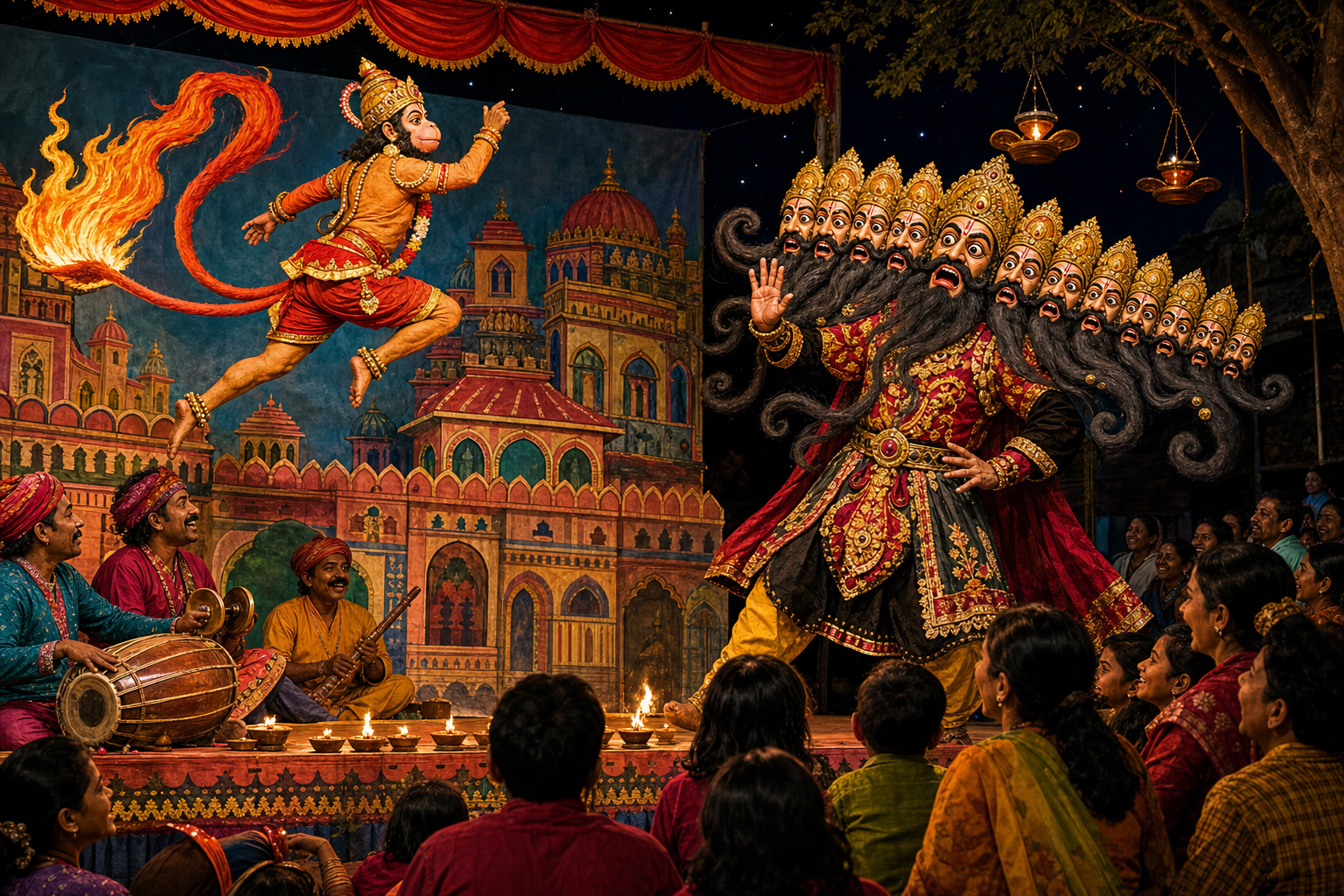
The burning of Lanka is already a dramatic reversal. Ravana’s court attempts to degrade Hanuman through his tail, yet the punishment becomes the means by which Lanka is set ablaze. The intended humiliation returns to the aggressor. Hanuman leaves not as a defeated captive but as the servant who has exposed the vulnerability of Ravana’s apparently unassailable capital.
The Valmiki Ramayana presents the destruction with poetic grandeur. Regional elaborations associated with the Ananda Ramayana and Bhavartha Ramayana can add a different emotional register. In one humorous development, the fire reaches Ravana’s ten beards. Imperial menace is punctured by an undignified image: the ruler who ordered mockery now becomes the object of laughter.
That laughter is not an accidental decoration. It performs moral work. Ravana’s pride depends on controlling the scene, reducing Rama’s messenger to a spectacle, and making punishment demonstrate royal supremacy. The comic variation reverses every part of that intention. Hanuman controls the fire’s narrative meaning, Ravana becomes the spectacle, and royal vanity is made ridiculous.
Comic justice can sometimes communicate adharma’s weakness more immediately than solemn description. A terrifying ruler expects fear to confirm his authority. Laughter withdraws that confirmation. It tells the listener that apparent grandeur has already begun to collapse, even before the final battle.
You need not choose between respecting Valmiki and appreciating a humorous regional telling. You do need to label them honestly. The beard episode should not be presented as though every Ramayana contains it, but neither should it be discarded simply because it is an elaboration. Its value lies in the way it interprets the moral reversal already present in Hanuman’s Lanka mission.
Variation does not mean that every detail has the same status
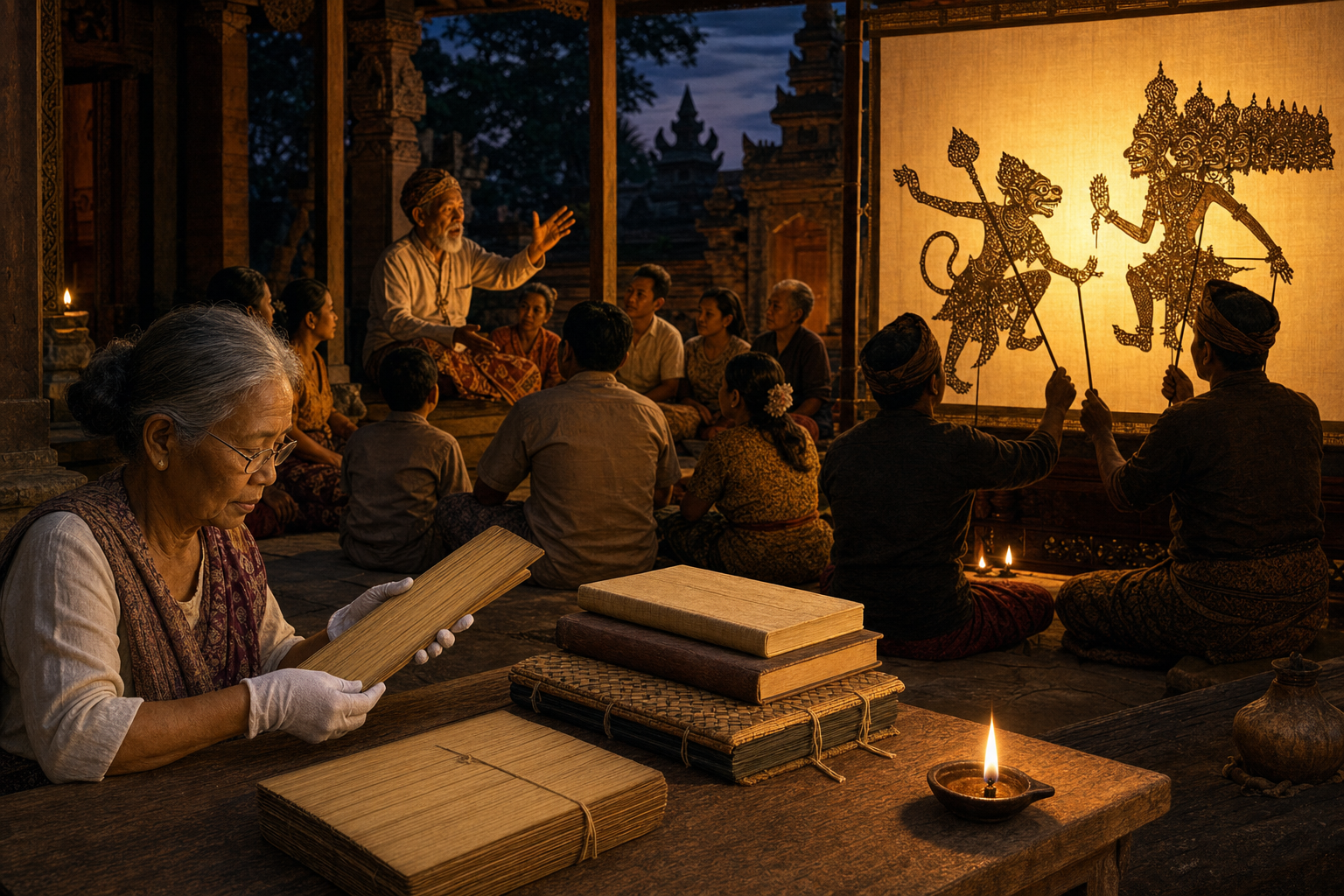
People often fall into one of two errors when they meet a Ramayana variation. The first is to declare the unfamiliar detail false because it is absent from the version they know. The second is to blend every detail into a single composite narrative and attribute the whole thing vaguely to the Ramayana. Both approaches erase useful distinctions.
A living narrative tradition can preserve a stable moral structure while varying imagery, tone, emphasis, and dramatic detail. Hanuman still enters hostile Lanka in Rama’s service. Ravana still tries to humiliate him. Fire still becomes an instrument of reversal. A folk telling can then sharpen the humiliation through the burning of Ravana’s beards without changing whose conduct represents dharma and whose represents arrogance.
Yet shared moral meaning does not make provenance irrelevant. Valmiki’s account, a later Sanskrit composition, a vernacular devotional retelling, and an orally transmitted family story do not have identical textual histories. Saying so is not disrespectful. It is the condition for appreciating each one on its own terms.
Use specific language when you pass a story on:
- Say, In the Valmiki Ramayana, when the detail belongs there.
- Say, In the Ananda Ramayana or In the Bhavartha Ramayana, when that is the identified textual setting.
- Say, In a humorous folk telling, when the exact literary origin is uncertain or the story is known through oral circulation.
- Say, In our family or regional tradition, when that is genuinely how you received it.
This vocabulary lets you preserve both reverence and accuracy. It also protects regional traditions from being flattened into anonymous embellishments. A variant becomes easier to value when you know where it lives, how it is told, and what feature of dharma it brings into focus.
A practical way to read any new Hanuman story
When a striking Hanuman story appears in a video, discourse, children’s book, or family conversation, you can evaluate it without becoming either credulous or dismissive. Use this five-step method.
- Write down the exact claim. Do not begin with the vague question, Is this in the Ramayana? Ask whether the claim concerns a boon, a physical act, a line of dialogue, or a humorous addition.
- Identify the named telling. Look for Valmiki Ramayana, Ananda Ramayana, Bhavartha Ramayana, another regional work, or an oral tradition. If no telling is named, keep the attribution general.
- Separate the narrative spine from the variable detail. In the Lanka episode, Hanuman’s mission, captivity, burning tail, and reversal form the broad structure. Ravana’s blazing beards are a comic elaboration within a particular stream of retelling.
- Ask what the variation accomplishes. Does it magnify devotion, make pride ridiculous, explain an ability, bring the story into a local idiom, or make a moral relation easier to remember?
- Retell it with its label attached. A precise introduction takes only a few words: In one humorous folk Ramayana tradition. Those words preserve the story without falsely universalizing it.
Key takeaways
- Hanuman’s powers become spiritually meaningful because bhakti and discernment govern their use.
- The childhood boons explain extraordinary capacity; they do not by themselves explain Hanuman’s moral greatness.
- Different tellings may present or emphasize the boons differently, so an exact list needs an identified textual basis.
- The burning of Ravana’s ten beards is best understood as comic moral reversal in a regional or folk stream, not as a detail found uniformly in every Ramayana.
- Respect for a living tradition and care about textual provenance belong together.
The next time you encounter an unfamiliar Hanuman story, ask two questions before accepting or rejecting it: Where does this version belong, and what does its variation help you see? In the best folk tellings, the added laughter does not diminish Hanuman’s power. It shows why power governed by seva can defeat an arrogance that takes itself far too seriously.
References
- Hindu Blog – When Ravana’s Ten Beards Blazed: The Comic Justice of Hanuman’s Lanka Visit
- Hindu Blog – Boons Hanuman Received: Complete List and Their Significance
