
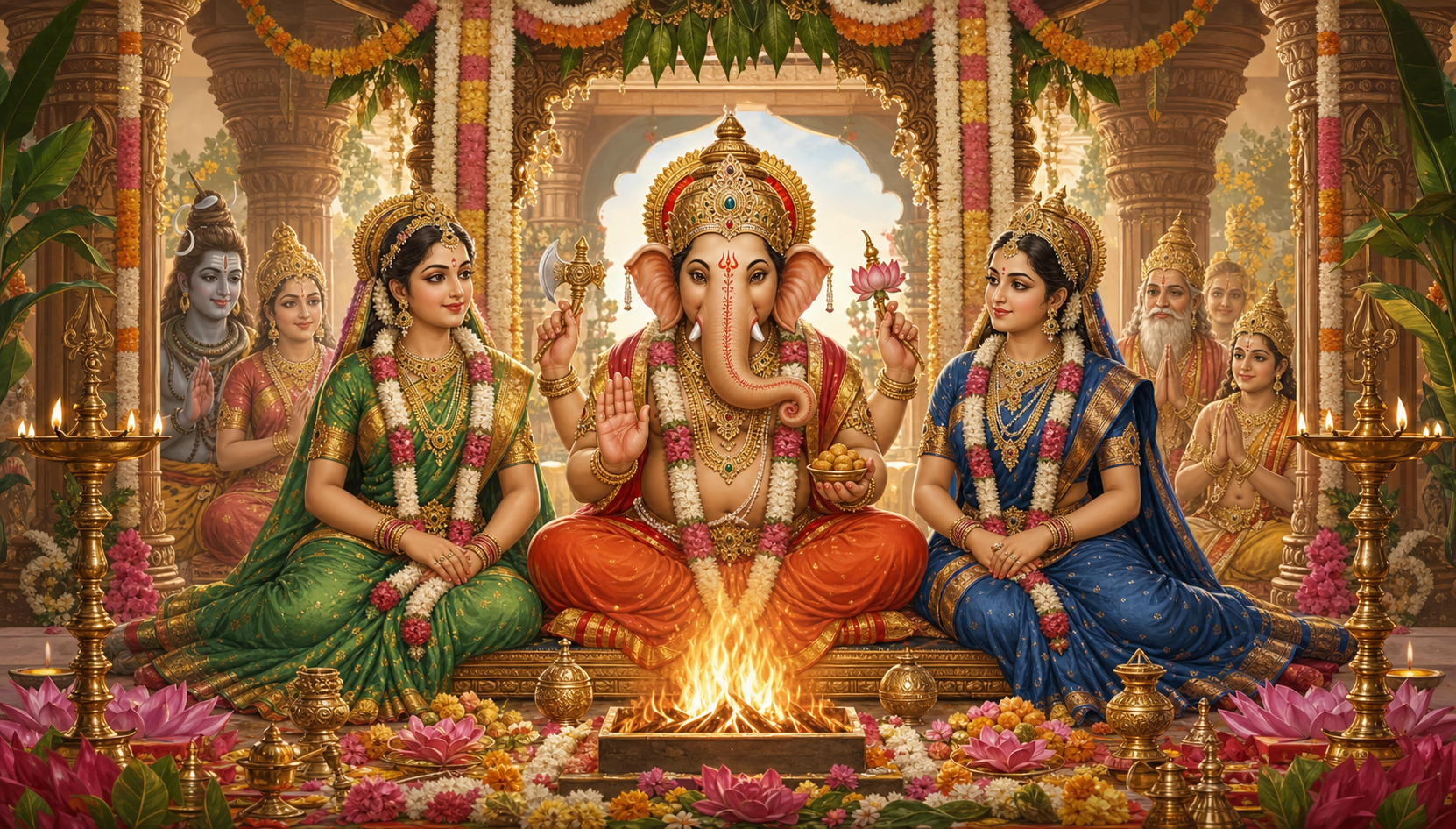
Ganesha’s marriage to Siddhi and Buddhi is best read as more than an isolated divine wedding. Across the supplied accounts, it becomes a compact exploration of how discernment, reverence and effective action belong together.
This approach also clarifies why Ganesha can be married in one tradition, accompanied by differently named consorts in another, and worshipped as a Brahmachari elsewhere. The accounts become more intelligible when each textual or regional setting is allowed to express its own theological emphasis.
The decisive journey redefines what it means to know the world

Both the DharmaRenaissance account and the HinduPad account locate the central narrative in the Rudra-samhita’s Kumara-khanda of the Shiva Purana. They associate the contest and wedding with Chapters 19 and 20 in commonly available arrangements, while warning that numbering can differ between editions. The section and narrative setting are therefore more dependable identifiers than chapter numbers alone.
In the reported narrative, Shiva and Parvati must decide which of their two sons will marry first. They declare that priority will go to the son who travels around the earth and returns first. Karttikeya immediately departs on his peacock, responding through speed, confidence and direct effort. Ganesha, whose vehicle is a mouse, remains behind to consider what the command means.
Ganesha’s answer is ceremonial rather than merely verbal. The two reports describe him bathing, preparing seats for his parents, worshipping them and completing seven clockwise circumambulations around them. He then explains that reverently circling one’s parents carries the significance of circling the world and visiting sacred places. Shiva and Parvati accept the reasoning and acknowledge the intelligence with which he has addressed the challenge.
The episode does not oppose work to clever avoidance. Ganesha performs his act openly, grounds it in sacred reasoning and accepts ritual obligations rather than dismissing them. Karttikeya understands the world through geographic movement; Ganesha interprets it through relationship, origin and duty. The contrast is between two valid capacities, although the story gives priority to the capacity that understands a task before acting upon it.
The wedding gives personal form to discernment and attainment
After Ganesha’s completion of the challenge is accepted, Prajapati Vishvarupa offers his daughters Siddhi and Buddhi in marriage. Both supplied reports identify Vishvarupa as their father in this Shiva Purana passage. This corrects a common conflation created by the narrative frame: Brahma recounts the events to Narada, but the recurring indication that Brahma is speaking does not make him the brides’ father.
The accounts describe Shiva and Parvati as welcoming the proposal. Vishvakarman arranges the celebration, and deities and sages attend. The emphasis rests on auspiciousness, family participation and the divine qualities of the brides rather than on a modern romantic courtship. The HinduPad report also observes that the brief passage supplies no speeches in which Siddhi and Buddhi discuss the proposal. A source-conscious retelling should not turn that textual silence into invented dialogue.
The names reveal why this union is integral to the preceding contest. Buddhi denotes intelligence, understanding and the discerning faculty that judges among possible courses of action. Siddhi denotes accomplishment, fulfillment, successful attainment or perfection; in some specialized spiritual settings, it can also refer to an extraordinary capacity. Ganesha displays Buddhi when he interprets the challenge and Siddhi when that understanding reaches an accepted completion.
The marriage can therefore be read as a theology of responsible action. Discernment without attainment remains an unrealized possibility, while attainment without discernment can efficiently produce the wrong result. Joined to Ganesha, Siddhi and Buddhi represent the coordination of right judgment, appropriate means and completed work.
Kshema and Labha extend the symbolism beyond the wedding
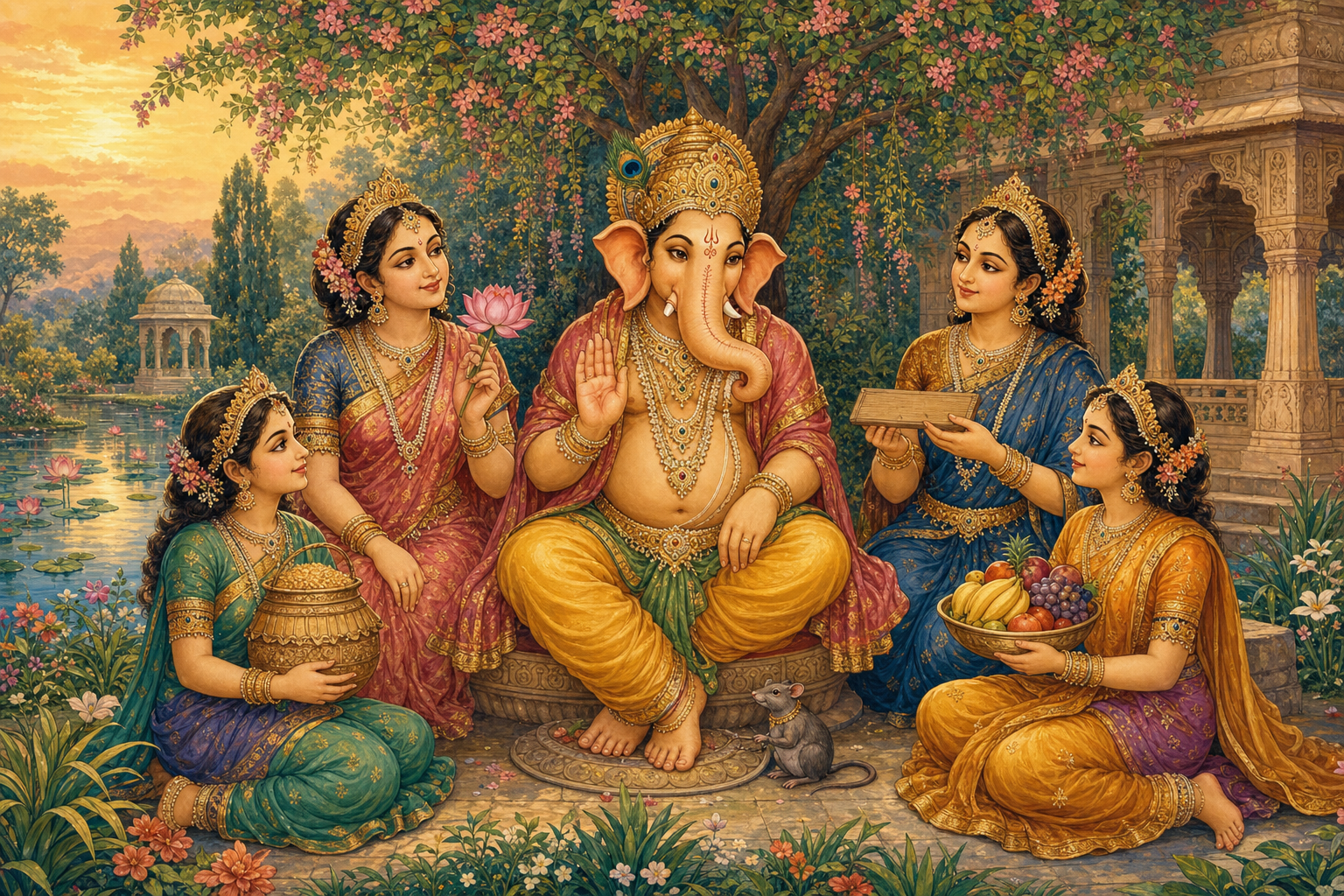
Both reports state that the Shiva Purana passage assigns two sons to Ganesha’s household: Siddhi gives birth to Kshema, and Buddhi gives birth to Labha. They explain Kshema through ideas such as welfare, security, preservation and well-being, while Labha denotes gain, benefit or acquisition. Popular summaries may reverse or otherwise alter these relationships, but that is not the lineage reported for this passage.
These names create a sequence rather than an unconditional promise of wealth. Wise judgment guides action; action reaches sound completion; beneficial results arise; and what is worthwhile can then be preserved. Material prosperity can fall within that semantic field, but reducing the family to a formula for effortless riches removes the ethical and intellectual preparation on which the narrative places its attention.
This sequence helps explain Ganesha’s association with consequential beginnings. The story does not suggest that a beginning succeeds merely because it has been initiated. It presents success as something made durable by understanding the problem, selecting fitting means and preserving the resulting good.
Different consorts and contest prizes belong to different traditions
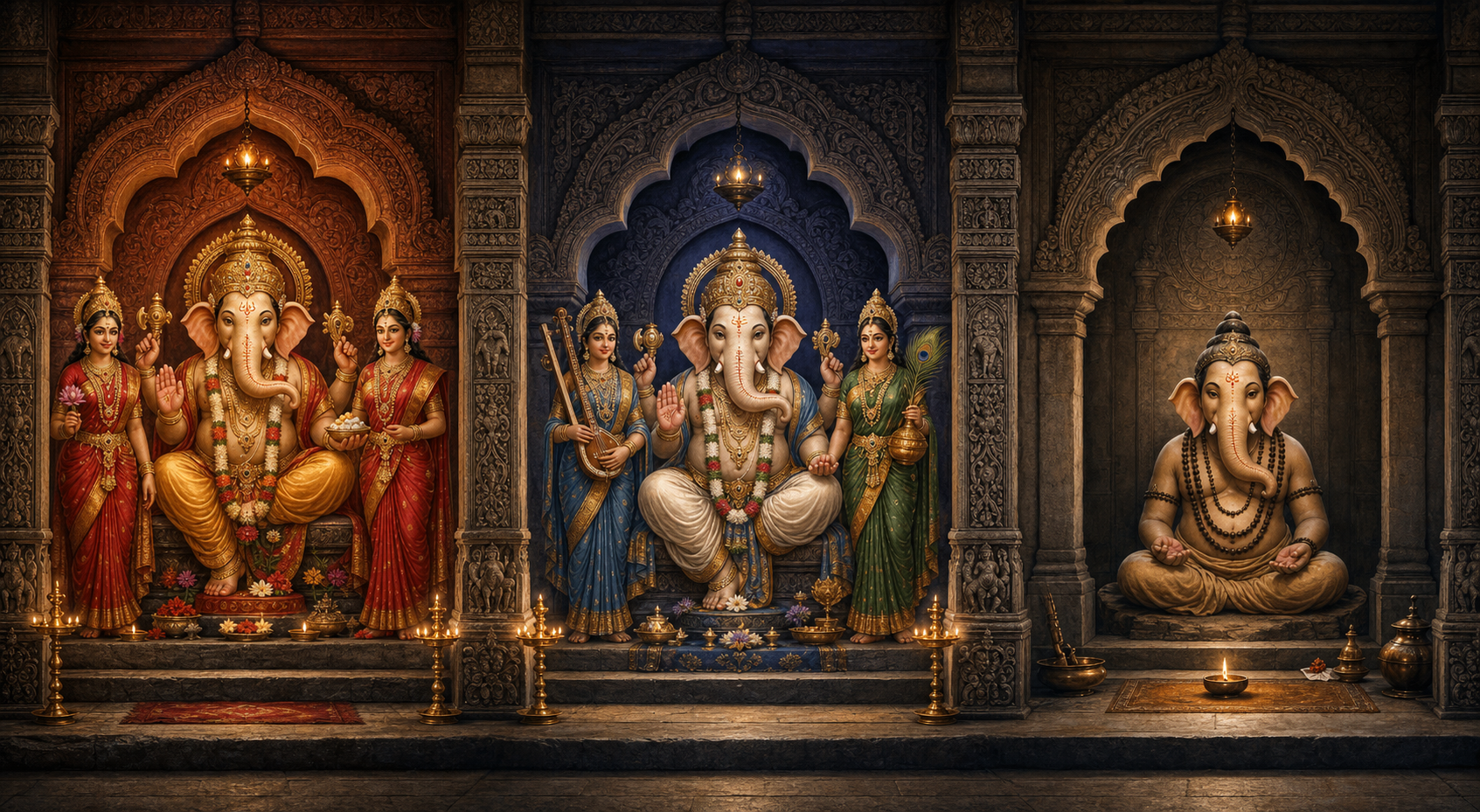
The supplied articles caution against constructing a single biography from every Ganesha tradition. Some representations pair him with Siddhi and Buddhi, while others prominently name Riddhi and Siddhi. The reports distinguish Riddhi, associated with prosperity, increase or flourishing, from Buddhi, associated with intelligence and judgment. The pairings overlap in their auspicious significance without making the names interchangeable.
Other retellings preserve the same memorable act of Ganesha circling his parents but make a fruit of knowledge, a necklace or another precious object the prize. In the Shiva Purana marriage account described by both sources, however, the declared reward is priority in marriage. Combining the prize from one version with the wedding from another may produce a familiar devotional story, but it no longer represents the cited passage precisely.
The same care applies to marital status. The reports acknowledge traditions in which Ganesha is revered as a lifelong Brahmachari, despite his wedding in this Shaiva narrative. They also report that Karttikeya returns from his physical journey, feels wronged after learning of Ganesha’s marriage and withdraws to Mount Krauncha, remaining a bachelor within this particular account. The HinduPad article contrasts that conclusion with Tamil traditions that venerate Murugan with Valli and Devasena.
Such differences need not be treated as failed attempts to preserve one uniform chronology. Puranic narration, regional devotion, temple iconography and oral storytelling can use family relationships to illuminate different qualities of a deity. Precision comes from naming the version under discussion, not from erasing the plurality.
Key takeaways for a careful reading
- The Shiva Purana account makes priority in marriage, rather than a fruit or necklace, the reward for circling the earth.
- Ganesha’s solution integrates ritual worship, filial duty and reasoned interpretation; it is not presented as a concealed shortcut.
- Siddhi and Buddhi personify accomplishment and discernment, while Kshema and Labha extend the pattern toward well-being and beneficial gain.
- Riddhi-Siddhi pairings and Brahmachari portrayals should be understood within their own devotional settings rather than forced into the cited wedding narrative.
Future retellings can preserve both devotional richness and textual clarity by identifying their source tradition before explaining its symbolism. That practice leaves room for regional variation while allowing the marriage of Siddhi and Buddhi to retain its distinctive lesson: understanding becomes fruitful when it is carried through to a worthy and sustainable result.
References
- DharmaRenaissance Blog – Lord Ganesha’s Marriage to Siddhi and Buddhi: The Powerful Meaning Revealed
- HinduPad – Lord Ganesha’s Marriage to Siddhi and Buddhi: The Triumph of Wisdom and Success