
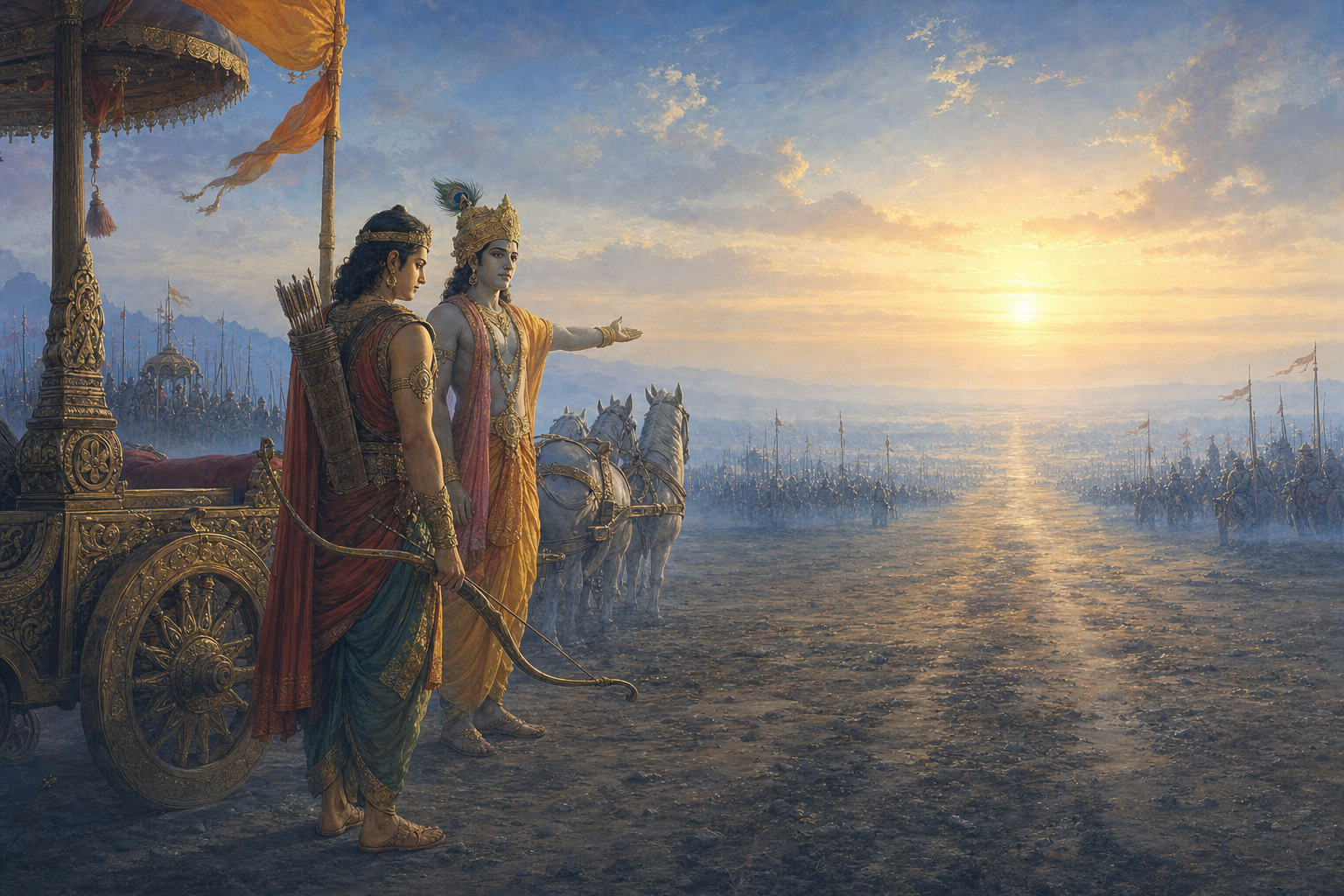
Vairagya is easily mistaken for a reduction of interest, ambition, or effort. The Bhagavad Gita presents a more demanding possibility: a person may care deeply about a duty while refusing to make peace of mind, identity, or moral judgment dependent on a preferred result.
Read alongside the energy described as Josh, Vairagya becomes a discipline for purposeful action rather than an escape from it. The practical question is not whether to choose zeal or detachment, but how to direct effort without becoming possessed by its outcome.
The false choice between caring and letting go

The two source articles agree that Josh and Vairagya perform different but complementary functions. Josh is an ordinary term for vigor, courage, enthusiasm, and readiness to act; it is not presented as a technical category of the Gita. Vairagya more specifically concerns freedom from craving, possessiveness, and compulsive dependence on experiences or results. In Sri Sri Ravishankar’s interpretation, both capacities are necessary. This shared reading appears in the DharmaRenaissance account and the HinduPad account.
This distinction separates Vairagya from two attitudes with which it is often confused. Indifference treats the object of action as unimportant; avoidance retreats because engagement is difficult. Vairagya permits the matter to remain important while loosening fear, vanity, resentment, and the demand for personal validation. It changes the actor’s relationship to responsibility rather than abolishing responsibility.
The balance is therefore situational, not a fixed compromise. A lethargic or evasive mind may require greater activation. An agitated mind, already expending abundant energy but unable to tolerate uncertainty, may require greater release. Spiritual maturity lies partly in recognizing which correction is needed.
Arjun’s recovery moves through courage, perspective, and choice

Arjun’s condition at Kurukshetra gives this synthesis its ethical weight. The HinduPad article describes a crisis involving relatives, teachers, respected elders, possible social disorder, moral guilt, and revulsion toward violence, accompanied by visible physical distress. His paralysis is consequently presented as more than cowardice or lack of motivation.
Both reports interpret the opening instruction in Bhagavad Gita 2.2-3 as an attempt to restore Arjun’s agency. The later appeal to his role, courage, honor, and responsibility in 2.31-37 continues that work. The aim, in this reading, is to make deliberation and choice possible again. Such a targeted intervention should not be converted into a general permission to shame anyone experiencing fear or distress; the narrative addresses a particular person, relationship, and conflict.
Courage alone is not the completed teaching. The frame subsequently widens beyond reputation, victory, and immediate loss. Both articles discuss the phrase Anityam asukham lokam in Bhagavad Gita 9.33 as a recognition that an impermanent world cannot provide unchanging security. They also note that its textual movement is toward devotion, not toward nihilism or contempt for worldly responsibilities.
The DharmaRenaissance article adds an important interpretive qualification: the challenges to despondency and the statement in 9.33 do not appear as one uninterrupted sequence. Sri Sri Ravishankar’s explanation gathers teachings from different parts of the Gita into a thematic pattern. That pattern is pedagogically useful when it is not mistaken for the literal order of every cited passage.
Arjun is eventually directed toward his battlefield duty, but the DharmaRenaissance source cautions against detaching that command from the Mahabharata’s concrete setting. The transferable principle is disciplined engagement with a legitimate duty, not the conversion of a context-specific martial instruction into a slogan for aggression.
Non-attachment relocates responsibility rather than reducing it

Bhagavad Gita 2.47 supplies the most direct bridge between effort and inward freedom in both reports. Their reading places intention, preparation, discernment, ethical conduct, and effort within the practitioner’s field of responsibility, while denying total command over the fruit. The verse’s warning against attachment to inaction closes an important loophole: uncertainty about results does not excuse neglect.
Before action: identify the duty and available choices
Vairagya does not make planning unnecessary. It allows a person to assess purpose, means, foreseeable consequences, competence, and limits without forcing the decision to guarantee emotional security. A desired result may guide preparation without becoming an unconditional demand placed upon reality.
During action: keep preference from governing judgment
The equanimity associated with action in Bhagavad Gita 2.38 and 2.48 does not erase the practical difference between gain and loss or victory and defeat. It prevents attraction and fear from monopolizing attention. On this reading, steadiness is a form of competence: the work can be adjusted according to evidence rather than according to panic, pride, or anticipated applause.
After action: evaluate without turning results into identity
An outcome can still be measured, welcomed, regretted, and learned from. What Vairagya removes is the claim that one result establishes the actor’s total worth. Success need not authorize conceit, and failure need not become a final judgment on the person. This preserves the capacity to improve and act again.
The same architecture appears in the DharmaRenaissance source’s discussion of Bhagavad Gita 6.35, where sustained practice is joined with Vairagya in the discipline of a restless mind. Practice supplies repetition and continuity; dispassion weakens the attractions and aversions that repeatedly divert attention.
A practical diagnosis begins with the source of paralysis

The DharmaRenaissance article applies the teaching to a student overwhelmed by an examination, a professional dependent on recognition, and a caregiver or social worker approaching resentment and exhaustion. These examples point to a useful diagnostic distinction: outwardly similar inaction can arise from insufficient energy, excessive attachment, or both.
When greater zeal is needed
Josh is the corrective when a legitimate responsibility is acknowledged but effort never begins, discomfort is repeatedly used as a reason to withdraw, or discouragement has obscured an existing capacity. The relevant response is purposeful activation: recover the reason for acting, identify the next available responsibility, and direct energy toward it.
When greater dispassion is needed
Vairagya is the corrective when effort is already intense but thought is dominated by recognition, comparison, fear of failure, or the fantasy of controlling every consequence. The task is not necessarily to reduce standards. It is to release the claim that only one outcome can justify the work or secure the actor’s identity.
External inactivity cannot by itself establish Vairagya. As the DharmaRenaissance source observes, someone may leave a project while remaining inwardly consumed by fantasy, regret, or resentment. Conversely, vigorous action may coexist with non-possessiveness. The decisive evidence lies in what governs the mind, not merely in how busy the body appears.
Key takeaways
- Vairagya is freedom from compulsive attachment, not indifference to people, standards, or consequences.
- Josh contributes courage and sustained effort, but it requires direction by dharma and restraint from egoic fixation.
- The Gita’s teaching on the fruits of action limits claims of control while preserving responsibility for preparation, conduct, and effort.
- Equanimity belongs before, during, and after action; it protects judgment and keeps either success or failure from becoming a total verdict on the self.
The next difficult duty can therefore become a field of practice: energy may be applied fully, consequences faced honestly, and the future left open without surrendering either responsibility or inner freedom.
References
- DharmaRenaissance Blog — Vairagya and Josh: The Bhagavad Gita’s Powerful Formula for Fearless Action
- HinduPad — Vairagya and Josh: The Bhagavad Gita’s Powerful Formula for Fearless Action