
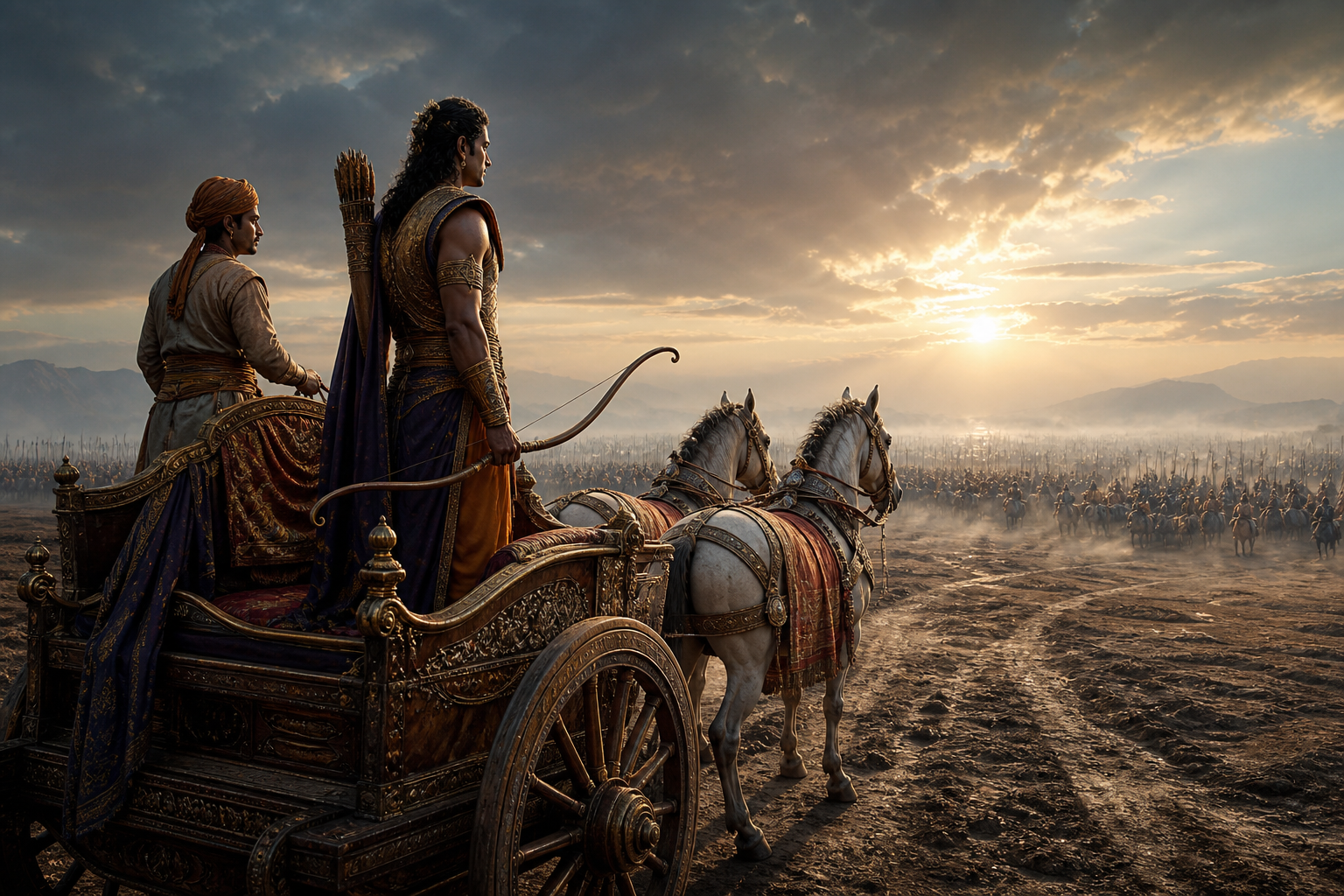
When you meet Pārtha in the Bhagavad Gita or maharatha in the Mahabharata, it is easy to read the first as a decorative alias and the second as an ancient power level. Both readings miss what the language is asking you to notice.
An epic name recalls the identity from which a person must act. A warrior rank assesses the responsibility that person can carry. Dharma then judges how that capacity should be used. Keep those three questions separate—who am I here, what can I actually handle, and what is the right use of that ability—and the vocabulary of the epics becomes a practical discipline for decisions under pressure.
Read the name before judging the warrior
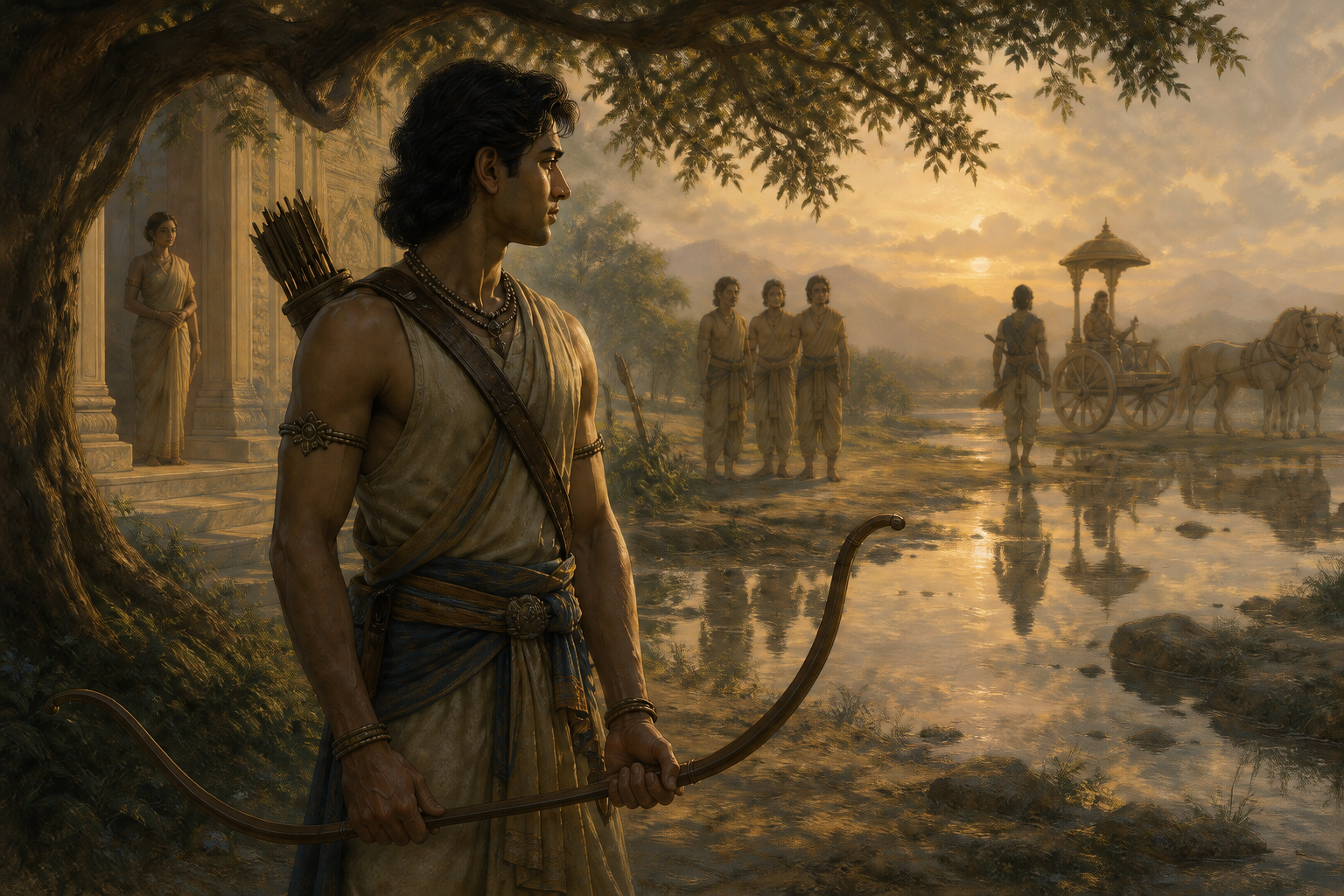
In Bhagavad Gita 1.25, Sri Krishna calls Arjuna Pārtha as the warrior looks upon the assembled Kurus, including elders such as Bhīṣma and Droṇa. Pārtha means the son of Prithā, another name for Kunti. The address therefore places Arjuna inside a maternal lineage and a web of relationships at precisely the moment when battle might reduce everyone to allies, enemies, and targets.
That does not settle Arjuna’s dilemma for him. It makes the dilemma harder to evade. He is not an isolated fighter free to measure success by victory alone. He is a son, relative, student, warrior, and moral agent. His relationships do not automatically tell him which action is right, but they reveal who will bear its consequences.
This is how you can read Arjuna’s other appellations as well. When Pārtha, Kaunteya, Dhananjaya, or Gudākeśa appears, do not mentally replace it with the generic label Arjuna and move on. Ask three questions: Who is addressing him? Which aspect of him is being brought forward? What decision or instruction follows? The shift in name often tells you what Arjuna must remember before he can hear what comes next.
One distinction matters here. Pārthiva is a related Sanskrit word associated with the earth, earthliness, and a prince or king, but it is not the epithet used for Arjuna in Gita 1.25. Pārtha and pārthiva can be paired symbolically—the child of a lineage and the earth-bound person entrusted with responsible rule—but they should not be treated as interchangeable words. That symbolic pairing is most useful when it turns sovereignty inward: before trying to command events, you must be able to govern attention, impulse, speech, and conduct.
Do not confuse a warrior rank with a moral certificate
The familiar progression from ratha to maharatha to atiratha describes increasing martial capability. It does not mean that every bearer of a higher rank is ethically flawless, nor that technical superiority makes every decision righteous. Rank answers a strategic question: what can this warrior do in battle? Dharma asks a separate question: toward what end, within what limits, and with what responsibility will that power be used?
| Rank | Practical battlefield sense | What to notice ethically |
|---|---|---|
| Ratha | An able chariot-warrior who can perform the martial role competently. | Are the fundamentals steady enough to make the warrior dependable? |
| Maharatha | An exceptional warrior with broad weapons mastery, awareness, and the ability to face multiple threats while supporting allies and formations. | Does excellence protect the larger unit, or merely display personal prowess? |
| Atiratha | A force of unusual skill, endurance, foresight, and command influence whose presence can change the course of a battle. | Can exceptional power become a collective advantage without escaping restraint and accountability? |
These are best read as qualitative assessments of competence, composure, and command. Later interpretive traditions sometimes assign numerical measures to the ranks, but an exact combat ratio should not be presented as a universal epic definition unless a particular commentary or textual tradition is identified. The useful distinction is not an arithmetic contest. It is the movement from capable execution, to exceptional independent performance, to influence over the whole field.
Tradition often places figures such as Bhīṣma, Droṇa, and Arjuna among the highest martial tiers. Their stature, however, does not remove the moral tensions surrounding loyalty, obligation, restraint, and consequence. That is precisely why the Mahabharata remains instructive. It does not let ability perform the work of conscience.
Measure capacity, influence, and ethical direction separately
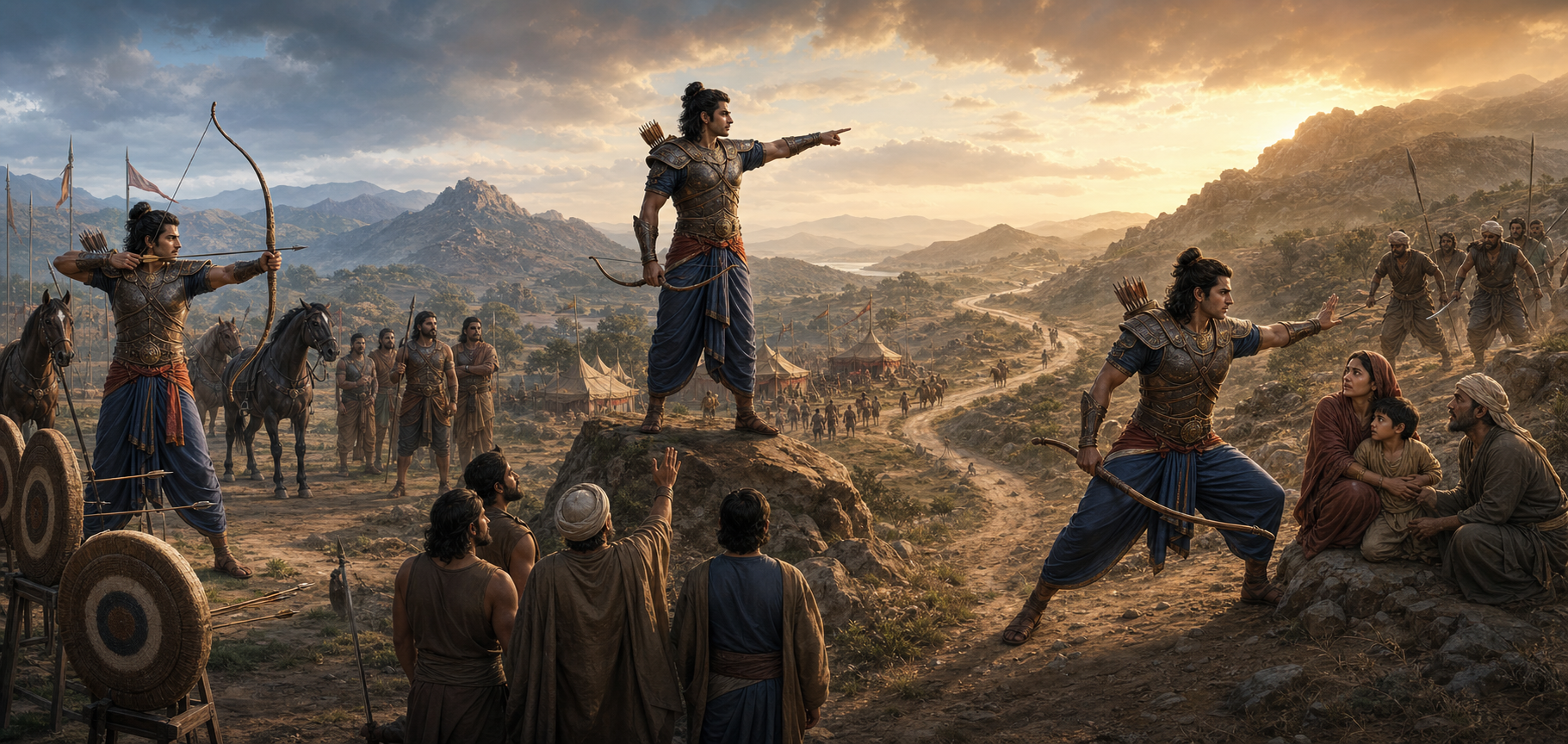
A clear reading of an epic warrior requires three independent assessments. Capacity is what the person can reliably do. Influence is how far the effects of that action travel through a formation, kingdom, family, or institution. Ethical direction is whether the ability serves protection and justice or feeds pride, vengeance, fear, and disorder.
This separation corrects two common mistakes. The first is worshipping competence as though strength were self-justifying. The second is praising good intentions while ignoring whether the person has enough discipline and skill to protect anyone. Untrained virtue can fail at the moment of need; undisciplined power can multiply adharma. Kshatra dharma demands both capability and a rightful governing purpose.
The battlefield of Kurukshetra is a physical conflict, and its martial language should not be dissolved into metaphor. Yet it also provides a compelling map of inner conflict. Before action, competing loyalties, fears, attachments, and duties assemble within the person who must decide. The outer contest and the inner contest are not identical, but the second affects how the first is conducted.
Other Dharmic traditions preserve distinct vocabularies for this problem. Buddhism speaks of kleśas, Jainism of kaṣāyas, and Sikhism warns against haumai and the five thieves. These teachings should not be flattened into one doctrine. They do share a practical insistence that an uncontrolled inner adversary can corrupt outward ability. Self-mastery therefore does not mean timidity or withdrawal. It means refusing to let anger, ego, craving, or fear appoint itself commander.
Use the Pārtha–Atiratha test before a difficult action
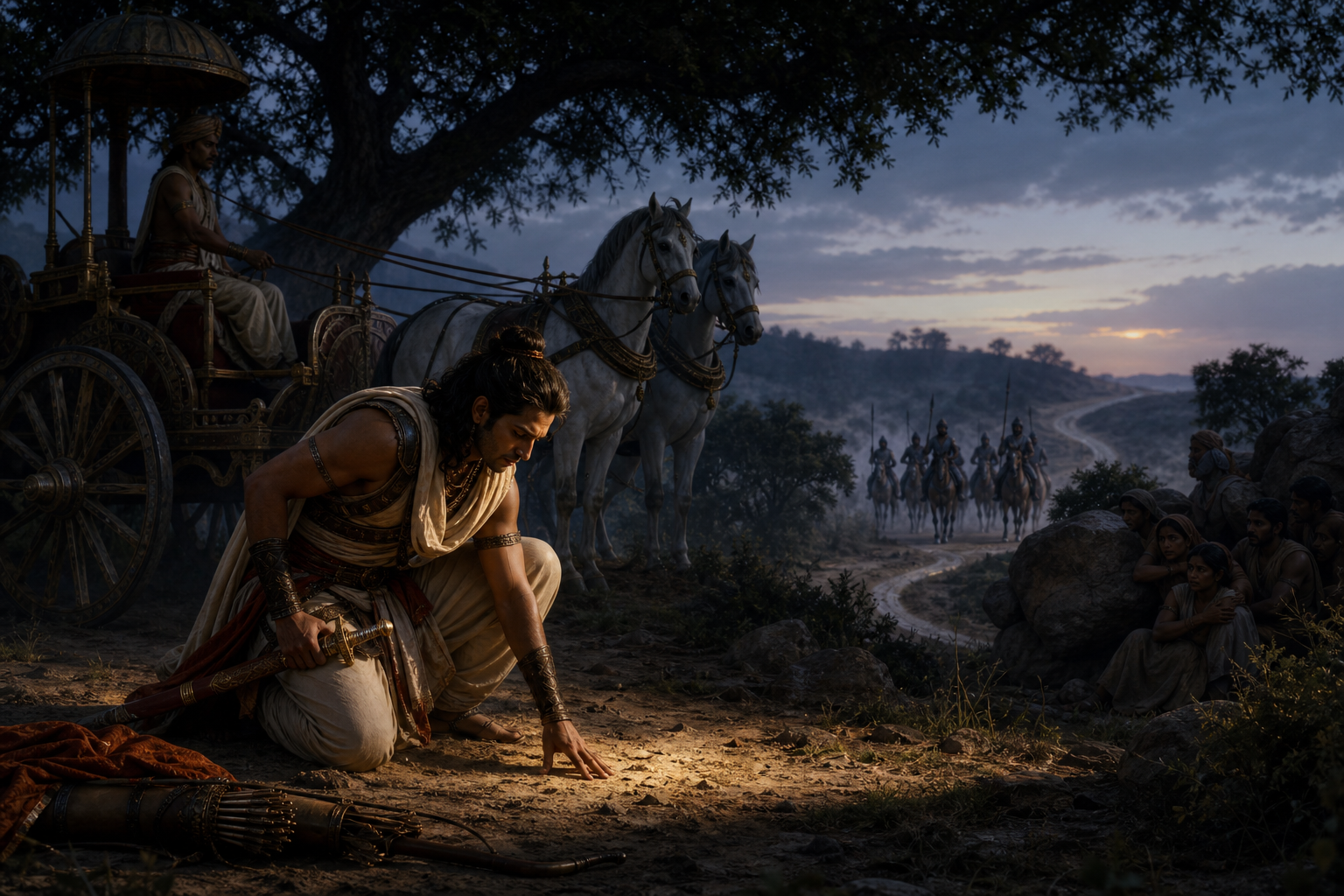
You do not need a battlefield to apply this grammar. Use it when a decision carries conflict, authority, or consequences for other people. The point is not to award yourself an epic title. It is to prevent emotion, status, and competence from collapsing into one flattering story.
- Name the identity that carries the duty. Ask which role is yours in this decision: parent, child, teacher, student, colleague, leader, citizen, or caretaker. Choose the role that creates responsibility, not the label that gives you the most power.
- See the whole field. Identify the people affected, the relationships that will remain after the conflict, the facts you know, and the facts you are merely assuming. This is the Pārtha move: restore human relationship before reducing the situation to winning and losing.
- Size the task honestly. A bounded task may require ratha-like competence. Several moving threats, coordination, and protection of others resemble a maharatha-sized responsibility. A decision that changes the environment for everyone carries atiratha-like influence. If the task is larger than your preparation, seek counsel or support before acting.
- Place a boundary around power. Decide what you will protect, what harm you will refuse, which truth must be spoken, and which impulse must not control the method. Restraint is not an afterthought added once victory is secure; it belongs inside the definition of rightful action.
- Pause, witness, align, and act. Notice the emotional surge without pretending it is absent. Test the intended action against duty and consequence. Then act with enough clarity that the pause does not become an excuse for endless avoidance.
- Review conduct rather than image. Afterward, ask whether you fulfilled the relevant duty, protected those within your care, stayed within the chosen boundary, and corrected new information. Do not ask only whether you looked strong or obtained the outcome you wanted.
Consider a manager who discovers a consequential error made by a colleague. Identity asks the manager to remember both stewardship and relationship. Capacity asks whether the facts have been verified and whether the manager has authority to correct the process. Influence asks who may be harmed if the error continues. Dharma places boundaries on the response: protect those at risk, tell the truth, correct the system promptly, and do not turn necessary accountability into humiliation. The framework does not supply one mechanical answer, but it prevents authority from masquerading as anger.
The same method works in family disagreement. Remembering kinship does not require surrendering a rightful boundary. It changes how you establish it. You can refuse wrongdoing without denying relationship, speak firmly without making cruelty the proof of conviction, and delay a heated reply without abandoning the decision itself.
Key takeaways
- An epic epithet is an interpretive cue. Pārtha recalls Arjuna’s maternal lineage and relational accountability when conflict threatens to reduce people to opposing sides.
- Pārthiva can deepen the symbolism of earthly responsibility and self-rule, but it is not the word used to address Arjuna in Bhagavad Gita 1.25.
- Ratha, maharatha, and atiratha primarily distinguish levels of battlefield capability and influence; exact numerical ratios belong to later interpretive schemes unless a specific tradition is named.
- A high warrior rank establishes capacity, not moral innocence. Dharma still judges purpose, restraint, method, and consequence.
- In your own difficult decisions, separate identity, task size, influence, and ethical direction before choosing an action.
At your next point of pressure, do not begin with the question, “How do I win?” Begin by naming the Pārtha in you—the relationship and duty you must not forget. Then measure the field honestly, bring only the power you can govern, and take the next action within dharma.
References
- DharmaRenaissance Blog — Partha and Pārthiva Revealed: Profound Symbolism of the Mortal Seeker in Gita Chapter 1
- DharmaRenaissance Blog — Maharatha vs Atiratha: Timeless Warrior Ranks, Epic Valor, and Kshatra Dharma
