
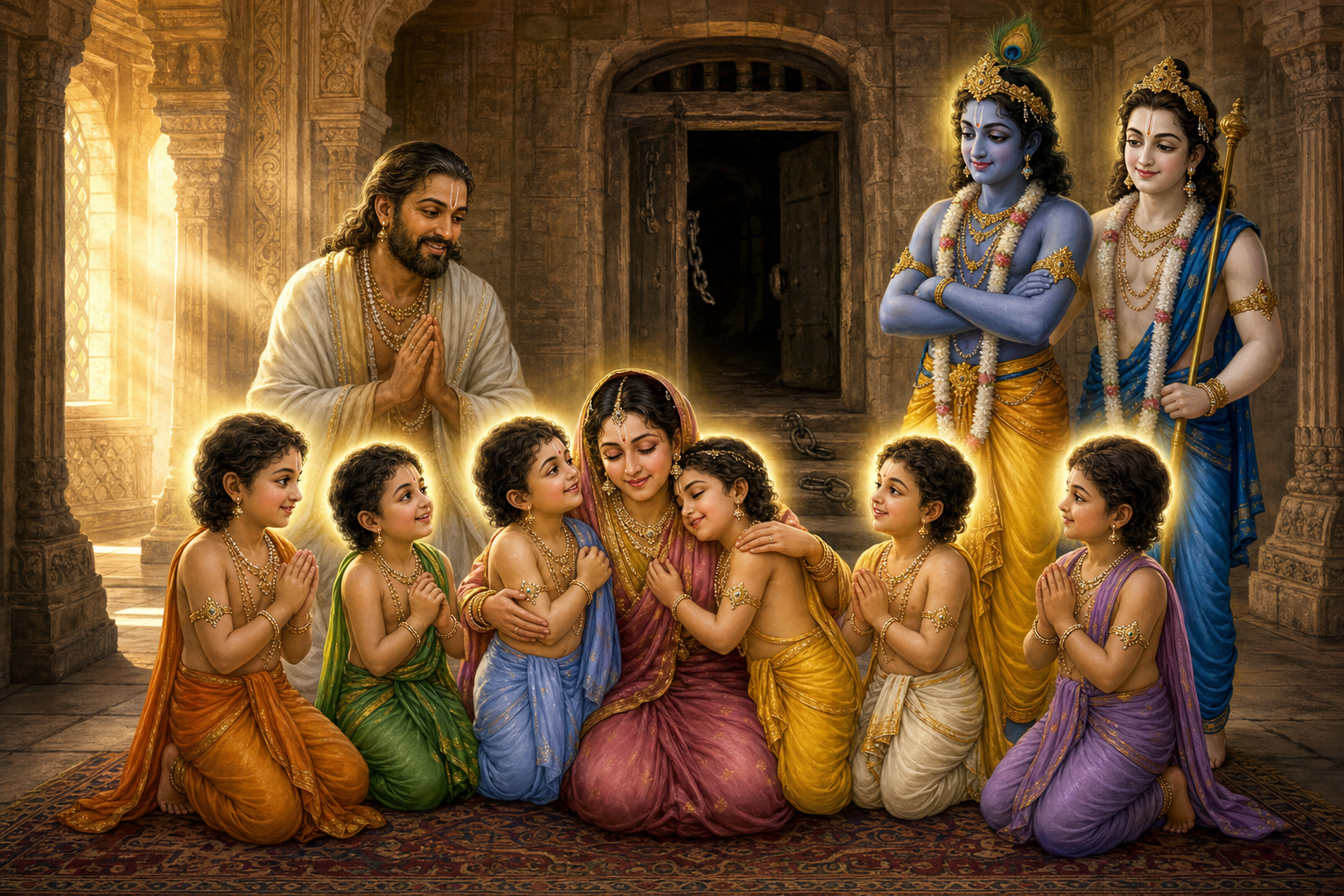
If you have wondered why Krishna did not save Devaki’s first six babies, you are asking the question that a shortened retelling often leaves unanswered. The six can sound like a grim countdown to the eighth child, as though their only purpose were to establish Kamsa’s cruelty before Krishna arrived. But their story continues beyond death, and its ending changes how the entire episode should be understood.
You have to hold two truths together. In Mathura, six defenseless infants suffer a terrible wrong and Devaki endures a mother’s repeated bereavement. At another level, their births complete a karmic history extending beyond that lifetime. The second truth explains the narrative’s larger pattern; it must never be used to belittle the first.
The six sons had a history before Mathura
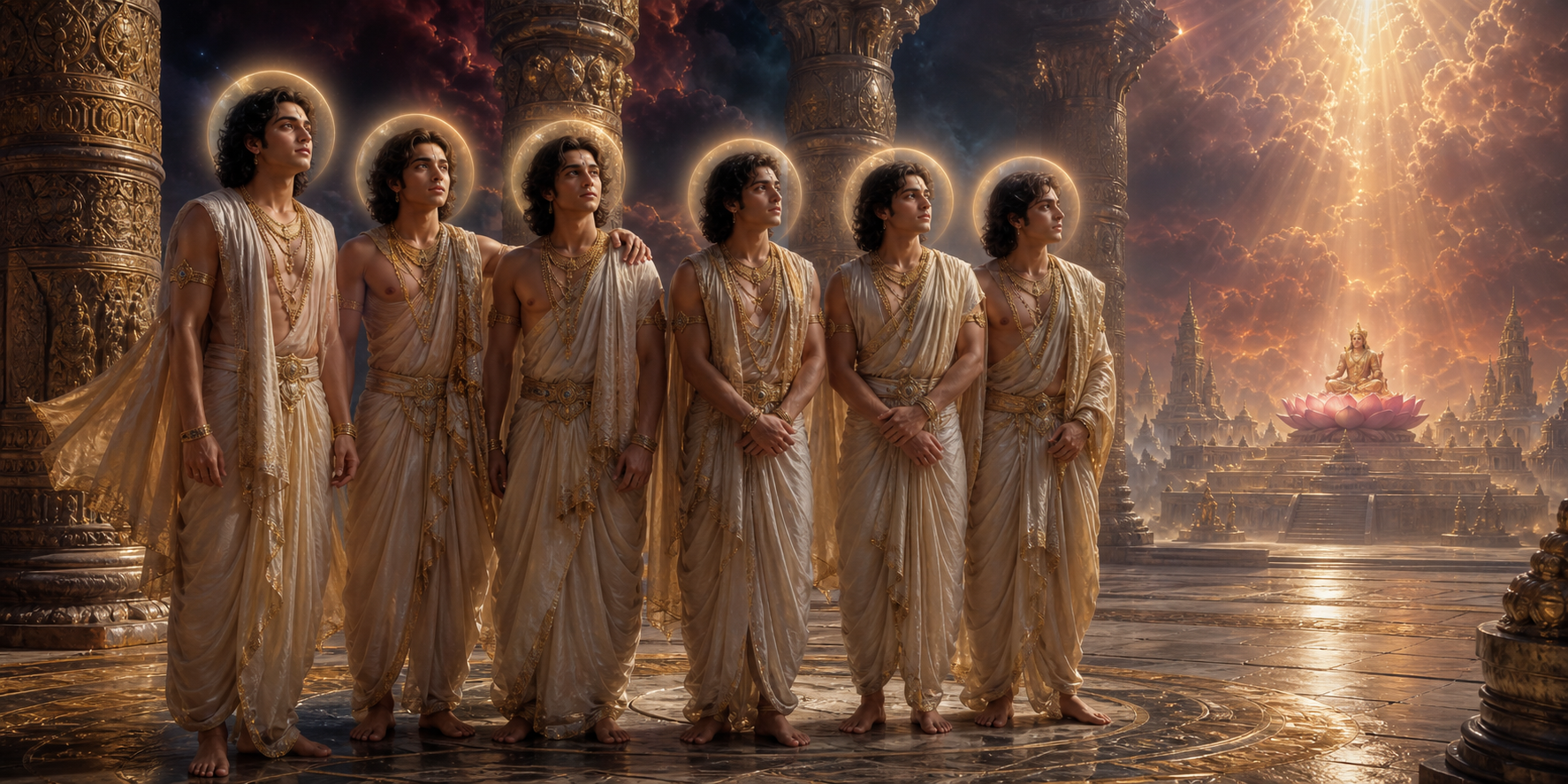
Devaki’s sons are collectively called the Shadgarbha, meaning “the six in the womb.” Their earlier identity is not described in exactly the same way across the Harivamsa and allied Purana traditions. That variation is important because it prevents us from treating one genealogy as the only point of the story.
In one prominent lineage, the six are sons of Marichi, the mind-born son of Brahma. A grave offense against a higher authority, sometimes described as mockery or rejection, brings a curse upon them. Another lineage places them among the daityas. They turn away from asuric allegiance or seek favors from Brahma, provoking Hiranyakashipu’s anger and a curse that binds them to further births and suffering.
Kalanemi provides the connection to Kamsa. Depending on the telling, Kalanemi is associated with the six as a prior father or as an old enemy. His later birth as Kamsa brings the ancient conflict into Devaki’s prison chamber. New bodies and names do not erase earlier relationships; unresolved deeds reappear until their consequences are completed.
You do not need to force these strands into one family tree. Notice instead what remains stable: the six commit or become implicated in an ancient transgression, a curse carries that disorder through successive births, Kamsa becomes its violent instrument, and Krishna eventually brings the cycle to an end. The genealogy varies, but the moral architecture does not.
The names Smara, Udgitha, Parishvanga, Patanga, Kshudrabhrit, and Ghrini are often given for the six, although variant lists also circulate. If you encounter a different enumeration, that difference need not overturn the episode’s central meaning.
The complete story ends with reunion, not murder
The familiar part begins with the prophecy that Devaki’s eighth child will kill Kamsa. Fear converts the ruler into a jailer and murderer. He tries to master the future by destroying Devaki’s children as they are born, yet each act draws him further into the destiny he is trying to escape.
- The warning about Devaki’s eighth child makes Kamsa imprison Devaki and Vasudeva.
- Devaki’s first six sons are born under captivity and killed by Kamsa.
- Balarama and Krishna enter the story after those deaths, and Kamsa is eventually defeated.
- Devaki continues to remember the children she lost and asks to see them again.
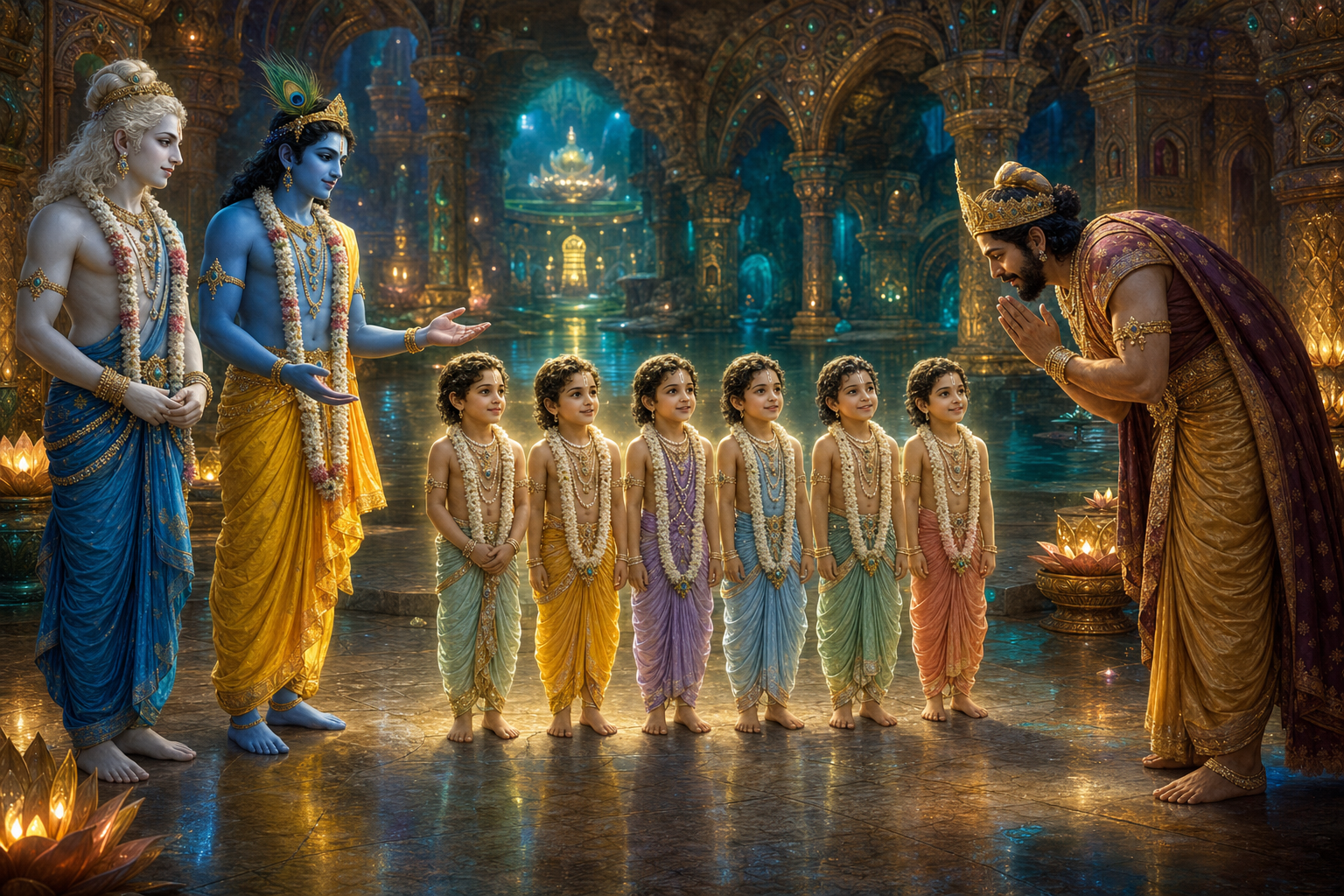
- Krishna and Balarama travel to Sutala-loka, the realm of Mahabali, and secure the release of the six.
- The sons return to Devaki’s arms, recover awareness of their deeper identity through the reunion and Krishna’s grace, and are released from their long cycle of sorrow.
Stopping after the third step makes the sons disposable figures in Krishna’s biography. Following the story to Sutala reveals something else: their deaths are not the last word, and Devaki’s love is not forgotten once Krishna has defeated the tyrant. Cosmic restoration includes the grief left inside the family.
That is why Devaki’s request matters. Krishna has already fulfilled the public work of overthrowing Kamsa, but victory over adharma has not yet repaired every wound caused by it. The return of the six addresses the intimate remainder: a mother’s unanswered longing and six beings still awaiting release.
Karma explains the chain but never excuses Kamsa
The hardest misreading is also the most damaging: the sons had previous karma, therefore their murder was somehow acceptable. That conclusion does not follow. Karma explains why particular lives become entangled; it does not grant one person permission to harm another. Kamsa acts from fear, attachment to power, and hostility. His place within an older karmic pattern does not cancel his agency or accountability.
A shapa, or curse, gives narrative shape to moral causation. It connects an earlier breach with consequences that mature later. But a curse is not a declaration that every cruel choice made along the way becomes dharmic. The same chain can contain a consequence for one being and a fresh offense by another. The six encounter the result of an ancient history; Kamsa creates further consequences through the way he chooses to act.
This distinction also protects Devaki from a callous theology. Nothing in the karmic background makes her repeated bereavement trivial. Her helplessness before Kamsa is given real weight, and her longing remains significant even after his defeat. The eventual reunion answers that longing instead of telling her that she should have risen above it.
If this episode enters a conversation about someone’s actual loss, do not speculate about what the bereaved person or the dead “must have done” in another life. The story gives you no authority to audit another person’s karma. Its safer and more dharmic use is inward: examine the consequences of your own actions, refuse Kamsa’s attempt to justify violence through fear, and meet another person’s sorrow with compassion.
Readers formed by other dharmic paths may recognize a family resemblance without erasing doctrinal differences. Buddhism connects kamma with results that mature across lives; Jainism describes karmic bondage and release through ethical discipline; Sikh thought maintains moral causation while giving decisive importance to divine nadar, or grace. These teachings are not interchangeable, but each resists the idea that actions are consequence-free. The useful comparison lies in that ethical structure, not in pretending that every tradition defines karma or liberation identically.
Krishna’s grace completes karma by restoring what was broken
Krishna’s anugraha is not a loophole through which consequences disappear. The six undergo the births associated with their curse, and Kamsa performs the act toward which his earlier enmity has carried him. Grace enters when that chain has reached its limit. It prevents completed karma from becoming endless captivity.
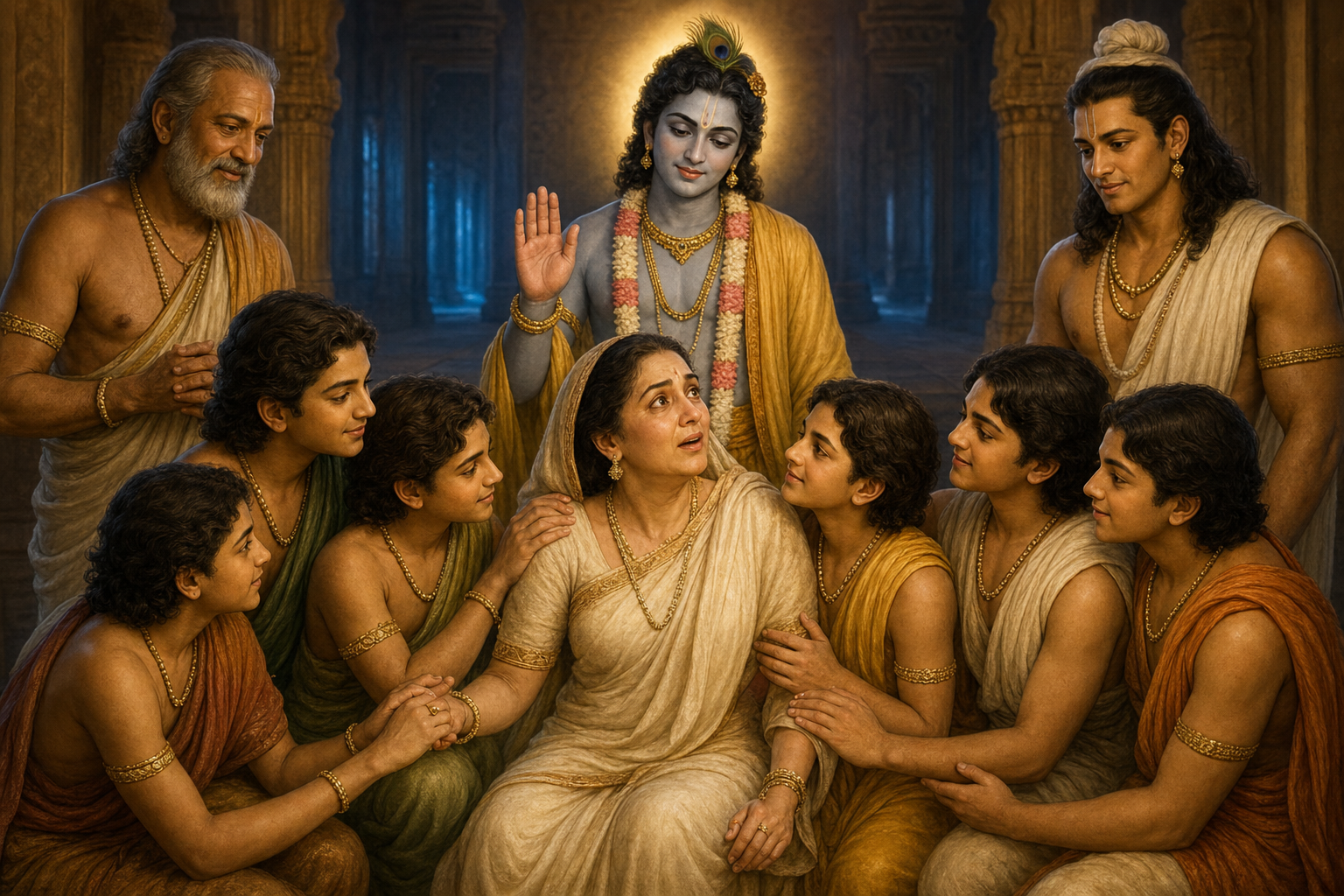
Yet grace does more than settle an account. Krishna goes to Sutala, brings the sons into Devaki’s presence, restores remembrance, and makes liberation possible. The outcome is therefore more than punishment served. Relationship, knowledge, and rightful identity are restored. This is why the episode presents justice in a restorative form rather than as an unending exchange of injuries.
Devaki’s part in that restoration should not be overlooked. She does not command the cosmic order or undo the past herself. She remembers, longs, and turns toward Krishna. Her bhakti becomes the human opening through which the unfinished family wound is addressed. Divine grace answers devotion without pretending that the original suffering never occurred.
You can use four questions to keep your reading of this episode clear:
- What action began the chain? Identify the earlier offense and curse without insisting that every variant supply the same genealogy.
- Who remains responsible now? Do not let past-life causation erase Kamsa’s present choice to murder.
- Whose pain still needs an answer? Keep Devaki’s grief in view after the public defeat of adharma.
- What does grace restore? Look for recovered relationship, remembrance, and liberation, not merely the termination of punishment.
Those questions also offer a practical discipline. Apply accountability first to yourself. Extend compassion first to the person who suffers. Leave hidden karmic calculations to the moral order rather than using them to pass judgment. Then understand prayer and devotion not as ways to deny consequences, but as ways to seek the clarity and grace through which a destructive cycle can finally end.
Key takeaways
- Devaki’s first six sons are the Shadgarbha, beings whose karmic history begins before their births in Mathura.
- Their precise genealogy varies, but the stable pattern is offense, curse, repeated birth, death through Kamsa, reunion, and release through Krishna.
- Karmic causation explains their entanglement without making Kamsa’s violence righteous or diminishing Devaki’s grief.
- Krishna’s grace does not pretend that the past never happened; it ends the bondage produced by it and restores relationship and self-knowledge.
- The episode should make you more accountable for your own conduct and more compassionate toward another person’s suffering, never more eager to assign blame through imagined past lives.
The next time you hear the six sons mentioned only as victims before Krishna’s birth, carry the telling through to Sutala and back to Devaki’s arms. That final movement is not an optional epilogue. It is where the episode reveals what dharmic justice ultimately seeks: not the perpetuation of suffering, but the restoration that allows suffering to end.