

When pain lasts longer than you expected, spiritual language can start to feel like a demand. Should you accept what happened, overcome it, detach from it, or insist that life is fundamentally joyful? If your experience is difficult, being told to choose joy can sound like a denial of reality. If you have known deep peace, being told that life is nothing but suffering feels equally incomplete.
You do not need to settle that argument before you can respond wisely. Dharmic traditions give you a more useful task: identify what is happening, stop adding avoidable suffering, and practise the form of steadiness your own path teaches. Joy then becomes neither forced cheerfulness nor a reward for arranging life perfectly. It becomes a way of meeting changing conditions without being wholly possessed by them.
Stop asking life to be only easy or only hard
Life can be painful at the level of events and still contain a freedom that is not reducible to those events. These are different claims about different dimensions of experience.
At the everyday level, bodies age, plans fail, attachments are threatened, relationships change, and pleasure does not stay. Buddhism uses dukkha for this wider field of pain, stress, and unsatisfactoriness. The diagnosis is not that every moment feels miserable. It is that conditioned experiences cannot provide permanent security because they arise, change, and pass.
At a deeper level, several Dharmic paths speak of a freedom that is not dependent on getting the next event to cooperate. Some Hindu traditions describe Atman-Brahman as sat-chit-ananda: being, consciousness, and bliss. Buddhism directs attention toward the cessation of craving and ignorance rather than toward an eternal self. Jainism understands the purified jiva as possessing knowledge and bliss. Sikh practice locates anand in remembrance of the Divine Name and teaches Chardi Kala, a resilient spiritual optimism lived in alignment with hukam. These teachings are not interchangeable metaphysical propositions, even when they produce comparable disciplines of courage, restraint, and compassion.
Advaita Vedanta distinguishes empirical reality, vyavaharika, from ultimate reality, paramarthika. Mahayana Buddhism also uses conventional and ultimate perspectives, although its account of the ultimate is not the Vedantic account of Atman. Jain anekantavada warns that reality cannot be exhausted by one unqualified assertion. From one standpoint, life is undeniably difficult. From another, suffering does not define the whole of what can be realised.
This distinction protects you from two common mistakes. The first is despair: treating a painful condition as proof that existence is only pain. The second is spiritual bypassing: treating a teaching about bliss or liberation as proof that your present pain should not matter. A mature practice does neither. It acknowledges the wound at the level where it exists and applies the remedy appropriate to that level.
Identify the layer of suffering in front of you

Before choosing a practice, ask what kind of suffering you are facing. Classical Buddhist analysis separates immediate pain, the suffering caused by change, and the pervasive friction of conditioned processes. The distinction is practical because each layer asks something different of you.
When the problem is immediate pain, reduce harm first
Illness, bereavement, betrayal, exhaustion, fear, and material danger are not solved by arguing that the true self is blissful or that everything is impermanent. Your first dharma is concrete: protect life, stop preventable harm, tell the truth about what has happened, and accept appropriate help. Meditation may steady you, but it does not remove the need for safety, care, repair, or grief.
Use one factual sentence to separate the event from the verdict your mind has placed on it. “This relationship has ended” names an event. “Nothing meaningful will ever remain” predicts an entire future. “I failed at this task” is specific. “I am a failure” turns an outcome into an identity. The factual sentence may still hurt, but it gives you something you can respond to.
When the problem is change, release the demand for permanence
Viparinama-dukkha, the suffering of change, appears even in pleasant experiences. Achievement brings satisfaction, then becomes normal. Affection brings warmth, then fear of loss. A desired possession briefly excites the mind, then joins the background of ordinary life. Negativity bias and hedonic adaptation help explain why the mind can quickly normalise gains while continuing to scan for threats.
The useful question is not “How do I stop everything from changing?” Ask instead: “What has ended, what remains, and what does dharma require from me now?” This turns impermanence from an accusation into information. You can mourn what has passed without making permanence the price of loving anything.
When the problem is conditioning, observe the whole loop
Sankhara-dukkha is subtler. No dramatic crisis may be present, yet the mind keeps generating friction through craving, aversion, comparison, possession, and identification. You obtain something and immediately fear losing it. A thought appears and is treated as a command. Discomfort arises and you react before deciding whether the reaction is wise.
Watch one complete cycle: the trigger, the bodily sensation, the story, the impulse, the action, and the consequence. Do not begin by trying to destroy the thought. Find the earliest point at which choice is still available. Perhaps you cannot prevent anger from appearing, but you can prevent it from becoming cruel speech. Perhaps you cannot prevent longing, but you can decline the purchase, message, or habit that keeps strengthening it. That interruption is already sadhana.
Build practice in the right order

Dharmic practice is often reduced to meditation, but attention is difficult to stabilise when conduct continually produces agitation. A more reliable order is ethics, attention, wisdom, and relationship. These dimensions reinforce one another; neglecting one makes the others carry work they were not designed to do.
Ethics removes suffering you keep recreating
Begin by asking whether an avoidable action is reopening the wound. Yoga places ahimsa, satya, asteya, brahmacharya, and aparigraha before its deeper meditative limbs. Its niyamas add cleanliness, contentment, disciplined effort, self-study, and surrender to Ishvara. Buddhist sila, Jain vows, and Sikh commitments to honest living and seva perform related work: they reduce the guilt, conflict, grasping, and isolation that make the mind harder to govern.
Choose one restraint and one constructive duty. The restraint might be refusing to repeat a harmful story, retaliate, conceal a relevant truth, or feed a compulsion. The duty might be making a repair, fulfilling an obligation, offering practical service, or caring properly for the body. Do not use meditation to become calm enough to continue conduct you already know is adharmic.
Attention gives you room before reaction
Once immediate harm has been addressed, bring attention to the body and breath. Stress arousal narrows perception, making flight, aggression, and avoidance feel like the only available choices. Slow diaphragmatic breathing can help regulate that arousal. If it is comfortable for you, allow the breath to settle near six unforced breaths per minute. Do not strain, compete with a count, or add breath retention merely to make the exercise feel more advanced. If you become dizzy or short of breath, return to natural breathing.
Then use the attentional form taught by your path. Yoga develops dharana and dhyana; Buddhism cultivates samatha, vipassana, and mindfulness of breathing; Jain practice uses meditation in the service of restraint and purification; Sikh practice steadies awareness through simran. The immediate aim is modest but consequential: notice pain without automatically becoming its next action.
Wisdom corrects the assumption beneath the reaction
Attention shows you the pattern. Wisdom asks why it has such authority. A practitioner working within Yoga or Vedanta might ask, “Am I confusing a changing vritti with the seer?” A Buddhist might ask, “What am I treating as permanent, controllable, or mine?” A Jain might ask, “Which partial standpoint have I turned into the whole truth?” A Sikh might ask, “What would alignment with hukam require now, without confusing acceptance with passivity?”
Use the question native to your path. Shared practices do not erase doctrinal boundaries: Buddhist anatta, Vedantic witness-consciousness, Jain jiva, and Sikh devotion to the Divine are not alternate names for one proposition. Their practical meeting point is narrower and more defensible. Each challenges the frightened mind’s claim that its current interpretation is complete.
Devotion and community prevent practice from becoming self-absorption
Some suffering grows stronger in isolation. Bhakti, mantra, kirtan, puja, Buddhist sangha, Jain fellowship, and Sikh sangat place your private struggle inside a larger field of meaning and responsibility. Simran turns remembrance into a daily orientation; seva prevents that remembrance from remaining merely inward.
If solitary observation is making you more preoccupied with your own mental state, add a relational practice. Sit with your community, ask for guidance from a trustworthy teacher, or perform one useful act for a person who cannot repay you. Compassion training is associated with increased prosocial behaviour, but the Dharmic test is simpler: your practice should make another being safer in your presence, not merely make you feel spiritually accomplished.
Use this sequence when suffering suddenly intensifies

When emotion is strong, a complicated philosophy is hard to retrieve. Use the following sequence as a bridge between the first wave of reaction and the next responsible action.
- Name the event without turning it into an identity. State what happened in plain language. Remove predictions about your entire future and judgements about your entire worth.
- Check for immediate harm. If someone is in danger, if a health need is urgent, or if a practical responsibility cannot wait, address that before beginning contemplative analysis.
- Settle the body’s alarm. Release unnecessary tension and let breathing become slower and diaphragmatic if that is comfortable. The aim is enough steadiness to choose, not a special state.
- Classify the suffering. Is this direct pain, resistance to change, or a recurring conditioned loop? More than one may be present, but identify the layer driving your next reaction.
- Choose the smallest relevant dharma. Restrain one harmful impulse, tell one necessary truth, fulfil one duty, repeat the Name, return to the meditation object, or ask for appropriate help.
- Move attention outward. Once stable enough, perform a useful act. Service interrupts the belief that your pain is the only reality while preserving the truth that it still matters.
- Notice one available good without grasping at it. Warmth, food, beauty, prayer, friendship, competence, or a moment of quiet can be received without being ordered to last forever.
This sequence does not promise that distress will disappear. Its purpose is to prevent distress from making every decision on your behalf. Repeated practice gradually moves the point of choice earlier in the cycle, before impulse becomes speech, conduct, or habit.
If suffering makes you unsafe, disoriented, or unable to manage ordinary responsibilities, seek qualified medical or mental health support or contact the appropriate emergency service where you live. Spiritual discipline can accompany professional care. It should not be used to replace necessary treatment or crisis support.
Let joy become a capacity rather than an escape
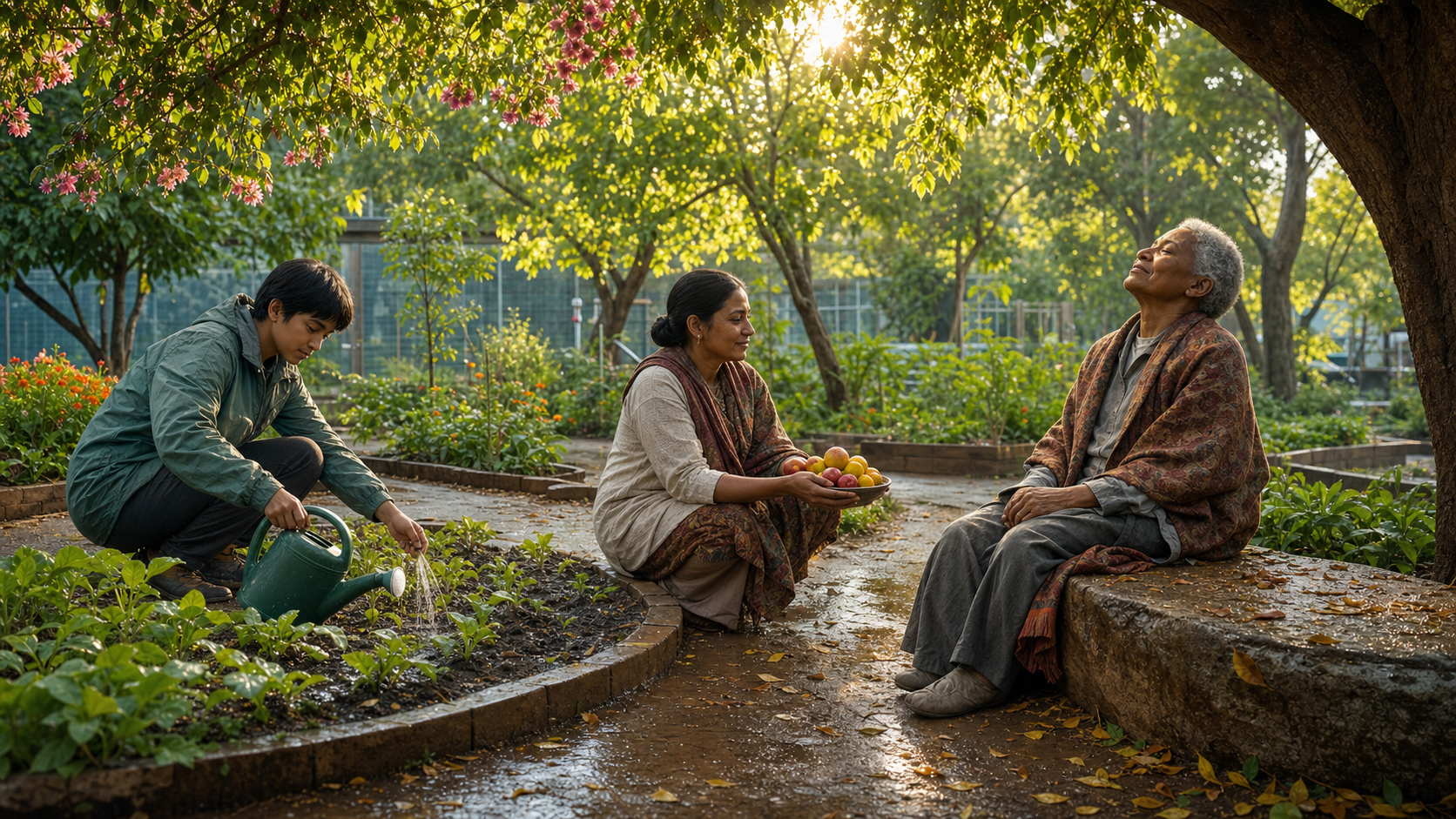
Joy becomes another burden when you treat it as the mood a good practitioner must maintain. Pleasant feeling, sukha, naturally changes. If you demand that it continue, pleasure already contains anxiety. If you use it as evidence of spiritual attainment, its disappearance can feel like failure.
Ananda points beyond successful mood management in Vedantic and Bhakti settings. The Bhagavad Gita’s ideal of even-mindedness in pleasure and pain does not require emotional numbness. It asks you not to surrender discernment whenever conditions rise or fall. Jainism associates bliss with the unobstructed qualities of the purified soul. Sikh Anand Sahib places abiding joy within remembrance of the Divine. Buddhism approaches the issue through freedom from craving: the pleasant can be known without being seized as a permanent refuge.
You can therefore enjoy what is present without asking it to secure your identity. Notice the pleasant experience clearly. Notice the impulse to preserve, repeat, display, or possess it. Let the experience change without accusing it of betrayal. Then allow its energy to become generosity, patience, courage, or service. Stable Dharmic joy expresses itself as clarity and compassion, not as a permanent smile.
This is also a practical test for Chardi Kala. Resilient optimism is not a performance that hides grief. It is the refusal to let adversity cancel remembrance, duty, and service. Likewise, contentment, santosha or santokh, does not mean refusing to correct injustice or improve conditions. It means that action is no longer driven entirely by the belief that you are incomplete until the world obeys you.
Key takeaways
- Pain at the everyday level and freedom at the deepest level are not mutually exclusive claims. Do not use either one to erase the other.
- Distinguish direct pain, suffering caused by change, and conditioned mental friction. Each requires a different first response.
- Start with ethical restraint and necessary action. Attention becomes more stable when your conduct is not continually creating fresh agitation.
- Use the contemplative language of your own path. Shared Dharmic disciplines do not make Vedantic Atman, Buddhist anatta, Jain jiva, and Sikh devotion doctrinally identical.
- Judge joy by what it enables: less grasping, clearer action, greater courage, and more compassionate service.
At the next difficult moment, do not demand an immediate verdict on whether life is suffering or joy. Name the layer you are facing, interrupt one harmful reaction, and take the smallest action your dharma makes clear. That is where freedom becomes more than an idea, and where joy begins to acquire roots.