
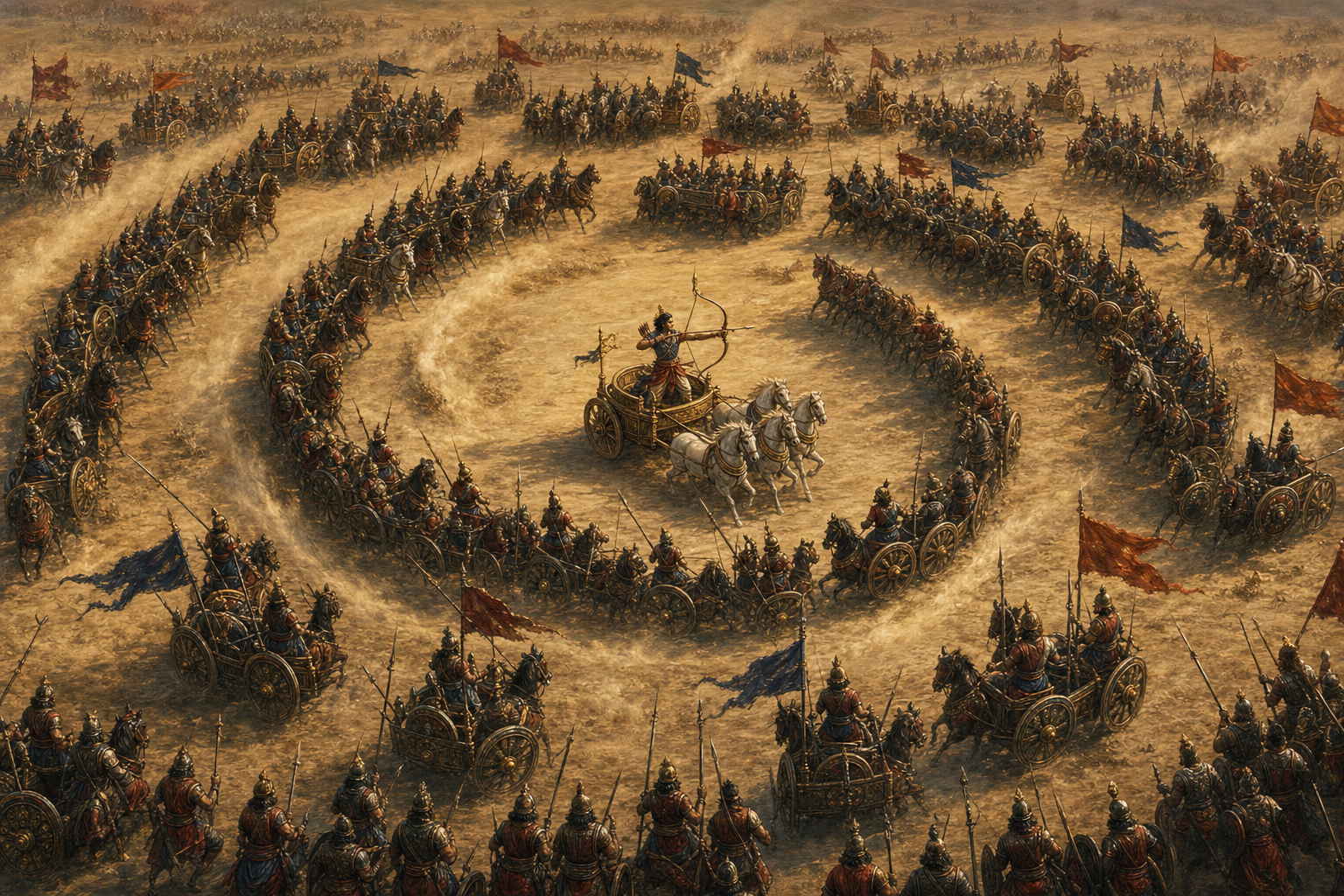
If the only lesson you remember is that Abhimanyu knew how to enter the Chakravyuha but not how to leave it, you have the ending but not the strategy. The decisive question is not how one warrior crossed a ring. It is how a coordinated system converted his advance into isolation.
That distinction gives you a better way to read the episode. It reveals why courage cannot replace coordination, why a breach can serve the defender, and why dharma judges more than the efficiency of a plan.
Read the Chakravyuha as motion, not as a maze
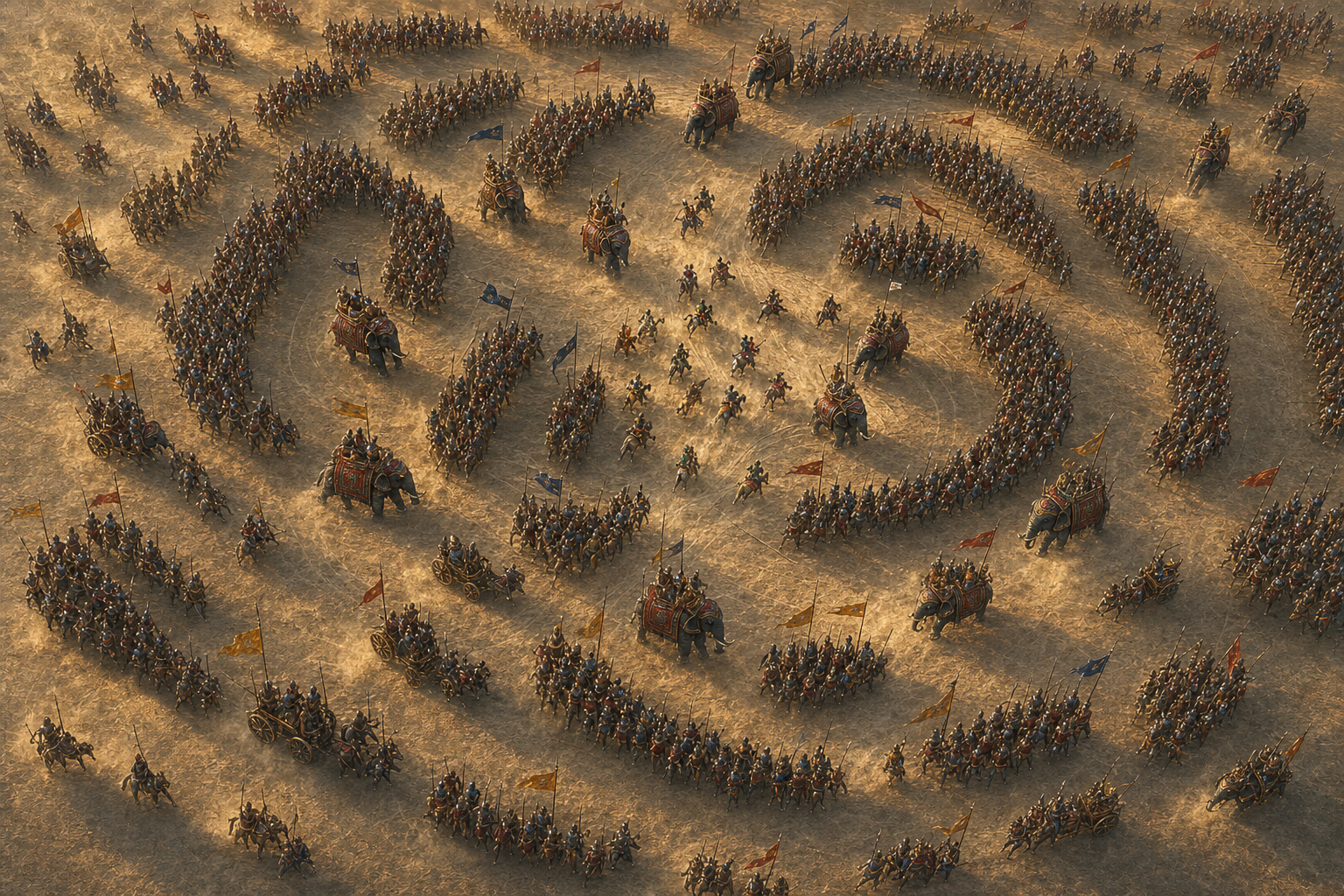
The easiest mistake is to imagine the Chakravyuha as a static spiral with one hidden route through it. Its essential feature was movement. Concentric layers of warriors rotated and reconfigured, creating openings that could close after an opponent crossed them. What looked like a gateway was also a mechanism for controlling where the intruder went next.
This makes the formation more sophisticated than a defensive wall. A wall tries to keep you outside. The Chakravyuha could allow you in, separate you from the force behind you, and force you to meet fresh resistance while your own support became harder to reach. Its power came from synchronized layers, not from the circular shape alone.
Watch for four mechanisms when you examine the formation:
- Controlled ingress: the defender determines where an attacker can penetrate.
- Segmentation: the advancing force is divided into smaller elements that can be handled separately.
- Broken continuity: communication, reinforcement, and supply become harder as the layers close and shift.
- Phased attrition: the isolated attacker spends strength against successive rings instead of confronting one fixed line.
A successful entry therefore proves only that the outer problem has been solved. It says nothing about whether the entrant can preserve freedom of movement, remain connected to allies, reach the actual objective, or return. When assessing any layered strategy, stop asking only, “Can the perimeter be breached?” Ask, “What happens to the unit immediately after the breach?”
The thirteenth-day trap began before Abhimanyu entered
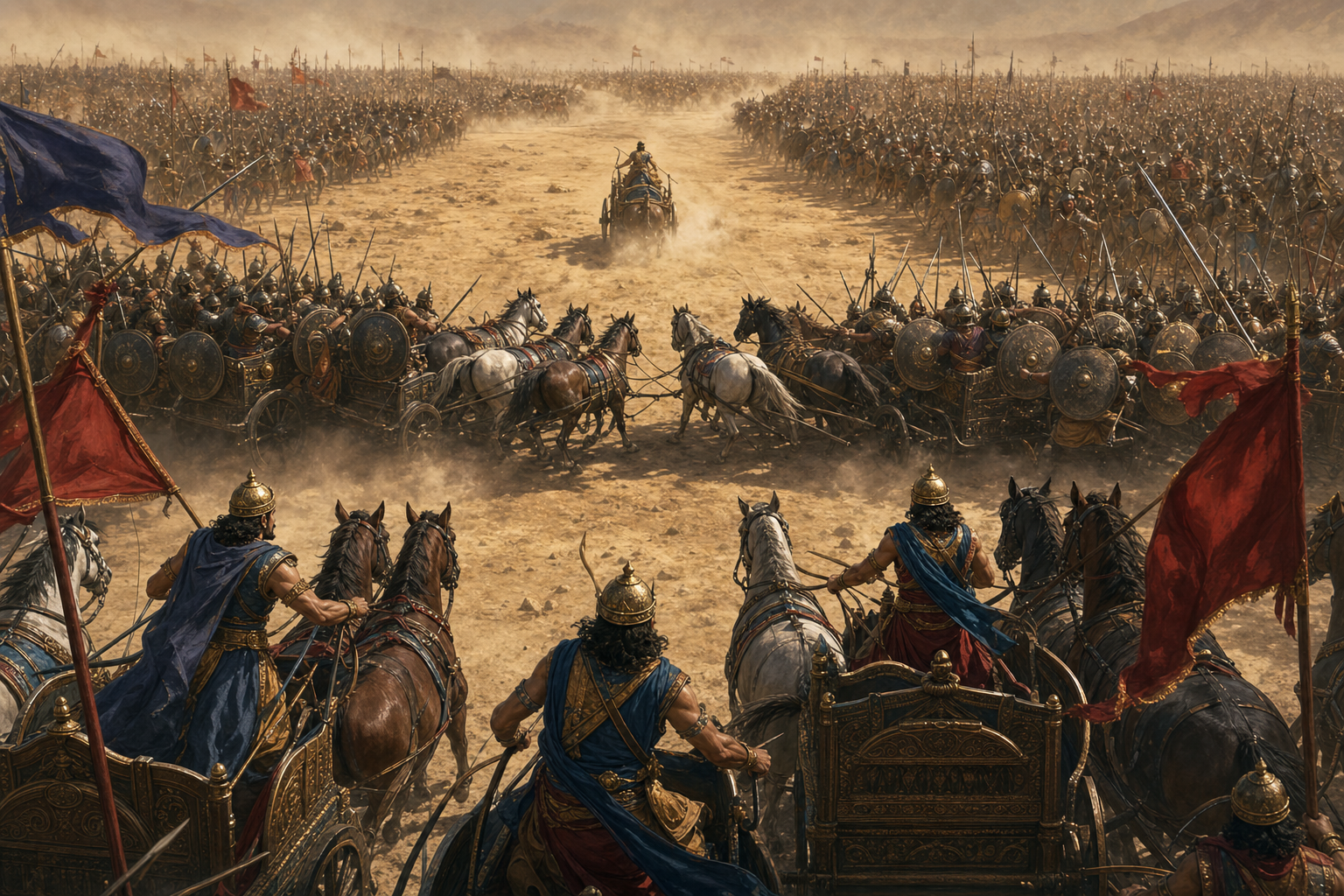
On the thirteenth day of the Kurukshetra War, the Kaurava objective was to capture Yudhishthira. Dronacharya deployed the Chakravyuha after Arjuna had been drawn away from the critical sector. That sequence matters. The Kauravas did not merely build a difficult formation and wait to see who attacked it. They shaped the conditions under which the Pandavas would have to respond.
The operation can be read as a sequence of linked decisions:
- Define the strategic target. The aim was the capture of Yudhishthira, not destruction for its own sake.
- Displace the strongest counter. Drawing Arjuna away changed the Pandavas’ available choices before the formation was deployed.
- Present a problem that demands immediate action. The advancing Pandava force could not simply ignore a formation built around the threat to Yudhishthira.
- Exploit unequal knowledge. Abhimanyu possessed the skill to penetrate the array, but the Pandava response lacked a secure, complete solution for entry, continued support, and exit.
- Let the layers turn progress into exposure. Once the entrant became separated, the formation could impose repeated resistance while denying the advantages of a connected force.
This is why the episode cannot be understood as a contest of individual strength alone. The decisive advantage was created through timing, information, positioning, and command control. Physical combat was only the visible stage of a plan already working at the operational level.
If you are studying the episode as strategy, map the decisions made before contact. Who was moved away? What objective forced a response? Which side knew how the formation would change? Who could communicate across the layers? These questions explain more than a diagram of concentric circles ever will.
Abhimanyu exposes the difference between skill and readiness
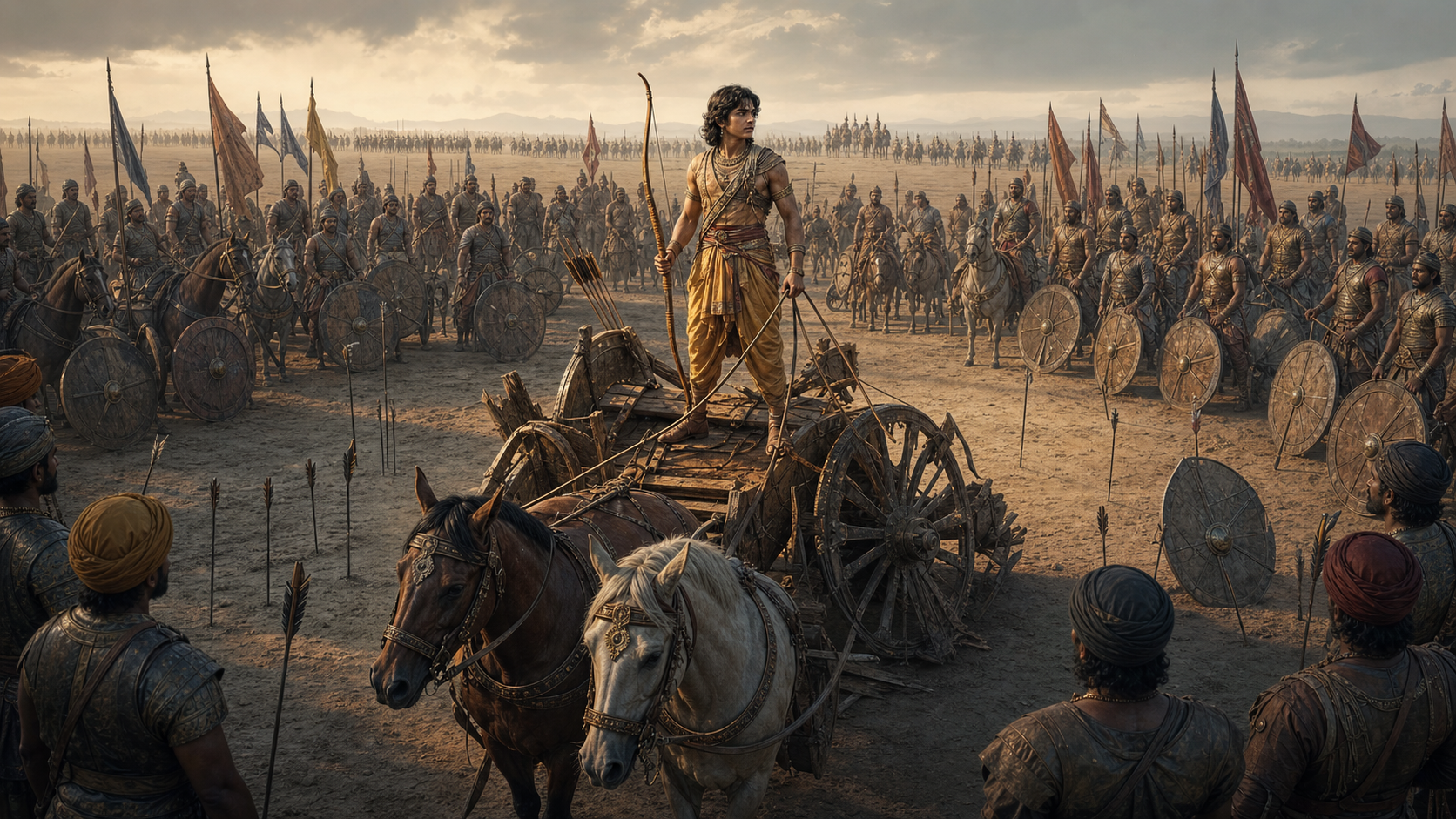
Abhimanyu’s achievement was genuine. He penetrated a formation designed to control and isolate its attackers. Reducing him to a careless youth ignores the difficulty of what he accomplished. Treating his bravery as a complete answer ignores the limitation that made the achievement unsustainable.
Entry skill is local: it solves the obstacle immediately ahead. Mission readiness is systemic: it joins entry to continued movement, communication, reinforcement, and recovery. A force prepared for the first without securing the others has not completed its plan.
Abhimanyu had the capability needed at the opening. The larger Pandava response could not ensure that success at the opening would remain connected to support behind it. The fatal gap was therefore not merely a missing technique in one warrior’s knowledge. It was a mismatch between an individual’s capability and the collective plan built around him.
That distinction changes where you place responsibility. A leader cannot ask only whether a capable person can start a difficult task. The leader must also ask whether the surrounding system can sustain that person after the initial success. If support depends on a passage remaining open while the opponent controls that passage, the plan rests on the defender’s cooperation.
You can recognize the same structural error outside warfare. A software team may know how to deploy a major change but lack a reliable route to roll it back. An institution may know how to invoke emergency powers but have no clear process for restoring normal authority. A campaign may send a capable field unit forward without preserving communication with the people who must reinforce it. In each case, the ability to enter a new state is mistaken for the ability to operate safely within it.
Before assigning someone to breach a difficult system, ask one practical question: if that person succeeds immediately, will your support still be able to reach them? If the answer depends on everything remaining unchanged, you do not yet have a support plan.
Dharma judges the method as well as the objective
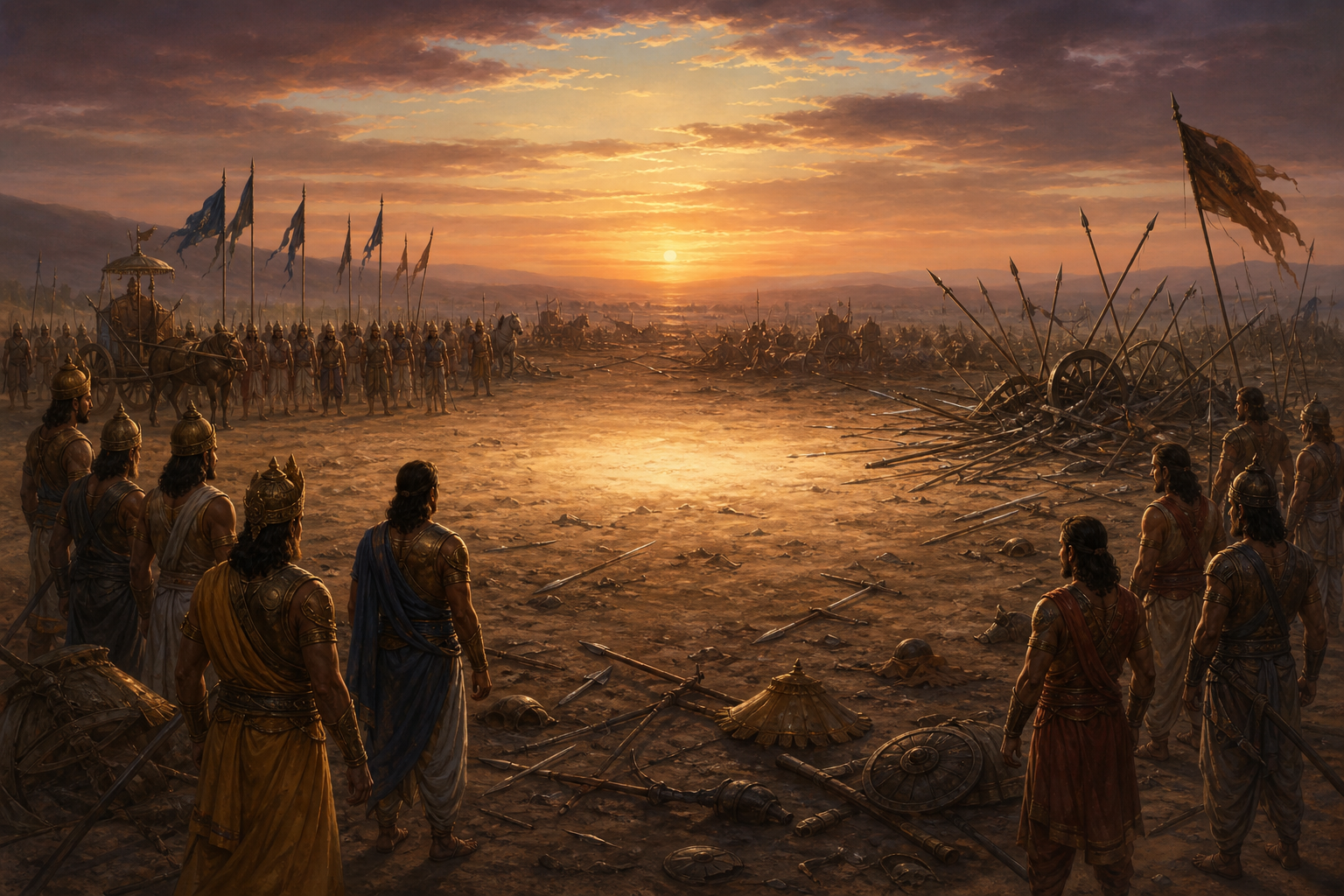
The Mahabharata does not permit strategic cleverness to settle the moral question. Within the frame of Dharma-Yuddha, conduct must be weighed alongside results. Proportionality, fidelity to promises, the treatment of those placed at a disadvantage, and the protection of non-combatants remain part of the judgment even when a tactic works exactly as intended.
The Abhimanyu episode sharpens that test because isolation is both the formation’s tactical achievement and the condition that creates its gravest ethical tension. It is not enough to say that an opponent entered a trap and therefore anything that followed was justified. Nor is it enough to condemn a formation merely because it was effective. You must examine what restraint required after the tactical advantage had been secured.
A dharmic reading should therefore ask: Was the objective itself legitimate? Were the means proportionate to it? Did advantage erase restraints that should have remained binding? Did commanders accept responsibility for the foreseeable consequences of their decisions? These questions prevent admiration for ingenuity from becoming moral surrender to success.
The wheel also carries meanings beyond the battlefield, but those meanings should not be collapsed into the tactic. In Hindu thought, the chakra can evoke rita, order, and cyclical time. Buddhism turns the dharmachakra as an image of Dharma. Jain reflection associates the wheel with vigilance and continuity of ethical effort, while the Sikh chakkar carries associations of timelessness and unity. These resonances belong to a shared civilizational vocabulary; they do not make every circular formation sacred or give every use of coordinated power a dharmic sanction.
The useful distinction is simple: order is not automatically righteousness. A formation can be disciplined, elegant, and successful while still requiring moral scrutiny. The more efficiently power is organized, the more important it becomes to ask what directs it.
Key takeaways: use the six-question Chakravyuha test
When a plan requires you or your team to enter a complex, changing system, test it before committing:
- What is the objective? Name the result that matters. Entering the system is an action, not an objective.
- Who controls the gate? If the other side decides when access opens and closes, assume the apparent opportunity may serve its design.
- Where is the exit? Define how you will withdraw, recover, or return to ordinary operations before entry begins.
- How will support stay connected? Identify the communication and reinforcement path that must survive after the outer layer is crossed.
- How will the system react? Plan for moving layers and changing resistance, not a frozen version of the problem seen at the start.
- What dharmic boundary remains binding? Decide which restraints cannot be discarded even if pressure rises or advantage appears.
The comparison with modern layered security is useful within limits. A network defense also seeks to control ingress, detect movement, separate threats, and coordinate responses across layers. But the Chakravyuha is not a technical specification for contemporary security. Carry forward its strategic logic: a perimeter is only one layer, communication is part of defense, and an intruder’s apparent progress may be the defender’s intended path.
The next time you encounter the Abhimanyu episode, draw the formation as a relationship map rather than a decorative wheel. Mark the objective, the gate, the support route, the exit, and the ethical boundary. Any blank space on that map identifies the same danger the episode preserves for us: courage entering where strategy has not prepared a way through.
References
