
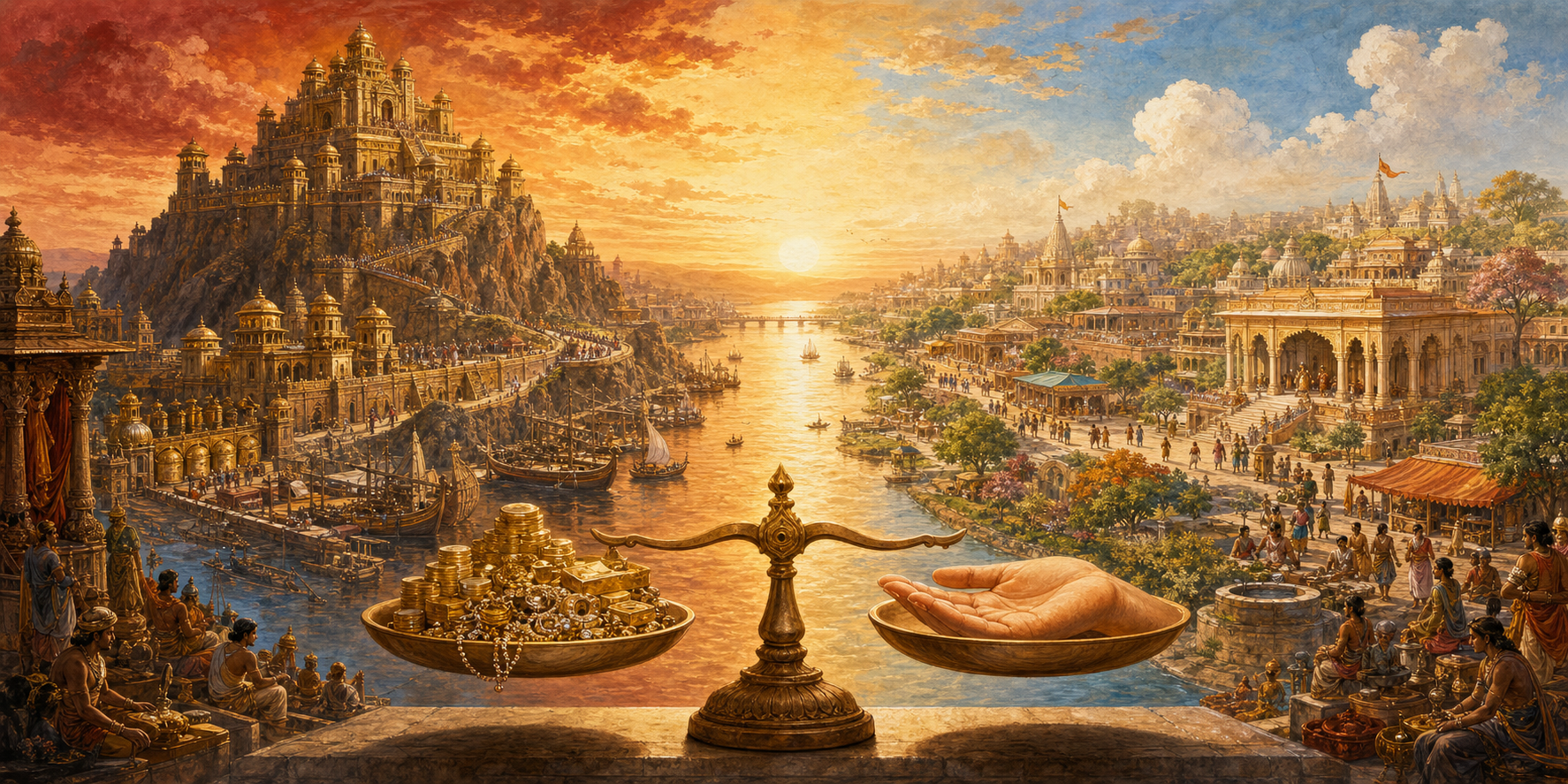
You may be deciding whether a policy, business plan, charitable project, or family goal is genuinely dharmic, or merely profitable with sacred language attached. The Ramayana gives you a demanding test: do not ask only how much wealth will be created. Ask how it will be acquired, who will be protected, who may challenge the decision, and what will restrain the successful.
The contrast between golden Lanka and restored Ayodhya is useful precisely because the choice is not between prosperity and poverty. It is between prosperity governed by dharma and prosperity captured by appetite. That distinction can change how you evaluate a household budget, an institution, or the conduct of a state.
Wealth is not the villain; possession without restraint is
A dharmic approach does not require every householder, enterprise, or kingdom to reject artha. Wealth supports families, temples, education, hospitality, defence, public works, and care for people in difficulty. The problem begins when artha stops serving a larger moral order and becomes the authority that defines that order.
Rama Rajya places the aims of life in an intelligible sequence: dharma guides artha and kama toward the higher horizon of moksha. This does not make material success suspect. It makes material success answerable. A profitable action is not necessarily righteous, while a righteous action must still reckon honestly with material consequences.
Lanka makes the distinction impossible to evade. Its imposing gateways, layered defences, palaces, gardens, harbours, and metallic brilliance evoke a wealthy and technically accomplished civilization. None of that splendour supplies moral legitimacy by itself. Sophisticated infrastructure can magnify good government, but it can also magnify the reach of an undisciplined ruler.
Before calling an accumulation of wealth successful, examine it through three separate questions:
- Acquisition: Was the wealth earned or received through honest exchange, service, inheritance, gift, or another legitimate means, or was it secured through coercion, appropriation, deception, or abuse of office?
- Allocation: Does the surplus strengthen real obligations, circulate through dana, and support people and institutions, or does it principally finance display, domination, and the insulation of the powerful?
- Restraint: Is there a point at which enough is enough? Are accounts open to scrutiny, conflicts acknowledged, and limits established before ambition begins to rewrite the rules?
The contrast between Kubera and Ravana sharpens this audit. Kubera represents prosperity held in trusteeship and bounded by dharma. Ravana seizes what was not his and treats command over wealth as proof of his right to command. The difference is not that one possesses gold and the other does not. It is that one remains responsible for wealth while the other becomes possessed by it.
This corrects two common errors. Poverty is not automatic evidence of virtue, and abundance is not automatic evidence of merit. When you assess a prosperous person, institution, or nation, look past the visible quantity of wealth. Trace its origin, its beneficiaries, its burdens, and the disciplines imposed on those who control it.
Lanka shows how capable institutions become unjust
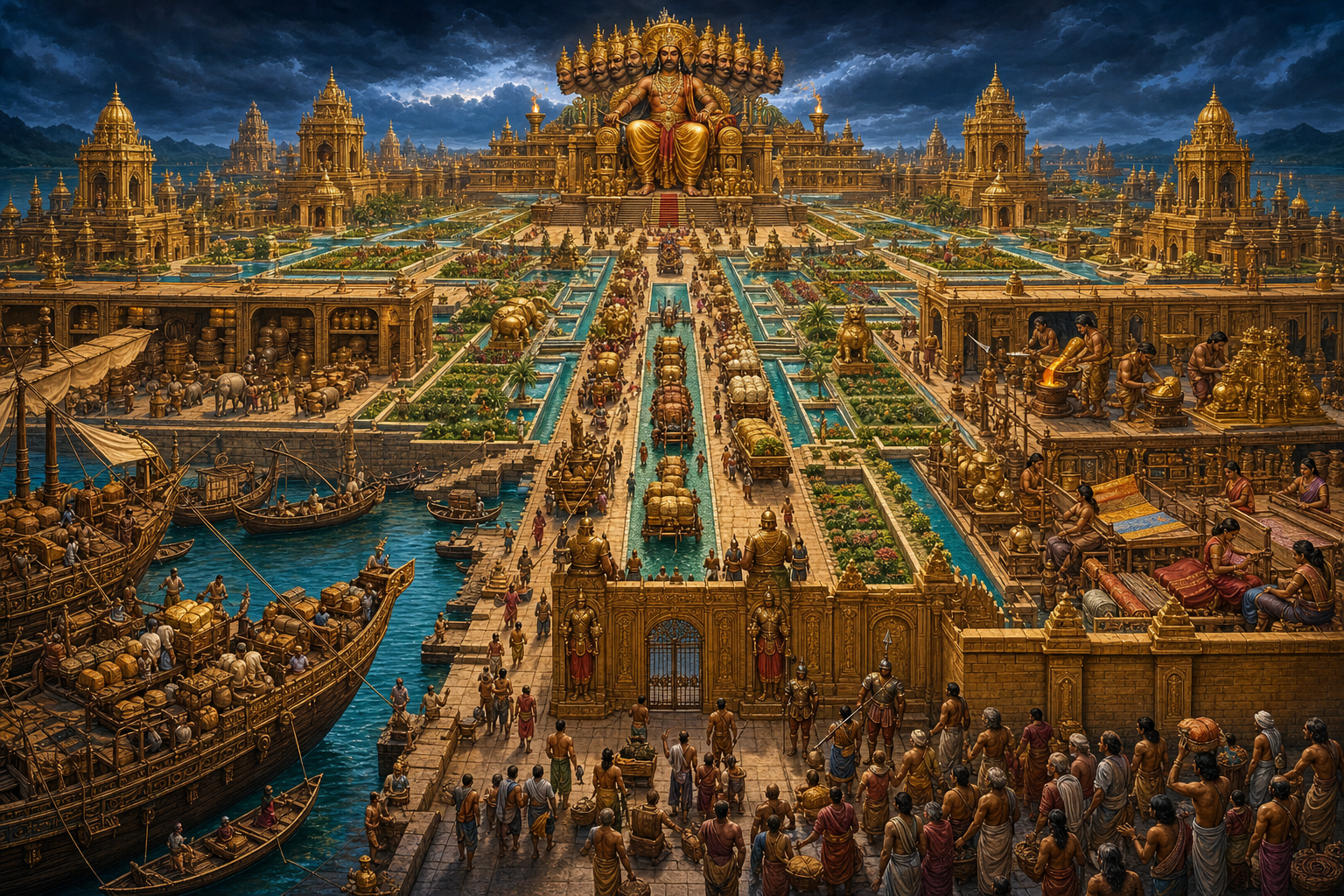
Ravana is not portrayed as a merely ignorant man. Learning, devotion, courage, strategic resources, and an impressive capital all stand behind him. His failure is therefore more instructive than the failure of an obvious incompetent. Ability cannot rescue governance once lobha and ahankara determine what ability is used to achieve.
The decisive institutional breakdown appears in Ravana’s treatment of counsel. Vibhishana fulfils the statesman’s obligation to speak an unwelcome truth to power, but access to the court does not produce meaningful deliberation. A ruler has not listened merely because an adviser was permitted to finish speaking. Counsel matters only if adverse information can alter the decision.
That distinction applies far beyond kingship. A family discussion, board meeting, temple committee, cabinet consultation, or community assembly can preserve all the outward forms of deliberation while punishing anyone who questions the preferred result. Once people learn that honesty costs them standing, the leader receives agreement but loses information.
Hanuman’s survey of Lanka includes attention to guards, defensive vulnerabilities, the city’s layout, and public morale. The irony is sharp: a state may closely observe an external threat while remaining blind to the internal habits that make it vulnerable. More surveillance, reports, dashboards, and advisers cannot correct a decision process in which evidence must flatter the ruler.
If you hold authority, install a dissent test before the next consequential decision:
- Name at least one person who is explicitly authorized to argue against the preferred course without retaliation.
- Record the strongest objection in language its advocate considers fair. A weakened version of the objection is not deliberation.
- State what evidence or event would cause the decision to be reopened. If the honest answer is “nothing,” desire has probably displaced judgment.
- Protect the bearer of bad news. A system that praises truth in principle but penalizes the truthful in practice will steadily manufacture ignorance.
Vibhishana also prevents us from confusing loyalty with obedience. Genuine loyalty seeks the ruler’s return to dharma; it does not help the ruler proceed toward ruin. When a leader treats correction as betrayal, the leader eventually retains flatterers while losing the people most capable of preventing disaster.
Rama’s victory places limits on the victorious
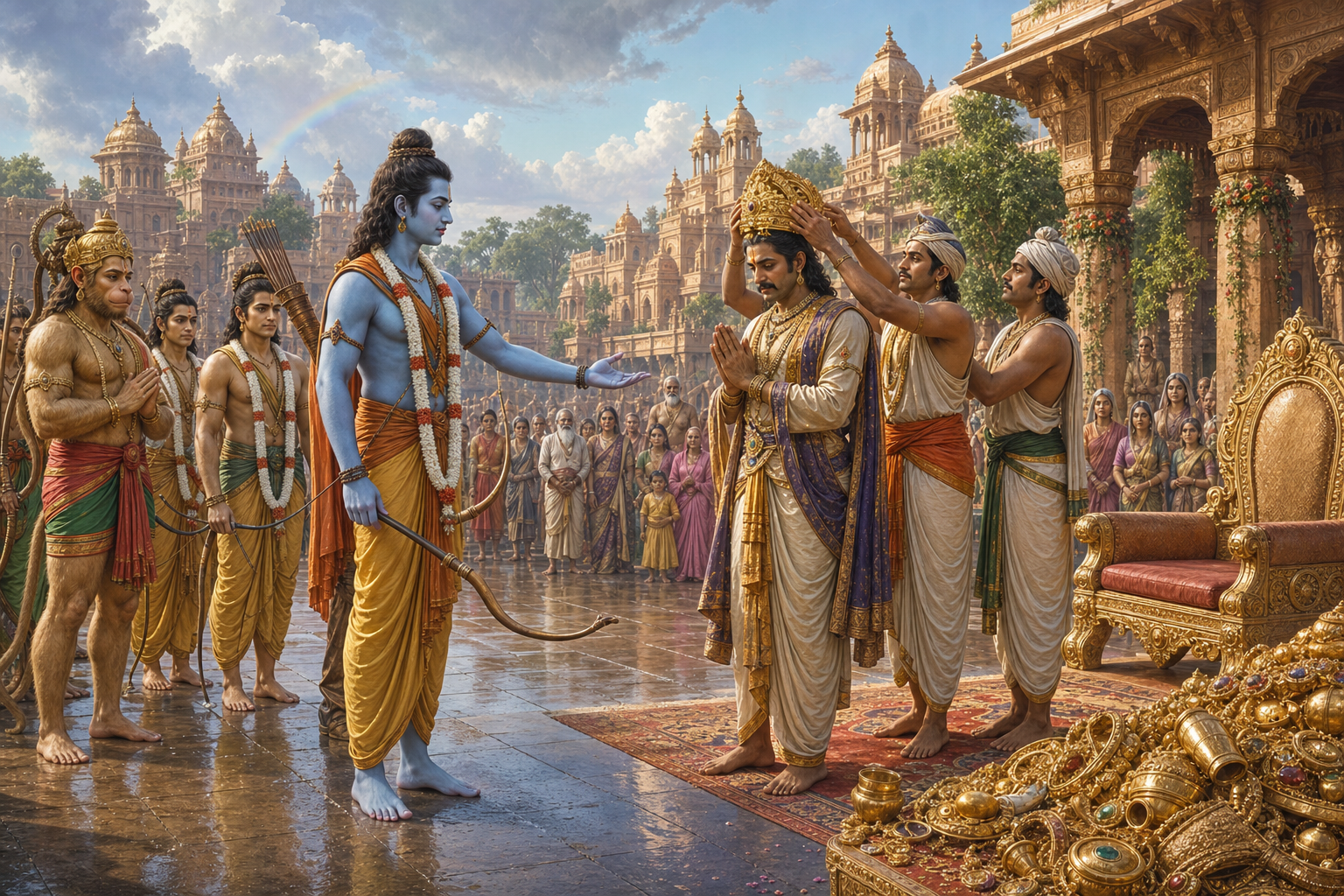
The ethical character of power becomes clearest after it has prevailed. Rama defeats Ravana, but he does not convert Lanka into a personal possession. He restores political order under Vibhishana instead of annexing the golden city. Victory therefore ends in relinquishment, not an enlargement of appetite.
This is one of the Ramayana’s most practical standards for governance: a legitimate objective must have a legitimate endpoint. If an intervention continues expanding after its stated purpose has been achieved, the original justification may have become a pretext. You should ask before granting power what event will end it, what authority will then be returned, and who will verify that the limit has been honoured.
The conduct of dharma-yuddha reinforces the same principle. The protection owed to emissaries, the importance of proportionate response, and the restraint imposed on combat show that a righteous end does not make every means righteous. The war setting should not be flattened into a modern administrative manual, but its moral logic remains applicable: power must be bounded while it is being used, not merely praised after a favourable result.
Rama’s acceptance of Vibhishana’s sharanagati adds another dimension. Dharmic order leaves room for remorse, moral choice, and reform. It does not demand that every person associated with a corrupt regime be treated as permanently indistinguishable from that regime. Good governance must be firm about wrongdoing without making restoration impossible.
The coronation at Ayodhya then gives sovereignty its positive meaning. The crown is a charge of service and accountability rather than a certificate of entitlement. Truthful speech and accounting, fairness in trade and employment, protection of vulnerable people, compassion in the application of law, and fidelity to vows are not private ornaments added to governance. They are part of what makes authority fit to govern.
The Ramayana does not offer a ready-made modern constitution, tax code, or regulatory system. It supplies the prior moral test by which any such system must be judged. Does the arrangement discipline its rulers as seriously as it disciplines its subjects? Does it make correction possible? Does it protect the weak when doing so inconveniences the strong? Does it know when to relinquish extraordinary power?
Use a seven-question dharmic audit before you decide
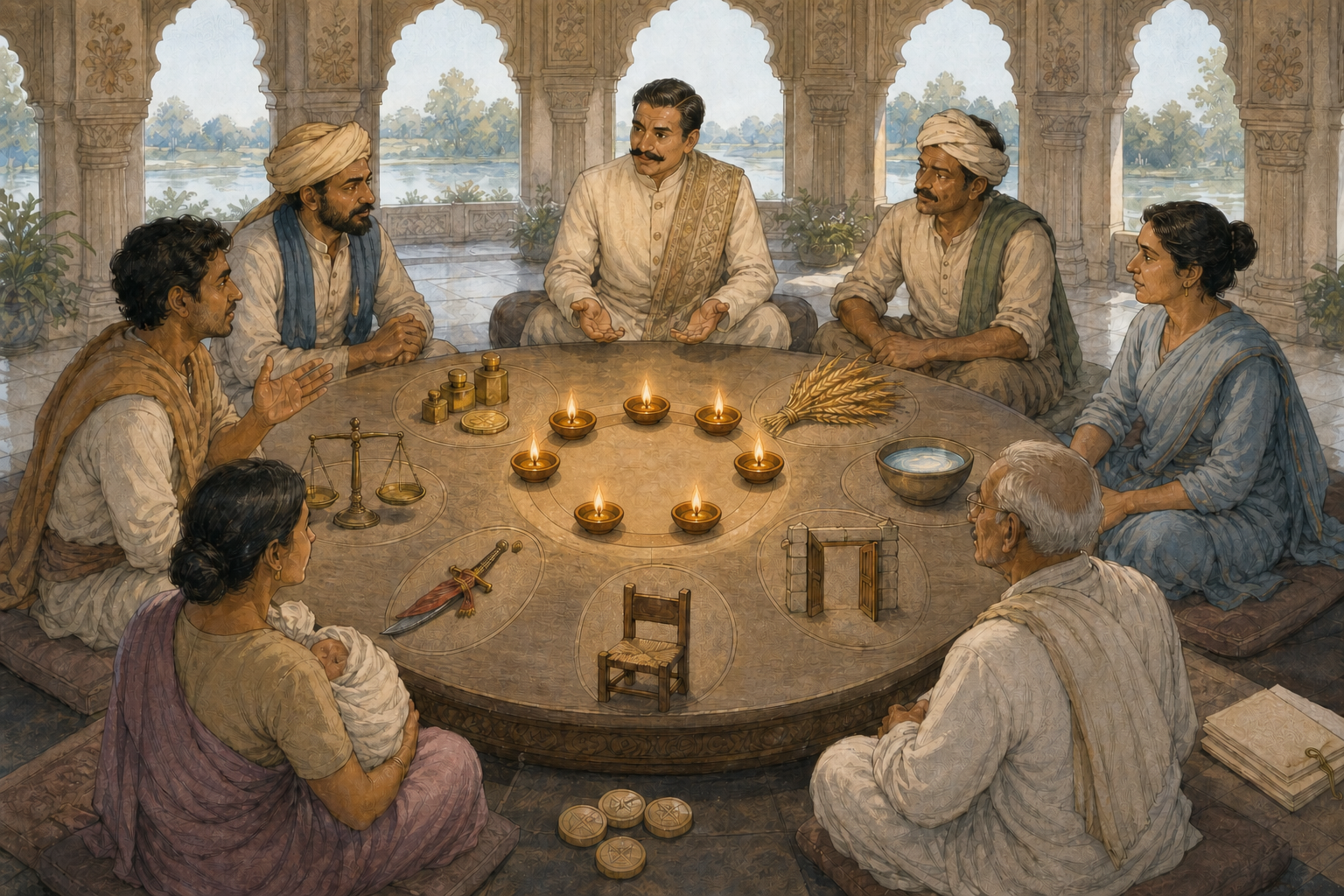
You can apply these ideals without pretending that your home, organization, or public office is ancient Ayodhya. Before approving a major expenditure, expansion, appointment, acquisition, campaign, or institutional change, write a one-sentence answer to each of the following questions. Attach evidence wherever the answer depends on a factual claim.
- What human good is this wealth or power meant to serve? Name the purpose without using words such as growth, influence, prestige, or success. Those describe scale or status, not the good being delivered.
- How is it being acquired? Trace the transaction, labour, authority, and sacrifice behind the gain. A noble plan cannot cleanse dishonest accounting, coerced consent, appropriated property, or obligations quietly transferred to someone with less power.
- Who can say no? Identify the person or body able to challenge the proposal, examine the accounts, and delay approval without fearing exclusion or punishment. If everyone depends on the decision-maker’s favour, apparent consensus proves little.
- What is enough? Establish a stopping rule before the rewards arrive. Aparigraha is not passivity; here it means refusing to let possession expand simply because expansion remains possible.
- Who receives the benefit and who carries the burden? Look beyond the immediate winners. Test the proposal against fairness in employment and exchange, the treatment of vulnerable people, and duties to the wider community.
- How will error be exposed and repaired? Decide what will be reported, who will review it, where complaints can be heard, and what remedy follows a broken promise. Accountability without a path to correction is only disclosure.
- What happens after victory? Define which powers, resources, or privileges will be returned when the stated aim is achieved. Rama’s settlement of Lanka makes relinquishment part of success rather than an afterthought.
A blank or evasive answer identifies a governance gap. It does not automatically prove that the whole project is wrong, but it tells you where desire is outrunning discipline. Pause there. Improve the design before money, prestige, or political commitment makes reversal harder.
Three classical disciplines can turn this audit into regular practice. Aparigraha establishes sufficiency and limits accumulation. Dana circulates surplus toward genuine need instead of allowing wealth to harden into self-display. Satsanga places ambition in the company of people and teachings capable of refining it. These are often treated as personal virtues, but they also function as controls on institutional behaviour.
At home, this may mean giving dana and shared obligations a deliberate place in the budget before discretionary display consumes the surplus. In a business, association, or temple committee, it means accurate accounts, fair dealing, declared conflicts, and a safe route for objections. In public life, it means stating the legitimate objective, hearing unwelcome counsel, protecting vulnerable people, publishing an account of action, and ending exceptional authority when the objective is met.
This is an ethical audit, not a determination that a particular investment is financially suitable or that a transaction satisfies the law. When a decision places another person’s money, employment, property, or legal rights at risk, obtain the relevant professional review as well as applying the dharmic test. Moral language should deepen due diligence, not replace it.
Key takeaways
- The Ramayana does not condemn prosperity. It asks whether artha remains governed by dharma.
- Lanka’s splendour proves that wealth, technology, security, and learning cannot compensate for a ruler’s refusal of restraint.
- Vibhishana’s counsel makes protected dissent a test of institutional health, not a sign of institutional weakness.
- Rama’s refusal to possess conquered Lanka shows that legitimate power needs a declared endpoint and a willingness to relinquish control.
- A dharmic wealth decision must withstand scrutiny of its purpose, acquisition, distribution, limits, accountability, and final settlement.
Take the seven questions into your next consequential meeting before the preferred decision becomes untouchable. Ask the person most able to disagree to answer first, and record the limit on power before approving its use. If the plan becomes fairer and more accountable under that pressure, wealth is being trained for service. If it depends on silence, concealment, or limitless accumulation, change the plan before invoking Rama Rajya to bless it.
References
- DharmaRenaissance Blog – Lankapuri’s Golden Splendor: Ramayana’s City on Trikuta and a Timeless Warning on Greed
- HinduPad – Sri Rama Rajyotsavam 2026: Date, Puja Vidhi, and the Enduring Ideal of Rama Rajya
