
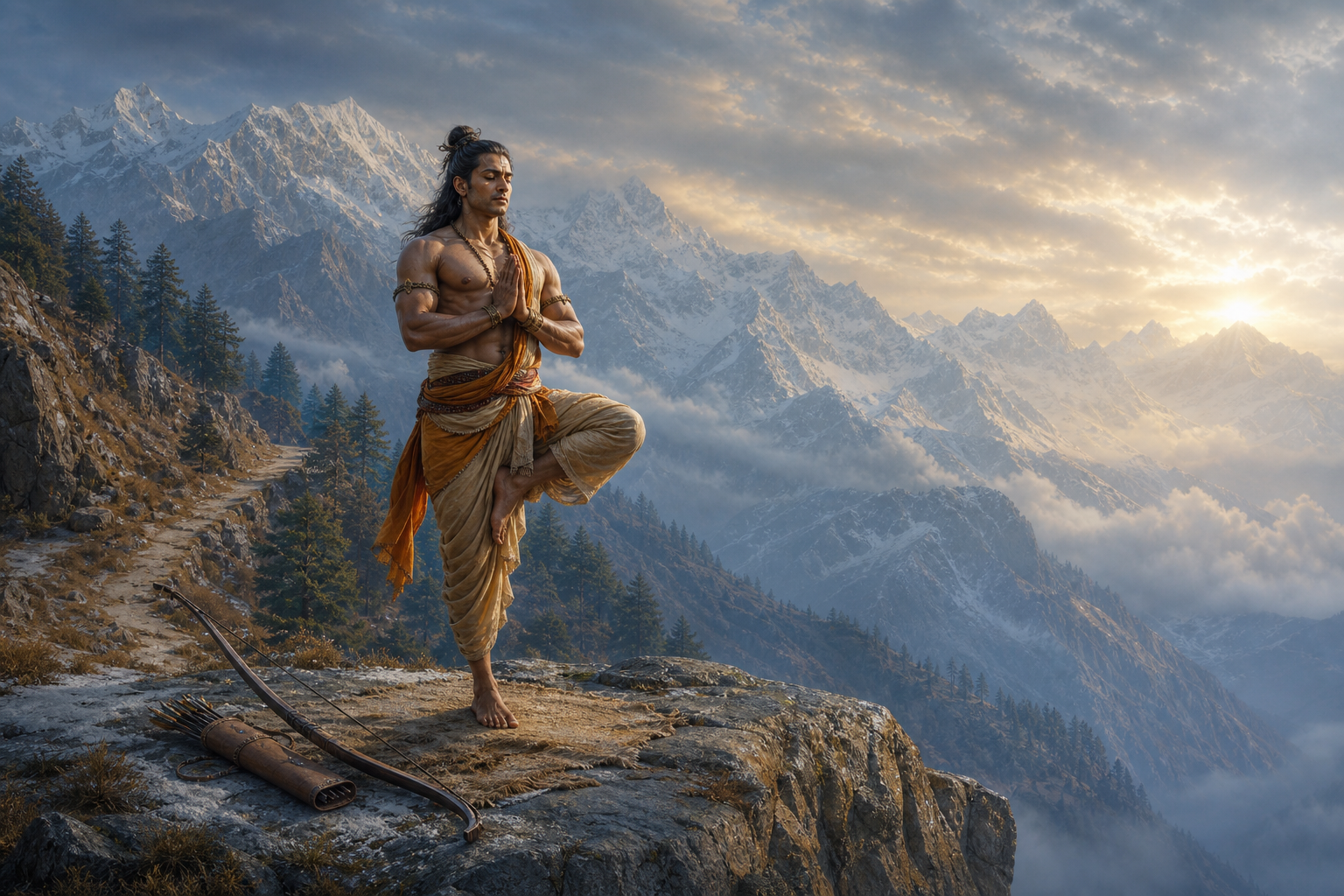
If you are trying to understand whether Kshatra-Dharma is a religious permission slip for violence, Arjuna’s ascent to Indrakeel gives a clear answer. The formidable archer does not withdraw to the Himalayas because he lacks strength. He goes because strength without mastery of intention is unfit to defend dharma.
That distinction matters whenever you can command, punish, expose, dismiss, retaliate, or otherwise affect another person’s life. Arjuna’s path offers a demanding sequence for using such power well: clarify what you are protecting, discipline the impulses mixed into that duty, submit your judgment to correction, choose proportionate means, and decide where action must stop.
The strongest archer leaves the battlefield
During the Pandavas’ forest exile, a future Dharma-Yuddha stands behind Arjuna’s Himalayan journey. Celestial weapons will be needed against opponents possessing exceptional power. Yet the quest begins under Vyasa’s guidance as an inward preparation, not as an arms race. Arjuna must develop the character capable of carrying the force he seeks.
This is the first correction to a shallow reading of Kshatra-Dharma. Martial skill is not the same as moral fitness. Courage under fire does not guarantee freedom from anger, vanity, resentment, or the hunger to dominate. The person able to hit a target must still prove that he can identify the right target, refuse an illegitimate one, and stop when the duty has been fulfilled.
Arjuna’s aim is therefore larger than personal victory. His power is to serve lokasangraha: the protection of an ordered social world in which dharma can endure. That purpose changes the meaning of every weapon. An astra acquired for self-glorification magnifies ego; the same capacity accepted as a trust can protect those who cannot protect themselves.
The Indrakeel sequence joins spiritual, ethical, and martial formation because none is sufficient alone. Spirituality without responsibility can become withdrawal from duty. Force without spiritual discipline can become predation. Ethics without the ability to act can leave the vulnerable at the mercy of adharma.
You can use this distinction to evaluate any claim made in the name of righteous strength. Ask what concrete good is being protected, who has the duty to protect it, and what limits bind the proposed action. If the answers amount only to pride, revenge, prestige, or victory at any price, the language of dharma is concealing an undisciplined appetite.
Tapas is a control system for power
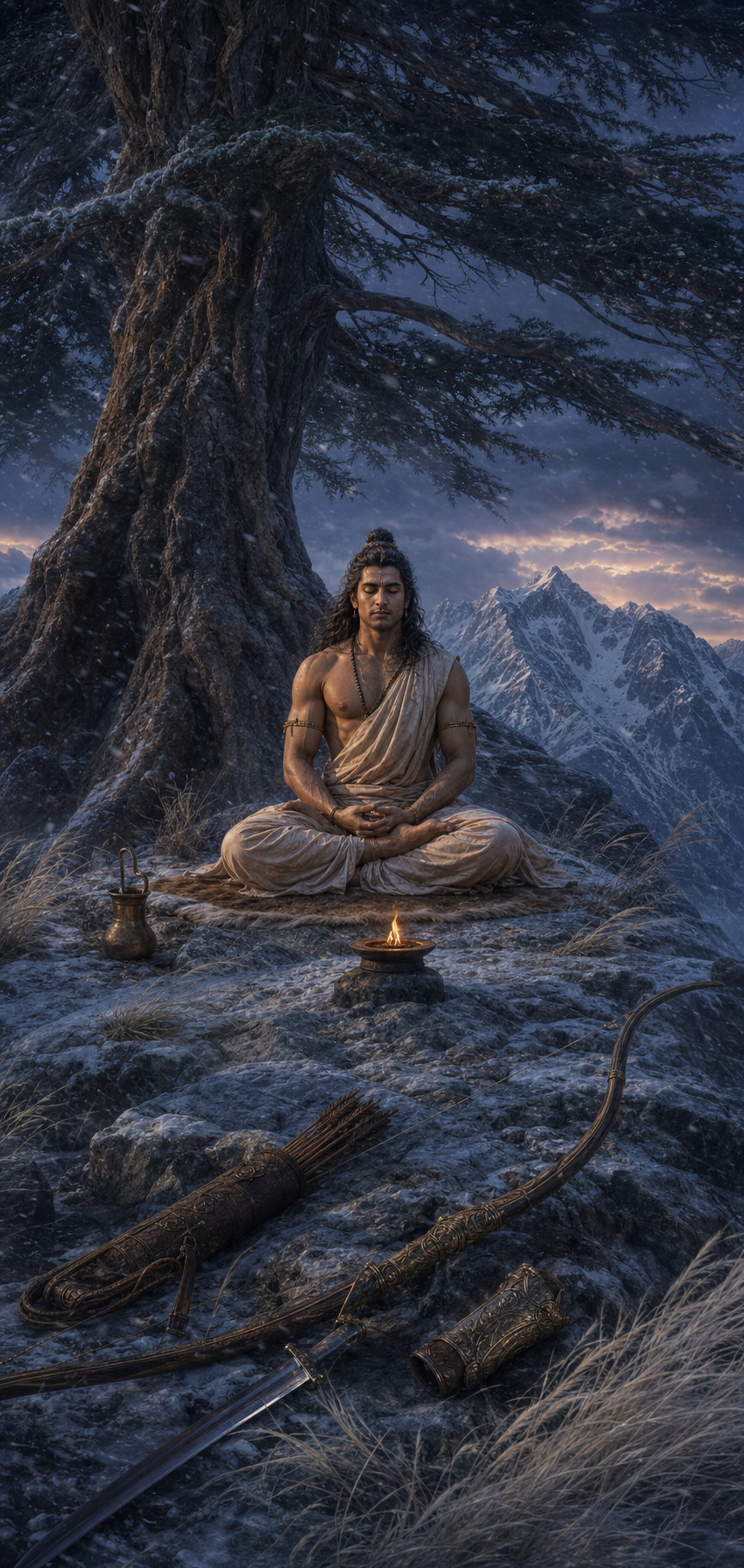
Indrakeel removes the usual supports of status and comfort. In the Himalayan wilderness, Arjuna undertakes vows, restrains sensory indulgence, practices meditation and mantra-japa directed toward Mahadeva, and subjects the body to austerity. The mountain’s silence is functional: it makes impulses that are easy to disguise amid activity much harder to ignore.
Tapas here is not self-punishment, nor is it a transaction in which suffering purchases a divine weapon. It creates the inner friction through which scattered desire is brought under a chosen purpose. Hunger, discomfort, isolation, and repetition test whether a vow still governs when convenience disappears. For a warrior, that is direct preparation for acting under pressure without allowing pressure to select the action.
The archer’s discipline and the contemplative’s discipline meet in ekagrata, one-pointed attention. Sight must settle before the arrow is released. In the same way, intention must settle before consequential power is used. A restless mind can possess flawless technique and still make a disastrous moral decision.
You do not need to imitate severe epic austerities to apply this principle. Extreme fasting, exposure, or sleep deprivation can cause harm and should not be improvised as a spiritual experiment. Choose a safe restraint that reveals how your mind reacts: keep a defined vow, remove a habitual distraction, maintain a regular contemplative practice, or delay a non-urgent response until anger has subsided. The point is not theatrical hardship. It is learning whether discomfort commands you.
Mentorship is part of this discipline. Vyasa initiates the preparation; Indra, appearing in ascetic form, examines Arjuna’s purpose and redirects him toward Shiva. Arjuna does not treat correction as an insult to his competence. He accepts that greater responsibility requires a sanction and training beyond his present judgment.
This gives you a useful test for spiritual practice: does it make you more teachable? If austerity makes you contemptuous, brittle, or convinced that ordinary limits no longer apply to you, it is feeding ahankara. Tapas suited to Kshatra-Dharma should increase steadiness, accountability, and the ability to receive an unwelcome correction without abandoning duty.
The Kirata trial breaks the claim of ego
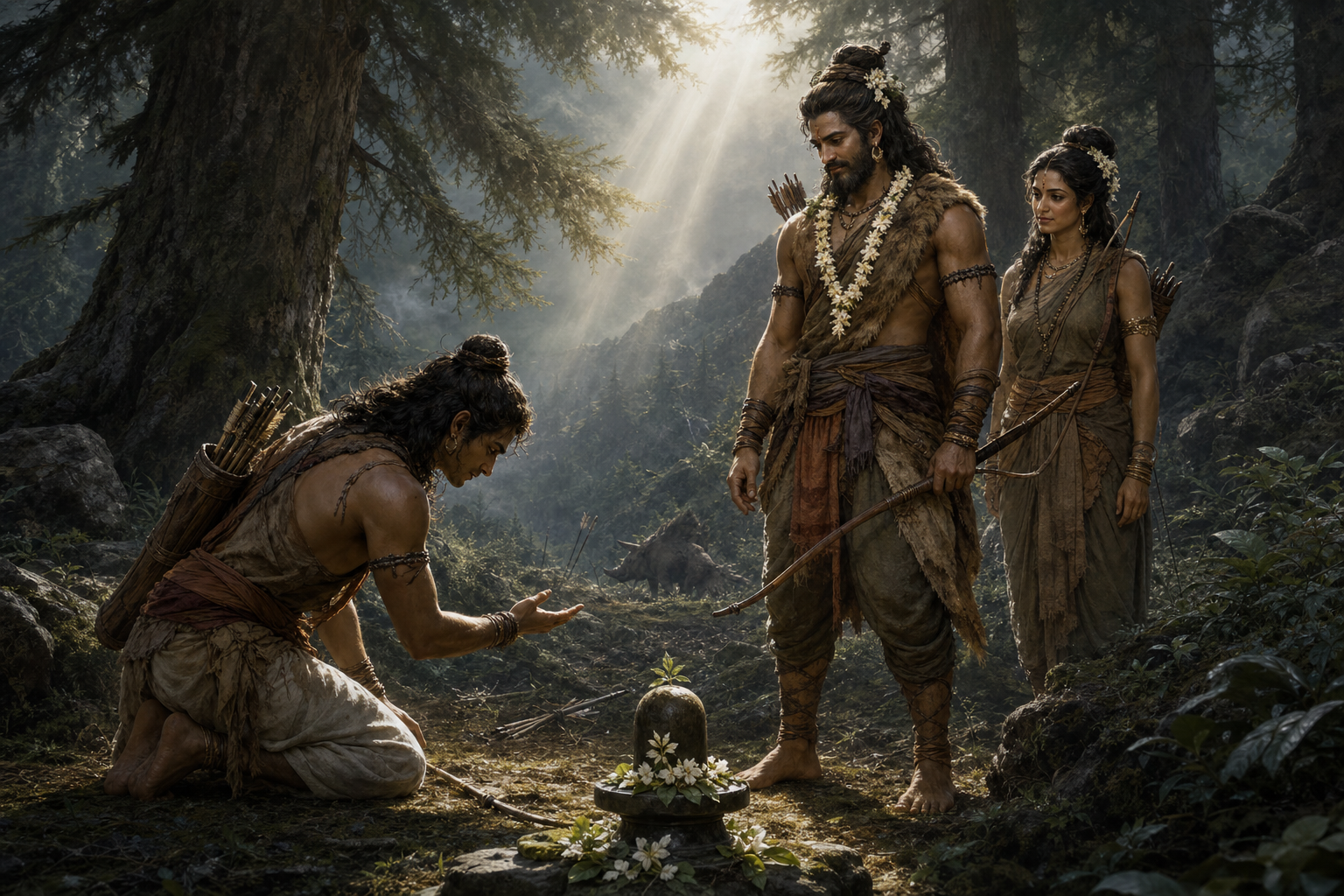
Shiva does not first meet Arjuna in a form that confirms the warrior’s expectations. He appears as a Kirata, a mountain hunter. When Muka approaches in the form of a wild boar, arrows from Arjuna and the hunter strike the threat. A dispute over the kill turns into combat, and Arjuna encounters an opponent he cannot overcome through his familiar excellence.
The sequence exposes a danger more subtle than cowardice. Arjuna acts against a real threat, but the dispute that follows draws his identity into the action. The question shifts from whether danger has been stopped to whose arrow deserves precedence. A legitimate beginning can still become an ego-driven continuation.
That pattern is easy to recognize outside a battlefield. You may begin by correcting falsehood, defending a colleague, protecting a community, or enforcing a necessary boundary. Once the immediate harm has been checked, however, the desire to humiliate the other person can keep the conflict alive. Duty has a stopping point; wounded pride usually does not.
At the edge of exhaustion, Arjuna recognizes that the hunter is Shiva and yields his pride before the divine reality confronting him. He then receives the Pashupatastra, along with stringent restrictions on its use. The order matters. He is not entrusted with terrible power because he has proven invincible. He receives it after discovering the limit of his ability and abandoning the demand that his identity prevail.
The Kirata encounter therefore supplies three checks for a heated dispute:
- Check the threat: Are you still stopping actual harm, or are you now reacting to disrespect?
- Check the aim: Would the protected good be secure without your opponent’s humiliation?
- Check the stopping point: What observable condition will tell you that enough has been done?
If you cannot separate the protected good from the need to be seen winning, pause before escalating. Arjuna’s humility is not passivity. It is what prevents legitimate strength from becoming an instrument of self-worship.
Kshatra-Dharma begins with limits
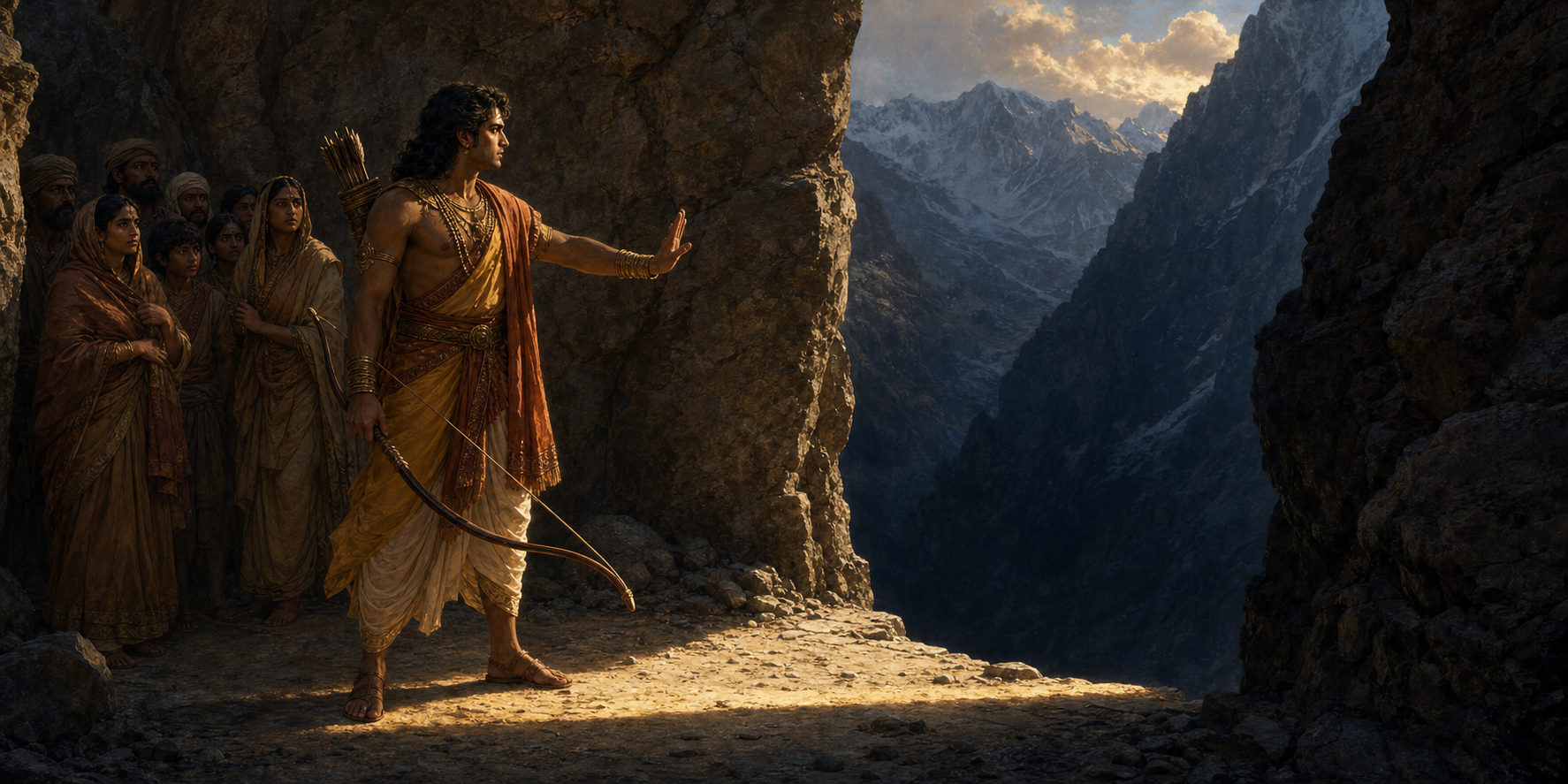
After Shiva’s trial, the devas confer further weapons. The astras associated with Varuna, Yama, Indra, and Mahadeva represent distinct capacities rather than an interchangeable mass of destructive force. Most importantly, possession does not imply unrestricted permission. The more terrible the capacity, the more exacting its restraints must be.
This gives the episode the shape of a jurisprudence of power. A weapon has a proper purpose, a legitimate target, conditions for use, and consequences beyond the user’s immediate desire. The Pashupatastra carries the severest injunctions because superior force can destroy the very order it is supposed to protect.
A modern reader can translate that moral architecture into four questions. These are an interpretive aid, not a quotation from the Mahabharata:
- Duty: Is action required to protect a person, community, institution, or just order for which you are genuinely responsible?
- Necessity: Have less harmful means failed, become unavailable, or proved inadequate to the danger?
- Proportion: Is the intervention limited to what the threat requires, or has punishment become an end in itself?
- Termination: Can you state in advance when the intervention will stop and what restraint will govern afterward?
This framework rejects two convenient evasions. The first is aggression decorated with sacred vocabulary. The second is moral withdrawal that leaves others exposed while calling inaction purity. Kshatra-Dharma belongs to the person entrusted with protection, so it requires both the willingness to confront adharma and the discipline to use no more force than the duty demands.
Ahimsa is not discarded in that synthesis. It remains the restraint that prevents avoidable harm and makes violence morally grave rather than exhilarating. Yet a protector’s obligations differ from an ascetic’s renunciation. Refusing every intervention can itself have consequences for people under one’s care. The hard task is not choosing a slogan, but discerning the least harmful action that will actually protect the good at stake.
Indra’s undisguised audience with Arjuna confirms this union of capacity and character. As divine father, teacher, and guardian of the weapons being entrusted, Indra does more than reward austerity. He extends Arjuna’s education. Under Matali’s guidance, Arjuna develops celestial charioteering and command under pressure; with Chitrasena, he studies music and dance, refining rhythm, timing, perception, and grace. The warrior’s education broadens because technical destruction is not the same as complete mastery.
This is a practical standard for leadership training. If every exercise increases the ability to compel but none develops perception, composure, cultural understanding, or self-restraint, it is producing an efficient executor rather than a guardian. Arjuna’s formation brings kshatra-tejas, the radiance of force, under brahma-tejas, the radiance of knowledge.
The same civilizational pattern appears through different disciplines across the Dharmic traditions. Buddhist attention places intention under observation. Jain tapas and radical ahimsa press the work of restraint to an exacting degree. The Sikh ideal of the sant-sipahi unites spiritual grounding with courageous protection, without hatred. These paths should not be flattened into identical doctrines, but they share a warning that applies directly to Arjuna’s quest: victory over another cannot substitute for mastery of oneself.
Key takeaways: carry Indrakeel into a hard decision
- Name the protected good. Complete the sentence This action is necessary to protect… If the answer is mainly your status, anger, or desire to win, do not disguise it as duty.
- Separate capacity from permission. Being able to impose a consequence does not establish that you should impose it. Authority increases the need for restraint.
- Choose the least force that will work. Start with clarification, a boundary, mediation, withdrawal, or another lower-harm measure when it can genuinely protect the good at stake.
- Seek corrective counsel. Consult someone who understands the duty but does not share your emotional investment. A mentor who only validates escalation cannot perform the role that Vyasa, Indra, and Shiva perform in Arjuna’s formation.
- Set the stopping condition before acting. Decide what resolution looks like while your judgment is still clear. Do not let wounded pride extend an intervention after its legitimate purpose has been achieved.
- Return to stillness. After acting, examine whether you protected order, caused avoidable harm, or secretly pursued domination. Let that review discipline the next decision.
Before your next consequential decision, put two sentences on paper: I am protecting… and I will stop when… If anger prevents you from completing them clearly, you have found the place where your own Indrakeel practice must begin.
References
