
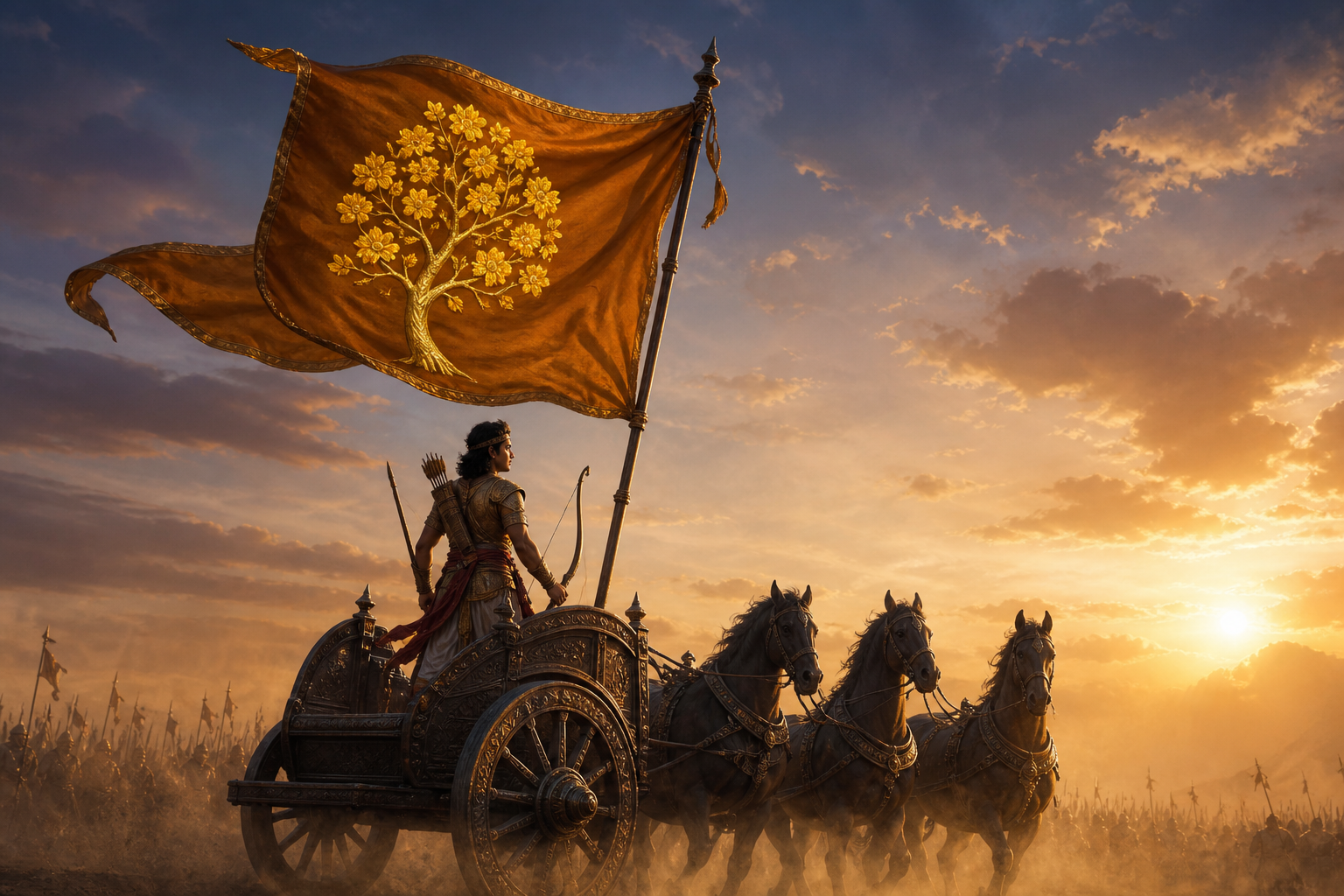
If you came looking for a one-line meaning for Abhimanyu’s banner, the honest answer is more useful than a neat slogan. His chariot bore the Karnikara, a golden flowering emblem. It identified him on the battlefield, but its significance cannot be reduced to a fixed formula such as “flower equals youth.”
You will understand the banner more clearly if you read it in three stages: first as a warrior’s identifying standard, then as a chosen image of living radiance, and finally through the poignancy that Abhimanyu’s fate gives it. Keeping those stages separate prevents both a dry reading and an invented one.
The shortest reliable answer
Abhimanyu’s dhvaja carried the Karnikara, identified here with the Indian laburnum and its golden flowers. In the setting of Kurukshetra, a chariot banner was not merely decorative. It marked the warrior’s presence and communicated identity, lineage, dharma, and sacred legitimacy.
That gives us a firm core: the Karnikara belonged to the visible identity Abhimanyu carried into battle. The golden blossom then opens a field of interpretation involving radiance, vitality, beauty, and life amid destruction. Those meanings are reasonable readings of the image, not a secret code with only one authorized translation.
Key takeaways
- The Karnikara was the emblem associated with Abhimanyu’s chariot banner.
- A dhvaja served as battlefield identification while also expressing the warrior’s larger identity and dharmic position.
- The golden flowering image supports readings of luminosity, youth, vitality, and noble presence.
- The banner becomes especially poignant once you know how Abhimanyu’s battle ends, but that retrospective poignancy should not be mistaken for a literal prophecy.
- The safest interpretation begins with what the emblem did before asking what it may mean to us.
First read the dhvaja as battlefield language
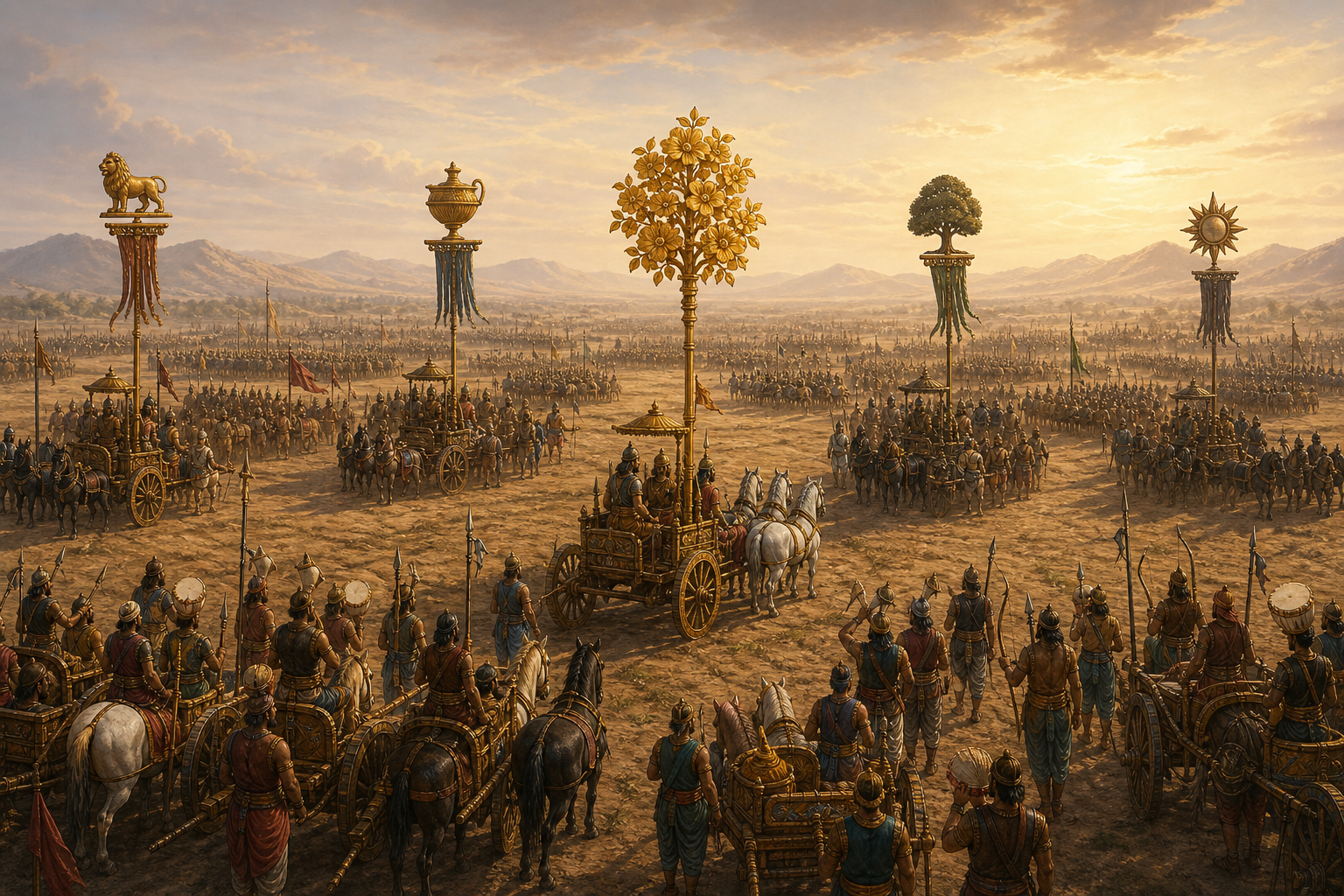
A modern reader can easily treat an epic banner as a logo: an attractive image placed beside a famous name. That misses its immediate purpose. Amid chariots, weapons, armor, movement, and dust, a raised standard made a warrior recognizable. Before anyone interpreted the emblem poetically, the banner answered a practical question: whose chariot is this?
Recognition was only the first layer. The dhvaja declared more than battlefield location. It presented the bearer as someone situated within lineage, duty, allegiance, and a moral order. This is why removing the banner from the warrior’s story leaves you with an incomplete symbol. Karnikara is not a free-floating flower motif; it is Karnikara carried by Abhimanyu at Kurukshetra.
When you encounter any Mahabharata standard, therefore, ask three concrete questions before looking for symbolism: Who bears it? What does it depict? At what kind of moment is it visible? For Abhimanyu, the answers bind a golden flowering image to a young warrior entering the epic’s most severe field of action.
Why a flowering emblem changes the tone

A weapon emblem would direct your attention immediately toward force. A predatory animal would suggest speed, command, ferocity, or dominion. A flowering tree works differently. It introduces life, color, growth, and beauty into a landscape organized around violence.
That contrast does not make Abhimanyu soft or passive. A blossom is not the opposite of courage. The Karnikara’s golden flowering presence can instead be read as vitality made visible: something bright and fully alive entering danger without losing its character. The emblem’s beauty and the warrior’s valor can belong to the same image.
Gold also needs careful handling. In this banner, the first significance of gold is visual luminosity. It allows you to imagine a radiant standard moving above the chariot. You do not need to convert that color automatically into wealth, kingship, divinity, or supernatural protection. Those additions require evidence beyond the color itself.
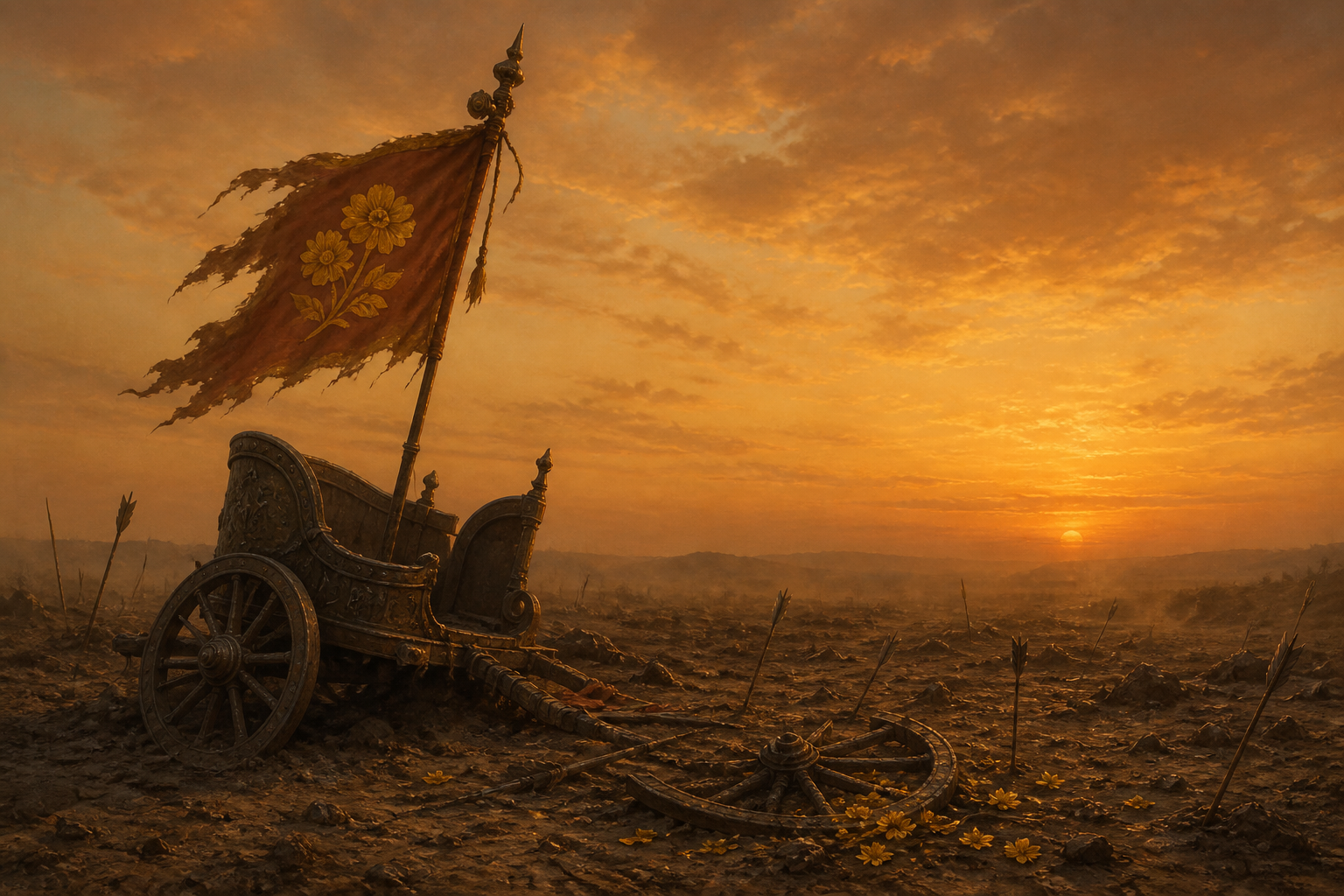
The most affecting meaning emerges through narrative contrast. Once you know Abhimanyu’s fate, the flowering emblem acquires a painful tenderness: radiant life is remembered beside its destruction. Yet the direction of interpretation matters. The story changes how you see the banner; the banner does not necessarily predict the story. That distinction keeps the reading moving without turning the Karnikara into an invented omen.
Keep fact, context, and reflection in their proper places
Dharmic symbols often carry several meanings at once, but “many meanings” does not mean that anything can be claimed. A disciplined reading separates three layers.
- Begin with the stated association. Abhimanyu’s banner bears the Karnikara. This is the anchor. If an explanation forgets either Abhimanyu or the banner, it has drifted away from the subject.
- Add the cultural function. The dhvaja identifies a warrior and publicly presents his lineage, commitments, and dharmic standing. This explains why the emblem matters within the battle rather than only in later art.
- Offer reflection as reflection. Radiance, youth, vitality, beauty under pressure, and the fragility of embodied life are intelligible ways to read the golden blossom. Introduce them with phrases such as “can be read as” rather than “must mean.”
This method is useful beyond Abhimanyu. It lets you take sacred imagery seriously without flattening it into a dictionary entry. It also protects the epic from a common modern habit: presenting an attractive personal association as though it were an explicit declaration within the narrative.
A simple test helps. If you can point to a named bearer, object, or battlefield function, you are dealing with the narrative core. If you are drawing a lesson about courage, mortality, or inner character, you are interpreting. Both can be valuable. They should not be mislabeled as the same kind of claim.
Five common misreadings to avoid
- Replacing Karnikara with a generic sacred flower. The emblem is not simply “a flower,” and it should not silently become a lotus. Its particular identity as Karnikara matters.
- Treating the banner as ornament. A dhvaja identifies and represents its bearer. Its function comes before its decorative appeal.
- Equating beauty with innocence or weakness. The flowering motif accompanies a warrior. Its beauty does not cancel martial courage.
- Reading Abhimanyu’s fate backward into the emblem as prophecy. The ending makes the Karnikara poignant to the reader, but poignancy is not proof that the banner foretold his death.
- Insisting on one exhaustive meaning. “Youth,” “radiance,” or “sacrifice” may illuminate one aspect, but no single English noun captures the emblem’s battlefield, cultural, and narrative functions together.
These corrections matter when you encounter an illustration, social-media caption, school lesson, or devotional talk. Check whether it names the Karnikara, explains the dhvaja, and distinguishes interpretation from narrative fact. If it jumps directly to a dramatic moral without doing those things, it has probably skipped the part that makes the symbol intelligible.
How to explain or depict the banner responsibly
If you are teaching the Mahabharata, writing a caption, or discussing Abhimanyu with younger readers, use a four-step sequence. It is short enough for an introduction and precise enough to avoid mythology-by-slogan.
- Name the object: Abhimanyu’s chariot standard was a dhvaja bearing the Karnikara.
- Explain the function: the banner made the warrior recognizable and expressed his larger identity within the dharmic world of the battle.
- Describe the image: Karnikara contributes a golden, flowering, living presence rather than the visual language of a weapon or beast.
- Mark the interpretation: say that the blossom can evoke radiance, vitality, and the poignancy of life entering destruction, especially in light of Abhimanyu’s fate.
A concise explanation might therefore read: “Abhimanyu’s chariot bore the Karnikara, a golden flowering emblem. His dhvaja identified him while declaring the identity and dharma he carried into battle. The radiant blossom can be read as life and valor made visible amid destruction, a meaning that becomes more poignant after we know his fate.”
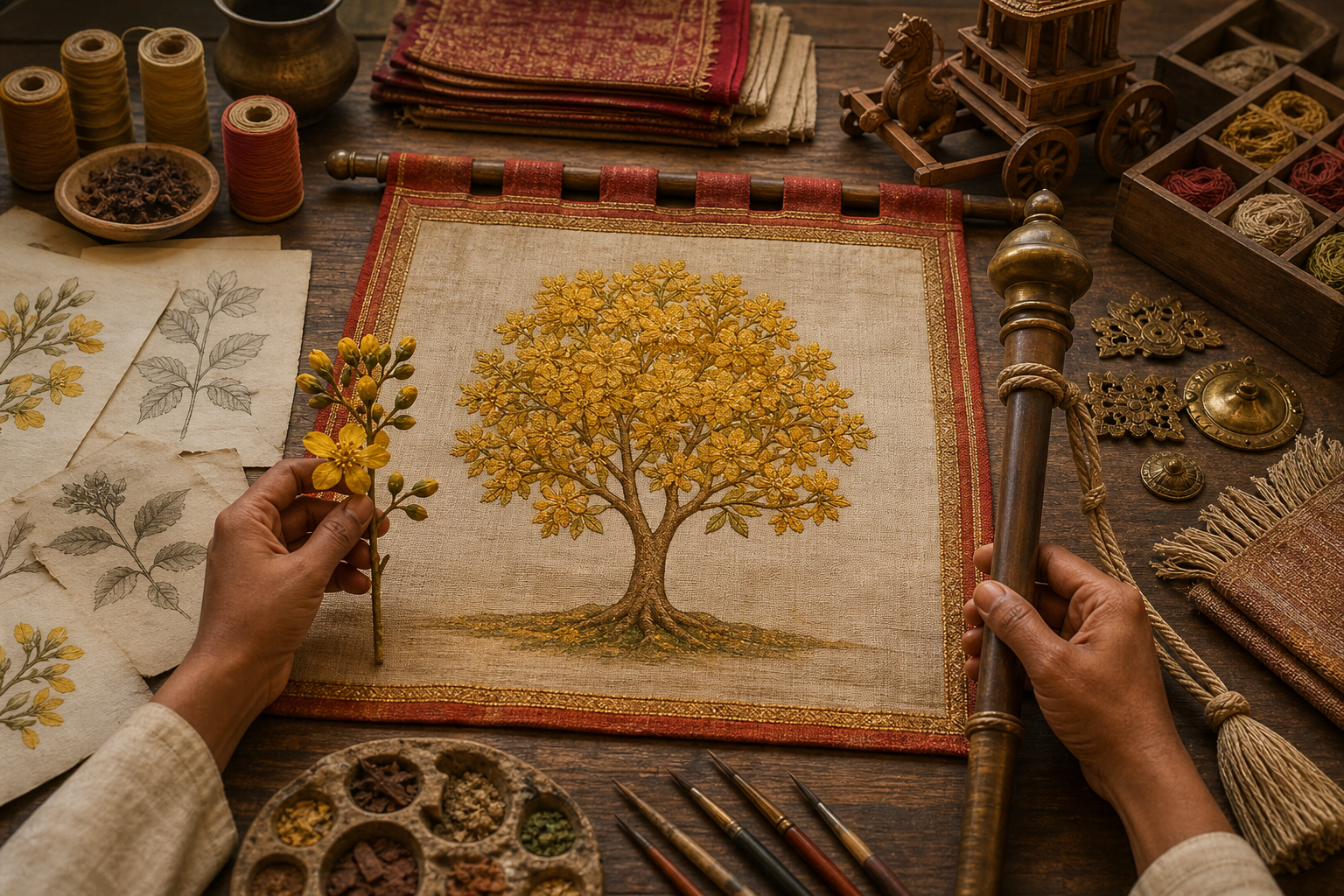
For visual art, preserve the same hierarchy. Show a golden flowering motif on a raised chariot standard, then identify it explicitly as Karnikara. Do not substitute a more familiar flower merely because viewers will recognize it faster. If the exact botanical form is stylized, label the emblem instead of claiming that the artwork is a definitive historical reconstruction.
For personal reflection, turn from the image to conduct rather than superstition. Ask what your own visible standard would announce when circumstances become difficult. Would your actions still reveal the values you claim in easier moments? That question grows naturally from the dhvaja’s role as public identity; it does not require treating the Karnikara as a charm, prediction, or magical protection.
The next time you see Abhimanyu represented only by his final battle, look for the banner above the chariot. Name the Karnikara first. Then let its golden flowering presence sharpen the harder question: what does a person choose to make visible when courage is no longer theoretical?
References
