
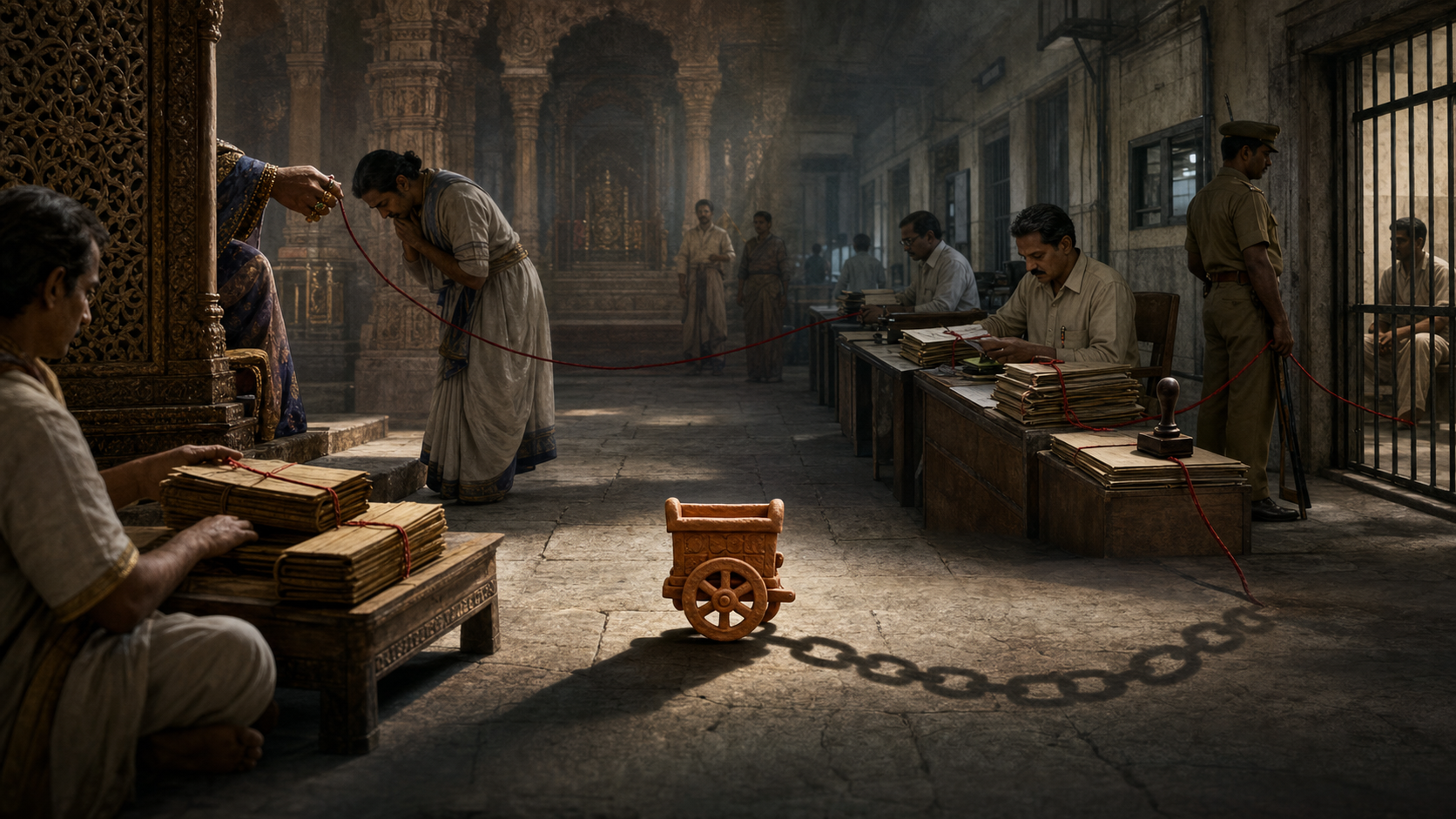
If you have heard that a Sanskrit play “anticipated” India’s Emergency, you may reasonably suspect a comparison imposed after the fact. The useful question is not whether ancient characters can be assigned to modern politicians. It is whether Śūdraka understood the process by which private appetite enters public administration, fear silences officials, and legal procedure becomes a costume for injustice.
Read in that way, Mricchakatika gives you something more useful than a political allegory. This drama, attributed to Śūdraka and commonly dated to the fifth century CE, becomes a diagnostic for public life: follow the real chain of power, test whether officials can refuse an unlawful demand, examine what happens to inconvenient witnesses, and ask whether political change restores restraint or merely changes the beneficiaries of power.
Read the parallel as a chain of power, not a cast list
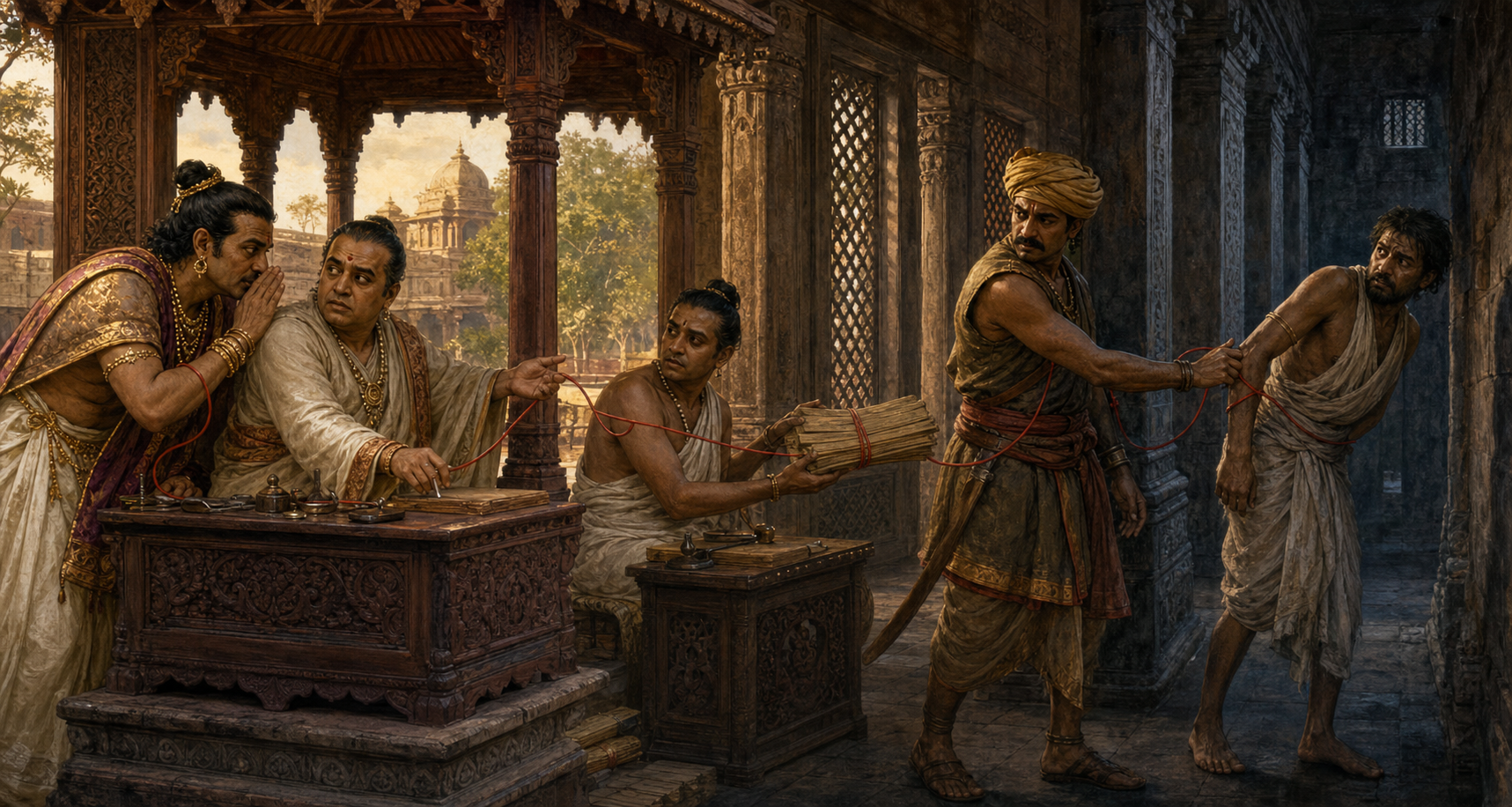
Mricchakatika unfolds in Ujjaini around Charudatta, a cultured Brahmana merchant whose generosity has left him poor, and Vasantasena, a wealthy courtesan drawn to his integrity. Their personal story is caught inside a larger civic disorder. King Pālaka possesses the throne, but his sovereignty does not secure justice. His brother-in-law Śhakāra can exploit proximity to the palace, intimidate subordinates, manipulate appearances, and expect official machinery to protect him.
That distribution of power matters more than any proposed one-to-one identification. Pālaka need not be treated as a disguised Indira Gandhi, nor Śhakāra as a prophetic portrait of Sanjay Gandhi. Ancient Ujjaini and twentieth-century India had different institutions, social conditions, and political actors. The comparison becomes credible only at the structural level: formal authority is concentrated at the top, an intimate of power exercises influence without equivalent accountability, officials learn to accommodate pressure, and harm acquires an administrative appearance.
During the Emergency of 1975–77, civil liberties were suspended, the press was censored, people were detained under preventive laws, and coercive governance became widespread. Sanjay Gandhi’s influence over slum clearances and mass sterilisation drives illustrated the danger of an extra-constitutional centre of initiative: someone without the sovereign’s formal office could nevertheless shape decisions, incentives, and abuses. The point is not that every modern act has an exact Sanskrit counterpart. It is that accountability weakens when practical power and official responsibility become separated.
Śhakāra also reveals how that separation works at the human level. He first attempts to obtain criminal obedience through subordinates and inducements. When conscience obstructs him, he looks for another hand and another way to conceal responsibility. His method follows a recognisable sequence:
- A private desire is treated as though access to power has made it legitimate.
- A subordinate is asked to carry out the act, distancing the beneficiary from the wrongdoing.
- Refusal becomes an inconvenience to be bypassed rather than a moral warning to be heard.
- Official standing is used to control the public account of what happened.
- Institutions process the resulting lie as an ordinary case.
This is how adharma scales. The decisive moment is not always a dramatic decree from the ruler. It may be the smaller moment when an aide stops asking whether an instruction is right, a functionary decides that refusal is too costly, or an official confuses access to authority with lawful authority. By the time a court receives the matter, several people have already converted private fear into public action.
You can use a two-pass method when reading the play—or assessing a government. On the first pass, identify who formally holds each office. On the second, trace who can actually obtain a detention, punishment, favourable ruling, suppressed report, or coerced act. Pay particular attention to people who can issue consequential demands but cannot be questioned through the institution they influence. The distance between those two maps is where shadow power lives.
Act Nine shows how procedure can outlive justice
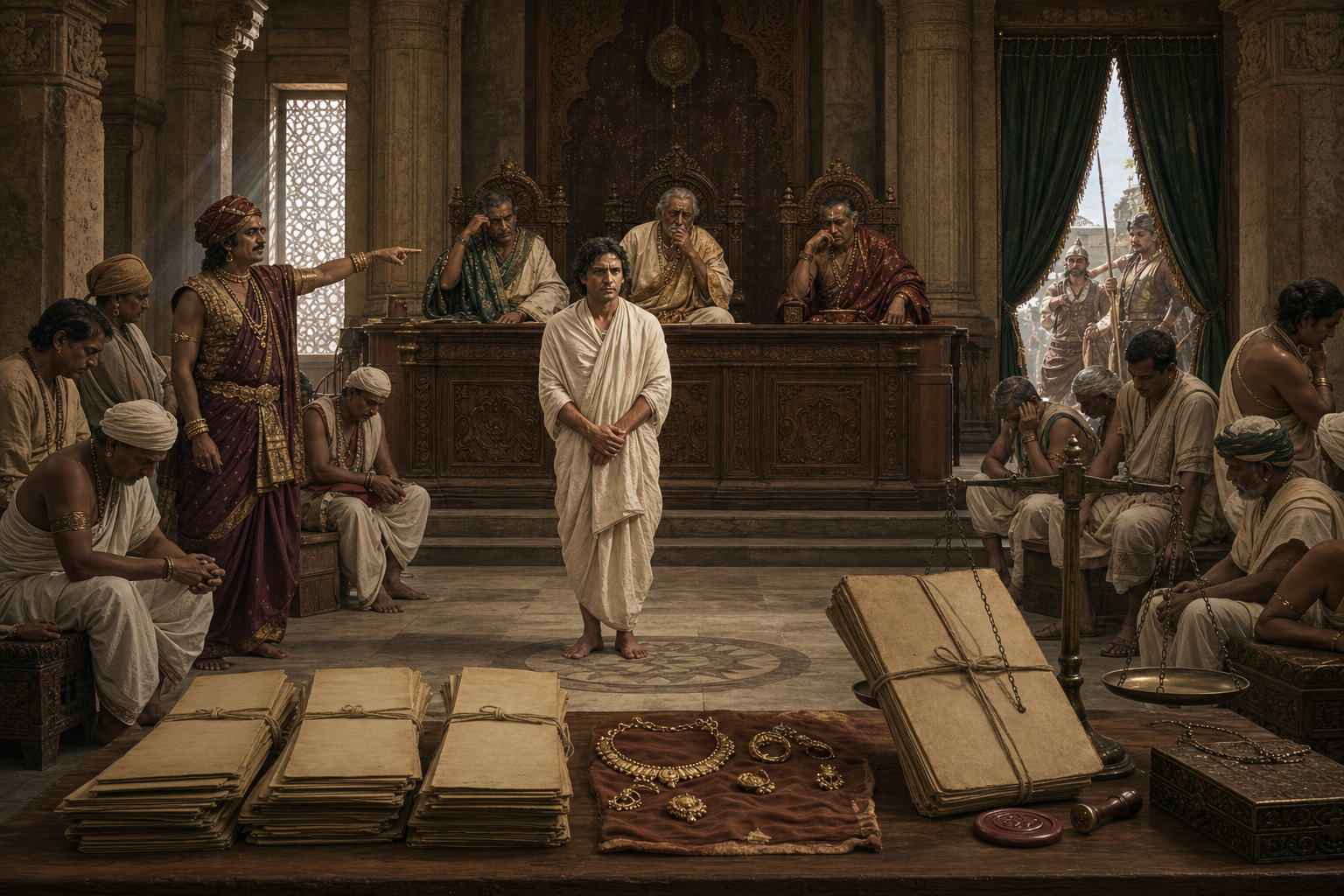
The trial of Charudatta in Act Nine, Vyavahaara, is the play’s sharpest lesson in institutional decay. The court still summons an accused person, receives material presented as evidence, hears arguments, and pronounces a judgment. Nothing about the outward sequence necessarily announces that justice has collapsed. That is precisely the danger. A legal system can retain its vocabulary and ceremonies after losing the independence that gives them meaning.
Charudatta is implicated through contrived appearances. The judge recognises that the accusation sits badly with the man’s known character and initially insists that he be summoned gently and respectfully. Yet respect for the accused does not become resistance to political pressure. The palace ultimately determines the result, and Pālaka intensifies the punishment to public impalement. The crown has not formally abolished the court; it has made the court’s discernment inconsequential.
That scene forces a distinction among judicial courtesy, judicial conscience, and judicial independence. Courtesy affects how an accused person is addressed. Conscience allows a judge to feel that an outcome is wrong. Independence allows the judge to reject that outcome when evidence and duty require it. Only the third protects the innocent. A sympathetic official who signs the demanded order still transfers coercive power to the wrongdoer.
India had received a warning about institutional dependence even before the Emergency. In 1973, three senior Supreme Court justices were superseded when A. N. Ray was appointed Chief Justice of India, provoking concern over judicial independence. During the Emergency, discussion of a “committed judiciary” made the underlying expectation unusually plain: should a judge remain committed to constitutional duty when it obstructs the executive, or become committed to the political programme of those exercising power?
The Habeas Corpus case, ADM Jabalpur, brought that conflict into the most consequential setting. H. R. Khanna’s dissent demonstrated that institutional courage is possible even when it becomes personally and professionally costly. Mricchakatika’s judge represents the opposite failure. He can perceive the injustice, speak in morally troubled language, and still let the coercive will of the palace determine what his office does.
When someone tells you that proper procedure was followed, therefore, do not stop at the sequence of hearings and signatures. Ask where the evidence originated, whether contrary testimony could alter the result, who possessed the power to override professional judgment, and what happened to an official who resisted. A predetermined outcome does not become just because clerks, advocates, and judges were required to escort it through familiar forms.
This is also why personal virtue cannot substitute for institutional design. Charudatta’s character makes the accusation morally implausible, but a sound court must be capable of establishing innocence even when the accused is unknown, unpopular, or socially marginal. Dharma in public life requires more than good rulers and admirable defendants. It requires offices whose occupants can act truthfully without needing permission from the person whose conduct is at issue.
Truth needs witnesses who stand outside the palace

Charudatta is not saved by becoming more powerful than Śhakāra. The false account is broken by testimony. A Buddhist monk helps bring truth into the open, and Vasantasena—whose supposed death supports the prosecution—returns as the indispensable living witness. The court’s failure can be corrected because truth still has human carriers who have not all been absorbed, frightened, or erased by power.
Śūdraka’s choice of witnesses carries a civilisational point. Truth is not confined to the throne, the Brahmana, the judge, or any single social profession. Charudatta’s self-restraint, the monk’s moral intervention, Vasantasena’s agency, and the refusal of subordinates to commit wrongdoing all contribute to the recovery of justice. The community of conscience is wider than the formal state.
This is dharmic pluralism in practical form. Satya requires a fact to be spoken even when authority prefers a lie. Ahimsa requires refusal to turn another human being into an instrument or disposable obstacle. Karuṇā requires institutions to see the person endangered by their machinery. Seva requires action on behalf of the public good, not merely inward agreement with it. Hindu, Buddhist, Jain, and Sikh traditions give these disciplines different theological settings, but none allows public status to erase moral accountability.
The Emergency’s censorship and detentions show what an authoritarian turn must do to survive: narrow the number of people who can contradict the official account, then raise the cost of being one of them. Journalistic courage therefore mattered as an institutional function, not simply as a display of individual bravery. Ramnath Goenka and the Indian Express endured state scrutiny and regulatory pressure while helping preserve public awareness under censorship. Like the witnesses in Mricchakatika, an independent press can place inconvenient reality back into civic circulation.
The practical lesson is not to wait for a single heroic witness. A society needs several routes by which truth can reach the public: an official who can refuse, a judge who can dissent, a journalist who can publish, an accused person who can answer, and a witness whose credibility does not depend on favour from the government. If every route passes through the same political gatekeeper, apparent institutional variety offers little protection.
You should also notice how authoritarian reasoning attacks the witness before addressing the testimony. Social rank, profession, political affiliation, or personal unpopularity becomes a shortcut for deciding that a person need not be heard. Mricchakatika refuses that shortcut. A courtesan and a Buddhist monk can correct a royal court because truth does not become less true when spoken from outside the approved hierarchy.
That gives you a concrete civic discipline: separate what a witness can establish from whether you admire the witness. Demand corroboration where it is needed, but apply the same standard to palace insiders and dissidents. Defend the channel through which adverse facts may be presented even when you expect to dislike the facts. A witness system protected only for one’s allies is merely a temporary political convenience.
Dharma restores limits instead of licensing new rulers
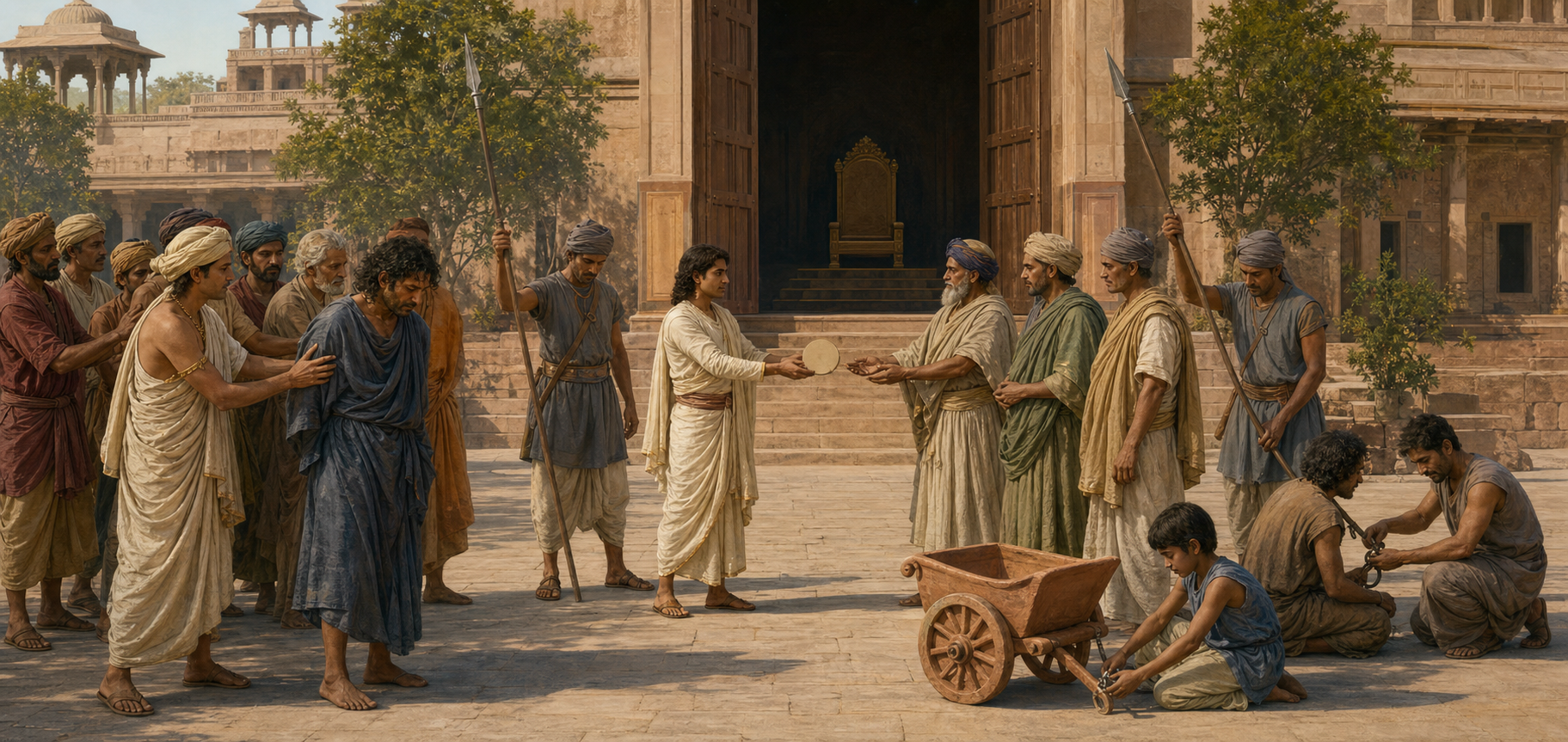
Mricchakatika does not end at the exposure of a lie. Pālaka is deposed, Aryaka assumes the throne, Charudatta is vindicated, and mercy restrains retribution. The political order changes, but the moral purpose of that change is not to give the victorious side its own opportunity for lawlessness. It is to realign power with justice and compassion.
That restraint is essential to the play’s account of dharma. If adharma means that power can punish an innocent person to protect itself, a new ruler does not become dharmic merely by directing arbitrary punishment at the old ruler’s faction. The standard must remain valid after the identities of ruler, accused, and dissenter have changed. Otherwise, political victory only rotates the cast.
India’s democratic recovery offers the corresponding modern lesson. In 1977, the electorate ended the Emergency through the ballot box, reopening space for institutional correction. The importance of that event lies not only in which government lost. Citizens used an existing constitutional mechanism to reject concentrated power rather than accepting permanent coercion as the price of political stability.
An election can remove a government, but restoration must be judged by what follows. Do legal institutions recover the ability to test executive action? Can the press expose wrongdoing without administrative retaliation? Are people detained or condemned by the former order given a path to vindication? Does the succeeding government accept limits that it demanded for its predecessor? These questions distinguish constitutional recovery from factional revenge.
This is where the rasa of karuṇā becomes political rather than merely sentimental. Compassion is not an invitation to ignore responsibility. It keeps punishment from reproducing the same contempt for persons that made the original injustice possible. Accountability identifies wrongdoing, restores the innocent, and repairs institutions. Vengeance treats unrestricted power as acceptable once it reaches supposedly righteous hands.
Whenever a movement promises to save the nation from abuse, ask it four questions before granting trust: Which exceptional powers will you surrender after the crisis? Which independent institutions may rule against you? How will an innocent opponent clear his or her name? What restraint will you observe toward the defeated? A programme that can answer only how it will capture power has not yet described a dharmic restoration.
Key takeaways: five questions for recognising civic adharma
- Who really decides? Compare the constitutional chart with the practical chain of influence. Unaccountable power often sits in the gap.
- Can a subordinate refuse? If conscience can be bypassed through another official, the system is selecting for obedience rather than duty.
- Can evidence change the outcome? Hearings and respectful language mean little when the palace has already fixed the punishment.
- Can an outsider correct the record? Courts, journalists, citizens, monks, professionals, and unpopular witnesses must have routes for presenting adverse facts.
- Will the victors accept limits? Genuine restoration protects institutions and the innocent; it does not transfer arbitrary power to a new faction.
The next time you encounter a claim that coercion was lawful because every form was observed, read it through Act Nine. Trace who supplied the accusation, who could safely contradict it, who controlled the final punishment, and whether private moral unease ever became public refusal. That is where the difference between a functioning institution and an authoritarian instrument becomes visible.
Then apply the harder test to your own side. Defend truthful witnesses before you know whom their testimony will embarrass, judicial independence before you know which government it will obstruct, and limits on executive power before your preferred leader occupies the executive. Mricchakatika’s warning remains useful only when dharma is treated as a standard above political loyalty.
References
